A simple tip you can use to improve your photography is to add people. Photography beginners always want to remove people from their photographs. This is totally wrong. This tendency goes hand in hand with another beginner notion, that you need to put everything right in the middle of your image. Why everyone thinks these things when they start out in photography is unknown.
When you’re struggling with a photo or you want to enhance the image add a hand, or a person, or a face. Adding something human to a photograph will always help the viewer of your photograph relate almost immediately. It brings a sense of scale to your photo and it will make it more interesting.
Here are a few examples related to the subject of chess in photography with no people: 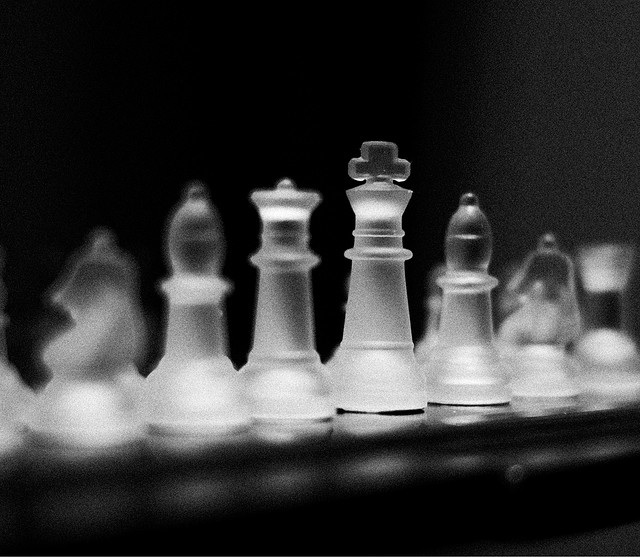 photo by cmogle

photo by alancleaver
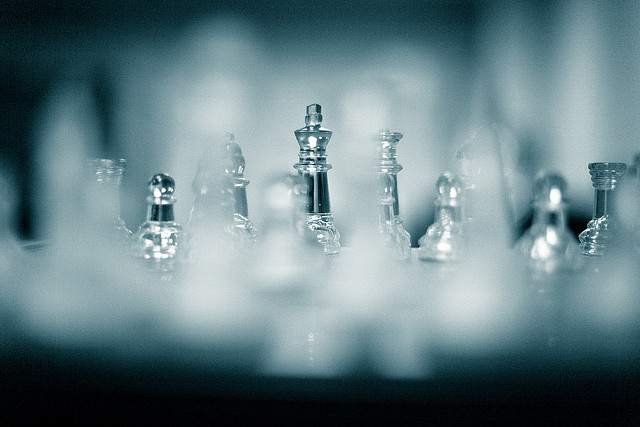
photo by kwl
The photographs above aren’t terrible. However when you add people (below) they look downright mundane in comparison. Take note that images may even be worse from a technical standpoint but they are more interesting to look at! What would you rather have, a technically perfect photograph or a really interesting image? Ideally you want both but when you’re just starting out you often just have to pick one…
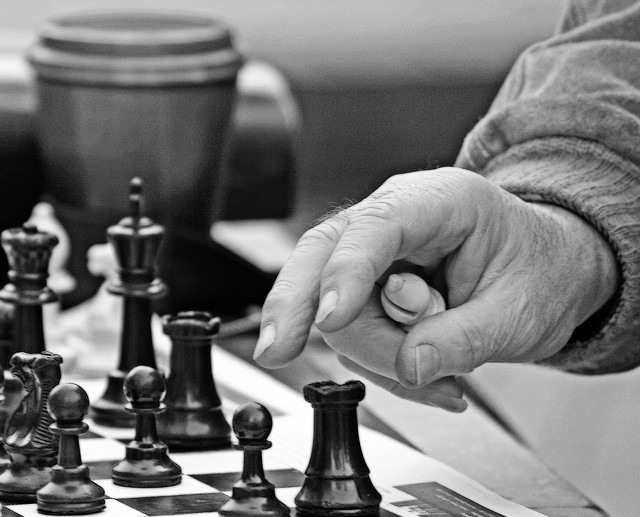
photo by IanSane

photo by proimos

photo by austinevan
Notice there is movement and action in the last photograph. This image has some serious technical problems but it serves as a perfect example of how even a poor quality image can be more interesting if the subject matter is compelling.
Like most topics in photography this is entirely subjective. Whose to say what is and what is not interesting. Just keep this tool in your belt when you’re out shooting photographs. It almost never hurts to add people!
Why People Make a Photograph Work
A photograph with a person in it gives the viewer somewhere to look first.
The brain is hard-wired to find faces, hands, and human silhouettes before it
parses anything else in the frame. That instant attention is what separates a
postcard of a place from a photograph of an experience. Once the eye has a
person to anchor on, the rest of the scene becomes the context that explains
who they are and what they are doing there.
Including people also fixes one of the most common beginner problems: a
flat, scaleless image. A wide hallway looks ordinary on its own. The same
hallway with a small figure walking down it suddenly has depth, a sense of
volume, and a story. The person is the ruler the eye uses to measure
everything else.
How to Add People Without Looking Awkward
- Wait for the moment, do not pose for it. A passerby
glancing toward the light, a hand reaching for a coffee cup, a child
looking up at a window. Real gestures beat staged ones almost every time. - Use silhouettes when faces are tricky. Backlit
silhouettes work as anchor points without exposing strangers’ identities,
which is helpful when shooting in public. See our
silhouette
photography guide. - Keep the person small in frame for environmental context.
A figure occupying 5 to 15 percent of the frame reads as scale, not
portrait. This is the essence of an
environmental
portrait. - Place the person off-center. Drop them on a
rule of thirds
intersection so the eye moves through the scene rather than parking on the
subject and stopping. - Show a hand, not a whole person, when space is tight.
A hand holding a camera, a paintbrush, a teacup is enough humanity to
transform an otherwise still life.
Common Mistakes
- Cropping at the joints. Avoid framing that cuts off the
subject at the knees, ankles, wrists, or neck. Either include the joint
fully or crop well above or below it. See our
amputate guide for the
full list of cuts to avoid. - Centering the person dead-middle. A centered figure
pinned to the middle of the frame stops the viewer’s eye instead of
leading it. Move them to a third or use
leading lines to
point at them. - Asking strangers to “act natural.” The instant they
know they are being photographed, they freeze or perform. Pre-focus, frame
the scene first, then catch them in motion. - Forgetting the background. A telephone pole growing
out of someone’s head is the cliche for a reason. Look at every edge of
your frame before pressing the shutter. - Lighting the scene but not the person. Move so the
subject’s face catches some light, even just a thin rim. A faceless
silhouette can work, but accidental shadow on the face usually does not.
Try This
Pick a location you have photographed before that did not include people:
a building, a landscape vista, an interior, an alley. Go back at a busy time
of day and shoot the exact same composition twice. Once with the scene empty,
once when somebody walks through it. Compare the two on a screen side by side.
The empty version will read as a description of the place. The version with a
person will read as a moment that happened in the place. That is the
difference this lesson is about.
For a more deliberate exercise, set yourself a 30-photo limit and require
that every frame contains at least one person, even if just a hand or a
shadow. Once the constraint is forced, you will start noticing how often the
human element was already there waiting.
FAQ
Do I need to ask permission before photographing strangers?
Legally it depends on your country and whether you are on public or private
property. Ethically: if a person is identifiable and you plan to publish the
image commercially, get a release. For street photography of public scenes,
photographing without asking is generally legal in most places, but be
respectful and stop if asked. Our
photography
ethics guide goes deeper.
What focal length works best for including a person in a wider
scene? 35mm and 50mm full-frame equivalents are the natural choices.
35mm gives you context plus subject. 50mm flattens just enough to feel
intimate without isolating. Wider than 28mm tends to distort faces near the
edges. Tighter than 85mm cuts out the environment that makes the person
meaningful in the first place.
Is it cheating to include a friend or model in every photograph?
No. Many of the most-loved photographs in history were taken with the
photographer’s friend, partner, or assistant in the frame as a deliberate
anchor (Robert Frank, Saul Leiter, and Joel Meyerowitz all used this
approach). Pre-arranged subjects are a tool, not a shortcut.
What if the location does not naturally have people?
Empty places (a remote landscape, a closed museum, a quiet workshop) can
still be improved by including a person, even just yourself. A self-portrait
in the corner of a wide landscape gives the same scale benefit. Use a tripod
and the camera’s self-timer.
How do I photograph children naturally? Get on their eye
level, give them something to do (looking at a book, blowing bubbles, eating
fruit), and stay back with a longer focal length so they forget you are
there. Our
photographing
children guide has more.
Related Reading
- Portrait
photography hub: how to make people the subject, not the anchor. - Street
photography: the discipline built entirely around capturing people in
public. - Group
photography: handling more than one person in a single frame. - Headshot
photography: when the person is the entire image.