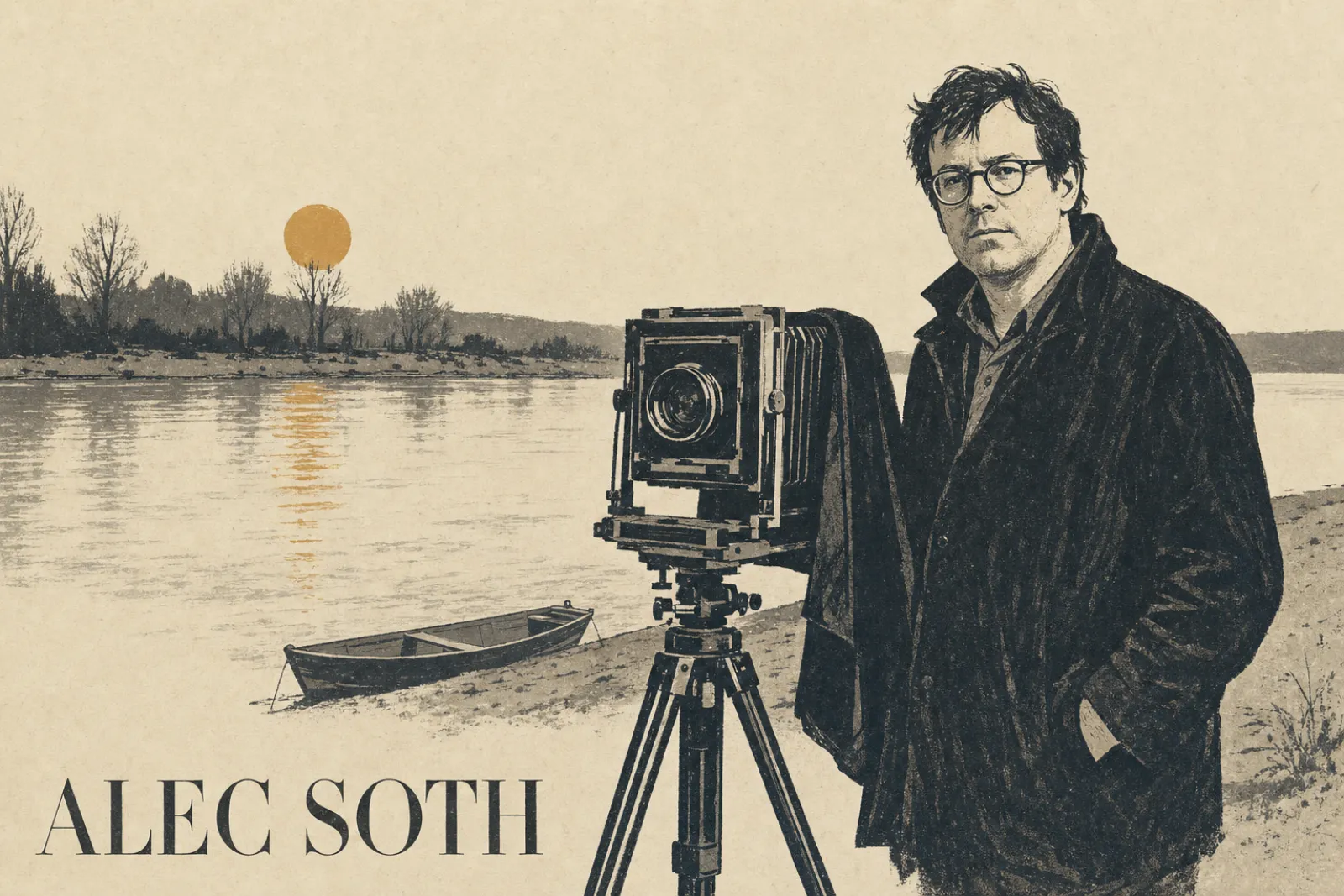
Alec Soth is an American photographer, born in Minneapolis, Minnesota, in 1969, who built his reputation on long road trips through the United States with a large view camera. His first book, Sleeping by the Mississippi, published in 2004, mixed portraits of strangers with landscapes and interiors found along the river. He became a full member of Magnum Photos in 2008 and has published more than 25 books.
Soth studied at Sarah Lawrence College in Bronxville, New York. He has named Robert Frank as an influence on Sleeping by the Mississippi, and he has said that Nicholas Nixon and Sally Mann shaped his decision to work in large format. He admired Diane Arbus, and critics have compared his pictures to those of Walker Evans and Stephen Shore. What he set out to avoid, by his own account, was anything that looked like a photographic cliche or like another photographer’s picture.
Down the Mississippi with a view camera
The photographs in Sleeping by the Mississippi carry dates from about 1999 to 2002. Soth drove from place to place along the river, through states including Minnesota, Iowa, Wisconsin, Illinois, Kentucky, Tennessee, Arkansas, Mississippi and Louisiana. He did loose research before each trip and taped a list of keywords to his steering wheel, then let chance meetings decide where he stopped. He has compared the method to surfing the web, but in the real world.
He worked with an 8×10 view camera on a tripod. This is large format photography, and it is slow: each sheet of film is costly, and each picture has to be set up with care. Soth has described himself in those years as shy and introverted. He found that the big camera, and his own awkwardness, tended to disarm the people he met, and he has said that photography gave him a reason to step into the lives of strangers. He asked permission, and he waited until people were at ease before making the exposure.
Soth printed the first version of the book himself. A Jerome Foundation grant in 2001 supported the project, and it won the Santa Fe Prize for Photography in 2003. In 2004 Steidl published it, Soth was included in the Whitney Biennial, and one of the Mississippi portraits, Charles, was used on the Biennial poster. He became a Magnum nominee the same year. He has said the title was meant to suggest sleep, dreams and longing more than a report on the present-day river.
Wondering how a single trip becomes a body of work? How to build a long-term photography project covers planning one and seeing it through.
Niagara, Broken Manual and a paper called the Dispatch
Niagara followed in 2006, also from Steidl. Its subject is Niagara Falls as a place where people go to marry, and Soth photographed couples there after their weddings.
Broken Manual, published by Steidl in 2010, turned to people who had withdrawn from society: monks, survivalists, hermits and runaways. Soth presented the book as a kind of underground manual for escaping one’s life, and he used the pseudonym Lester B. Morrison for it. In the same year the Walker Art Center in Minneapolis showed a survey of his work under the title From Here to There: Alec Soth’s America. The catalogue won an Infinity Award from the International Center of Photography in 2011.
Soth also became a publisher. His imprint, Little Brown Mushroom, put out narrative photography books that work in a similar way to children’s books. Between 2012 and 2014 he and the writer Brad Zellar travelled state by state in the role of small-town newspaper reporters and issued the results as the LBM Dispatch. There were seven issues: Ohio, Upstate, Michigan, Three Valleys, Colorado, Texas and Georgia. They went to meetings, dances, festivals and other gatherings. For the book Songbook, published by Mack in 2015, Soth took the news context away from these pictures so that what remained was the wish for connection underneath them. He received a Guggenheim Fellowship in 2013.
Curious about publishing small runs yourself? How to make a photography zine walks through editing, layout and printing.
A year away, then portraits made indoors
In 2016, after a New York Times Magazine assignment about a laughter yoga workshop in India, Soth stopped his usual practice for about a year. In 2017, during a residency in San Francisco, the choreographer Anna Halprin, then 97, invited him to photograph her at home. That sitting started him working again.
The result was I Know How Furiously Your Heart Is Beating, published by Mack in 2019. Its photographs are dated 2017 and 2018, and they were made in people’s homes in cities including Minneapolis, New Orleans, London, Berlin, Warsaw, Bucharest and Odessa. The pictures are portraits and views of rooms: bedrooms, kitchens, shelves of books. Later books include The Parameters of Our Cage (2020), a correspondence with Christopher Fausto Cabrera, who was then held in a Minnesota prison, A Pound of Pictures (2022) and Advice for Young Artists (2024).
How a Soth picture is built
Three choices recur across the books, and each one can be practised.
- Slowness is part of the portrait. A view camera on a tripod cannot be used quickly or secretly. The sitter knows a picture is being made and has time to settle. Soth’s portraits are agreed, not taken unawares, which places them closer to environmental portraits than to candid street work. A tripod on any camera forces the same pause.
- The setting carries half the meaning. In Charles, the roof, the flight suit and the two model airplanes say as much about the man as his face does. In the 2019 book the rooms are given the same weight as the people in them.
- Portraits, places and objects are mixed. Sleeping by the Mississippi puts portraits next to landscapes and interiors with nobody in them. The meaning comes from the order, so sequencing a body of work is as much a part of the method as exposure.
- A loose plan, then chance. Keywords on the steering wheel gave Soth something to look for without fixing where he would find it.
Not sure how to ask a stranger for a picture? Street portraits explains how to ask and how to get a good frame once the answer is yes.
Photographs and books to look for
- Charles, Vasa, Minnesota (2002). A man in a flight suit stands on a roof holding two model airplanes. Notice how the props and the place explain him. This is the picture used for the 2004 Whitney Biennial poster.
- Peter’s Houseboat, Winona, Minnesota (2002). A picture from the Minnesota end of the river journey, titled for a home and its owner. Look at it beside the portraits to see how the book moves between people and places.
- Niagara (2006). Look for the picture of a woman in a bridal gown sitting outside what appears to be a motel, where the ceremony and the plain setting share one frame.
- Broken Manual (2010). Titles such as The Arkansas Cajun’s Backup Bunker (2007) show the approach: the hiding place is often the subject, and the person is sometimes absent.
- Songbook (2015). Pictures such as Dance N Style, Sandusky, Ohio (2012) began as local reporting. Read them without captions and ask what remains.
- I Know How Furiously Your Heart Is Beating (2019). Compare the portraits with the pictures of empty rooms and bookshelves, and see how each kind informs the other.
Want to turn a set of pictures into something to hold? Photo book design covers layout, pacing and printing.
Try this: three keywords and one slow portrait
Give this 20 minutes. Write three plain words on a slip of paper, such as “porch”, “radio” and “blue”, and take a walk or a short drive with the list in view. Stop only when you see one of the words. If a person is connected to what you found, ask permission to make their portrait. Put the camera or phone on a tripod, or rest it on something solid, and do not hold it to your face. Step back far enough to include the place around them. Talk for a minute, wait until they stop posing, and make no more than four frames. Then photograph the object or the place alone, with no person in it. Put the two pictures side by side afterwards and see what each adds to the other.
Questions people ask about Alec Soth
What camera does Alec Soth use?
The work that made his name was shot on an 8×10 large format view camera mounted on a tripod. Soth has said that large format film and processing made it an expensive way to work, and that Nicholas Nixon and Sally Mann influenced the choice.
What is Sleeping by the Mississippi about?
It is a book of portraits, landscapes and interiors made on drives along the Mississippi River, with photographs dated from about 1999 to 2002. Steidl published it in 2004 and it has been reissued several times, including an edition from Mack. Soth has said it is about dreams and longing.
Is Alec Soth a member of Magnum Photos?
He became a Magnum nominee in 2004 and a full member in 2008. He took part in Magnum group projects including Postcards From America.
What is Little Brown Mushroom?
It is the publishing imprint Soth founded for small narrative photography books. It published the seven issues of the LBM Dispatch, made with the writer Brad Zellar between 2012 and 2014.
For other photographers who worked in series and on the road, see the A to Z of photographers.