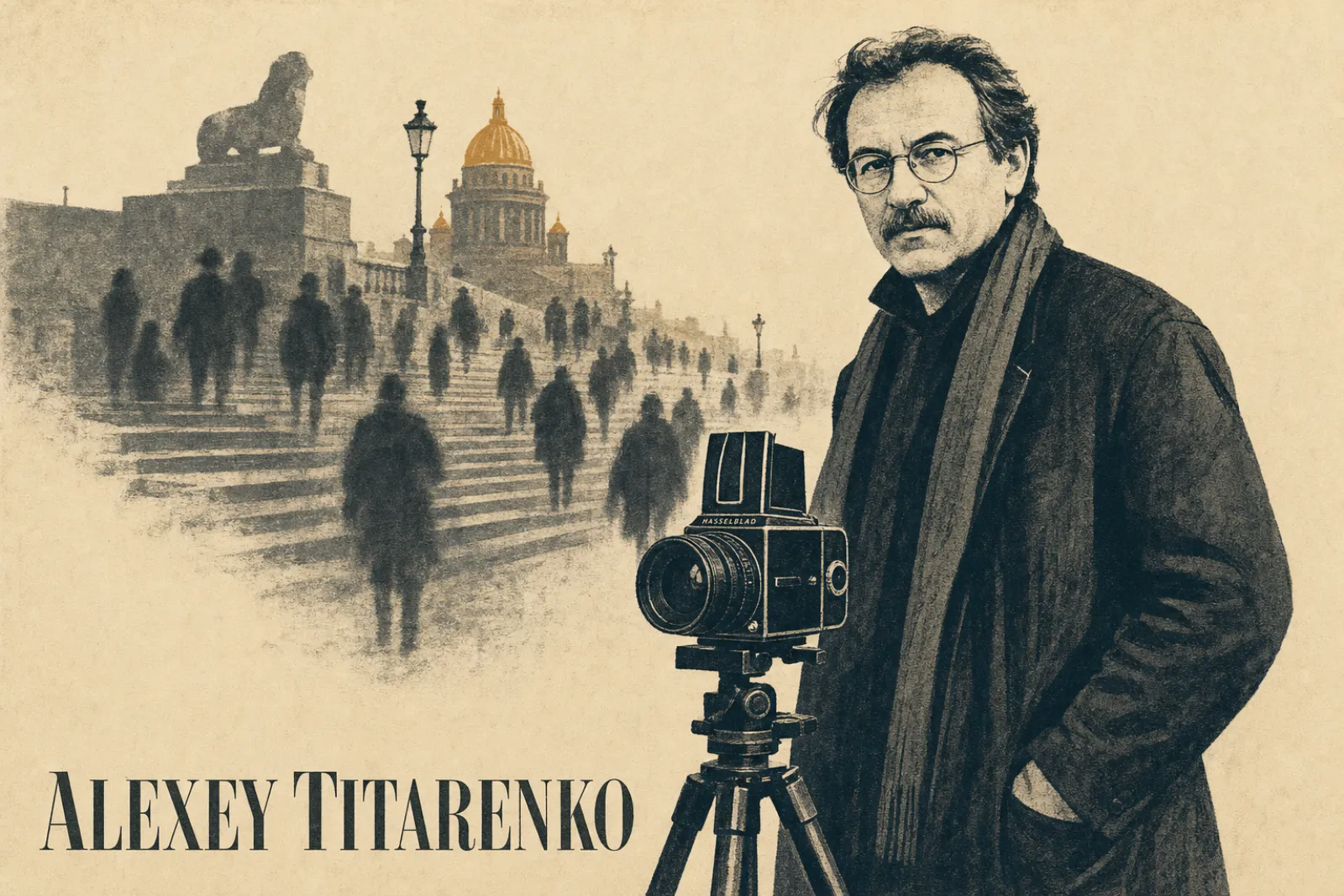
Alexey Titarenko is a photographer born in 1962 in Leningrad, the city since renamed Saint Petersburg. He is known for City of Shadows, a series made there from 1991 to 1994, in which long exposures turn crowds on the street into blurred, shadow-like forms. He printed his black and white photographs by hand in the darkroom, and later made series in Venice, Havana and New York.
Titarenko began photographing at the age of nine. In 1978 he joined Zerkalo (The Mirror), an independent photo club in Leningrad, where at 15 he was the youngest member. He studied in the Department of Cinematic and Photographic Art at the Leningrad Institute of Culture, receiving a master’s degree in 1983. His early work drew on the Russian avant-garde, in particular Kazimir Malevich and Alexander Rodchenko. Other photographers named among his influences include Walker Evans, Alfred Stieglitz and Man Ray. He has also pointed to sources outside photography: the music of Dmitri Shostakovich, the novels of Fyodor Dostoevsky and Sergei Eisenstein’s film Battleship Potemkin.
Collage against the Soviet system
After his studies Titarenko served eighteen months as an infantry soldier in the Soviet Army. His first professional success came in the second half of the 1980s with Nomenklatura of Signs, a series of collages and photomontages, some made by superimposing negatives. It was a commentary on the Communist regime and its bureaucracy. In 1988 it gave him his first solo exhibition in Western Europe, in Paris, and in 1989 it was included in Photostroyka, an exhibition of Soviet photography that toured the United States. The series was published as a book by Damiani in 2020.
City of Shadows: Saint Petersburg after 1991
The Soviet Union collapsed in 1991, and the years that followed in Saint Petersburg were marked by food shortages. Titarenko began taking pictures every day. He set up a Hasselblad camera in the shopping district near the Vasileostrovskaya subway station, photographing people as they searched for food.
He chose to use long exposures. The idea came from nineteenth-century French photographic methods he had studied at university. He combined long exposure with deliberate movement of the camera, so that the crowd became a mass of shadows. He has said that he wanted to convey the metaphor of people as shadows as exactly as he could, and to awaken empathy for the inhabitants of his city.
Music shaped the mood. He has named Shostakovich’s Thirteenth Symphony, including the movement called At the Store, and the Second Cello Concerto. The series also refers to the Odessa Steps sequence in Battleship Potemkin. After shooting, he grouped the pictures so that the series followed a narrative.
City of Shadows brought him international recognition. In 2002 it was shown at the Musée Réattu during the Rencontres d’Arles festival in France, in an exhibition presented as the four movements of Saint Petersburg. In 2005 the television channel Arte produced a 30-minute documentary about him, Alexey Titarenko: Art et la Maniere.
How long does a shutter need to stay open to blur a crowd? Long exposure photography covers the settings, the gear and the common problems.
The same method in other cities
Titarenko kept returning to his home city. Black and White Magic of St. Petersburg followed from 1995 to 1997 and was published as a book in 1997. Time Standing Still followed from 1997 to 2000. From the early 2000s he also photographed Venice, a city often paired with Saint Petersburg, which is called the Venice of the North, and Havana. In 2011 fifteen of his Havana prints were shown at the J. Paul Getty Museum in Los Angeles, in the exhibition A Revolutionary Project: Cuba from Walker Evans to Now.
He became a naturalized citizen of the United States in 2011. His New York series, dated by his gallery from 2004 to 2018, applied the same long exposures and darkroom printing to another city. The book The City Is a Novel was published by Damiani in 2015. His prints are held by museums including the J. Paul Getty Museum, the Museum of Fine Arts, Houston, the Philadelphia Museum of Art and the Museum of Fine Arts, Boston.
How the shadows are made
The pictures rest on two stages, and both are deliberate.
- Time is the subject. In a long exposure anything that holds still is recorded sharply and anything that moves is smeared. Buildings, railings and steps stay solid. People passing through do not. The choice of shutter speed decides whether a crowd reads as individuals or as a flow.
- The camera may move too. Titarenko added intentional camera movement to some pictures, which softens even the fixed parts of the scene.
- The street is the setting. These are still street photographs, made in public among ordinary people. John Bailey, in an essay comparing him with Garry Winogrand, noted that Titarenko had to overcome the problem of being too visible, since people who react to a photographer change the picture.
- The print is finished by hand. He made gelatin silver prints himself. His methods include selective bleaching and toning, often applied with a brush, and the Sabattier effect, in which a print is exposed to light during development. The result is a wide, subtle range of greys, and no two prints are quite the same. Darkroom basics explains the standard process these methods depart from.
- Weather is material. His printing brings out the texture and reflective quality of snow, rain and cloud.
- Pictures are ordered like music. He grouped City of Shadows into a narrative, and the Arles exhibition borrowed the language of a symphony by dividing the city into four movements.
Why keep a subject like this in monochrome? Black and white photography looks at what removing colour does to tone and mood.
Want to control tone area by area in your own pictures? Dodging and burning is the place to begin.
Series to look for
- Nomenklatura of Signs (1986 to 1991). Collage and photomontage, not street photography. Look for the debt to Malevich and Rodchenko, and compare it with what came next.
- City of Shadows (1991 to 1994). The crowds near the Vasileostrovskaya station. Notice what stays sharp and what does not, and how a mass of people becomes a single form.
- Black and White Magic of St. Petersburg (1995 to 1997). The series that followed in the same city. Compare the handling of grey with City of Shadows.
- Havana. The method taken to another city. The Getty showed fifteen of these prints in 2011 in an exhibition that ran from Walker Evans to the present.
- New York. Dated by his gallery from 2004 to 2018. Compare what long exposure and hand printing do here with what they do in City of Shadows.
Try this: one stairway, three exposure times
Give this 20 minutes. Find a place where people move steadily past something fixed: a stairway, a station entrance or a pedestrian crossing. Put the camera on a tripod, or use a phone’s long exposure mode with the phone braced against a wall. Shoot near dusk or on a dull day so that slow shutter speeds are possible, or fit an ND filter in brighter light. Keep one composition and make three pictures: about one second, about four seconds and about fifteen seconds. Convert them to black and white. Compare which figures survive in each: people who paused will still be there, and people who kept walking will have thinned into streaks. Then make a fourth frame in which you move the camera slightly on purpose during the exposure, and see what that does to the buildings.
Questions people ask about Alexey Titarenko
How did Alexey Titarenko make City of Shadows?
He photographed crowds in Saint Petersburg with a Hasselblad camera, using long exposures and intentional camera movement so that moving people blurred into shadow. He then printed the negatives by hand, using bleaching and toning to control the greys.
Is the blur made in the camera or in the darkroom?
The blur comes from the exposure: the shutter stays open while people move. The darkroom work, including selective bleaching, toning and the Sabattier effect, shapes the tones of the print.
What influenced Titarenko’s photographs?
He has named the music of Shostakovich, the novels of Dostoevsky and Eisenstein’s Battleship Potemkin. His early photomontages drew on Malevich and Rodchenko, and his long exposures on nineteenth-century French photography.
Which books collect Titarenko’s work?
City of Shadows was published in Saint Petersburg in 2001. The City Is a Novel followed from Damiani in 2015, and Nomenklatura of Signs (Damiani, 2020) presents the early montage series.
Other photographers who worked with time, cities and the darkroom are listed in the A to Z of photographers.