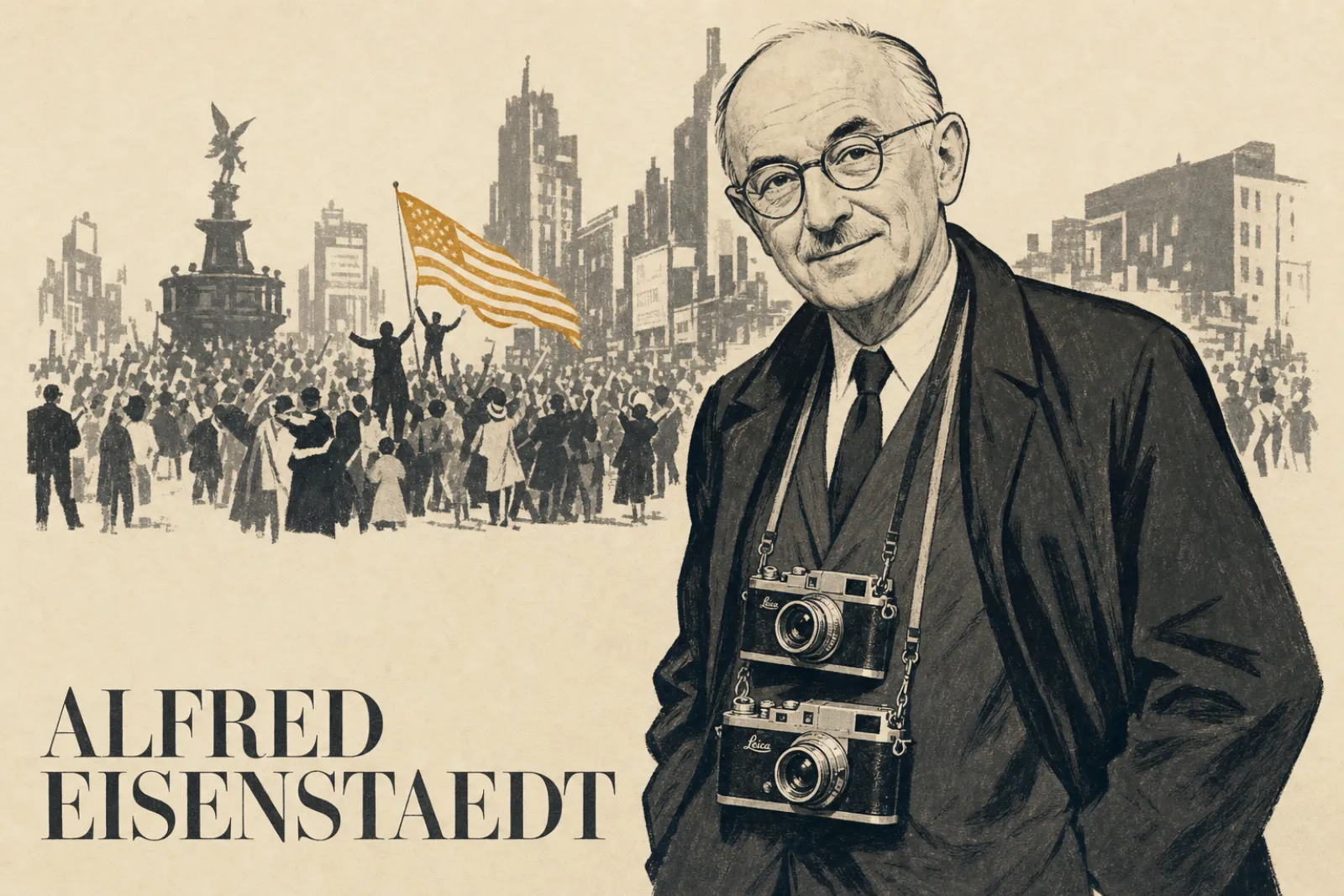
Alfred Eisenstaedt (1898 to 1995) was a German-born American photojournalist who worked first in Berlin and then, from 1936, as a staff photographer for Life magazine in New York. He was an early user of the 35mm camera and of available light in news work. He is best known for V-J Day in Times Square, his 1945 photograph of a sailor kissing a woman in white.
Eisenstaedt was self-taught. He learned his trade in the picture agencies and illustrated magazines of Berlin, and he carried that way of working to the United States. At Life he was one of the original four staff photographers, alongside Margaret Bourke-White. He was a generalist. He photographed politicians, actors, scientists, children and landscapes with the same small camera and the same preference for the light that was already there.
From selling buttons in Berlin to the picture agencies
Eisenstaedt was born on 6 December 1898 in Dirschau, West Prussia, the town that is Tczew in Poland. His family was Jewish and moved to Berlin in 1906. He was given his first camera at 11, an Eastman Kodak folding camera that used roll film. He served in the German Army artillery during the First World War and was wounded in 1918.
In the 1920s he worked in Berlin as a belt and button salesman. In 1928 he began freelancing for the Berlin office of Pacific and Atlantic Photos, and in 1929 he became a full-time photographer. His first major assignment that year was the Nobel Prize ceremony in Stockholm. The Associated Press took over the office in 1931. He also contributed to the Berliner Illustrirte Zeitung and other picture magazines.
The European pictures already show his range. In 1932 he photographed a waiter on ice skates at the Grand Hotel rink in St. Moritz. In 1933 he photographed Joseph Goebbels at the League of Nations in Geneva. He covered a meeting of Hitler and Mussolini in Italy, and in 1935 he made more than 3,500 photographs in Ethiopia.
In 1935, as the Nazi regime oppressed Jewish families such as his, Eisenstaedt emigrated to the United States. He settled in Jackson Heights in Queens, New York, and later became an American citizen.
What does a working news photographer’s job involve? Exploring the world of photojournalism covers the field and its demands.
Life magazine and its covers
In New York he freelanced for Harper’s Bazaar, Vogue and Town and Country. In 1936 Henry Luce hired him as a staff photographer for the new picture magazine Life, and he stayed on the staff until 1972. Life published more than 2,500 of his photo stories, and his pictures appeared on more than 90 of its covers.
The assignments were varied: student nurses, ballet dancers, Bette Davis, portraits of Sophia Loren, an assignment in Kenya in 1966. In 1944 Life called him the dean of the miniature-camera experts of the day.
How do single pictures become a story across several pages? How to create a photo essay sets out the structure.
Times Square, 14 August 1945
On the day Japan’s surrender was announced, Eisenstaedt was in Times Square with Leica cameras around his neck. By his own account he saw a sailor moving through the crowd, grabbing and kissing women, and ran ahead of him. When the sailor seized a woman in a white uniform, Eisenstaedt photographed them. It was over in a few seconds. He said that he made exactly four pictures. The camera was a Leica IIIa.
Life published the picture in its issue of 27 August 1945. A Navy photographer, Victor Jorgensen, photographed the same kiss from another angle, and his version, Kissing the War Goodbye, ran in the New York Times the next day. The faces are not clearly visible. Several people claimed to be the pair. A 2012 book, The Kissing Sailor, identified them as George Mendonsa, a sailor, and Greta Zimmer Friedman, a dental assistant who was wearing her work uniform. Friedman said that the sailor grabbed her and that the kiss was not her choice. Since the 2010s the picture has often been discussed in that light.
A small camera, the light in the room and few frames
Eisenstaedt’s method was plain, and most of it can be copied.
- A small camera makes a photographer less threatening. He worked with hand-held 35mm Leicas. He observed that people did not take him too seriously with his little camera, and that he came to them as a friend. That is the basis of candid photography: people carry on being themselves.
- Use the light that exists. He was an early devotee of available light. Working without flash keeps the atmosphere of a place and does not announce each exposure. Natural light photography explains how to read and use it.
- Focus before the moment. In Times Square his cameras were already focused from 10 feet to infinity, so he could run and shoot without touching the lens. This is zone focusing.
- Get ahead of the action. He did not chase the sailor from behind. He ran in front and let the subject come to him.
- Shoot little and choose the peak. He took only a few pictures of each subject and moved on. Of his 1963 picture of children at a puppet show he said the best frame was the one made at the climax of the action. That is the decisive moment in practice.
- Set up when it helps. For the skating waiter he put a chair on the ice, asked the waiter to skate past it and focused on the chair. Fixing focus on a marker and letting the subject reach it is a method still used in photographing moving subjects.
Does a small camera still matter on the street? Street photography covers working unnoticed in public places.
Photographs to look for
- The skating waiter, St. Moritz (1932). The head waiter of the Grand Hotel ice rink on skates. Knowing that the focus was set on a chair explains how a moving figure could be caught sharp.
- Joseph Goebbels at the League of Nations, Geneva (1933). Made two years before Eisenstaedt, who was Jewish, left Germany. It belongs to his agency years, when politics was a regular assignment.
- V-J Day in Times Square (1945). A sailor and a woman in a white uniform, made in seconds in a crowd. Compare it with Victor Jorgensen’s picture of the same instant to see what a change of position does.
- Children at a Puppet Theatre, Paris (1963). Made in the Tuileries Garden. Eisenstaedt said the best frame was the one from the climax of the action. Look at it with that choice in mind.
- Portraits of Sophia Loren. A set of portraits of one sitter that has been described as showing mischief, dignity and love.
Try this: pre-focus, get ahead, four frames
Take 15 minutes in a busy public place with a camera or phone. Turn the flash off. If the camera allows it, set focus manually to about 10 feet (3 metres) and choose a small aperture such as f/8, so that most of the scene is sharp. On a phone, tap and hold to lock focus at that distance. Do not follow people. Instead, pick a spot that people are walking towards, stand there and let them arrive. When something happens, a greeting, a laugh, a child pulling on a hand, make no more than four frames and lower the camera. Repeat three times. Afterwards, pick one frame from each set and note what made it the peak.
Questions people ask about Alfred Eisenstaedt
What camera did Alfred Eisenstaedt use?
He is associated with the 35mm Leica, which he used hand-held with available light. V-J Day in Times Square was made with a Leica IIIa. His first camera, at 11, was an Eastman Kodak folding camera.
Who are the people in V-J Day in Times Square?
The faces are not clearly visible in the picture. A 2012 book, The Kissing Sailor, identified them as George Mendonsa, a Navy sailor who died in 2019, and Greta Zimmer Friedman, a dental assistant who died in 2016. They were strangers, and Friedman said the kiss was not something she chose.
How long did Eisenstaedt work for Life magazine?
He was hired in 1936 as one of the original staff photographers and remained on staff until 1972. Life published more than 2,500 of his photo stories and more than 90 of his cover pictures.
When did Alfred Eisenstaedt die?
He died on 23 August 1995, aged 96, on Martha’s Vineyard, Massachusetts, where he had spent summers for 50 years. In 1993 he had photographed the Clinton family there. He received the National Medal of Arts in 1989.
Eisenstaedt is quoted on the photography quotes page, and more photographers are listed in the A to Z of photographers.