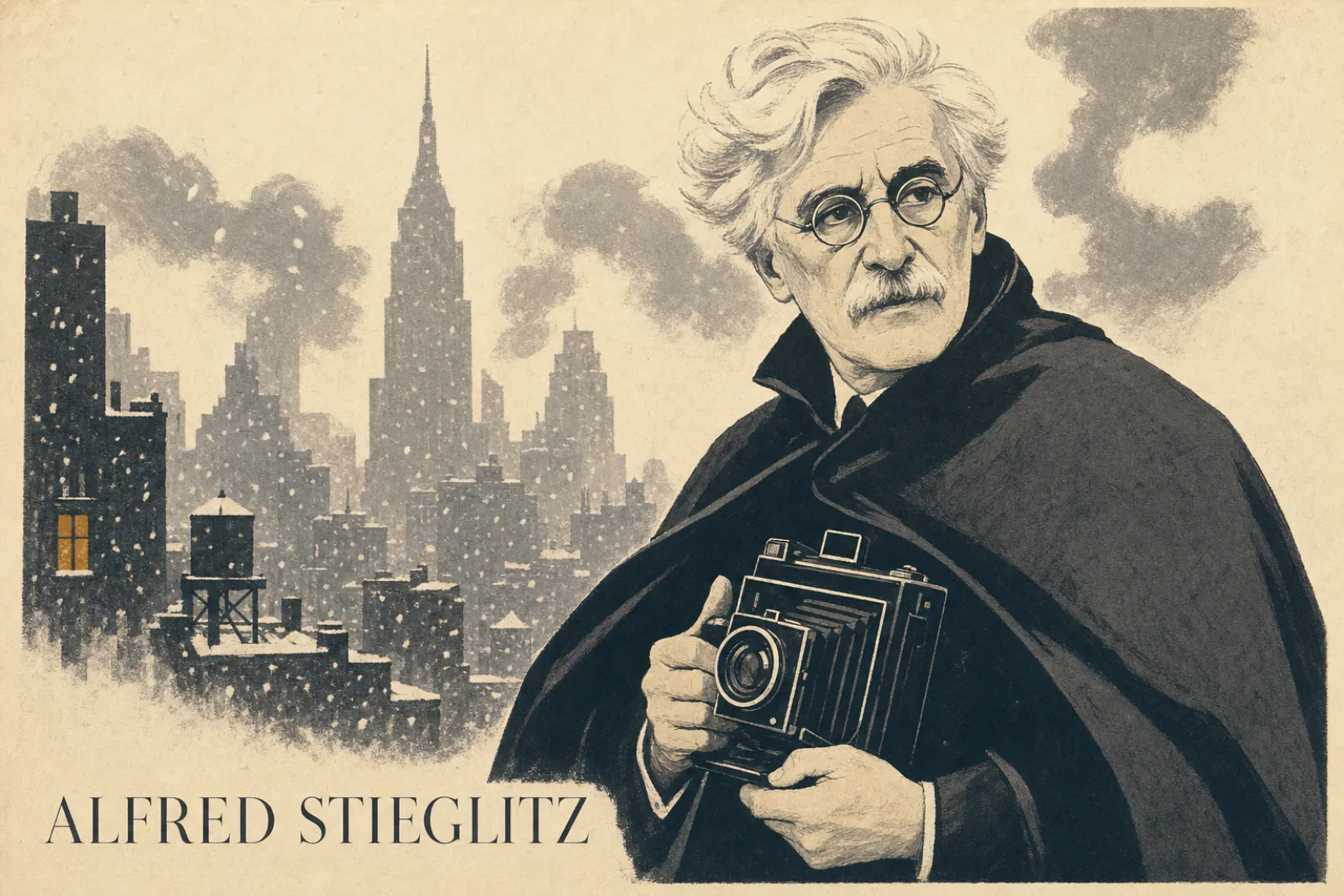
Alfred Stieglitz (1864 to 1946) was an American photographer, editor and gallery owner who worked mostly in New York. He photographed the city in snow and rain, made a long series of portraits of the painter Georgia O’Keeffe, and photographed clouds as abstract pictures. He is known above all for one thing: he spent fifty years arguing, in print and on gallery walls, that a photograph could be a work of art.
Stieglitz learned photographic chemistry in Berlin from Hermann Wilhelm Vogel, a researcher in photographic processes. Back in New York he gathered other photographers around him, among them Edward Steichen, Clarence H. White and Gertrude Käsebier. Later he championed younger photographers whose sharp, direct pictures broke with the soft style he had once promoted, first Paul Strand, then Ansel Adams and Eliot Porter.
From a Berlin classroom to a New York blizzard
Stieglitz was born on 1 January 1864 in Hoboken, New Jersey. His father, Edward Stieglitz, was a wool merchant. In 1881 the family moved to Europe, and Alfred went to school in Karlsruhe and then studied mechanical engineering in Berlin. Vogel’s chemistry teaching drew him toward photography, and he bought his first camera, an 8×10 plate camera, in Germany. He spent the later 1880s travelling in Europe, photographing and entering competitions. In 1887 his picture The Last Joke, Bellagio won first place in a competition run by the British magazine Amateur Photographer.
He returned to New York in 1890. His father set him up in a photoengraving business, the Photochrome Engraving Company, which rarely made money. What mattered more was that he began walking the streets with a camera he could hold in his hands. On 22 February 1893 he stood for three hours in a snowstorm at Fifth Avenue and Thirty-Fifth Street with a borrowed hand camera, waiting for the right arrangement. The result, Winter, Fifth Avenue, shows a horse-drawn omnibus and its driver pushing through the storm. He cropped the negative on all four sides and printed it as a carbon print on rough paper. The International Center of Photography credits him with pioneering photography in snow, in rain and at night.
Want to try pictures in snow and rain yourself? Photography in bad weather covers exposure, protection for the camera and what to look for when the weather turns.
Camera Work, the Photo-Secession and the gallery at 291
Stieglitz did as much with magazines and rooms as with cameras. In 1896 two New York clubs merged into the Camera Club of New York, and he turned its journal, Camera Notes, into a serious magazine from its first issue in July 1897. In February 1902 he formed the Photo-Secession, a group of photographers committed to photography as fine art, shortly before an exhibition he organised at the National Arts Club. The group worked in the pictorialist manner: soft focus, heavy handwork in the darkroom, and printing in platinum and gum bichromate to get effects close to painting and etching. The photography movements page places pictorialism beside the styles that replaced it.
His next magazine, Camera Work, ran for 50 issues from 1903 to 1917. Its illustrations were photogravures, ink prints made from photographs, and Stieglitz tipped them into the copies by hand. Steichen designed the cover. In November 1905, at Steichen’s urging, Stieglitz opened the Little Galleries of the Photo-Secession at 291 Fifth Avenue. The gallery, soon known simply as 291, showed photographs next to modern painting and sculpture. Matisse had his first American exhibition there in 1908, and Picasso his first American solo show in 1911. Rodin, Cézanne and Brâncuși were shown there too.
The gallery closed in June 1917, and Camera Work ended the same year. Its last issue was given almost entirely to Paul Strand, whose sharp, unsoftened pictures marked a break with pictorialism. Stieglitz moved the same way. He wrote that he liked his photography straight and unmanipulated, a print that looked like nothing but a photograph.
Wondering how photography got from soft-focus salon prints to the sharp modern picture? The history of photography walks through the main turns, from the daguerreotype onward.
O’Keeffe, clouds and a last gallery
Stieglitz first showed Georgia O’Keeffe’s drawings at 291 in May 1916. She moved to New York in June 1918, and they married in 1924. He photographed her for two decades. The Art Institute of Chicago counts some five hundred photographs of her made between 1917 and 1937 and calls the result a composite portrait: one person described through many pictures, including close studies of her hands, feet and torso as well as her face. Several of the early prints in the Art Institute’s collection are palladium or platinum prints, and others are gelatin silver.
In 1922 the critic Waldo Frank suggested that the strength of Stieglitz’s pictures came from his subjects. Stieglitz answered by photographing clouds, a subject open to anyone. A sequence of ten called Music came in 1923, then Songs of the Sky, and from 1925 to 1934 the pictures he titled Equivalents, at least 220 of them. In 1924 the Museum of Fine Arts in Boston took a group of his photographs into its permanent collection.
He kept running galleries: the Intimate Gallery, and from December 1929 An American Place, which he directed until his death. There he showed O’Keeffe every year, along with the painters John Marin, Arthur Dove, Marsden Hartley and Charles Demuth. He gave Ansel Adams an exhibition in 1936 and Eliot Porter one two years later. Stieglitz died in New York on 13 July 1946. O’Keeffe assembled a master set of his prints, and in 1949 she gave 1,317 of them to the National Gallery of Art in Washington. A further gift in 1980 brought the set to 1,642 photographs.
How Stieglitz made a photograph hold together
- Choose the place, then wait. For Winter, Fifth Avenue he picked his position first and stood there for three hours until the bus, the driver and the snow fell into place. The method is the one behind timing and anticipation: the frame is fixed, the moment is what you wait for.
- Finish the picture after the exposure. He cropped that negative on every side within a day. In his view the first framing was a start, and cropping was part of making the picture.
- Look for shapes before story. The Steerage is built from a gangway, a mast, a stairway and round chains, with the crowd of passengers fitted among them. Reading a scene as shapes is what lets a crowded frame stay clear.
- Take away the reference points. Most of the Equivalents have no horizon, no building and no tree, and the sky is printed nearly black so that the clouds stand out. With nothing to give scale or direction, the picture reads as abstract photography although it is a plain record of the sky.
- Use many pictures for one subject. The O’Keeffe portrait works as a set. No single frame is asked to say everything, which is the idea behind careful photo sequencing.
- Treat the print as the work. Carbon, photogravure, platinum, palladium and gelatin silver each gave him a different surface, and he chose among them picture by picture.
Curious about platinum, palladium and other hand-made printing methods? Alternative photography processes explains what they are and how people still work with them.
Photographs to look for
- Sun Rays, Paula, Berlin (1889). An early picture that Stieglitz did not exhibit or publish until 1921 at the earliest. The Art Institute of Chicago describes it as sharp and crisp, unlike the more atmospheric work he was making at the time.
- Winter, Fifth Avenue (1893). The omnibus in the blizzard. Notice how much of the frame is weather, and remember that the final composition was cut from a larger negative. It was exhibited and published at least 25 times before 1900.
- The Terminal (1893). Made with a 4×5 hand camera in lower Manhattan. A driver in a rubber coat waters his steaming horses in the snow. It is a working street scene, with nothing prettified.
- The Hand of Man (1902). Photographed from a moving train in Long Island City and published in the first issue of Camera Work. An industrial subject given an elegant composition.
- The Steerage (1907). Taken on the liner Kaiser Wilhelm II with a hand-held 4×5 Auto-Graflex. Stieglitz had one prepared plate and made one exposure. It was first published in Camera Work in October 1911.
- Equivalents (1925 to 1934). Dark prints of clouds, among the first photographs made deliberately as abstractions. Look at how little information each one needs.
Try this: one position, twenty minutes
Pick a street corner, a doorway or a bus stop where something passes through regularly. Choose your framing and do not move your feet for twenty minutes. Photograph only when a figure or vehicle reaches the spot in the frame where you want it. Make no more than twelve exposures. Afterwards choose the best frame and crop it on at least two sides, asking each time whether the picture is stronger without that strip. Then tilt the camera straight up and make three frames of sky with no horizon or rooftops, and see whether they still hold as pictures.
Questions people ask about Alfred Stieglitz
Why is Alfred Stieglitz important?
He made strong photographs over half a century and he built the means for photography to be taken seriously as art: the Photo-Secession, the magazine Camera Work, and a run of New York galleries beginning with 291. Those galleries also gave Matisse and Picasso their first American exhibitions.
What is The Steerage?
It is a photograph Stieglitz made in 1907 on a voyage to Europe. He was travelling first class, and the picture shows the passengers on the lower deck, in steerage. It was published in Camera Work in 1911 and is widely treated as his signature picture and an early work of modernist photography.
What are the Equivalents?
They are photographs of clouds that Stieglitz made from 1925 to 1934, following two earlier cloud series, Music and Songs of the Sky. He made them to show that his pictures did not depend on special subject matter, and they are counted among the first intentionally abstract photographs.
Was Alfred Stieglitz married to Georgia O’Keeffe?
Yes. They married in 1924, after his divorce from his first wife, Emmeline Obermeyer. He exhibited her paintings almost every year, and after his death she organised his prints and gave the main set to the National Gallery of Art.
Stieglitz is one of the photographers listed in the A to Z of photographers, and his words appear on the photography quotes page.