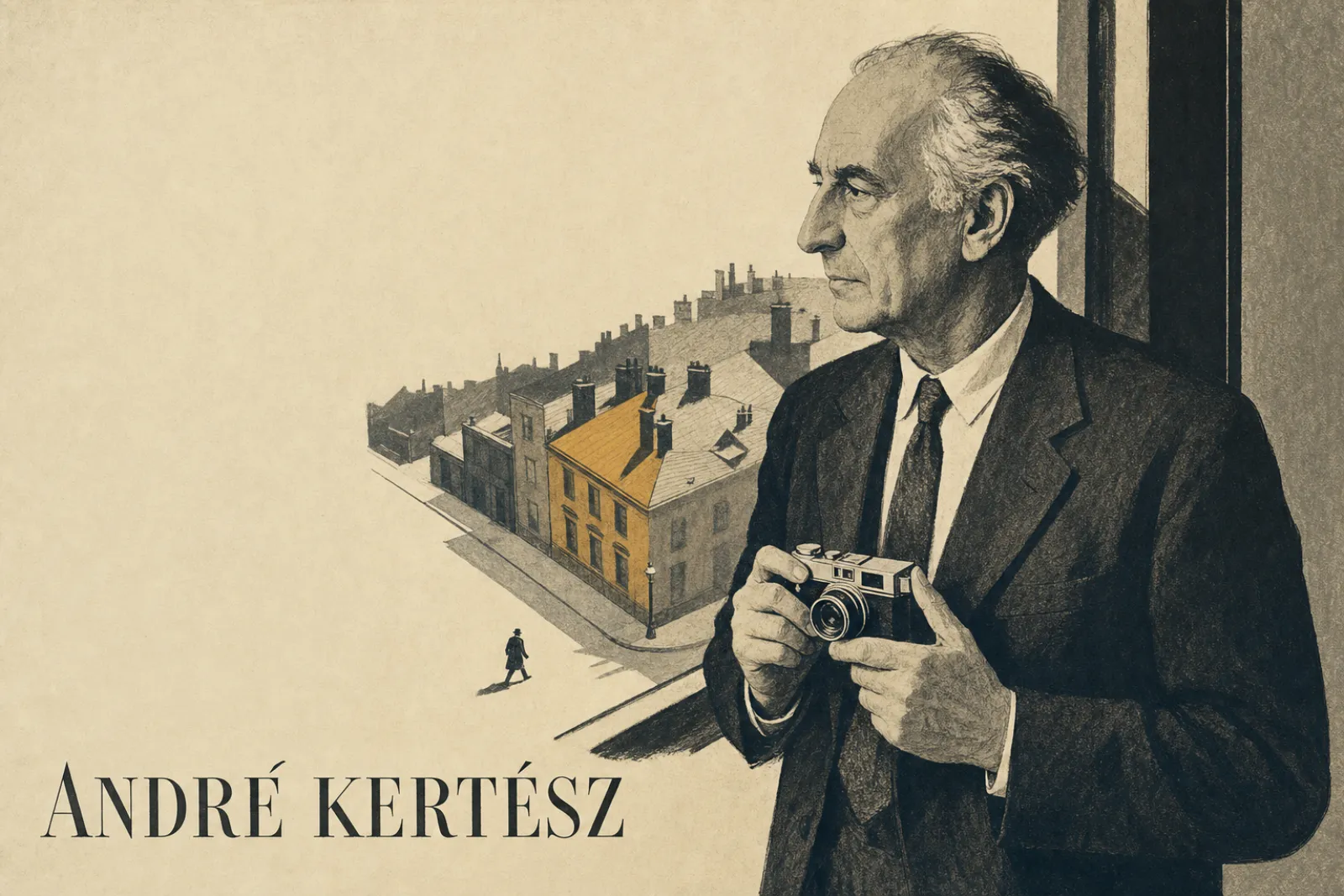
André Kertész (1894 to 1985) was a Hungarian-born photographer who worked in Budapest, Paris and New York across seven decades. He photographed streets, friends, studios, tabletops and the view from his own window, mostly with small hand-held cameras. He is known for finding exact, quiet compositions in ordinary things, and for showing a generation of photographers in Paris what a small camera could do.
Kertész taught himself. He had no art school behind him and no master to react against, only a job at the Budapest stock exchange. In Paris he became the older figure whom others learned from. The International Center of Photography records that Brassaï counted him as a mentor in the late 1920s and early 1930s, and that his work also affected Henri Cartier-Bresson and Robert Capa.
A stock exchange clerk with a camera in his pocket
He was born Andor Kertész in Budapest on 2 July 1894. His father, a bookseller, died in 1908. After he finished at the Academy of Commerce in 1912 his family arranged a job for him at the stock exchange. In the same year he bought his first camera, an ICA box camera, and began photographing the life around him.
He enlisted in the Austro-Hungarian army in 1914 and carried a lightweight Goerz Tenax camera at the front. He was wounded in 1915. A Hungarian magazine first published his work in 1917. Most of his wartime photographs were destroyed in 1919. One survivor is Underwater Swimmer, Esztergom (1917), in which the water distorts the body of a swimmer. It points forward to work he made sixteen years later.
Paris, 1925 to 1936: studios, cafés and a Leica
Kertész moved to Paris in 1925, against his family’s wishes, and changed his first name to André. He found a circle of artists and writers there. Early in 1926 the painter Piet Mondrian invited him to his studio. Kertész made two pictures there that are still among his best known: a view of the studio and a still life of the painter’s glasses and pipe.
In 1927 the gallery Au Sacre du Printemps showed thirty of his photographs. In 1928 he bought a Leica, his first 35mm camera, and it suited the way he already worked. He photographed for the illustrated press, the early home of photojournalism, including the French magazine VU under its editor Lucien Vogel, and for German and British papers. The Getty describes this as the period in which he took up modernist photography and explored still life.
In 1933 he made the Distortions, about 200 photographs of two models reflected in funhouse-style mirrors, first printed in the magazine Le Sourire. The bodies stretch and fold into shapes that are closer to sculpture than to portraiture. In the same years he published books: Enfants (1933), Paris vu par André Kertész (1934) and Nos Amies les Bêtes (1936). He married Elizabeth Salomon in June 1933.
Wondering how small cameras changed what photographers did on the street? Street photography covers the approach, the settings and the habits that grew out of that change.
New York: lean years, then recognition
Kertész arrived in New York in October 1936 to work for the Keystone agency. The move went badly. He left Keystone within a year, American editors had little use for his kind of picture, and during the Second World War he was classed as an enemy alien, which restricted his photographing outdoors. A book of his French work, Day of Paris, came out in 1945.
From 1946 he worked under a long-term exclusive contract with House and Garden, part of Condé Nast. It paid well. He gave up commercial work by 1962 and went back to photographing what interested him. In 1964 John Szarkowski, the new director of photography at the Museum of Modern Art, gave him a solo exhibition, and wide recognition followed: a Guggenheim Fellowship in 1974, the French Legion of Honour in 1983, and the purchase of 100 prints by the Metropolitan Museum of Art in 1984.
From 1952 he lived in an apartment on Fifth Avenue beside Washington Square. From there he photographed the park through a telephoto lens, often under snow, as a pattern of tracks and silhouettes. On Reading, a book of people absorbed in reading, appeared in 1971. In 1979 the Polaroid Corporation gave him an SX-70 camera, and he worked with it into the 1980s. His wife Elizabeth had died in 1977. Kertész died in New York on 28 September 1985.
Interested in the kind of instant camera Kertész used at the end of his life? Instant film photography explains how Polaroid and Instax film behave and what they suit.
How a Kertész photograph is put together
- Geometry first, then the exception. In Mondrian’s studio he lined up straight edges and flat planes, then let the curves of a staircase and a vase interrupt them. The Art Institute of Chicago notes that he looked for exactly those departures from order. A picture built on lines comes alive at the point where one of them bends.
- A high viewpoint. His New York apartment was on the twelfth floor, and the park below became a subject. Looking down turns the ground into a surface on which figures and tracks become marks. The page on camera angles and perspectives shows what each position does to a scene.
- Movement and shape together. The International Center of Photography describes his work as joining a reporter’s interest in movement and gesture to a formal concern for abstract shapes. The Satiric Dancer is both at once: a pose caught, and a figure arranged against a sculpture.
- Still life from what is at hand. A newspaper, bananas, a wine glass and a bottle of mineral water made one 1926 arrangement. His still life pictures depend on placement and light, with no special props.
- Distortion from mirrors and water. The swimmer of 1917 and the mirror nudes of 1933 use a reflecting or refracting surface to change a body’s shape in the camera. Reflection photography starts from the same idea.
- Feeling over record. The Getty presents his early pictures as records of how he felt about a scene more than of how it looked. In The Circus, Budapest the thing being watched is not shown at all.
Want to work on where the camera stands? Photography composition sets out fifteen techniques, including viewpoint, line and balance.
Photographs to look for
- Underwater Swimmer, Esztergom (1917). The only surviving picture from a wartime series of a swimmer. Water bends the swimmer’s body, an effect he returned to deliberately in 1933.
- The Circus, Budapest (1920). A couple peer through gaps in a fence at circus performers the viewer cannot see. The picture is about the act of looking.
- Chez Mondrian (1926). The painter’s studio, with a staircase, a vase and a round boater hat set against the straight lines of the room. It was not published until 1943.
- Satiric Dancer (1927). The dancer Magda Förstner poses on a couch in the Montparnasse studio of the sculptor Etienne Beöthy, her legs swivelled outward, with one of his sculptures beside her. A version ran in the Berlin magazine Die Dame in 1927.
- Fork (1928). Also known by its French title, La Fourchette, and one of his most famous pictures from the Paris years. Look it up as the plainest case of his habit of making a picture from an everyday object.
- The Lost Cloud, New York (1937). One small cloud beside the mass of Rockefeller Center. The Getty reads it as a picture of his own position as a newcomer in the city.
Try this: fifteen minutes at a window
Stand at an upstairs window, a balcony or the top of a staircase that looks down on a path, a courtyard or a street. Frame so that there is no sky and no horizon, only ground. Stay for fifteen minutes and photograph only when a person, a shadow or a vehicle sits where it balances the frame. Limit yourself to ten exposures. Then make one more picture indoors: arrange three or four things that are already on the table, such as a newspaper, a glass and a piece of fruit, and photograph them by window light without adding anything.
Questions people ask about André Kertész
What camera did André Kertész use?
He started in 1912 with an ICA box camera and carried a Goerz Tenax during the First World War. He used glass-plate cameras in his first Paris years, bought a Leica in 1928, and at the end of his life worked with a Polaroid SX-70.
What are the Distortions?
They are about 200 photographs made in Paris in 1933 of two nude models reflected in distorting mirrors. They were made for a magazine and later gathered as a book. They are studies in shape, and they connect back to his 1917 picture of a swimmer under water.
Why did Kertész struggle in the United States?
He arrived in 1936 for an agency job that lasted only about a year, had little English, and found that American magazines did not want his style of photograph. Wartime restrictions limited his work further. Recognition came after he left commercial work and the Museum of Modern Art showed him in 1964.
How did Kertész influence other photographers?
His habit of finding abstract order in scenes he came across, without arranging them, was taken up by younger photographers in Paris. Brassaï, Cartier-Bresson and Capa are the names the International Center of Photography gives. He stayed in touch with French photography late in life, and he and Robert Doisneau were together at Arles in 1975.
Kertész is one of the photographers listed in the A to Z of photographers.