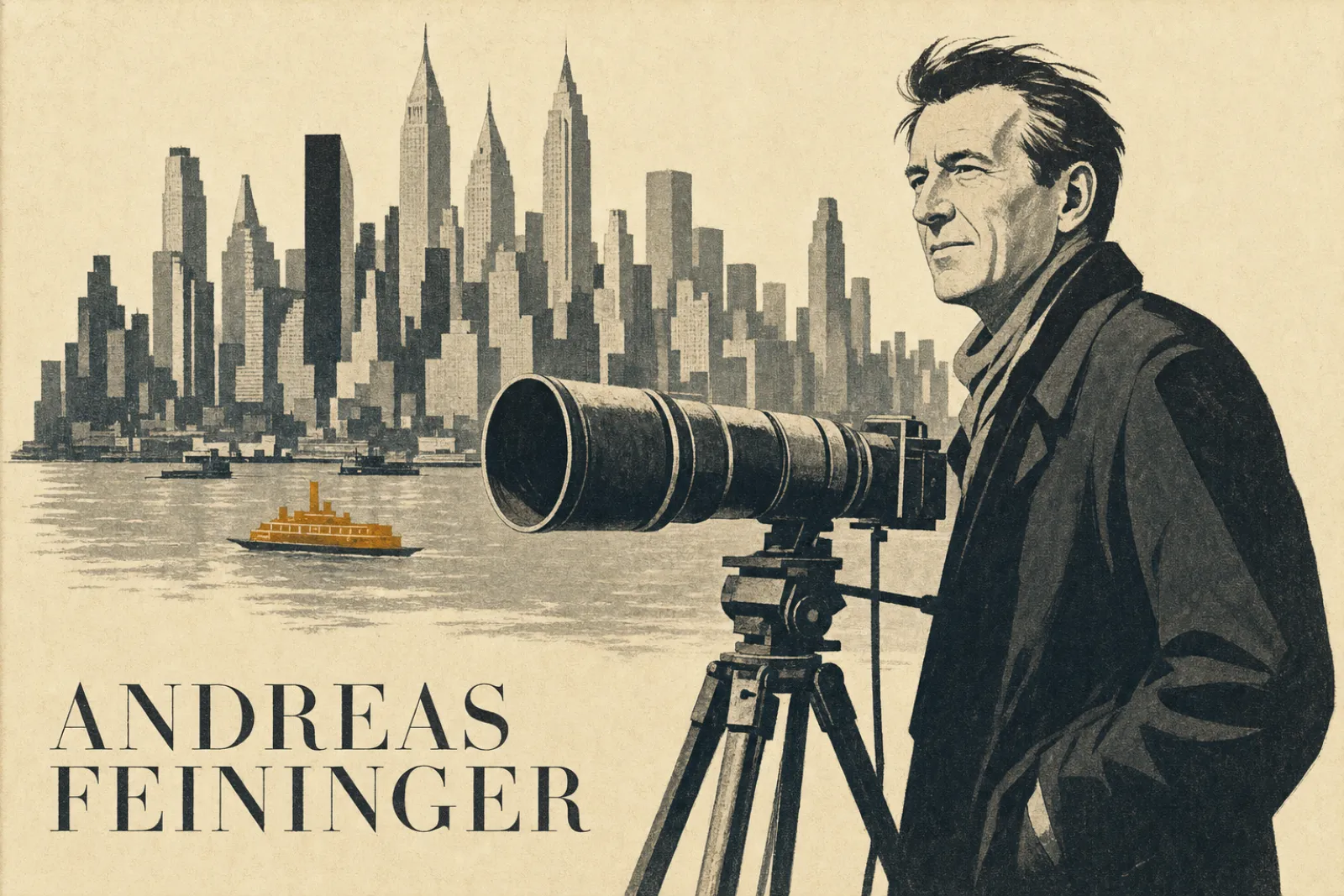
Andreas Feininger (1906 to 1999) was a photographer and writer who trained as an architect in Germany and spent his working life in New York. As a staff photographer at Life magazine from 1943 to 1962 he photographed cities, industry and natural forms, mostly in black and white and rarely with people in the frame. He is known for views of Manhattan made with long lenses he built himself, and for his books on how to photograph.
Feininger grew up inside the Bauhaus. His father was the painter Lyonel Feininger, who joined the school’s staff in Weimar in 1919, and Andreas enrolled there at sixteen. László Moholy-Nagy, who taught at the Bauhaus, gave him guidance in photography. At Life he was the odd one out: the magazine’s own account notes that most of its photographers concentrated on people, while he concentrated on things. In 1955 his work was included in The Family of Man, the Museum of Modern Art exhibition organised by Edward Steichen.
A cabinetmaker and architect before he was a photographer
Feininger was born in Paris on 27 December 1906. The family moved to Berlin in 1908 and to Weimar in 1919. He entered the Bauhaus in 1922 and finished as a cabinetmaker in April 1925, then studied architecture at the state building schools in Weimar and Zerbst. In 1929 his photographs were shown in the Film und Foto exhibition in Stuttgart.
He worked as an architect in Hamburg from 1929 to 1931 and then in Paris, in the studio of Le Corbusier. In the 1930s he moved to Stockholm, where he set up a firm that specialised in architectural and industrial photography. His first instructional writing dates from 1934. The training shows in everything that came later. He looked at a city, a bone or a shell the way a builder looks at a structure, and he wanted the photograph to explain how the thing was put together.
Interested in photographing buildings the way an architect sees them? Architectural photography covers viewpoint, straight verticals, light and interiors.
New York, the war years and two decades at Life
Feininger emigrated to the United States in 1939 and settled in New York. He worked first for the Black Star agency and for the United States Office of War Information, for which he photographed in Colorado in 1942. In 1943 he joined the staff of Life, and he stayed until 1962.
The city became his main subject. He is remembered first for energetic black-and-white scenes of Manhattan, and his books follow the same line: New York (1945), The Face of New York (1954) and a second New York in 1964. For Life he also photographed industry across the country. The magazine’s archive lists an oil field at Signal Hill crowded with derricks, the liner S.S. United States in New York Harbor, a Texaco gas station on Route 66 under heavy clouds, and a time exposure of the rotor blades of a grounded helicopter that produced abstract patterns of light.
To get these pictures he made his own equipment. The International Center of Photography records that he built four telephoto lenses and three close-up cameras. The long lenses let him stand far back from a skyline and keep its proportions true. The close-up cameras served the other half of his work: studies of bones, shells, plants and minerals that emphasise their structure. The Anatomy of Nature appeared in 1956, followed by Trees (1968) and Shells (1972).
After leaving Life he concentrated on his own projects, exhibiting and publishing. He received the Robert Leavitt Award of the American Society of Media Photographers in 1966 and the Infinity Lifetime Achievement Award of the International Center of Photography in 1991. He died in New York on 18 February 1999. His archive is held at the Center for Creative Photography in Tucson, Arizona.
The books that taught photography
Feininger wrote steadily from the 1930s onward, and the International Center of Photography calls him renowned as a teacher through his publications. The instructional titles include New Paths in Photography (1939), Feininger on Photography (1949), Successful Photography (1954), The Creative Photographer (1955), Total Picture Control (1961), The Complete Photographer (1965), Photographic Seeing and Principles of Composition (both 1973), Darkroom Techniques and The Perfect Photograph (both 1974) and Light and Lighting in Photography (1976). The Complete Photographer is the best known. The books are valued for combining practical experience with clear presentation. Many were translated into other languages.
How Feininger made structure visible
- Back up and use a long lens. From far away, with a telephoto, near and distant buildings are drawn at closer to their true relative sizes, so a skyline reads as stacked layers and nothing in the foreground looms. This is the effect explained under lens compression, and it comes from distance. The lens only crops the view.
- Avoid the distortion of standing close. A wide lens up close stretches whatever is nearest. Feininger’s telephoto lenses were built to give views without that perspective distortion.
- Go very close to small things. His close-up cameras magnified shells and bones until their construction filled the frame. The same thinking drives macro photography.
- Treat natural and built forms alike. The International Center of Photography says his purpose was to document the unity of natural things and their similarity to constructed forms. A shell and a tower get the same clear attention.
- Simplicity, clarity, organisation. Those are the three design principles the same source credits to him. Repeated derricks, windows or ribs become patterns because he removed everything that did not belong.
- Black and white by preference. He preferred black and white for the graphic control it gave, which keeps attention on form.
- Let time draw. The helicopter picture is a long exposure: with the shutter held open, the turning rotor became a pattern of light.
Want to try long lenses on distant subjects? Telephoto photography explains how to use them, hold them steady and choose a viewpoint.
Photographs to look for
- The Photojournalist (1951). A portrait of the photographer Dennis Stock made for Life, with a camera held so that it merges with his face. It may be Feininger’s best-known picture, and it is unusual for him because it is a portrait.
- Signal Hill oil fields. Derricks crowded together across the frame. Life’s archive records Feininger’s own view that the derricks had ruined the landscape.
- S.S. United States in New York Harbor. The ocean liner under way in the harbor of the city Feininger photographed most.
- Texaco gas station on Route 66. A roadside station under dramatic clouds. The sky is as much the subject as the building.
- Helicopter rotor blades, time exposure. The rotor of a grounded helicopter recorded as abstract patterns of light. It is the least literal of his Life pictures.
- Colorado for the Office of War Information (1942). Views along US 40 in Mount Vernon Canyon and of the town of Creede, made the year before he joined Life.
Curious how a photographer of a later generation handled big built structures? Andreas Gursky also photographed cities and industry from a distance, in colour and at very large print sizes.
Try this: the same view, near and far
Choose a row of things that recede into the distance: parked cars, lamp posts, a line of buildings. Stand close to the first one and photograph the row at your widest setting. Then walk back at least fifty paces, zoom in as far as your camera or phone allows, and frame the first object at the same size as before. Compare the two pictures. In the second, the distant objects are larger and the row looks packed together. Make three more long-lens frames from the far position, changing only your height, and pick the one in which the layers are clearest.
Questions people ask about Andreas Feininger
Was Andreas Feininger related to Lyonel Feininger?
Yes. Lyonel Feininger, the American painter who taught at the Bauhaus, was his father. His younger brother, T. Lux Feininger, was a painter and photographer.
What is Andreas Feininger best known for?
For black-and-white photographs of Manhattan, for close studies of natural objects such as shells and bones, and for The Photojournalist, his 1951 portrait of Dennis Stock. He is equally known for his instructional books, above all The Complete Photographer.
How long did Feininger work for Life magazine?
He joined the staff in 1943 and left in 1962, a span of nineteen years. Before that he had worked in New York for the Black Star agency and the Office of War Information.
Where is Andreas Feininger’s archive?
His photographic archive is at the Center for Creative Photography in Tucson. Prints are also held by the International Center of Photography, the J. Paul Getty Museum, the Victoria and Albert Museum and the George Eastman Museum, among others.
Feininger is one of the photographers listed in the A to Z of photographers.