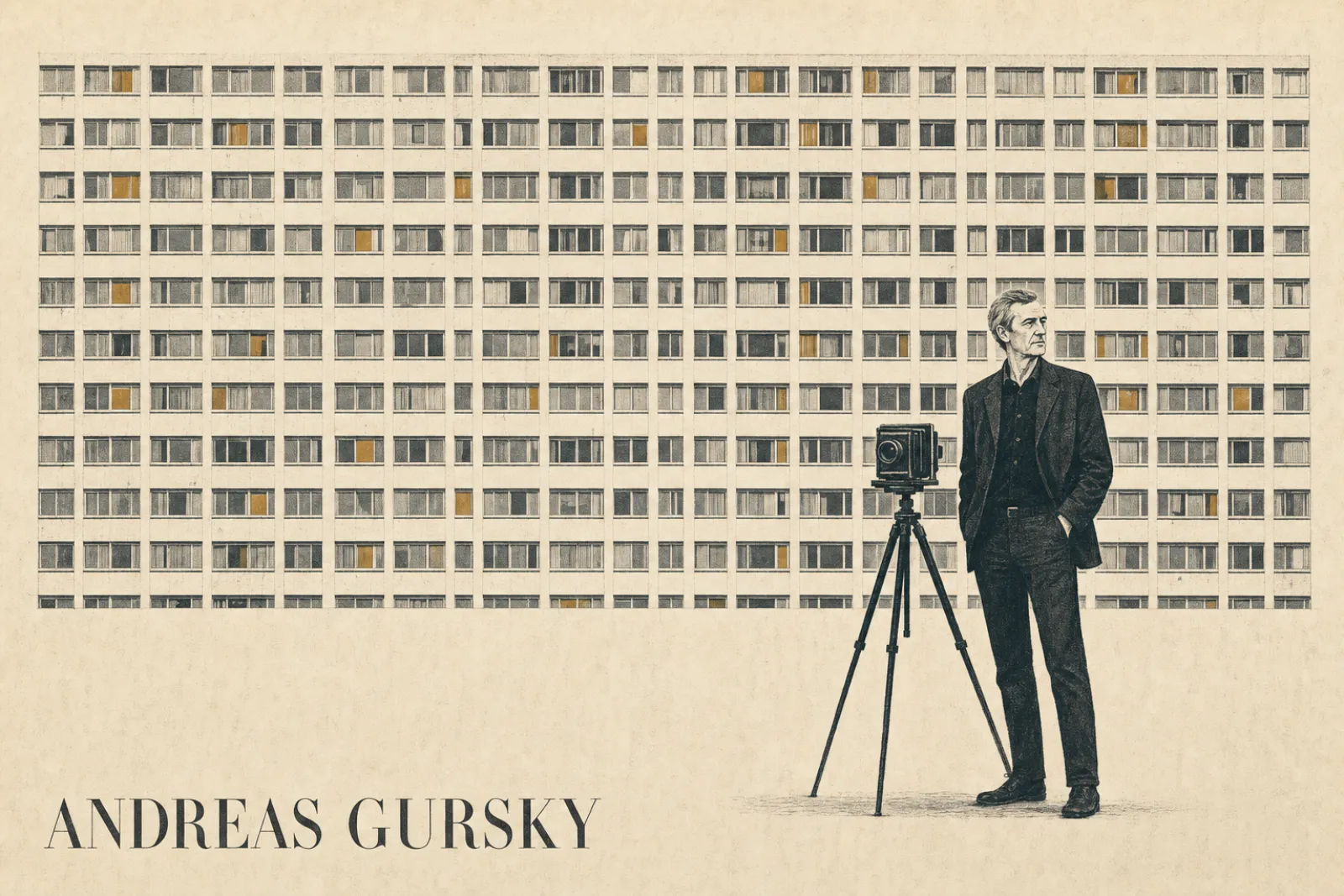
Andreas Gursky, born in Leipzig in 1955, is a German photographer who trained in Essen and Düsseldorf and made very large colour photographs of trading floors, apartment blocks, supermarkets, ports, rivers and crowds. Many were assembled on a computer from several exposures. He is known for the scale and detail of his prints, and for Rhein II, which in 2011 became the most expensive photograph sold at auction up to that time.
Gursky came out of the Düsseldorf art academy, where he studied under Bernd Becher. Bernd and Hilla Becher photographed industrial structures in a strict, standardised way and grouped them by type. Gursky kept their distance and their coolness and dropped their rules: he worked in colour, at great size, and from the 1990s he altered his pictures digitally. Before Düsseldorf he had studied in Essen under the photographer Michael Schmidt. Photography was also the family trade. His father, Willy Gursky, and his grandfather, Hans Gursky, were both photographers.
From Leipzig to the Becher class
Gursky was born on 15 January 1955 in Leipzig, then in East Germany. By the end of 1957 the family had moved to West Germany, first to Essen and then to Düsseldorf. From 1977 to 1980 he studied visual communication at the Folkwang school in Essen. From 1980 to 1987 he attended the Kunstakademie Düsseldorf, where he became a master student of Bernd Becher in 1985.
The pictures from those years were not manipulated. The gallery Sprüth Magers lists early works such as Klausen Pass (1984), Düsseldorf, Airport, Sunday Walkers (1985) and Niagara Falls (1989). His first solo exhibition was at Galerie Johnen and Schöttle in Cologne in 1988.
The change came with Salerno (1990), a view of a busy Italian port: ships, rows of coloured vehicles, cargo, houses and mountains behind. Gursky later described seeing in it the pattern, the density and the industrial look that he would pursue from then on, and he stressed the balance between great scale and a large amount of sharp detail.
Wondering how to photograph a city so that its structure shows? Cityscape photography covers skylines, viewpoints and light.
Stock exchanges, shop shelves and a grey river
In the early 1990s Gursky photographed factories, stock exchanges, airports, golf courses and large buildings from high viewpoints, so that crowds and infrastructure appear as patterns. His subjects were, in the words of one summary, large, anonymous, man-made spaces. Paris, Montparnasse (1993) shows a residential block designed by Jean Dubuisson. Buildings on either side block any single view of the whole facade, so the picture was made by digital combination. It presents a view that cannot be seen from any one spot.
He photographed stock exchange trading floors. For Chicago Board of Trade II (1999) he took several pictures of the floor, scanned them and merged them by computer, with some sections deliberately blurred to suggest movement. Brokers in jackets of different colours cluster around banks of monitors. From 1996 to 1998 he made the Prada pictures of sparse luxury shop shelves, and in 1999 99 Cent, the interior of a 99 Cents Only store in Los Angeles with its rows of identically priced goods.
Rhein II (1999) is the opposite of those crowded frames. It shows the Lower Rhine near Düsseldorf running straight across the picture between flat green banks under an overcast sky. Gursky removed dog walkers and a factory building digitally. A print measuring 190 by 360 centimetres sold at Christie’s in New York on 8 November 2011 for 4,338,500 dollars. It held the auction record for a photograph until 2022, when a print of Le Violon d’Ingres by Man Ray passed it.
Later work kept the method and widened the subjects. The Pyongyang pictures of 2007 show the mass games in North Korea, with tens of thousands of performers. The Ocean series of 2010 was built from high-definition satellite images. Bangkok (2011) shows the flickering, littered surface of the Chao Phraya River. The Museum of Modern Art in New York gave him a retrospective in 2001, and the Hayward Gallery in London showed him in 2018. From 2010 to 2018 he was a professor at the Kunstakademie Düsseldorf.
Is it still a photograph if parts are removed or combined? Photo retouching ethics looks at where different kinds of photography draw the line.
How a Gursky picture is built
- A high, distant viewpoint. Many of the pictures look down or across from far away. The viewer sees a whole trading floor or a whole stadium, which no one standing in it could. The page on camera angles and perspectives explains what elevation does to a scene.
- Everything sharp. Sprüth Magers notes that foreground and background share the same depth of field. Nothing is singled out by focus, so the eye has to travel. Depth of field explains how to keep a whole scene sharp.
- Several exposures joined into one. He used digital tools to remove and add elements, to assemble multiple photographs and to adjust perspective. The basic technique of joining frames is covered under image stitching.
- Repetition as subject. Windows, shelves, jackets and gymnasts repeat until they become pattern. Individual people are small. Gursky has said that no detail in his work is arbitrary, and that small and large structures are woven together under one organising principle.
- Print size. Some prints are around six feet high and ten feet long. From across the room they read as fields of colour, close to abstract painting. Up close they break into thousands of readable details. The page on scale covers how size relationships work inside a frame.
- Small editions. Most works were made in editions of six, with two artist’s proofs. Limited edition prints explains how editioning works.
Curious about an earlier photographer who also stood far back from cities and industry? Andreas Feininger did it in black and white with long lenses, decades before digital tools.
Photographs to look for
- Salerno (1990). The port picture that Gursky described as opening a new sense of possibility. Look for how ships, vehicles, containers, houses and mountains are all equally sharp.
- Paris, Montparnasse (1993). A single apartment block filling a print about 4 metres wide. Critics have compared its grid of windows to the paintings of Piet Mondrian.
- Chicago Board of Trade II (1999). The trading floor, with groups of brokers in coloured jackets around banks of monitors. Note the areas of blur that he built in.
- Rhein II (1999). A river, its banks and the sky reduced to horizontal bands. Keep in mind that people and a building were taken out: the scene was made emptier than it was.
- 99 Cent II Diptychon (2001). A two-part work developed from 99 Cent, digitally altered to reduce perspective. Shelves of bright packaging run across a print more than 3 metres wide.
- Pyongyang IV (2007). The mass games in a Pyongyang stadium, with gymnasts performing and thousands of children holding up cards to form patterns. Gursky left in small breaks in the pattern, such as performers out of step.
Try this: a wall of repeats
Find something that repeats across a large flat area: an apartment facade, supermarket shelves, a car park seen from a higher floor. Stand square to it, far enough back that the repeats fill the frame from edge to edge. Keep the camera level so that vertical lines stay vertical. Make five frames, stepping sideways between each, and choose the one where the pattern runs out of the frame on every side with no sky and no ground. Then look for the one or two places where the pattern breaks, and decide whether the picture is better with them or without.
Questions people ask about Andreas Gursky
Why did Rhein II sell for so much?
It is one print from a small edition by an artist whose work was already in major museums, and other prints of it are held by the Tate and the Museum of Modern Art. The price reached at Christie’s in November 2011, 4,338,500 dollars, was a record for a photograph at auction.
Does Andreas Gursky manipulate his photographs?
Yes, and openly. Before the 1990s he did not. From Salerno onward he moved toward digital work: combining exposures, removing elements and adjusting perspective. He said of Rhein II that the view could not be obtained on the spot and had to be constructed.
Who taught Andreas Gursky?
He studied in Essen under Michael Schmidt and then at the Kunstakademie Düsseldorf under Bernd Becher, becoming his master student in 1985. Gursky himself taught at the same academy from 2010 to 2018.
What does Gursky photograph?
Places where many people or many things gather under one system: stock exchanges, shops, factories, apartment buildings, stadiums and ports. He also made landscapes, including rivers and oceans, treated with the same distance.
Gursky is one of the photographers listed in the A to Z of photographers.