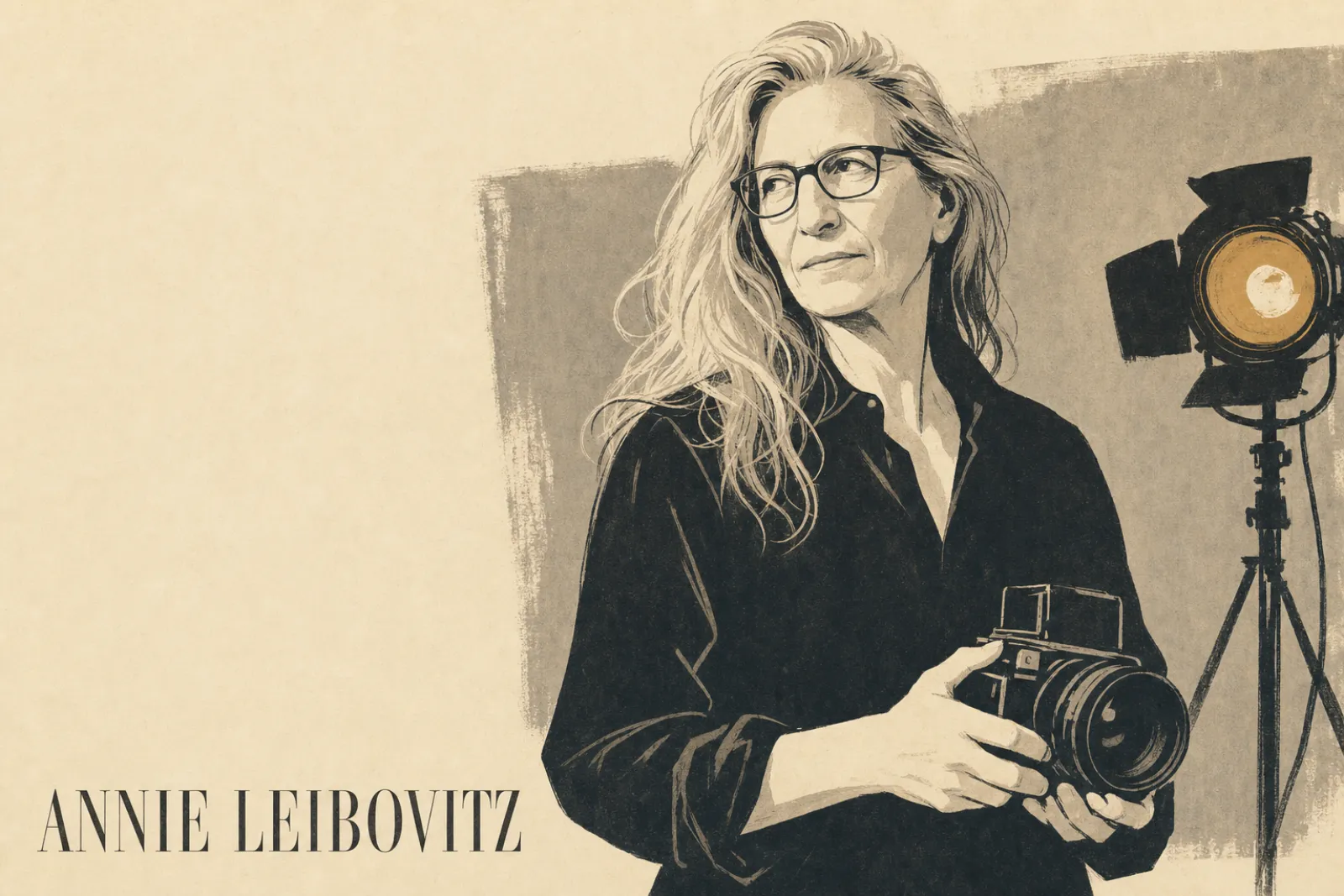
Annie Leibovitz is an American portrait photographer, born in Waterbury, Connecticut, in 1949. She made her name at Rolling Stone in the 1970s, moved to Vanity Fair in 1983 and began working regularly for Vogue in 1998. Her portraits of musicians, actors, athletes and heads of state are each staged around one clear idea. Her photograph of John Lennon and Yoko Ono, made on December 8, 1980, is the picture she is best known for.
She did not set out to be a photographer. She entered the San Francisco Art Institute in 1967 to study painting, meaning to become an art teacher, and changed her major to photography before graduating with a bachelor of fine arts degree in 1971. The photographers who inspired her then were Robert Frank and Henri Cartier-Bresson. Her first published work was reportage in that spirit: pictures from Israel and a photograph of the poet Allen Ginsberg at a peace march in San Francisco. The staged, lit, colour portrait came later, and she taught it to herself on the job.
From a painting class to chief photographer at Rolling Stone
Her father was a lieutenant colonel in the United States Air Force and her mother was a modern dance instructor. The family moved with his postings, and she took her first pictures while he was stationed in the Philippines during the Vietnam War. A summer trip to Japan with her mother after her second year of college turned her toward the camera. Back in San Francisco she enrolled in night classes in photography, and in 1969 she spent several months on a kibbutz at Amir in Israel, photographing as she went.
In 1970 she took her portfolio to Jann Wenner, the founder of Rolling Stone. Her first assignment for the magazine was a portrait of John Lennon, published on January 21, 1971. Wenner named her chief photographer in 1973, a job she held for ten years. The early work was made with a 35mm camera on black and white Tri-X film, close to the way a news photographer would work. In 1974 she moved to colour, and she taught herself lighting and colour technique as she went.
In 1975 she travelled with the Rolling Stones as the photographer for their Tour of the Americas, and came back with black and white portraits of Mick Jagger and Keith Richards. She also photographed Bob Dylan, Bob Marley and Patti Smith in these years.
Want to photograph musicians at work? Concert photography covers shooting live music, from stage light to where to stand.
Vanity Fair, Vogue and the staged colour portrait
The lighting, bold colour and inventive poses she developed at Rolling Stone won her a position at Vanity Fair in 1983, where she was the magazine’s first contributing photographer. The pictures became larger productions: lit, arranged and often provocative. In the same decade she photographed well-known people for an American Express advertising campaign that won a Clio award in 1987. In 1994 she photographed the sprinter Carl Lewis for a Pirelli advertisement, crouched at the start in bright red stiletto heels.
Her first museum exhibition, covering the years 1970 to 1990, opened at the National Portrait Gallery in Washington, D.C., in 1991 and toured for six years. She began to work regularly for Vogue in 1998, which added fashion photography to the portrait commissions. For many years her camera of choice was a Mamiya RZ67, a medium format camera, and she later used digital cameras as well.
The cover that drew the most public argument was More Demi Moore, on the August 1991 issue of Vanity Fair, which showed the actor seven months pregnant and unclothed. The editor, Tina Brown, expected a backlash and the issue went out in a wrapper. A film poster that parodied the picture led to a court case, Leibovitz v. Paramount Pictures, and in 1998 the parody was ruled to be fair use.
How is a portrait like this lit? Studio lighting setup starts with one light and builds from there.
Sontag, Sarajevo and the personal pictures
In 1989 she photographed the writer Susan Sontag, and the two stayed close until Sontag’s death in 2004. Sontag’s influence led her to travel to Sarajevo in 1993 during the war there, a return to reportage. Sontag also first conceived the book Women (1999), which set famous sitters beside miners, soldiers and showgirls.
A Photographer’s Life: 1990 to 2005, published in 2006, went further. It mixed magazine assignments with photographs of her own family, on the argument that both belonged to one life. A retrospective based on the book was held at the Brooklyn Museum with 200 photographs and then toured. Later books include Pilgrimage (2011), Portraits 2005 to 2016 (2017) and Wonderland (2021). She has three daughters, born in 2001 and 2005.
Honours followed the books. The French government made her a Commandeur de l’Ordre des Arts et des Lettres, the Library of Congress named her a Living Legend, the Royal Photographic Society gave her its Centenary Medal in 2009, and she received the Prince of Asturias Award for Communication and Humanities in 2013.
How a Leibovitz portrait is built around one idea
The lesson in her work for anyone making a portrait is that she decides what the picture is about before the sitter arrives. Each well-known picture can be described in a single sentence, and that sentence is the plan.
- One idea per picture. The artist Christo is photographed completely wrapped, so the viewer has to take it on trust that he is inside. A sprinter wears stilettos. The idea comes from what the person does.
- The pose carries the meaning. In the Lennon and Ono picture the whole content is in how two bodies are arranged: one unclothed and curled, one dressed and still. No prop or caption is needed. A posing decision made for meaning is different from one made to flatter.
- Colour is chosen, not found. Bold colour was part of what Vanity Fair hired her for. Treat colour as something to plan: a red shoe, a white bath, a plain ground.
- Light is learned. She began on 35mm black and white film and taught herself lighting when she moved to colour. That order, seeing first and lighting second, is open to anyone.
- Time with the sitter. For a 1978 album cover for Joan Armatrading she spent four days at the musician’s house making the pictures.
- Assignment and personal work in one sequence. A Photographer’s Life put commissioned and family pictures in the same book. Sequencing your own work this way shows what the two kinds of picture have in common.
What if the setting should say who the person is? Environmental portrait photography is about telling a story through the place around the sitter.
Photographs to look for
- John Lennon and Yoko Ono, December 8, 1980. Made for Rolling Stone. She had planned to photograph Lennon alone, and he insisted that Ono be in the picture. Lennon is unclothed and curled around Ono, who is dressed. He was killed five hours later, and the picture ran on the cover of the magazine. The American Society of Magazine Editors later named it the best magazine cover of the previous 40 years.
- Mick Jagger and Keith Richards, 1975. Black and white portraits from the Rolling Stones tour. Look at them as the end of her reportage period, before colour and staging took over.
- Whoopi Goldberg. She lies submerged in a bath of milk. Notice how a single prop makes the whole picture.
- More Demi Moore, 1991. The Vanity Fair cover of the pregnant actor. The same editors’ list placed it second. Compare it with Demi’s Birthday Suit, the August 1992 cover, in which a suit is painted on the actor’s body.
- Christo. The wrapped artist, described above. The portrait shows nothing of the face and still identifies the sitter.
- Queen Elizabeth II, 2007. Official portraits made for the Queen’s state visit to Virginia. She photographed the Queen again at Windsor Castle in 2016 for her 90th birthday.
Try this: one sentence, one portrait
Give yourself 20 minutes and one willing person.
- Before you pick up the camera or phone, write one sentence about what this person does or cares about. A gardener, a swimmer, someone who is always on the phone.
- Turn the sentence into one visible idea using one prop or one pose. No more than one.
- Choose a plain background and one colour that will stand out against it.
- Make no more than 12 frames. Change only the pose between frames, not the idea.
- Pick the single frame where a stranger could guess your sentence. If nobody could, the idea was not visible enough. Write a simpler one and repeat.
Planning a bigger shoot with several set-ups? A photography shot list shows how to write the plan down before the day.
Questions people ask about Annie Leibovitz
What is Annie Leibovitz best known for?
She is known for staged portraits of famous people made for Rolling Stone, Vanity Fair and Vogue. The best known single picture is the 1980 portrait of John Lennon and Yoko Ono, made five hours before Lennon was killed. The 1991 Vanity Fair cover of Demi Moore is the other picture most often named.
What camera did Annie Leibovitz use?
She started on a 35mm camera with black and white Tri-X film. For many years her camera of choice was the Mamiya RZ67, a medium format film camera. She has also used Hasselblad, Nikon and Canon cameras, including digital models.
Where did Annie Leibovitz study photography?
At the San Francisco Art Institute, from 1967 to 1971. She enrolled to study painting and changed to photography, taking night classes after a trip to Japan. She was already working for Rolling Stone when she graduated in 1971.
Did Annie Leibovitz take the last photograph of John Lennon?
She was the last person to photograph him professionally. The session for Rolling Stone took place on December 8, 1980, and he was shot and killed five hours later. The magazine later published the picture on its cover.
Annie Leibovitz is one of the photographers in the A to Z of photographers, and she is quoted on the photography quotes page.