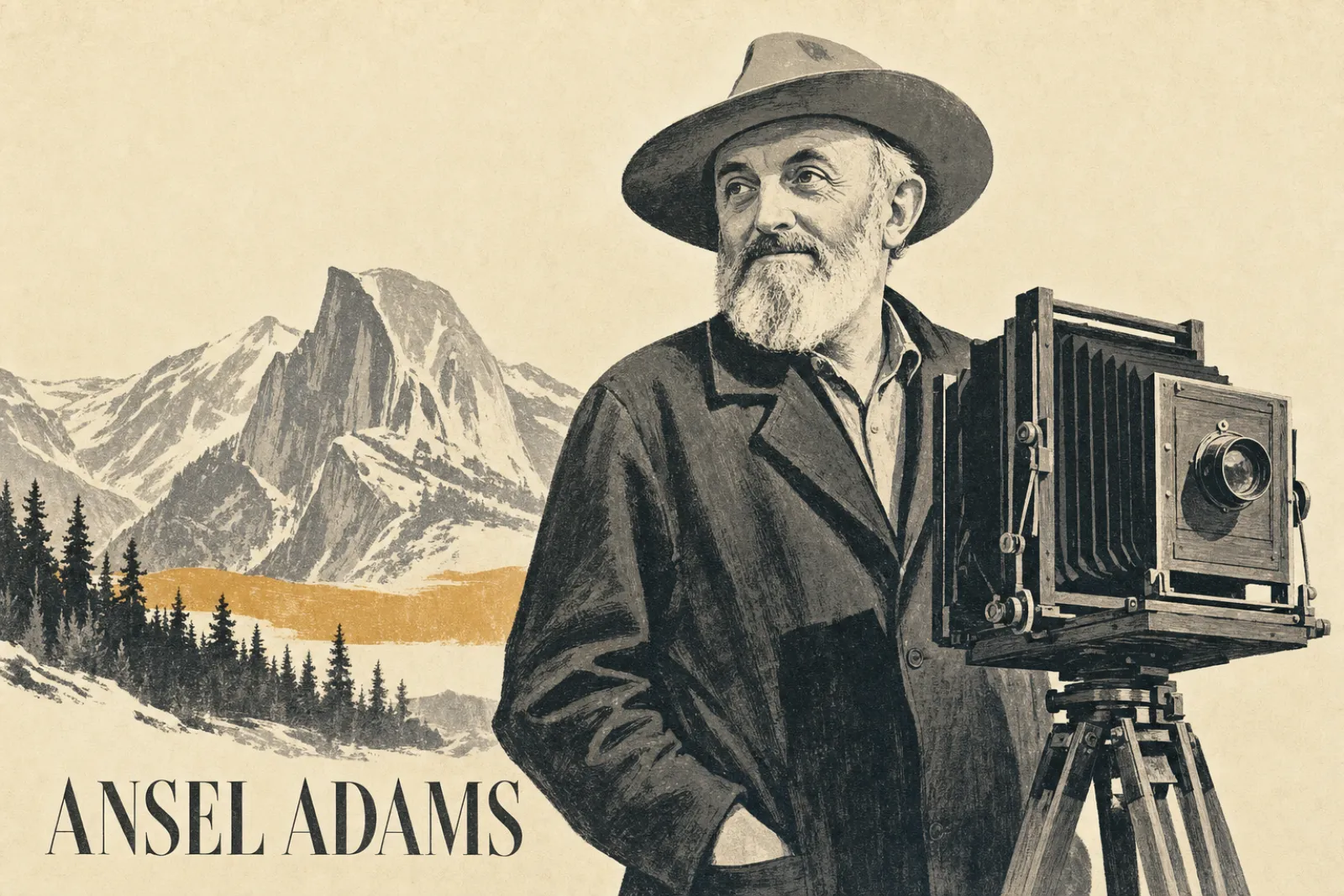
Ansel Adams (1902 to 1984) was an American photographer from San Francisco who photographed Yosemite, the Sierra Nevada and the national parks of the American West. He worked in black and white, first with view cameras and later also with a Hasselblad. He is known for sharp, full-toned mountain landscapes and for the Zone System, a method for controlling exposure and development that he worked out with Fred Archer.
He began as a Pictorialist, making soft-focus pictures in the fashion of the 1920s, and then turned against that style. In 1930 he encountered the work of Paul Strand, whom he met in Taos, New Mexico, and it persuaded him to give himself fully to photography and to sharp focus. Two years later he joined Edward Weston, Imogen Cunningham and others in Group f/64. In 1936 Alfred Stieglitz gave him a solo show at An American Place in New York, which sold well and was praised by critics.
A Brownie in Yosemite and a career he nearly spent at the piano
Adams took up the piano at 12 and for years considered a career as a classical pianist. In 1916, aged 14, he visited Yosemite for the first time. His father gave him a Kodak Brownie box camera on that trip, and he went back to the valley every year afterwards. He joined the Sierra Club at 17 and spent the summers of 1920 to 1923 as caretaker of its LeConte Memorial Lodge. He later joined the club’s High Trips as official photographer, was first elected to its board in 1934 and served for 37 years.
His first portfolio, Parmelian Prints of the High Sierras, came out in 1927 with the backing of the patron Albert M. Bender. In 1928 he married Virginia Best, whose father kept a studio in Yosemite. She inherited it in 1936, and it became the Ansel Adams Gallery. A first book, Taos Pueblo, followed in 1930 with a text by Mary Hunter Austin, and in 1931 the Smithsonian Institution gave him his first solo museum exhibition.
Group f/64 and the case for the sharp photograph
Group f/64 formed in 1932 and opened its first exhibition at the M.H. de Young Memorial Museum in San Francisco on November 15 of that year. Its seven founders were Adams, Cunningham, Weston, John Paul Edwards, Sonya Noskowiak, Henry Swift and Willard Van Dyke. The name refers to a small lens aperture that gives great depth of field, with everything sharp from near to far. The group’s manifesto called for “pure photography” that borrowed nothing from any other art form, a direct answer to Pictorialism. The group had dissolved by the end of 1935. Its place among other photography movements is easier to see beside the style it rejected.
Adams also taught and organised. His first instructional book, Making a Photograph, appeared in 1935. In 1940 he helped the trustee David H. McAlpin and the curator Beaumont Newhall set up the department of photography at the Museum of Modern Art, the first at a major American art museum. In 1945 he formed the first fine art photography department at the California School of Fine Arts, with Minor White as principal instructor and Dorothea Lange, Cunningham and Weston as guest lecturers. He was a founder of Aperture magazine in 1952 and ran annual workshops in Yosemite from 1955 to 1981.
Photographs made to protect the places in them
Adams used his pictures as evidence. His limited-edition book Sierra Nevada: The John Muir Trail (1938) helped the campaign that led to Kings Canyon being made a national park in 1940. In 1941 the National Park Service commissioned him to photograph the parks for mural-sized prints in the Department of the Interior building in Washington. The war stopped the project in 1942 and the murals were never made, but the National Archives holds 226 of the photographs, taken in Grand Canyon, Grand Teton, Yellowstone, Yosemite, Glacier, Zion and other parks and monuments.
During the war he also photographed the Manzanar War Relocation Center in the Owens Valley, where Japanese Americans were interned. The pictures were shown at the Museum of Modern Art and published as Born Free and Equal, a book that many rejected at the time as disloyal. A Guggenheim Fellowship in 1946, the first of three, let him return to the national parks. Until the 1970s he depended financially on commercial work, for clients including Kodak and Fortune magazine, and he was a consultant to Polaroid.
In 1975 he co-founded the Center for Creative Photography at the University of Arizona, which holds his archive, including more than 2,500 fine prints. He received the Presidential Medal of Freedom in 1980 and the Hasselblad Award in 1981. He died in Monterey, California, on April 22, 1984.
Can a photograph help protect a place? What is conservation photography explains how pictures are used that way.
How Adams decided what the print would look like before the exposure
The idea Adams taught most often was visualization, which he first defined in print in 1934. The photographer decides how the finished print should look, and feel, before releasing the shutter, and then chooses filter, exposure and development to get there. The aim is the picture in mind, not a record of how the scene happened to look.
- A filter to set the sky. For Monolith, the Face of Half Dome in 1927 he first tried a yellow filter, judged that it would not give enough contrast, and used his last plate with a deep red one. The red filter turned the bright sky nearly black against the snow. Coloured filters are the simplest tone control in black and white photography.
- Zones in place of guesswork. The Zone System, formulated around 1939 to 1940 at the Art Center School in Los Angeles, divides the tones of a print into eleven steps from Zone 0, pure black, to Zone X, pure white. Zone V is middle grey, the tone a meter aims for. Each zone is one stop from the next.
- Meter one thing at a time. By metering a single part of the scene, the photographer can choose which zone it will fall on, and so decide how dark the shadows and how bright the snow will print.
- Expose for the shadows, develop for the highlights. Exposure fixes the shadow detail. Development is then lengthened to raise contrast in a flat scene or shortened to hold the highlights in a harsh one.
- Small apertures on a big camera. The large format view camera, stopped well down, gave the front-to-back sharpness that Group f/64 argued for.
Want the method step by step? The Zone System page works through placing tones, including on a digital camera. Previsualization in photography covers the habit of seeing the image before you shoot.
Photographs to look for
- Monolith, the Face of Half Dome (1927). Made on April 17, 1927, from a rock outcrop called the Diving Board, 4,000 feet above the valley floor, with a Korona view camera and glass plates. He waited more than two hours for the cliff to stand half in shadow and half in light. Adams counted it as his first visualized photograph.
- Clearing Winter Storm. A view of Yosemite Valley from Inspiration Point as a snowstorm lifts, with El Capitan, Bridalveil Falls, Cathedral Rocks and Half Dome. Adams gave different dates for it, and researchers have proposed 1935. Notice that the weather, not the cliffs, is the subject.
- Moonrise, Hernandez, New Mexico (1941). The moon rises in a dark sky over a village, a church and a graveyard of white crosses, with snowy mountains behind. He could not find his exposure meter and worked out the exposure from the known brightness of the moon. He made one negative before the light left the crosses, and over the years he printed it more than 1,300 times.
- The Tetons and the Snake River (1942). Made in Grand Teton National Park for the mural project. The river winds from the lower right toward the centre left, between dark evergreens and lighter trees, under snow-covered peaks. It was one of the images placed on the Voyager Golden Record in 1977.
- Mount Williamson (1944). Made from Manzanar, and chosen for The Family of Man exhibition at the Museum of Modern Art in 1955.
- Moon and Half Dome (1960). Made with a 6×6 cm Hasselblad, the medium format camera he favoured in his last twenty years.
How do you set an exposure with no meter to hand? The Sunny 16 rule gives a way to work one out from the light alone.
Try this: place one tone on purpose
This takes 15 minutes, outdoors, with a camera or phone that lets you adjust exposure.
- Find a scene with bright sky or pale ground and one area of deep shade that has texture in it, such as bark, stone or a dark doorway.
- Set the picture style to black and white so you judge tone, not colour.
- Meter or tap on the shaded area only and take a frame. The camera will render that shade as middle grey, which is Zone V, and the picture will look washed out.
- Take a second frame two stops darker. The shade now sits on Zone III: dark, with texture still visible.
- Take a third frame two stops darker again and compare the three. Decide which one matches the scene as you wanted it to feel, and say why before you look at the next subject.
Not sure where the tones in a frame fell? How to read a camera histogram shows shadows and highlights as a graph.
Questions people ask about Ansel Adams
What camera did Ansel Adams use?
His first was a Kodak Brownie box camera given to him in 1916. Monolith was made in 1927 with a 6½ by 8½ inch Korona view camera and glass plates. In his last twenty years he often used a 6×6 cm Hasselblad, and he made thousands of Polaroid photographs as a consultant to the company.
What is the Zone System?
It is a method for planning exposure and development that Adams and Fred Archer formulated around 1939 to 1940. It divides the tones of a print into eleven zones, one stop apart, from pure black to pure white. The photographer meters parts of the scene, decides which zone each should fall on, and exposes and develops to suit.
Why did Ansel Adams photograph in black and white?
He did work in colour, mostly on commercial assignments. He preferred black and white because it gave him a wide range of bold tones that he could control, and he found the colour processes of his time too rigid.
When was Moonrise, Hernandez, New Mexico taken?
On November 1, 1941, in the late afternoon, from the shoulder of the highway near Hernandez. The date was worked out in 1991 by Dennis di Cicco of Sky and Telescope magazine from astronomical calculations.
Ansel Adams is one of the photographers in the A to Z of photographers, and he is quoted on the photography quotes page.