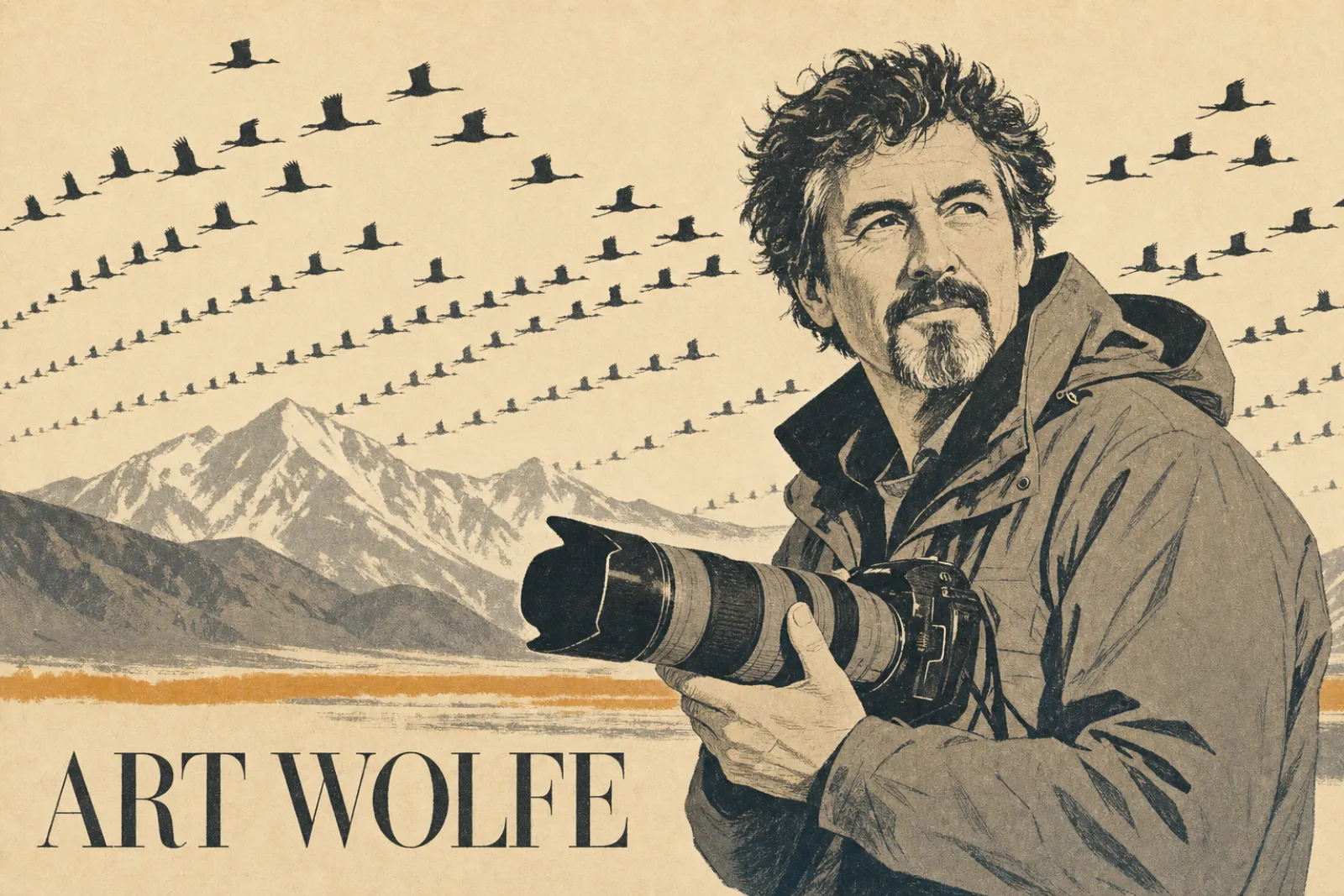
Art Wolfe is an American photographer, born in Seattle, Washington, in 1951, who trained in fine art and built a career on colour photographs of landscapes, wildlife and native cultures. He published his first book in 1978 and then at least one book a year from 1988. He is known for photo books such as Migrations and The Living Wild, for the public television series Travels to the Edge, and for using beautiful pictures to argue for conservation.
Wolfe names two photographers as his major influences: Ernst Haas and Eliot Porter. His approach to nature is described as a combination of photojournalism and art photography, documenting a subject and composing it as a picture at once. He taught alongside other nature photographers, working with Frans Lanting and Thomas Mangelsen on the Masters of Nature Photography workshops. Galen Rowell praised the range of his work.
An art education in Seattle
Both of Wolfe’s parents were commercial artists in Seattle. He studied at the University of Washington, where his professors included Jacob Lawrence, and graduated in 1975 with bachelor’s degrees in fine arts and art education. By his own account, his way of photographing rests on that training in the arts and on his love of the environment.
Within four years of graduating he had completed assignments for National Geographic magazine and produced his first book, Indian Baskets of the Northwest Coast (1978), made with his mentor Dr. Allan Lobb. His photographs went on to appear in National Geographic, Smithsonian, Audubon, GEO and Terre Sauvage, and on United States postage stamps.
A book a year: wildlife, land and people
The book became Wolfe’s main form. He published at least one title every year from 1988, and seven in 1997 alone. The subjects stayed within three fields: wildlife photography, landscape photography and photographs of native cultures. Titles from those years include Light on the Land (1991), Endangered Peoples (1993), Migrations (1994), Tribes (1997), Rainforests of the World (1998), Africa (2001) and High Himalaya (2001).
In 2000 he formed his own imprint, Wildlands Press. The Living Wild, published the same year, sold more than 70,000 copies and won a National Outdoor Book Award for design and artistic merit in 2001. Edge of the Earth, Corner of the Sky (2003) won the same award in 2004. A partnership with the publisher Earth Aware Editions began in 2014, the year of Earth Is My Witness. Later titles include Photographs from the Edge (2016) and Wild Lives (2023).
He also wrote about method. The Art of Photographing Nature appeared in 1993 and a later book, The New Art of Photographing Nature, in 2013. He led photographic tours and gave a seminar called Photography as Art.
Planning to photograph people in another culture? Cultural sensitivity in photography covers ethical ways to photograph people and places.
Television, exhibitions and conservation
Wolfe also worked in television. He hosted American Photo’s Safari on ESPN from 1993 to 1995. Travels to the Edge with Art Wolfe followed on public television in May 2007, with a first season of 13 episodes. By 2009 there were 26 episodes, filmed in nearly as many locations, among them the Omo Valley in Ethiopia. The series was produced by Oregon Public Broadcasting and distributed by American Public Television. In 2015 he appeared in the first season of the Australian documentary series Tales by Light.
His stated goal as a photographer was to win support for conservation by concentrating on what is beautiful on the Earth. In 1997 he created a conservation-themed photography contest. It culminated in 2012 in the International Conservation Photography Awards, exhibited by the Burke Museum. He was made a Fellow of the International League of Conservation Photographers, and the National Audubon Society gave him its Rachel Carson Award.
Other recognition includes Outstanding Nature Photographer of the Year from the North American Nature Photography Association in 1998, an Alfred Eisenstaedt Award for magazine photography in 2000 and an Honorary Fellowship of the Royal Photographic Society in 2005. Seattle’s Frye Art Museum gave him four major exhibitions, one of them titled One World, One Vision.
How do photographs serve a conservation cause? What is conservation photography explains the idea, and nature photography covers the wider field it grew from.
How Wolfe composes: pattern first, record second
Wolfe’s approach rests, by his own account, on his training in the arts. The subject matters, and so does the arrangement inside the frame. Several habits follow from that, and each can be practised.
- Look for the pattern. In Migrations he set out to strengthen the visual patterns in his pictures. Patterns and repetition turn a group of similar things from a record into a design.
- Treat document and art as one job. He used a journalistic and an artistic style together. The picture has to inform the viewer and it has to hold together as a composition.
- Work in colour on purpose. His reputation rests on colour images. Thinking about colour in photography as a design element, not a given, is the starting point.
- Carry one way of seeing across subjects. Wildlife, landscapes and cultures are all part of his work. What links them is an eye for arrangement, not the subject.
- Use beauty as the argument. He set out to win support for conservation by showing what is beautiful.
One part of his method is worth knowing about before you copy it. In Migrations he presented documentary photographs alongside others that had been enhanced. Using a process called cloning, he worked to strengthen the visual patterns in some pictures and give them more impact than the scene as first captured. The book is a useful case for anyone deciding where their own limits lie.
Where should editing stop? Photo retouching ethics sets out the questions to ask before you alter a picture.
Books and series to look for
- Migrations (1994). The book contains both documentary pictures and enhanced ones. Look at how repetition is organised across each frame, and ask which kind of picture you are looking at.
- The Living Wild (2000). More than 70,000 copies were sold, and it won a National Outdoor Book Award for design and artistic merit in 2001. Notice that the award was for the design of the book as well as the photographs.
- Edge of the Earth, Corner of the Sky (2003). Winner of the same award in 2004, which makes it a good pair with The Living Wild for studying how a photo book is put together.
- Travels to the Edge with Art Wolfe (2007). A travel and photography series for public television. Episode 13 of the first season was filmed in the Omo Valley of Ethiopia.
- Earth Is My Witness (2014). Published in the year his partnership with Earth Aware Editions began, and also the title of one of his exhibitions.
Want to make a book of your own pictures? Photo book design walks through layout, sequence and printing.
Try this: fill the frame with a pattern
This takes 15 minutes with any camera or phone.
- Find many of one thing close together: birds on a wire, leaves on the ground, bicycles in a rack, stacked chairs.
- Move or zoom until the repeated thing fills the frame from edge to edge. No sky, no horizon, no empty border.
- Make five frames, changing only your position, until the spacing looks even across the whole picture.
- Then make five more that include exactly one break in the pattern: one bird facing the other way, one leaf of a different colour.
- Compare the best frame from each set. Decide whether the pattern alone or the pattern with a break makes the stronger picture, and why.
- Do not clone or remove anything afterwards. The point is to find the pattern with your feet.
Questions people ask about Art Wolfe
What is Art Wolfe known for?
He is known for colour photographs of wildlife, landscapes and native cultures, published in a long run of photo books that began in 1978. He is also known as the host of the public television series Travels to the Edge with Art Wolfe and for his conservation work.
Where did Art Wolfe study?
At the University of Washington in Seattle. He graduated in 1975 with bachelor’s degrees in fine arts and art education, and Jacob Lawrence was among his professors.
Were the photographs in Migrations altered?
Some were. The 1994 book presented documentary photographs together with others that were enhanced. Wolfe used cloning in those pictures to strengthen their visual patterns.
What television series did Art Wolfe make?
He hosted American Photo’s Safari on ESPN from 1993 to 1995 and Travels to the Edge with Art Wolfe on public television from 2007. He also appeared in the first season of Tales by Light, which was first shown in Australia in 2015.
Art Wolfe is one of the photographers in the A to Z of photographers.