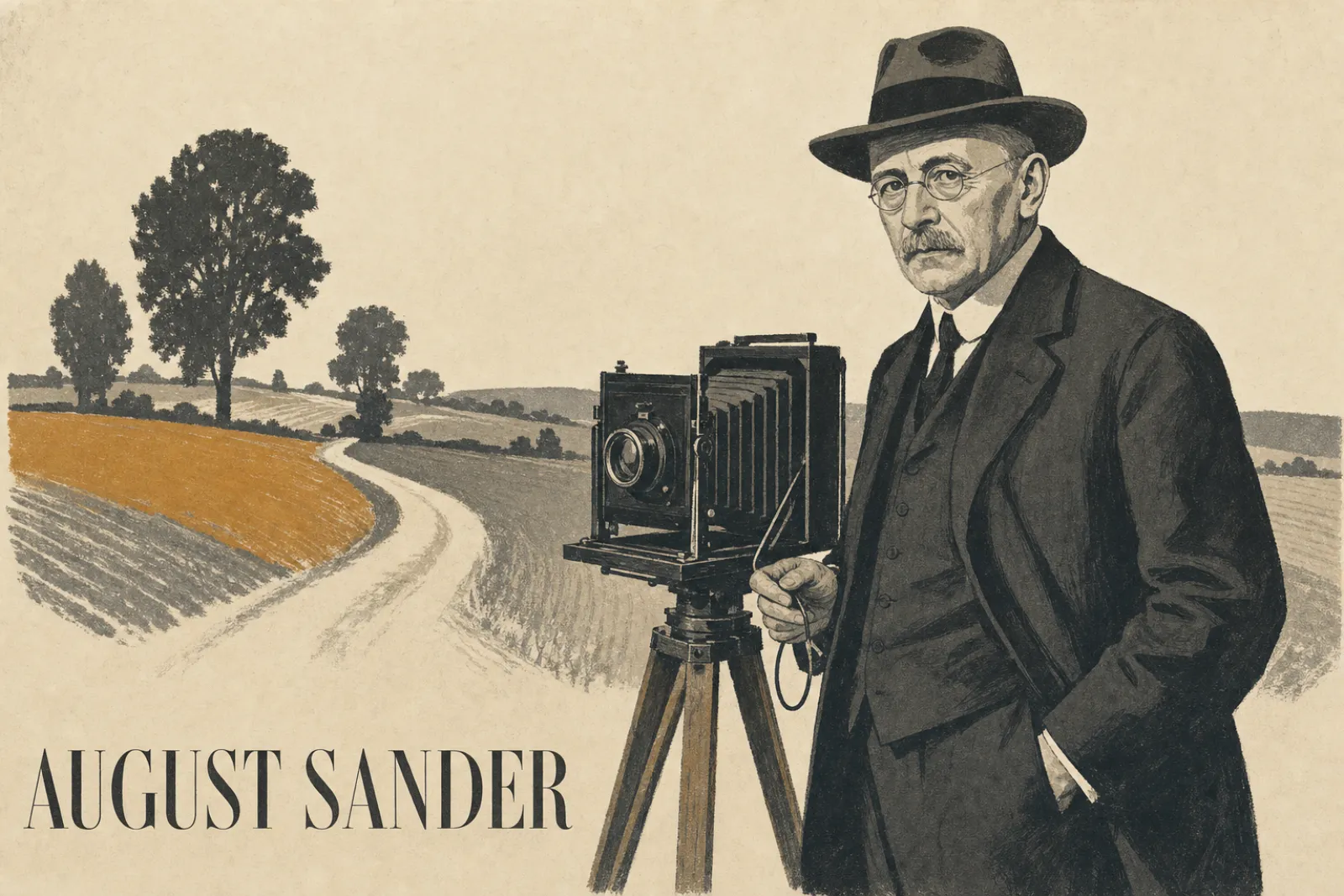
August Sander (1876 to 1964) was a German portrait photographer who ran a studio in Cologne from around 1910. With a large-format camera and glass negatives he photographed farmers, tradesmen, professionals, artists and people on the margins of German society, and labelled them by occupation instead of by name. He is known for People of the 20th Century, a portrait of a whole society arranged in seven groups.
Sander was a commercial studio photographer who found his direction among painters. In the early 1920s he became connected with the Cologne Progressives, a radical group of artists linked to the workers’ movement who wanted to join constructivism and objectivity. Their matter-of-fact outlook, close to the New Objectivity of those years, is one of the movements in photography that his plain portraits belong to. He admired the early daguerreotype, the process announced by Louis Daguerre, for its objectivity. His ambition later influenced Walker Evans and Dorothea Lange in the United States, and after them Diane Arbus.
From the iron-ore mine at Herdorf to a studio in Cologne
Sander was born on November 17, 1876, in Herdorf, in what was then the Kingdom of Prussia. His father was a mine carpenter, and the family later ran a small plot of farmland. Sander went to work at the local iron-ore mine, and there he first met photography by assisting a photographer from Siegen who was working for the mining company. An uncle gave him his first camera in 1892 and paid for equipment and a darkroom, and he taught himself from there.
From 1897 to 1899, during his military service, he worked as a photographer’s assistant. In 1901 he joined a photographic studio in Linz, in Austria, became a partner in 1902 and then its sole owner. He married Anna Seitenmacher in 1902. Around 1910 he left Linz for Cologne, where he set up a studio in the Lindenthal district.
People of the 20th Century: a society in seven groups
The project that occupied most of his working life was a portrait atlas of German society. Accounts date its beginning differently, from 1911 to the middle of the 1920s. Sander divided it into seven groups:
- The Farmer
- The Skilled Tradesman
- Woman
- Classes and Professions
- The Artists
- The City
- The Last People, which included the homeless and war veterans
In 1929 he published a first selection of 60 portraits as Face of Our Time, with an introduction by the writer Alfred Döblin. Döblin wrote that Sander had succeeded in writing sociology by making photographs instead of writing. The pictures show Germany in the years of the Weimar Republic, a time of rapid social change, financial insecurity and political unrest, and the sitters run from bohemian artists to Nazis and their victims.
In 1927 he had also spent three months travelling through Sardinia with the writer Ludwig Mathar and made around 500 photographs there, though the planned book was never finished.
Thinking about a project that runs for years? How to plan a long-term photography project covers setting the scope and keeping it going.
Seizure, war and the fire of 1946
Under Nazi rule the portrait project was stopped. In 1936 Face of Our Time was seized and its printing plates were destroyed. His son Erich, who was active in left-wing politics, had been arrested in 1934 and sentenced to ten years in prison, where he died in 1944 of an untreated ruptured appendix. Sander’s work also includes landscape, nature and architecture photographs.
Around 1942 he left Cologne for the village of Kuchhausen in the Westerwald, which saved the most important part of his work. His Cologne studio was destroyed in a bombing raid in 1944. The negatives stored in its basement survived the bombing, and then 25,000 to 30,000 of them were destroyed in a fire in 1946.
After the war he salvaged the negatives that remained and printed from them again. In 1953 he sold 408 photographs of Cologne, made between 1920 and 1939, to the city’s museum, and they were published in 1988 as Köln wie es war. A book of 80 photographs, Deutschenspiegel, appeared in 1962. He died in Cologne on April 20, 1964. The archive, about 10,700 negatives, was sold by his grandson Gerd Sander in 1992 to the SK Stiftung Kultur in Cologne. Fuller editions of People of the 20th Century were published after his death.
How a Sander portrait is made to work
The pictures look simple, and each of the choices behind them can be copied by anyone practising portrait photography.
- A slow camera. Sander rejected the newly invented Leica and stayed with large format cameras, glass negatives and long exposure times. A long exposure means the sitter has to hold still and agree to be photographed. The large negative records the small details of a face and of clothing.
- The type before the name. The portraits are titled by trade or role: a bricklayer, a pastry cook, a secretary. The caption tells the viewer to read the person as a member of a group, and the face then pushes back against the label.
- A plain setting. Many of the portraits are set against neutral backgrounds, so that dress, posture and hands carry the information about profession and social position.
- The same treatment for everyone. A farmer, a tradesman, an artist and a homeless man all belong to the same survey and are photographed in the same manner. The evenness is what makes the comparison between them possible.
- Meaning from the set. A single portrait says little about a society. Sixty of them, grouped so they can be compared, say a great deal. The grouping is as much his work as the exposures, which is why photo sequencing is worth studying alongside him.
How does a portrait show what someone does for a living? Environmental portrait photography is about telling a person’s story through their setting. Documentary photography covers the wider practice of recording people and places over time.
Photographs to look for
- Young Farmers (1914). Three young men from the village of Dünebusch in western Germany stand in an empty landscape, probably on their way to a dance. Each wears a suit and hat, carries a walking stick and glances over his shoulder at the camera. Despite the title they were not farmers: two worked in an iron-ore mine and one in its office. The critic John Berger wrote about the picture in his 1980 essay The Suit and the Photograph.
- The Painter Otto Dix and His Wife, Martha (1925 to 1926). A portrait of a painter of his own time and his wife. Even here the title gives the profession first.
- Working Students (1926). The title names a role and not the people in it. Compare it with The Painter Anton Räderscheidt, also from 1926, where the sitter is named.
- Bricklayer (1928). A portrait titled by trade alone. A print sold at Sotheby’s in New York in December 2014 for $749,000, the highest price paid for his work at that time.
- The Pastry Cook (1928). Made in the same year as Bricklayer and titled the same way, by the job.
- Secretary at West German Radio, Cologne (1931). Titled by job, employer and city, with no name. It dates from two years after Face of Our Time.
Want to try portraits of people you do not know? Street portraits explains how to ask a stranger and get a good frame.
Try this: three people, one way of looking
This takes about 20 minutes and three people who do different things: a neighbour, a shopkeeper, someone at work.
- Photograph each person standing or sitting where they work, whole figure in the frame, looking at the lens.
- Keep everything else the same for all three: the same distance, the same camera height at chest level, the same upright format.
- Ask each person to hold still. Count slowly to three before you press the shutter, and make no more than four frames of each.
- Choose one frame per person. Caption each with the occupation only, no name.
- Put the three side by side and look at what changes: clothes, hands, stance, how each person meets the camera.
Have a set of pictures and no order for them? How to create a photo story or series looks at turning single frames into a body of work.
Questions people ask about August Sander
What is August Sander known for?
He is known for People of the 20th Century, a collection of portraits meant to show a cross-section of German society, arranged in seven groups by occupation and class. A first selection of 60 portraits was published in 1929 as Face of Our Time.
What camera did August Sander use?
He used large-format cameras with glass negatives and long exposure times. He chose not to take up the small Leica when it appeared, because the large negative recorded the fine detail he wanted.
What happened to August Sander’s work under the Nazis?
Face of Our Time was seized in 1936 and its printing plates were destroyed. His son Erich died in prison in 1944. Sander moved the most important part of his work to the village of Kuchhausen, but his Cologne studio was bombed in 1944 and a fire in 1946 destroyed 25,000 to 30,000 negatives.
Where is the August Sander archive?
In Cologne. His grandson Gerd Sander sold the archive, which holds about 10,700 negatives, to the SK Stiftung Kultur in 1992.
August Sander is one of the photographers in the A to Z of photographers, and he is quoted on the photography quotes page.