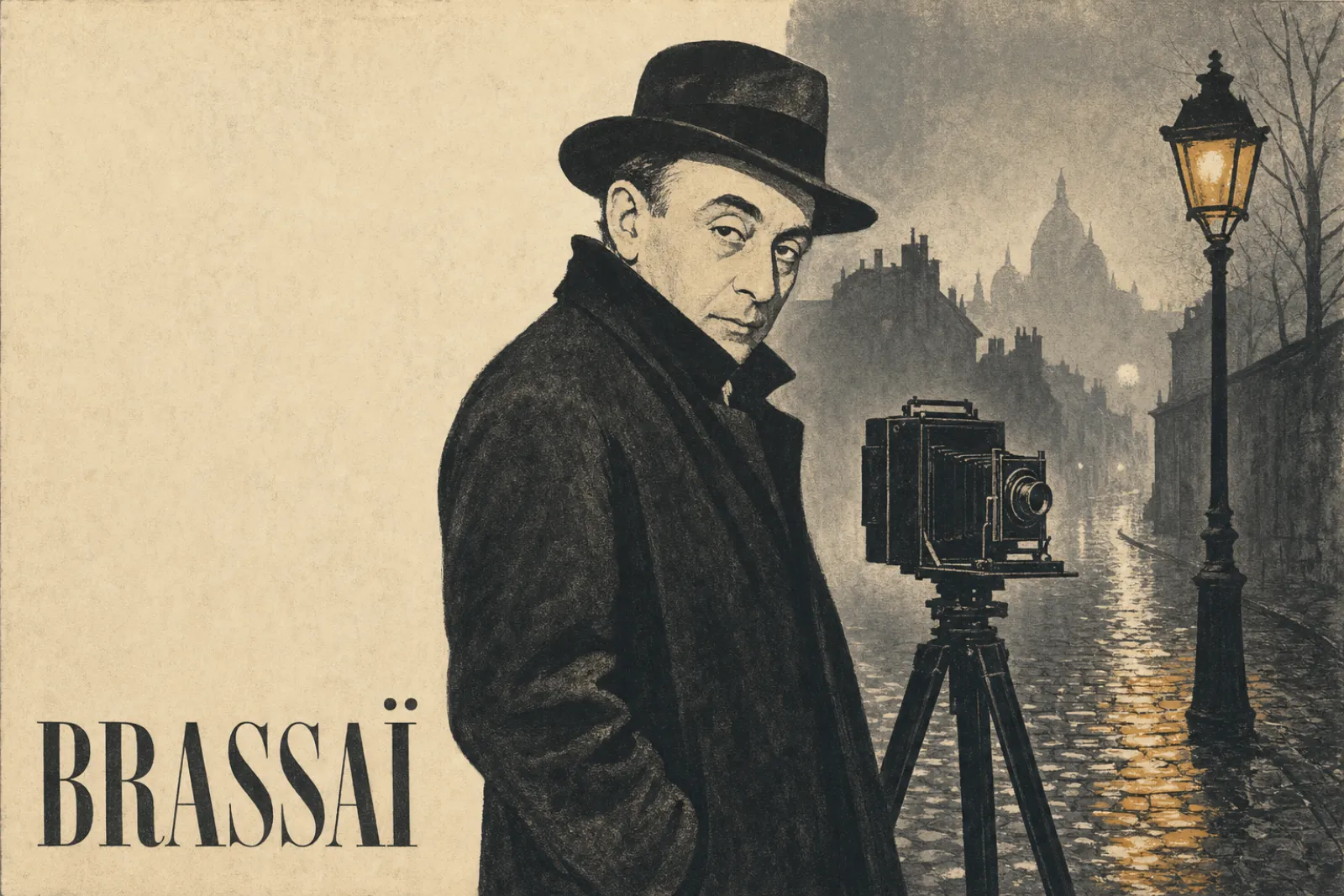
Brassaï was the working name of Gyula Halász, a Hungarian born photographer who lived in Paris from 1924 and became a French citizen in 1949. In the early 1930s he photographed the city after dark: empty streets in rain and fog, bars, dance halls and the people who filled them. His first book, Paris de nuit, made his name and is still the work he is known for.
He came to photography late and sideways. He had trained as a painter and sculptor and earned his living as a journalist. His fellow Hungarian André Kertész, who reached Paris in 1925, tutored him and showed him how to photograph at night. He took Eugène Atget, the older photographer of Paris streets, as a model. Through the art magazine Minotaure he met Man Ray and the Surrealist writers, who admired his pictures, though he kept some distance from the movement. John Szarkowski of the Museum of Modern Art later set him beside Henri Cartier-Bresson, contrasting the measured classicism of the one with Brassaï’s feeling for the bizarre.
From Brassó to Montparnasse
Gyula Halász was born on 9 September 1899 in Brassó, Transylvania, then part of Hungary and since then Brașov in Romania. The name Brassaï means “from Brassó”. He spent part of his early childhood in Paris, studied painting and sculpture at the Hungarian Academy of Fine Arts in Budapest, and moved to Berlin in 1920, where he wrote for Hungarian newspapers and attended the academy of fine arts in Charlottenburg.
In 1924 he settled in Paris, in Montparnasse, and went on working as a journalist. He improved his French by reading Marcel Proust. At first he did not take photographs at all. He found other people’s pictures to go with his articles. By the end of the 1920s he was making his own, and by 1931 they were appearing regularly in Paris magazines and weeklies. He signed the photographs Brassaï and kept his real name for the painting he still hoped to do.
Paris de nuit and the hidden city
Night in Paris was his main subject for about six years. He photographed churches, monuments, parks, cemeteries and both banks of the Seine, in every season and in all weather. He later wrote that he used photography to capture the beauty of streets and gardens in rain and fog. A publisher, Charles Peignot of Arts et Métiers Graphiques, saw twenty of the night pictures and gave him a contract. Paris de nuit, with a text by Paul Morand, was launched in December 1932 and is often dated 1933.
Wondering how anyone photographs a dark street at all? Night photography covers the exposure choices, the support and the light sources involved.
Alongside the empty streets he photographed the people of the night: bar regulars, dancers, performers and the Paris underworld. A second book of this material, Voluptés de Paris, came out in the mid 1930s with 46 photographs. The publisher added lurid captions and Brassaï disowned it. He learned from the episode to insist on control over how his books were made. Much later he returned to the same pictures on his own terms in The Secret Paris of the 30s, published in 1976.
In 1933 he was one of the first members of the Rapho agency, founded in Paris by Charles Rado. The same year he photographed Pablo Picasso’s studios for Minotaure, and from 1935 he worked for the American magazine Harper’s Bazaar. During the German occupation he stayed in Paris for all but a short period. His only income then was a 1943 commission from Picasso to photograph his sculptures. Picasso also pushed him back to drawing, and an exhibition of his drawings opened in Paris in June 1945.
Walls, drawings, films and books after the war
Brassaï never limited himself to one medium. From the early 1930s he photographed marks scratched and carved into the walls of Paris, and he kept at it for about thirty years. The first of these graffiti pictures were printed in Minotaure in 1933 and the book Graffiti followed at the start of the 1960s. He made a short film, Tant qu’il y aura des bêtes, which won a prize at the Cannes Film Festival in 1956. He wrote too: Conversations avec Picasso appeared in 1964 and Henry Miller: The Paris Years in 1975.
The Museum of Modern Art in New York gave him a one man show in 1948 and showed his work again in 1953, 1956 and 1968. In the late 1950s he bought a Leica and photographed in colour for the first time. By one account he stopped taking new photographs in 1962. France made him a Chevalier des Arts et des Lettres in 1974 and a Chevalier of the Légion d’honneur in 1976. He died on 8 July 1984 at Beaulieu-sur-Mer in the south of France and is buried in Montparnasse Cemetery.
How the night pictures were made
The outdoor night photographs depend on time. Kertész had photographed the Seine at night with an exposure of half an hour. Brassaï chose a larger format Voigtländer camera so that he could use long exposures as well, which forced a slow, calculated way of working. This is why his streets are so often empty: his outdoor night pictures only rarely include a human figure. The light does the work that people would do in a daytime street photograph.
He paid close attention to where the light fell. In one street view he let the glow reflected off wet paving soften the glare of the lamps themselves. Rain and fog were not obstacles. They were what he went out to find, because wet surfaces and mist carry and spread light. The same thinking drives any long exposure made in a city, and it is the reason fog and mist are worth going out in.
Want the settings side of this? Best camera settings for night photography gives starting points for aperture, shutter speed and ISO after dark.
Indoors he needed people sharp, so he used flash. An assistant prepared a flash powder gun and a reflecting screen, which gave a softer light than a bare flash bulb. Picasso nicknamed him “the Terrorist” for the explosions. That is a lesson in flash photography that still holds: bounce or spread the flash and it stops looking harsh. When he photographed Picasso’s sculptures he worked with a single strong lamp and unexpected camera angles, so that the direction of the light gave each piece its shape.
The graffiti called for a different approach. He preferred carved marks to painted ones, and he lit and framed them so that scratches in plaster read as faces, hearts and animals. Raking light across a wall brings out its relief, the basic move in photographing texture. He then sorted the series into nine groups with titles such as “Masks and Faces” and “Magic”, so that the order of the pictures steered how they were read.
Curious how the order of pictures changes their meaning? Photo sequencing explains how a body of work is edited and arranged.
Photographs to look for
- The stream snaking down the empty street (1930 to 1932). Electric light falls on a deserted street and picks out the pattern of cobblestones along the gutter, where a stream of water runs downhill. Notice how the reflected light on the paving is softer than the lamps.
- Enlarged Objects: Matches (around 1930). A close view of five wooden matches set against printed text, made for Paris Magazine. It is one of a series of extreme close-ups he took with a Voigtländer Bergheil and a macro lens. The play between the objects and the printed words leaves the meaning open.
- Bijou in the Bar de la Lune, Montmartre (1932). An elderly woman in worn finery and jewels sits at a bar table with a cigarette and a glass of wine and looks straight at the camera. This is the flash powder method at work.
- Couple at the Magic-City ball (1932). An elegantly dressed couple dance in a crowded ballroom at one of the Paris costume balls. It was one of the 46 pictures in Voluptés de Paris.
- Picasso by the Stove, rue des Grands Augustins (1939). Picasso sits smoking beside a large stove whose shadow rises behind him. The portrait was later published in Life.
- Graffiti series (1933 onwards). Look for the carved heart with the initials L and A, found on a wall in a working class district. The framing turns a few scratched lines into a symbol.
Drawn to the bars and dance halls more than the empty streets? Night street photography deals with photographing people after dark.
Try this: one wet street, three exposures
Wait for an evening when the ground is wet or the air is misty. Give yourself 15 minutes and one street with at least one lamp.
- Put the camera or phone on a tripod or a wall. Do not hold it in your hand.
- Frame the street so the lamp is in the picture and the wet ground fills the lower half.
- Make three exposures of the same frame: about 1 second, 4 seconds and 15 seconds. On a phone, use the night mode and its longest setting for the third.
- Move two steps so the lamp is hidden behind a tree, a post or a corner, and repeat the three exposures.
Compare the six pictures. Look at which exposure holds detail in the paving, and whether the hidden lamp gives a calmer picture than the visible one.
Questions people ask about Brassaï
What was Brassaï’s real name?
He was born Gyula Halász. Brassaï is a pseudonym meaning “from Brassó”, the town in Transylvania where he was born in 1899. He used it to sign his photographs.
What is Paris de nuit?
It is his first book of photographs, a collection of night views of Paris with a text by Paul Morand, published by Arts et Métiers Graphiques. It was launched in December 1932 and is often dated 1933. It made him known as a photographer.
What camera did Brassaï use?
In the early 1930s he used Voigtländer cameras, including a Voigtländer Bergheil, and chose a larger format so he could make long exposures at night. In the late 1950s he bought a Leica and began to photograph in colour.
Was Brassaï a Surrealist?
He published in the Surrealist linked magazine Minotaure from 1933 and supplied photographs for articles by Salvador Dalí and André Breton. The Surrealists admired his work, but he kept a certain distance from the movement. Photography movements sets Surrealism beside the other ideas of the period.
His night pictures of Paris led Bill Brandt to do the same for London in a book made in open homage. For more names from the same years, see the A to Z of photographers.