Crop factor is how much smaller a camera’s sensor is than a full-frame sensor (36 x 24 mm, the size of a 35mm film frame), measured across the diagonal. Multiply a lens’s focal length by the crop factor and you get the full-frame focal length that shows the same field of view: a 50mm lens on a sensor with a 1.5x crop factor frames the scene like a 75mm lens on full frame.
It matters because focal lengths are quoted as if every camera were full frame. Advice like “use 24mm for landscapes” or “85mm for portraits” only fits your camera after you convert it, and a lens that is wide on one body can be ordinary on another. To work out any lens and sensor pair instantly, use the crop factor calculator.
Why it is called a crop: the lens does not change, the sensor does
A lens throws a circle of image behind it, its image circle. The sensor sits in that circle and records the rectangle it covers. Put the same lens on a smaller sensor and the lens projects exactly the same image, at exactly the same size; the smaller sensor simply records less of it, the middle part. The result is the same picture you would get by shooting on full frame and cropping the edges off later. That is the whole idea behind the name. Its other name, focal length multiplier, comes from how you use it.
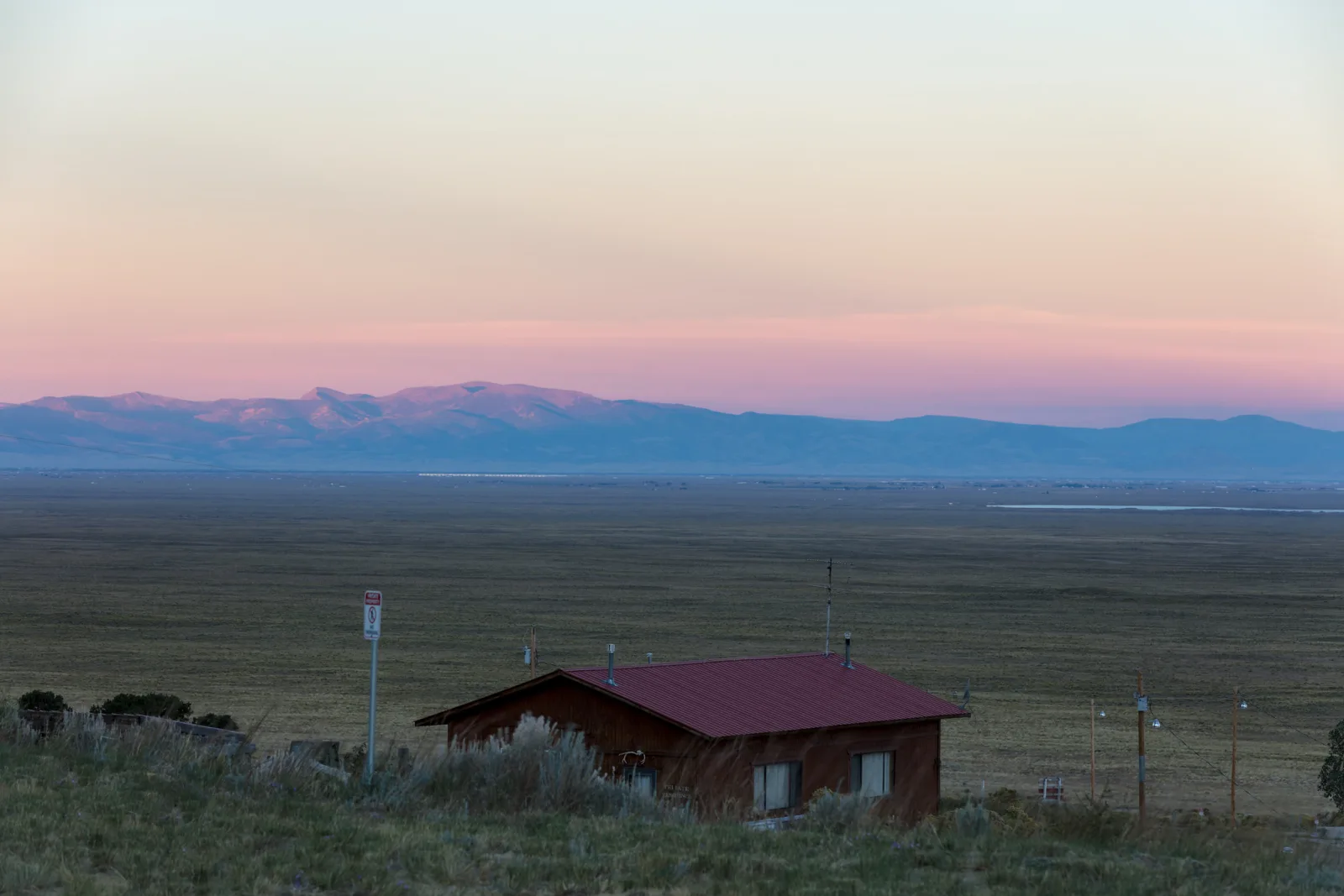
Look at the photo at the top of this page. It was made at 130mm on a full-frame sensor. Mount that lens on a camera with a 1.53x sensor, stand in the same place, and the sensor records a rectangle in the middle of this frame about 65% as wide and 65% as tall: the central peaks and the plain, with the top of the sky gone and the house cut in half by the bottom edge. A full-frame photographer would need a lens of about 200mm (130 x 1.53) to get that tighter view.
So why does the cropped picture look “zoomed in” rather than just smaller? Because you view it at the same size as every other picture. The small sensor’s image has to be enlarged more to fill your screen or a print, and that extra enlargement is what makes the subject look bigger. The magnification on the sensor itself is unchanged.
Crop factors by sensor format
Exact sensor sizes vary a little between cameras, so crop factors are rounded. The diagonal column is what the crop factor is calculated from.
| Format | Typical size (mm) | Diagonal (mm) | Crop factor | Area vs full frame |
|---|---|---|---|---|
| Medium format (44 x 33) | 44 x 33 | 55.0 | 0.79 | 1.7 times larger |
| Full frame | 36 x 24 | 43.3 | 1.0 | same |
| APS-C (most cameras) | 23.5 x 15.6 | 28.2 | 1.5 | 2.4 times smaller |
| APS-C (some cameras) | 22.3 x 14.9 | 26.8 | 1.6 | 2.6 times smaller |
| Four Thirds | 17.3 x 13.0 | 21.6 | 2.0 | 3.8 times smaller |
| 1-inch type | 13.2 x 8.8 | 15.9 | 2.7 | 7.4 times smaller |
| 1/2.3-inch type (small compacts) | 6.2 x 4.6 | 7.7 | 5.6 | 30 times smaller |
Notice the last column. A crop factor is a ratio of lengths, so the difference in area is the crop factor squared: 1.5 x 1.5 is about 2.3, which is why an APS-C sensor collects a little under half the light of full frame from the same scene at the same exposure. Medium format sensors are larger than full frame, so their crop factor is below 1 and a lens on them looks wider than its number suggests. The “1-inch” name is an old video-tube convention, not a measurement; the sensor is 13.2 mm wide. Camera sensor sizes compares all of these formats side by side.
How to calculate a crop factor yourself
- Find the sensor’s width and height in millimeters in the camera’s specifications.
- Work out its diagonal: the square root of (width squared plus height squared).
- Divide 43.27 mm, the full-frame diagonal, by that number.
For a 23.5 x 15.6 mm sensor: 23.5 squared is 552.25, 15.6 squared is 243.36, the total is 795.61, and its square root is 28.21 mm. Then 43.27 divided by 28.21 is 1.53, which is rounded to 1.5.
Shape matters: the diagonal hides the aspect ratio
Full frame and APS-C share a 3:2 shape, so for them the diagonal ratio, width ratio and height ratio are all the same 1.53. Four Thirds is a squarer 4:3 sensor (see aspect ratio). Its diagonal ratio is 2.0, but across the width it is 36 divided by 17.3, or 2.08, and down the height it is 24 divided by 13, or 1.85. So a 25mm lens on Four Thirds matches a 50mm on full frame corner to corner, but it is a little narrower than 50mm side to side (about 52mm) and a little taller than 50mm top to bottom (about 46mm). For most shooting that does not matter. When you are choosing the widest lens for a tight interior, it can.
Equivalent focal length chart
Multiply the focal length on the lens by the crop factor. The result is the full-frame lens that shows the same view.
| Lens | On 1.5x | On 1.6x | On 2.0x |
|---|---|---|---|
| 10mm | 15mm | 16mm | 20mm |
| 16mm | 24mm | 26mm | 32mm |
| 24mm | 36mm | 38mm | 48mm |
| 35mm | 53mm | 56mm | 70mm |
| 50mm | 75mm | 80mm | 100mm |
| 85mm | 128mm | 136mm | 170mm |
| 200mm | 300mm | 320mm | 400mm |
| 400mm | 600mm | 640mm | 800mm |
To go the other way, divide. If you want the view of a 50mm lens on full frame and your camera has a 1.5x sensor, 50 divided by 1.5 is about 33mm, so a lens around 33mm or 35mm does the job. On a 2.0x sensor, 25mm gives the same view. For the classic 24mm wide view you need 16mm on 1.5x, 15mm on 1.6x and 12mm on 2.0x.
A useful rule of thumb follows from this: a normal lens, one that sees roughly the way your eye takes in a scene, has a focal length close to the sensor’s diagonal. That is about 43mm on full frame, 28mm on APS-C and 22mm on Four Thirds, which is why a 35mm lens on APS-C or a 25mm on Four Thirds plays the role a 50mm plays on full frame.
Want every focal length and sensor worked out for you, including angles of view? The crop factor calculator gives the equivalent focal length, the angle of view and the lens that matches a full-frame view for any lens and sensor.
What crop factor changes, and what it does not
It does not change the lens or its exposure
A 50mm lens is 50mm on every camera, and f/2.8 is f/2.8. The f-number sets how much light falls on each square millimeter of sensor, and that is the same on any format. Use the same aperture, shutter speed and ISO on a crop camera as you would on full frame for the same brightness. A light meter knows nothing about sensor size, and it does not need to.
It does not change perspective
Perspective, how big near things look next to far things, is set only by where you stand. From the same spot, a crop sensor gives exactly the same perspective as a full-frame camera with the same lens; it just shows less of it. The perspective changes only when you move to reframe, which is the real cause of what people call lens compression. A crop sensor does not compress anything.
It changes depth of field at the same framing
If you keep the same framing, a smaller sensor gives more depth of field, because you got that framing either with a shorter lens or by standing further back, and both deepen focus. To compare the blur, multiply the f-number by the crop factor as well: a 33mm f/1.8 lens on a 1.5x sensor gives roughly the framing and depth of field of a 50mm lens at f/2.7 on full frame, and a 25mm f/1.4 on Four Thirds behaves like a 50mm at f/2.8. This multiplied number is the equivalent aperture. It describes the look and the total light, never the exposure setting.
Try it with one lens on five sensors in the tool below: switch sensors and compare how much of the scene each records, its equivalent focal length and its equivalent aperture, and notice that the exposure settings never change.
The same reasoning extends to noise. A sensor with 2.3 times less area collects about 2.3 times less light in total at the same exposure, so with the same framing, shutter speed and output size, and sensors of similar design, ISO 800 on APS-C looks roughly like ISO 1800 on full frame (800 x 1.5 x 1.5). That is a rough guide, not a law: sensor technology moves the numbers, and at base ISO in good light you will rarely see the difference. Noise and the full frame vs crop sensor comparison go further.
It makes wide angles harder
The same multiplication that makes long lenses look longer makes wide lenses less wide. A 16mm lens on a 1.5x sensor gives the view of a 24mm lens, so a true ultra-wide view needs something around 10mm. If you shoot interiors, night skies or tight streets on a small sensor, budget for a wide-angle lens made for that format.
It changes the handheld shutter speed you need
Camera shake is enlarged along with everything else. The old guide of 1 divided by the focal length becomes 1 divided by the equivalent focal length: a 100mm lens on a 1.5x sensor wants about 1/150 second or faster without stabilization, not 1/100. See camera shake for why the guide works and where it breaks.
Reach: when a crop sensor really gets you closer
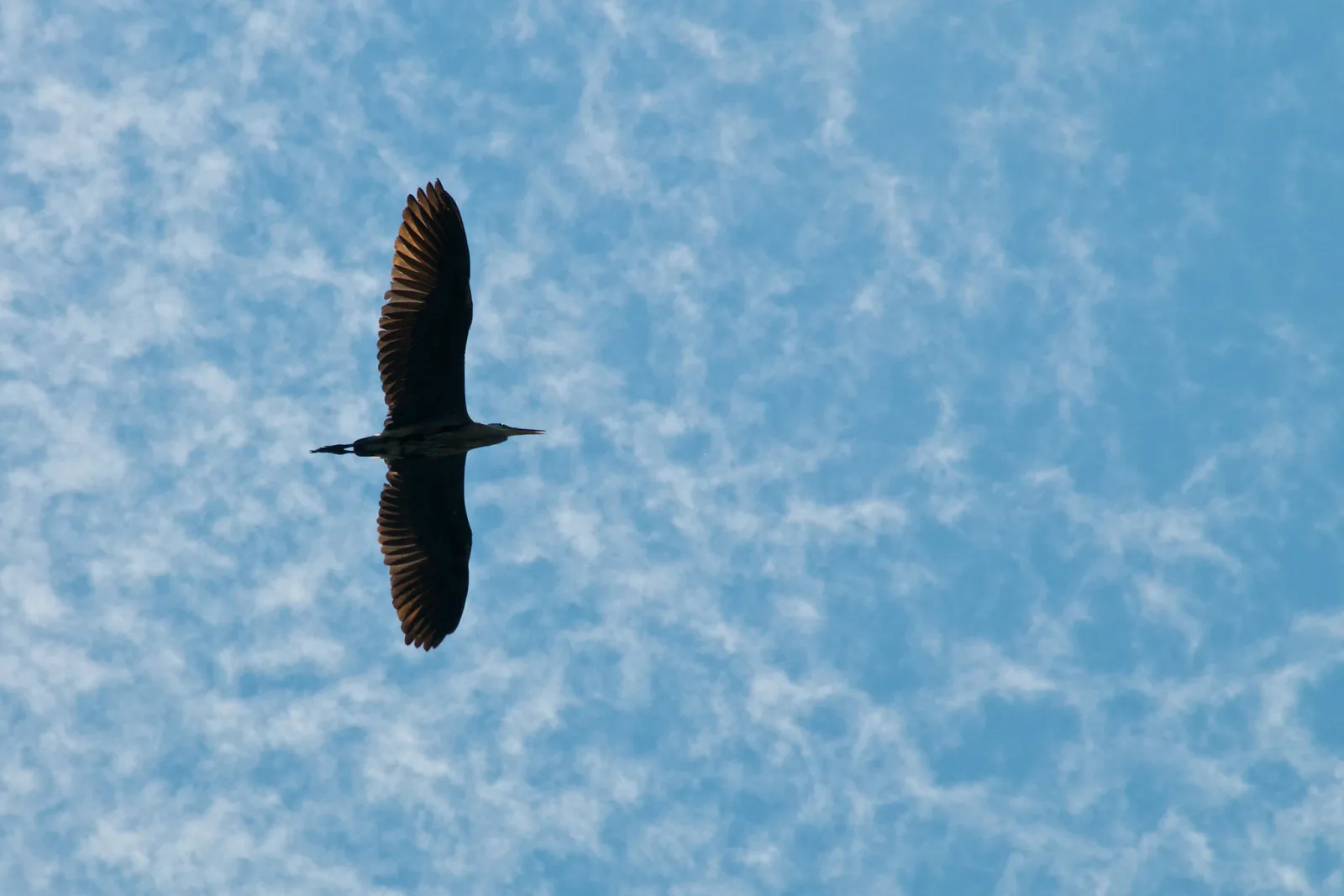
Wildlife and bird photographers often prefer small sensors for “reach”: a 400mm lens on a 1.5x body fills the frame like a 600mm lens on full frame. That is true for framing. Whether it gets you more detail on a distant bird depends on something else: how many pixels land on the bird.
The bird’s image on the sensor is the same size on either camera, because the lens is the same. So the question is only how finely each sensor divides that patch. Take a full-frame camera with 50 megapixels (8688 pixels across) and crop its file to the APS-C area: you keep about 5,670 pixels across, roughly 21 megapixels. A 24 megapixel APS-C camera puts 6,000 pixels across the same area, about 6% more detail on the bird in each direction. A 16 megapixel APS-C camera puts fewer. In other words, a crop sensor gives real extra reach only when its pixel pitch is finer than the full-frame camera you are comparing it with. Reach is pixels on the subject, set by the real focal length and the pixel size, not by the crop factor alone.
This is also why cropping later and shooting on a crop sensor are the same thing seen from two sides. Both show the middle of what the lens projected. The only difference is how many pixels you end up with inside that rectangle.
What each sensor would record from one photo
Here is the photo at the top of this page, a 50 megapixel full-frame file made at 130mm, with the rectangle each smaller sensor would have recorded through the same lens. Pixel counts are what you keep by cropping this file to that rectangle.
| Sensor | Rectangle in the photo | Looks like on full frame | Pixels left by cropping |
|---|---|---|---|
| Full frame (1.0x) | the whole frame | 130mm | 8688 x 5792, 50.3 MP |
| APS-C (1.53x) | middle 65% of width and height | about 200mm | about 5670 x 3765, 21.4 MP |
| APS-C (1.61x) | middle 62% | about 210mm | about 5380 x 3600, 19.4 MP |
| Four Thirds (2.0x) | middle 48% wide, 54% tall (a squarer shape) | about 260mm | about 4175 x 3140, 13.1 MP |
| 1-inch type (2.7x) | middle 37% | about 355mm | about 3185 x 2125, 6.8 MP |
Read the table one row at a time. The field of view narrows, the shape changes for Four Thirds, and the pixel count falls with the area. A camera built with that smaller sensor would have its own full pixel count spread across the rectangle instead, which is the whole reach argument in one line.
Seeing the sensors drawn to scale makes this click. Camera sensor sizes has an interactive tool that puts the same lens on each format and shows how much of the scene each one records.
Lenses, crop mode and adapters
Lenses made for small sensors. A lens designed for APS-C or Four Thirds has a smaller image circle. On a full-frame sensor it may darken the corners or leave a black circle around the picture. Its focal length is still real, though: an 18mm lens for APS-C is 18mm, and you multiply it by the crop factor once, exactly like any other lens, to get about 27mm equivalent. Nothing is applied twice. The kit zoom marked 18 to 55mm covers roughly what a 27 to 83mm zoom covers on full frame.
Full-frame lenses on small sensors work fine; the sensor records only the middle of the image circle, which is often the sharpest part.
Crop mode on a full-frame camera. Many full-frame bodies can record only the APS-C area of the sensor, either because a small-sensor lens is fitted or because you ask. It gives you the 1.5x view in the viewfinder, but it is the same as cropping later: a 45 megapixel camera becomes about 20 megapixels, a 24 megapixel camera about 10.7.
Teleconverters are different. A teleconverter sits between lens and camera and really does lengthen the focal length, so it enlarges the image on the sensor and costs light: a 1.4x converter loses one stop. A crop sensor costs no light per area, because it enlarges nothing.
Focal reducers do the reverse. These adapters squeeze a full-frame lens’s image into a smaller circle. A 0.71x reducer on a 1.5x camera gives about the field of view the lens has on full frame (1.5 x 0.71 is about 1.07) and makes it brighter by about one stop, f/2.8 becoming roughly f/2.
Phone focal lengths are already converted
When a phone says its main camera is “26mm” or its telephoto is “77mm”, those are full-frame equivalents. The real focal lengths are only a few millimeters, because the sensors are tiny, with crop factors often somewhere between 3 and 7. Do not multiply a phone’s number again; it has been done for you. The same is true of most compact camera specifications, which usually print both. Smartphone vs camera covers what the small sensor does to the rest of the picture.
Common mistakes with crop factor
- Thinking a crop sensor makes the lens longer. The lens and the image it projects are unchanged. The sensor records less of it, and the smaller picture is enlarged more for viewing.
- Multiplying the aperture to set exposure. f/2.8 on APS-C exposes exactly like f/2.8 on full frame. The equivalent aperture compares depth of field and total light at the same framing, nothing else.
- Believing a crop sensor changes perspective or compression. Only your position does that. Stand in the same place and the perspective is identical.
- Assuming a crop sensor always gives more reach. It gives a tighter frame. More detail on the subject needs more pixels on the subject, so compare pixel pitch, not just the multiplier.
- Treating a “50mm equivalent” as a 50mm in every way. A 33mm lens on APS-C matches a 50mm’s framing, but at the same f-number it gives more depth of field.
- Multiplying twice. A lens made for the small format is multiplied once, like any other lens. A phone’s printed focal length is already the full-frame equivalent, so it is not multiplied at all.
- Treating crop factors as exact. They are rounded diagonal ratios. 1.5 and 1.6 give equivalents only a millimeter apart at the wide end (15mm versus 16mm for a 10mm lens), and Four Thirds is 2.08 wide but 1.85 tall.
Try this: draw your crop on a real photo
You need ten minutes, a camera with a zoom (or a phone with two lenses) and a photo editor.
- Find your crop factor in the table above. On a phone, look up the printed equivalent focal lengths of two of its cameras instead.
- From one spot, photograph a scene with clear edges (a doorway, a building, a fence line) at your widest setting. Then, without moving, shoot it again at a focal length 1.5 times longer, for example 18mm and then 27mm, or the phone’s 1x and 2x.
- Open the wide picture and crop it to the middle of the frame by the same ratio: two thirds of its width and height for 1.5 times, half for 2 times. Put the crop next to the longer shot.
- If your camera is full frame and has a crop mode, take one frame with it on and one with it off instead, and compare the files’ pixel dimensions.
How to judge it: the crop and the longer shot should frame the same scene, with the same perspective, because you never moved. Then zoom both to 100% on screen. The longer shot will show more detail, because more pixels covered that part of the scene. (If your phone’s 2x is itself a crop of the main camera, the two will look alike, which proves the same point.) That one comparison holds the whole page: the crop factor sets the view, and the pixels set the detail.
Crop factor questions
What is crop factor in simple terms? It tells you how much narrower a camera’s view is than a full-frame camera’s with the same lens. A crop factor of 1.5 means the view matches a lens 1.5 times as long on full frame.
What is a 50mm lens on a crop sensor? On a 1.5x sensor it gives the view of a 75mm lens on full frame, and on a 1.6x sensor the view of an 80mm lens. On Four Thirds (2.0x) it frames like a 100mm lens, a classic portrait length.
Does crop factor affect aperture? Not for exposure: f/2 lets in the same light per area on every format, so your settings do not change. For depth of field and noise at the same framing, a smaller sensor behaves like a full-frame camera at the f-number multiplied by the crop factor.
Do I need special lenses for a crop sensor camera? No. Full-frame lenses for your mount work, with the crop factor applied. Lenses made for the smaller format are often lighter and include the short focal lengths you need for wide views, but they may vignette on a full-frame body.
Does a full-frame camera in crop mode equal a crop sensor camera? It gives the same field of view with the same lens, but with fewer pixels than the full sensor, because it simply discards the edges. Whether it matches a dedicated crop camera for detail depends on how many pixels each puts in that area.
Is a lower crop factor better? Neither is better in every case. A larger sensor gives shallower depth of field and usually less noise at the same framing; a smaller one gives a tighter view from a given lens, and smaller, lighter lenses.
Wondering whether a bigger sensor would change your own pictures? Full frame vs crop sensor sets out what each one does better and where the difference disappears.
Want to know exactly what angle each lens sees, in degrees? Angle of view shows how focal length and sensor size combine into the width of the scene.