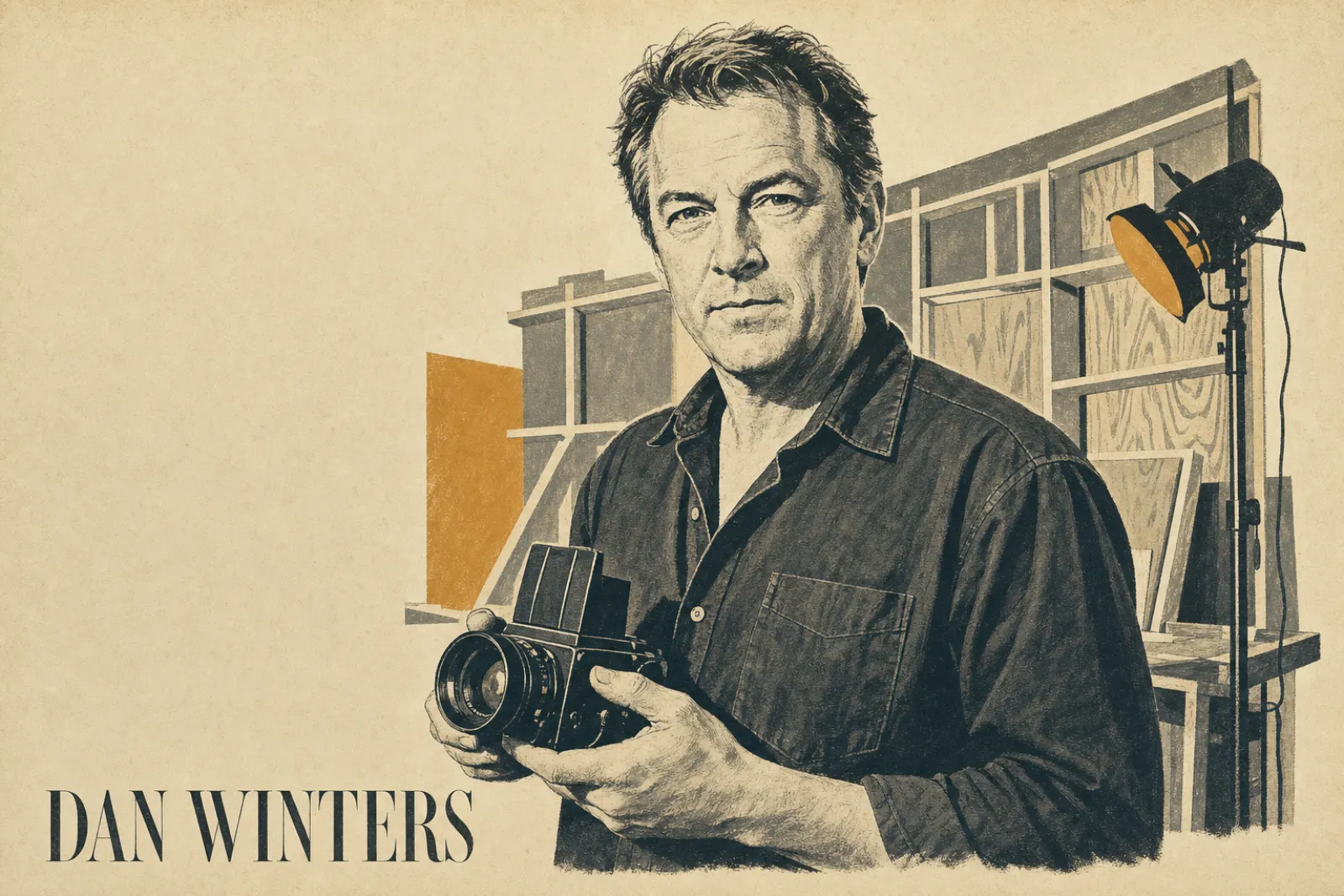
Dan Winters is an American photographer, born in Ventura County, California, in 1962. He started on a local newspaper and built a career making portraits and picture stories for magazines such as The New York Times Magazine, Wired, Esquire and Texas Monthly. He is known for portraits of actors, musicians and public figures that are carefully lit and staged, and for the range of other work he made beside them.
Winters came to magazines through newspaper photojournalism, and the mix shows. His gallery describes his output as celebrity portraiture, scientific photography, photo illustration, drawings and reportage. In 1998 he received the Alfred Eisenstaedt Award for Magazine Photography, which carries the name of Alfred Eisenstaedt. For a different answer to the question of how a setting can describe a sitter, compare the portraits of Arnold Newman.
From a 4-H darkroom to a California newspaper
Winters first studied photography and darkroom work in 1971, through his local 4-H club. In 1979, while still in his last year of high school, he began working full time in motion picture special effects, building and designing miniatures. He studied photography at Moorpark College in southern California, where he earned an associate degree, and then took a documentary film course at Ludwig Maximilian University in Munich.
His career in photography began in 1986 at the Thousand Oaks News Chronicle, a daily paper in Ventura County, where he worked as a photojournalist. After winning regional awards he moved to New York City, and magazine assignments followed. He moved to Los Angeles in 1991 and to Austin, Texas, in 2000.
Wondering what newspaper work teaches a photographer? Photojournalism explains the job, its rules and the habits it builds.
Portraits for the magazine page
The list of magazines that commissioned Winters is long. It includes Esquire, GQ, Vanity Fair, The New York Times Magazine, The New Yorker, Texas Monthly, Wired, Fortune, Rolling Stone, Time and National Geographic. His sitters included Barack Obama, the Dalai Lama, Stephen Hawking, Neil Young, Tupac Shakur, Helen Mirren, Brad Pitt and Steven Spielberg. He also worked for advertising clients, film studios and record labels.
His portrait of the actor Leonardo DiCaprio, made in Los Angeles on 2 November 2002 for The New York Times Magazine, won first prize in the Arts and Entertainment category of the 2003 World Press Photo contest. In the same year Kodak named him a photo “Icon” in its Legends series. In all he received more than one hundred awards from bodies such as American Photography, Communication Arts and the Society of Publication Designers.
His first book, Dan Winters: Periodical Photographs, was published by Aperture in 2009 and gathered this magazine work. A second, Dan Winters’s America: Icons and Ingenuity, accompanied a solo exhibition at the Jepson Center of the Telfair Museums in Savannah, Georgia, in 2012. His photographs are held by the National Portrait Gallery in Washington, the Museum of Fine Arts, Houston, the Harry Ransom Center in Austin and the Wittliff Collections at Texas State University.
Shuttle launches and a New York diary
Winters did not stay inside the studio. In 2011 NASA gave him close range access to the final launches of the space shuttles Discovery, Endeavour and Atlantis. He was one of only a handful of photographers allowed to work that near. Besides the launches he photographed the shuttle interiors, the instruments, the assembly buildings and mission control. The book Last Launch: Discovery, Endeavour, Atlantis was published by the University of Texas Press in 2012.
The Grey Ghost, published in 2016, is the opposite kind of project: a personal visual diary of New York City kept from the late 1980s, when he moved there from California at the age of 25, until 2016. It mixes well known landmarks such as the Empire State Building and the Statue of Liberty with chance moments found on the street. Between the two came Road to Seeing, a book of nearly 700 pages in which he set out how he became a photographer and what he thinks the work requires, with chapters on personal projects, street photography and portraiture.
Thinking about a project that runs for years beside paid work? How to plan and execute a long-term photography project covers choosing a subject and keeping going.
How a Winters picture is put together
The first thing to take from Winters is that he treats the whole chain as his own work. In a statement issued with his 2009 exhibition he described taking the picture, processing the film and making the print himself, and he called the final print the sum of the care put into every step. A photographer who learns darkroom work, or its digital equivalent, controls how the picture finally looks instead of handing that decision to someone else.
The second is that he builds what he needs. His early job making film miniatures did not go to waste. One of his exhibited works is titled as a photo booth that he constructed and then photographed in Austin in 2003, made for Entertainment Weekly. Another portrait presents the actor Laura Dern in the manner of a 1940s film ingénue. In both cases the setting was designed for the picture before the sitter arrived.
The third is attention to place. He has said a photographer needs an awareness of environment: interiors, exteriors, buildings, plants, animals, light and water. His gallery sums up the method as using the lens, the lighting and the environment to bring out what is particular to each subject, and his publisher credits him with a precise use of light, colour and depth. Those three words are a useful checklist for portrait photography of any kind: where the light comes from, what the colour of the set and clothes says, and how much depth the frame holds behind the sitter.
Not sure how a portrait light is placed? Studio lighting setup starts with one light and builds from there.
The shuttle pictures show the same planning applied to an event that could not be repeated. He bolted several automatically controlled cameras into place around the launch pad, some as close as 700 feet. He taped the lenses so that vibration could not shift the focus. Electronic triggers set off by the vibration of the shuttle started each camera at ignition, and the cameras then made a frame every five seconds. Nothing in that is special to rockets. It is the logic of any remote camera: decide the frame in advance, lock everything that can move, and let a trigger do the timing.
Does a setting really belong in a portrait? Environmental portrait photography looks at how surroundings tell part of a person’s story.
Photographs and books to look for
- Leonardo DiCaprio, Los Angeles, November 2, 2002. Made for The New York Times Magazine at the point when the actor had two major films about to open. It took first prize for Arts and Entertainment at World Press Photo in 2003. Study how the light and the setting are arranged around one face.
- Photo Booth, constructed and photographed in Austin, September 2003. The title tells the story: the booth is a set that Winters built. It is the clearest example of his habit of making the environment instead of finding it.
- Fred Rogers’s Sweater, Pittsburgh, August 17, 1998. A photograph of an object standing in for a person. Compare it with Neil Armstrong’s Lunar Suit, photographed at the Smithsonian in July 2012, and ask what a piece of clothing can say that a face cannot. Both sit close to still life photography.
- Endeavour on her pad, May 15, 2011, and Endeavour Passes Through the Clouds, May 16, 2011. Two works from the Last Launch series, one of the shuttle waiting and one of it climbing. Launch pictures like the second depended on cameras he could not stand behind.
- The Grey Ghost (2016). New York pictures made over almost thirty years, with titles such as Empire State Building, 1988, and Barbershop, Harlem, 1993. Look at how the landmark views and the street moments sit together in one book.
- Road to Seeing (2014). Not a photograph but the best single guide to his thinking, written for people learning photography.
Try this: build the set before the sitter arrives
This takes about 20 minutes and one willing person. The constraint is that every decision about the setting is made before they sit down.
- Pick one corner of a room near a window or a lamp. Choose a single background: a plain wall, a curtain, or a sheet pinned flat.
- Add one object that belongs to your sitter or says something about them, and place it where it will show.
- Put the camera or phone on a stand or a shelf and fix the frame. Stand a chair or a broom where the person will be and take a test picture.
- Adjust the light, the object and the background until the test picture works with nobody in it.
- Bring in your sitter and make ten frames without changing the set. Change only where they look and how they hold themselves.
Afterwards, pick the best frame and note how much of it was decided before the person appeared.
Questions people ask about Dan Winters
What is Dan Winters known for?
He is known for magazine portraits of well known people, made for titles including The New York Times Magazine, Wired, Esquire and Texas Monthly. He is also known for his photographs of the final space shuttle launches in 2011 and for his book Road to Seeing.
Where did Dan Winters study photography?
He began with a 4-H club darkroom in 1971, studied photography at Moorpark College in California and then took a documentary film course at Ludwig Maximilian University in Munich. His first photography job was on the Thousand Oaks News Chronicle in 1986.
How did Dan Winters photograph the space shuttle launches?
He placed automatically controlled cameras around the launch pad, some about 700 feet away, with the lenses taped so the focus could not slip. Triggers that reacted to the vibration at ignition started the cameras, which then took a picture every five seconds.
What books has Dan Winters published?
Periodical Photographs (2009), Dan Winters’s America: Icons and Ingenuity (2012), Last Launch (2012), Road to Seeing (2014) and The Grey Ghost (2016).
Other portrait and magazine photographers are listed in the A to Z of photographers.