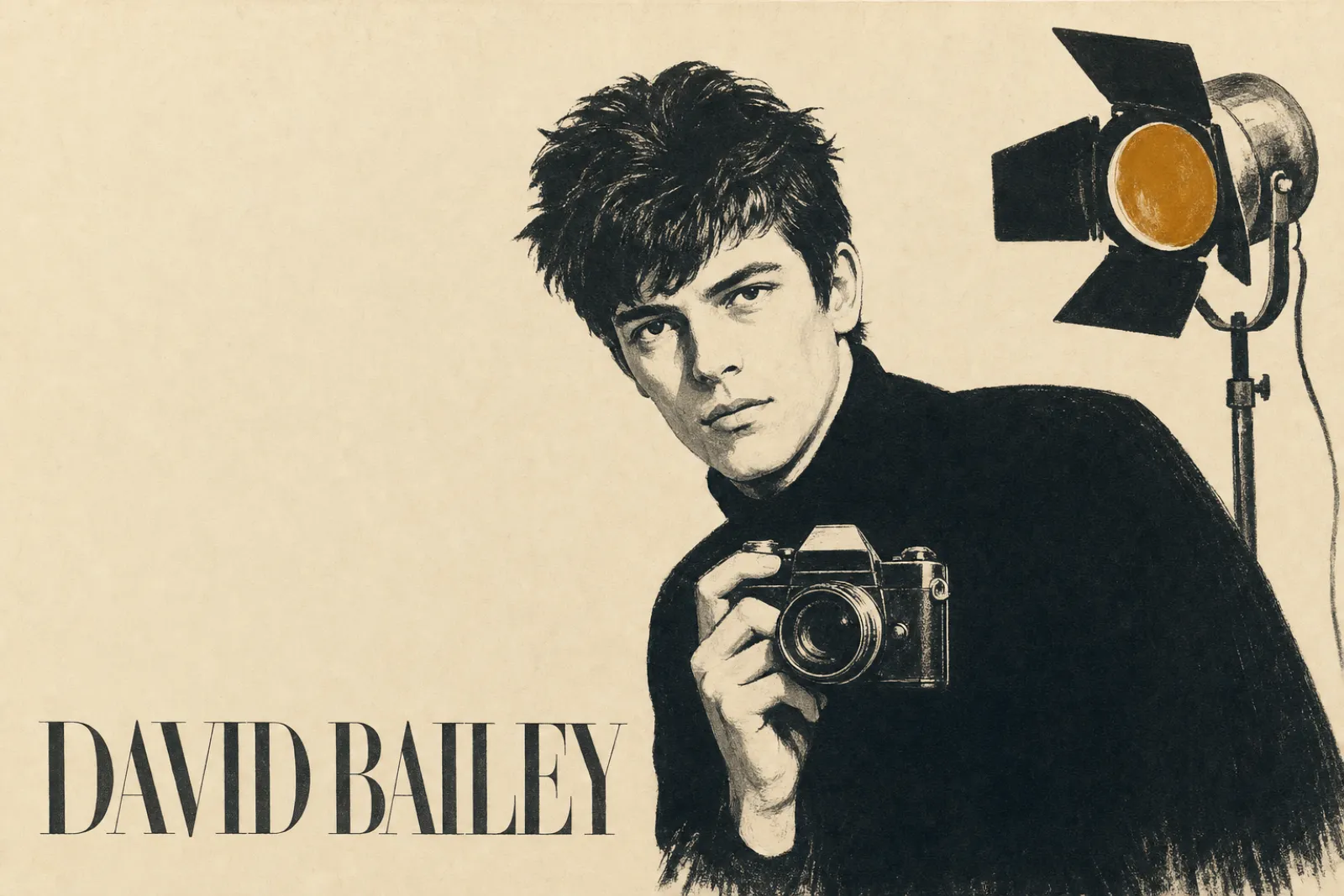
David Bailey is an English photographer, born in Leytonstone in east London in 1938. He joined British Vogue in 1960 and, through his fashion pictures and his portraits of actors, musicians and models, helped to fix the look of 1960s London. He is best known for plain, direct black and white portraits against a white background and for the 1965 portfolio David Bailey’s Box of Pin-Ups.
A photograph by Henri Cartier-Bresson, made in Kashmir, inspired Bailey to take up photography. He learned the trade as an assistant to the London fashion photographer John French. With Terence Donovan and Brian Duffy he formed a trio that the older photographer Norman Parkinson nicknamed “the Black Trinity”. All three turned away from the stiff rules of the generation before them and brought the energy of the London street into fashion pictures. His tight, high contrast portraits are often compared with those of Richard Avedon, and Bill Brandt and Diane Arbus are counted among his influences.
East Ham, the RAF and a first Rolleiflex
Bailey was born on 2 January 1938. His father was a tailor’s cutter and his mother a machinist, and from the age of three he lived in East Ham. He had dyslexia that was not diagnosed at the time, struggled at school and left at fifteen.
In 1956 he was called up for national service in the Royal Air Force and in 1957 he was posted to Singapore. There he bought a Rolleiflex. He was demobilised in August 1958 and bought a Canon rangefinder. The London College of Printing turned him down because of his school record, so he took the other route in: he worked as a second assistant to the photographer David Ollins and in 1959 joined the John French studio as an assistant.
Wondering whether assisting is still a way into the trade? The photography assistant guide explains how to start and what the job involves.
Vogue, Jean Shrimpton and the Box of Pin-Ups
In 1960 Bailey worked briefly for John Cole’s Studio Five and then signed a contract with British Vogue. Within months he was shooting covers, and at the peak of his work for the magazine he shot 800 pages of editorial in a single year. Vogue used him to renew its “Young Idea” section.
He met the model Jean Shrimpton in 1960 at Brian Duffy’s studio. She became the face of his early work, and she later said she owed him her career. Their 1962 trip to New York for a Vogue story titled “Young Idea Goes West” brought both of them wider attention. Bailey photographed her on the street among ordinary New Yorkers, which gave the pictures an immediacy that studio fashion work of the time did not have.
Curious how a fashion story gets from idea to printed page? How a fashion photo shoot happens walks through the people and the steps.
David Bailey’s Box of Pin-Ups, which the Victoria and Albert Museum dates to 1965, was a box holding 36 loose printed portraits of the fashionable people of mid 1960s London. The sitters included the Beatles, Mick Jagger, Rudolf Nureyev, Cecil Beaton and Jean Shrimpton. Only four were women, all of them models. Francis Wyndham wrote the notes, Mark Boxer and David Hillman designed it, and the cover carried a photograph of Bailey taken by Mick Jagger. The inclusion of the Kray twins, two East End gangsters, drew an objection from Lord Snowdon, and there was no American edition.
The 1966 film Blowup, directed by Michelangelo Antonioni, starred David Hemmings as a London fashion photographer, and Bailey’s life was one of the influences on the story. A second 1960s book, Goodbye Baby and Amen, followed in 1969. His first major exhibition was at the National Portrait Gallery in London in 1971.
Travel, films and later books
From 1970 Vogue sent Bailey abroad regularly, to Turkey, Egypt, India, Papua New Guinea and South America. He would spend four or five days on the fashion pictures and then photograph local people for himself. In 1976 he started Ritz Newspaper with David Litchfield, a paper about fashion, gossip and celebrity.
He also worked in film. He directed television documentaries on Cecil Beaton (1971), Luchino Visconti (1972) and Andy Warhol (1973), and from 1966 he directed television commercials. He photographed record sleeves for the Rolling Stones and others, and in 1985 he photographed the performers at the Live Aid concert at Wembley Stadium. In the 1970s, after his equipment was stolen, he replaced it with the small Olympus OM system and appeared in Olympus advertising.
The Victoria and Albert Museum gave him a retrospective in 1983. The books continued for decades: Havana (2006), the three volume Bailey’s East End (2014) and the autobiography Look Again (2020), written with James Fox. The National Portrait Gallery showed Bailey’s Stardust in 2014. He was made a CBE, received the Centenary Medal and an Honorary Fellowship of the Royal Photographic Society in 2005, and was given the Lifetime Achievement award of the International Center of Photography in 2016. A 2003 book, Bailey/Rankin Down Under, was shared with the younger British photographer Rankin.
Why a Bailey portrait is so bare
The central choice is the white background. Bailey explained that it was not laziness. The idea was to take everything out of the picture until only the person’s character was left. With no room, no props and no scenery, the viewer has nothing to read except a face, a pose and clothes. The same thinking is behind any plain backdrop headshot, and it is the strictest form of separating a subject from the background.
He then came in close. His 1984 portrait of Jack Nicholson is framed from the neck up, so the head fills the frame. The light is strong and comes from one side, leaving the other side of the face in heavy shadow. Most of the work is in black and white, which he thought showed a sitter’s personality more clearly than colour. Hard side light on a white ground gives strong contrast, and that contrast is what makes the pictures look so blunt.
Want to see what side light does to a face? Direction of light compares front, side and back light and what each one shows.
The part that cannot be seen is the time spent before the shutter. Bailey got to know sitters before a session and watched how they moved and used their hands. He talked, joked and sometimes provoked, to get past politeness. He said he adapted to each person, because the personality he wanted in the picture was theirs and not his. The result was a new informality in portrait photography: sitters look relaxed, and some are caught moving or laughing.
In fashion he worked the other way round and let the world in. He described a fashion photograph as a portrait of someone wearing a dress, and he treated the street or a foreign landscape as a frame around the model. That is why his work is sometimes filed under street photography as well as fashion photography.
Not sure how to get a sitter to relax? The portrait posing guide gives ways to direct people without stiffening them.
Photographs to look for
- Jean Shrimpton, New York, 1962. From the “Young Idea Goes West” trip. In one frame the model stands in a telephone box in a bold plaid outfit and looks at the viewer, while a middle aged man in a wool coat steps into the next box. Notice the contrast between posed and unposed, and between youth and age.
- David Bailey’s Box of Pin-Ups, 1965. Thirty six portraits of one social circle. Look at how little varies from sheet to sheet, and how much the sitters differ all the same.
- Balenciaga wedding dress, 1967. A model photographed from behind in a bare studio, in a silk dress with a train and a matching headdress. With the face hidden, the dress reads as sculpture. Bailey called it his favourite fashion picture.
- Vogue editorial, Göreme, Turkey, 1970. A model crouches on a dune beneath the rock formations of the region. It is an early example of the travel stories that mixed fashion, landscape and portrait.
- Jack Nicholson, 1984. A neck up portrait of the actor laughing with his mouth wide open. The light comes hard from the left, the right side falls into shadow and the background is plain white.
- Queen Elizabeth II, 2014. A black and white portrait made for her 88th birthday, in which she smiles and looks relaxed. It uses the same method he had used fifty years earlier.
Try this: ten faces on a white wall
You need one person, a white or pale wall, and a window to one side. Allow 15 minutes.
- Stand your sitter about an arm’s length in front of the wall, with the window to their left or right, not in front of them.
- Set the camera or phone to black and white.
- Frame from the collar to just above the hair. Nothing else goes in the picture.
- Spend the first five minutes talking with the camera down. Ask about something they care about.
- Keep talking and make ten frames. Do not ask for a smile or a pose. Press the shutter when their face changes.
Look through the ten and pick the one where the person looks most like themselves. Check whether it came early or late in the conversation.
Questions people ask about David Bailey
What is David Bailey famous for?
He is known for his fashion photographs for British Vogue from 1960 and for stark black and white portraits of the best known faces of 1960s London, including the Beatles and Mick Jagger. With Terence Donovan and Brian Duffy he is credited with capturing, and helping to create, “Swinging London”.
What is the Box of Pin-Ups?
It is a boxed portfolio of 36 loose portraits of fashionable London figures, with notes by Francis Wyndham. The Victoria and Albert Museum, which holds a copy, dates it to 1965.
Was the film Blowup based on David Bailey?
Partly. Michelangelo Antonioni’s 1966 film has a London fashion photographer as its main character, played by David Hemmings, and Bailey’s life and work were one of the influences on it.
What camera did David Bailey use?
He bought a Rolleiflex in Singapore in 1957 and a Canon rangefinder in 1958. In the 1970s he moved to the Olympus OM system, a compact 35mm single lens reflex outfit, and he appeared in advertisements for the Olympus OM-1 and the Olympus Trip.
Bailey is quoted on the photography quotes page, and other fashion and portrait photographers are listed in the A to Z of photographers.