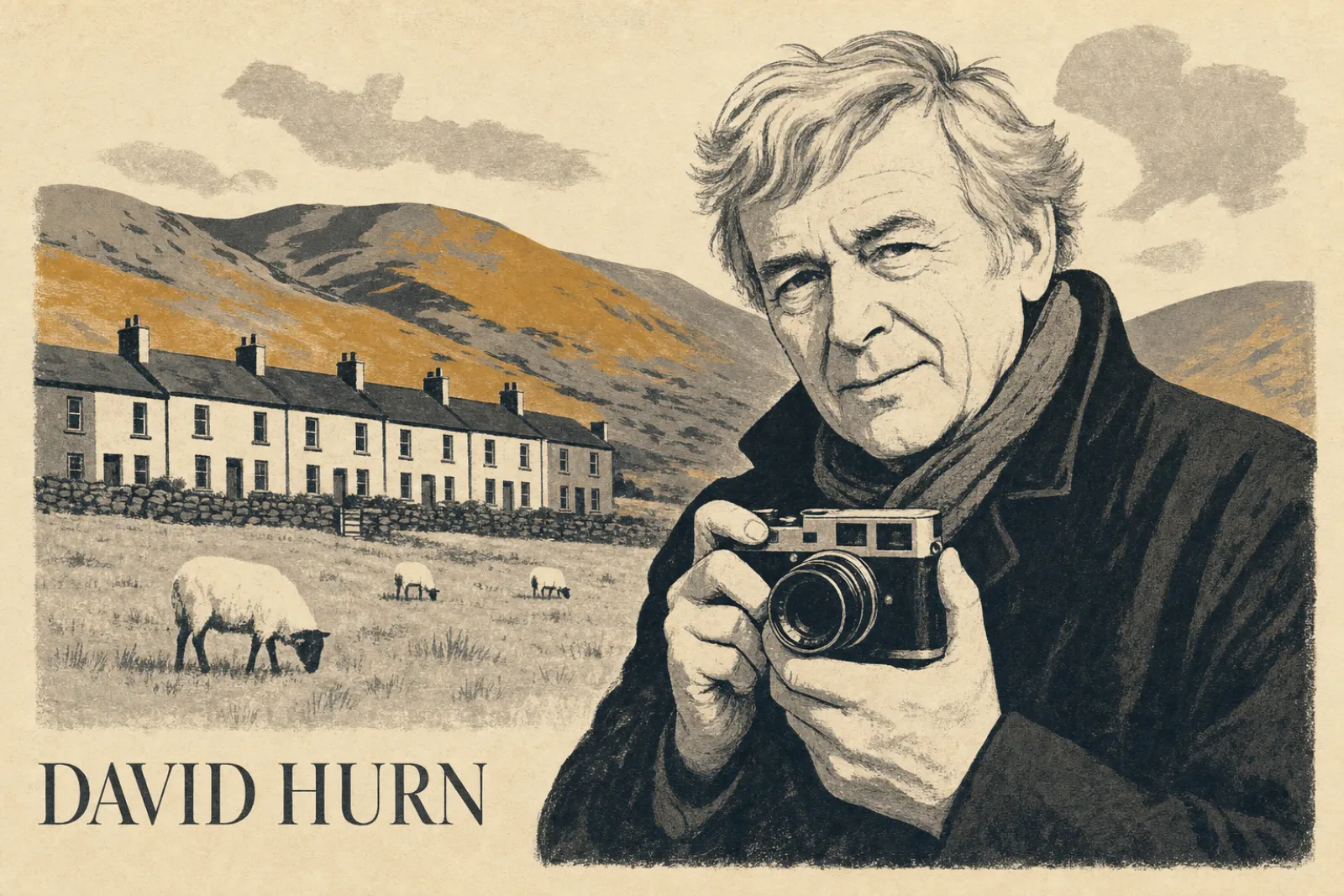
David Hurn is a documentary photographer of Welsh descent, born in Redhill, Surrey, in 1934. He taught himself photography, made his name covering the Hungarian revolution of 1956, joined Magnum Photos in the 1960s and then spent decades photographing ordinary life in Wales. He is known for that long record of one country, for founding the School of Documentary Photography in Newport, and for the book On Being a Photographer.
Hurn had no formal training. He began in 1955 as an assistant at the Reflex Agency in London and learned on the job. He became an associate of Magnum in 1965 and a full member in 1967, which put him in the same agency as its co-founder Henri Cartier-Bresson. Over the years he built a private collection by swapping his prints with other photographers, among them Cartier-Bresson and Bill Brandt. A selection from it was later curated by Martin Parr. Hurn in time turned away from covering current affairs and chose a quieter, more personal kind of picture making.
A school camera club, then Budapest
Hurn had dyslexia, and that led him to join his school camera club. After leaving school he turned down the prospect of a military career and moved to London, hoping to become a photographer. He started at the Reflex Agency in 1955. The next year, working as a freelance, he photographed the Hungarian revolution, and that reportage established his reputation as a photojournalist.
In the early 1960s he appeared in two films that Ken Russell made for the television arts series Monitor, A House in Bayswater (1960) and Watch the Birdie (1963).
Film sets, Aberfan and the 1960s
Hurn spent part of the 1960s photographing on film sets. In 1963 he was commissioned to shoot stills of Sean Connery for the James Bond film From Russia with Love. When the prop gun did not arrive he supplied his own Walther air pistol, which is the gun seen in those publicity pictures. In 1967 the producer Dino de Laurentiis asked him to go to Rome to photograph Jane Fonda in Barbarella.
In 1964 the director Dick Lester asked him to photograph the making of the Beatles film A Hard Day’s Night, not for the press but from a sociological point of view. Hurn stayed for about seven weeks. He photographed the band on the train where much of the film was shot, in make-up, on stage and at Abbey Road with their producer George Martin. He also photographed the bodyguards, the police and the fans who surrounded them.
On 21 October 1966 a colliery waste tip slid onto the village of Aberfan in south Wales and buried the junior school. It killed 116 children and 28 adults. Hurn travelled there when he heard the news and arrived as the light was going, while miners and villagers were still digging. Cartier-Bresson afterwards sent a note praising the coverage by Hurn and his colleague Ian Berry. Hurn has said that Aberfan made him realise he had hardly been back to Wales since he was a small child, and that it planted the idea of returning.
How should a photographer behave at a scene of grief? Photography etiquette and ethics sets out the questions to ask before raising a camera.
Going back to Wales
Around 1970 Hurn moved back to Wales. He lived at first in a van and spent a year travelling and photographing the country. He intended to stay for a year and did not leave.
The pictures made from the 1970s through the 1990s became the book Wales: Land of My Father (2000). They cover a period in which the country’s economy moved away from farming, coal, steel and slate. Hurn photographed miners and pit ponies, sheepdog trials, chapels, brass bands and beach outings, and he photographed the microprocessor factories, fast food and discos that arrived beside them. A second book, Living in Wales (2003), is a set of more than one hundred portraits of people who lived there, from writers and singers to a chimney sweep and a physician, made between 1996 and 2003.
Thinking of photographing your own area over many years? How to plan and execute a long-term photography project covers scope, routine and keeping going.
In 1973 he set up the School of Documentary Photography in Newport, and he resigned from it in 1989. In 1979 and 1980 a UK/USA Bicentennial Fellowship took him to Arizona, and the pictures from that time were published much later as Arizona Trips (2017). With the writer and teacher Bill Jay he produced two short practical books, On Being a Photographer (1997) and On Looking at Photographs (2000).
In 2017 Hurn gave about 1,500 of his own photographs, and about 700 by other photographers from his swaps, to Amgueddfa Cymru, the national museum of Wales. He had first visited the museum in Cardiff with his mother as a small child. A selection titled David Hurn: Swaps, curated by Martin Parr, was shown at Photo London in 2017 and at National Museum Cardiff from October 2021 to August 2022. The Royal Photographic Society made him an Honorary Fellow in 2016, and the Lucie Awards in New York honoured him for achievement in documentary photography.
How Hurn covers a subject
Hurn does not arrange scenes. In a statement used by Magnum he explains that life in front of the camera is already so full of complexity and surprise that he sees no need to invent new realities. Everything in the pictures was there. The work lies in choosing where to be and what to include, which is the discipline of candid photography applied over a whole career.
His most teachable habit is a three picture plan that he used at large events such as the Isle of Wight Festival. First, a crowd picture that shows the scale of the thing. Second, a character picture that shows the kind of people who came. Third, an interaction picture that shows them doing something together. He made the crowd picture first, as soon as he arrived, because its value as a record was certain.
Want to plan pictures before an event starts? How to write a photography shot list shows how to list what a set of pictures must contain.
The second habit is turning away from the obvious subject. At the Isle of Wight Festival in 1969 and 1970 most photographers pointed at the stage. Hurn pointed at the audience: people watching, dancing, cooking and washing, and families with children. On A Hard Day’s Night he gave as much attention to the police and the fans as to the Beatles. The edges of an event often say more about it than the centre, and this is a sound rule for festival photography and event photography of any size.
The third is patience with a single subject. The Welsh work is not one assignment. It is about three decades of small local occasions, which only add up when they are edited into a book. That is the method of documentary photography in its plainest form, and the editing follows the logic of a photo essay: old and new are placed side by side so the reader sees the change.
Wondering how to stay with one scene until it gives a picture? Working the scene explains how to keep looking after the first frame.
Photographs and books to look for
- A Hard Day’s Night (1964). Seven weeks with the Beatles during filming. Look for the frames made in the cramped train carriages and the ones where fans and police fill the picture.
- Aberfan (1966). The pictures show the coal waste heaped on the hillside above the school. Hurn has pointed to this coverage as a case where photographs helped bring about what happened afterwards.
- Isle of Wight Festival (1969 and 1970). A study of an audience. Find one crowd picture, one character picture and one interaction picture.
- Coach party holiday, Aberavon beach (1971). An early picture from Wales: Land of My Father, from the first years after his return.
- Sheep at a military artillery range, Mynydd Epynt (1973). Sheep shelter from the rain on a firing range. Two uses of the same land meet in one frame.
- The last pouring at Shotton Steel Works (1977). One of the pictures that records heavy industry closing. Compare it with National Coal Museum bus stop, Blaenafon (1997), made twenty years later.
Try this: three pictures of one gathering
Go to any place where people have gathered for a reason: a market, a school sports day, a match, a queue. Give yourself 20 minutes and a limit of three pictures to keep.
- On arrival, find a spot that shows how many people are there and make the crowd picture first. Stairs, a bank or a bench will give you height.
- Next, look for the character picture: one or two people whose clothes, expression or belongings tell you what kind of gathering this is.
- Last, wait for an interaction: people sharing food, arguing over a map, helping a child. Stay in one place until it happens.
- Do not photograph the main attraction at all.
Put the three pictures side by side and check whether a stranger could tell what the event was.
Questions people ask about David Hurn
What is David Hurn known for?
He is known for his reportage of the 1956 Hungarian revolution, his pictures of the Beatles during the filming of A Hard Day’s Night, his coverage of the Aberfan disaster, and his long documentary record of Wales. He is also known as the founder of the School of Documentary Photography in Newport.
Is David Hurn a member of Magnum?
Yes. He became an associate member of Magnum Photos in 1965 and a full member in 1967.
What is On Being a Photographer?
It is a short practical guide that Hurn wrote with Bill Jay, first published by LensWork in 1997 and reissued in later editions. The two followed it with On Looking at Photographs in 2000.
What did David Hurn give to the national museum of Wales?
In 2017 he donated about 1,500 of his own photographs and about 700 by other photographers, including Henri Cartier-Bresson, Eve Arnold and Bill Brandt. He had collected the second group by exchanging prints with the photographers themselves.
Other documentary photographers and Magnum members are listed in the A to Z of photographers.