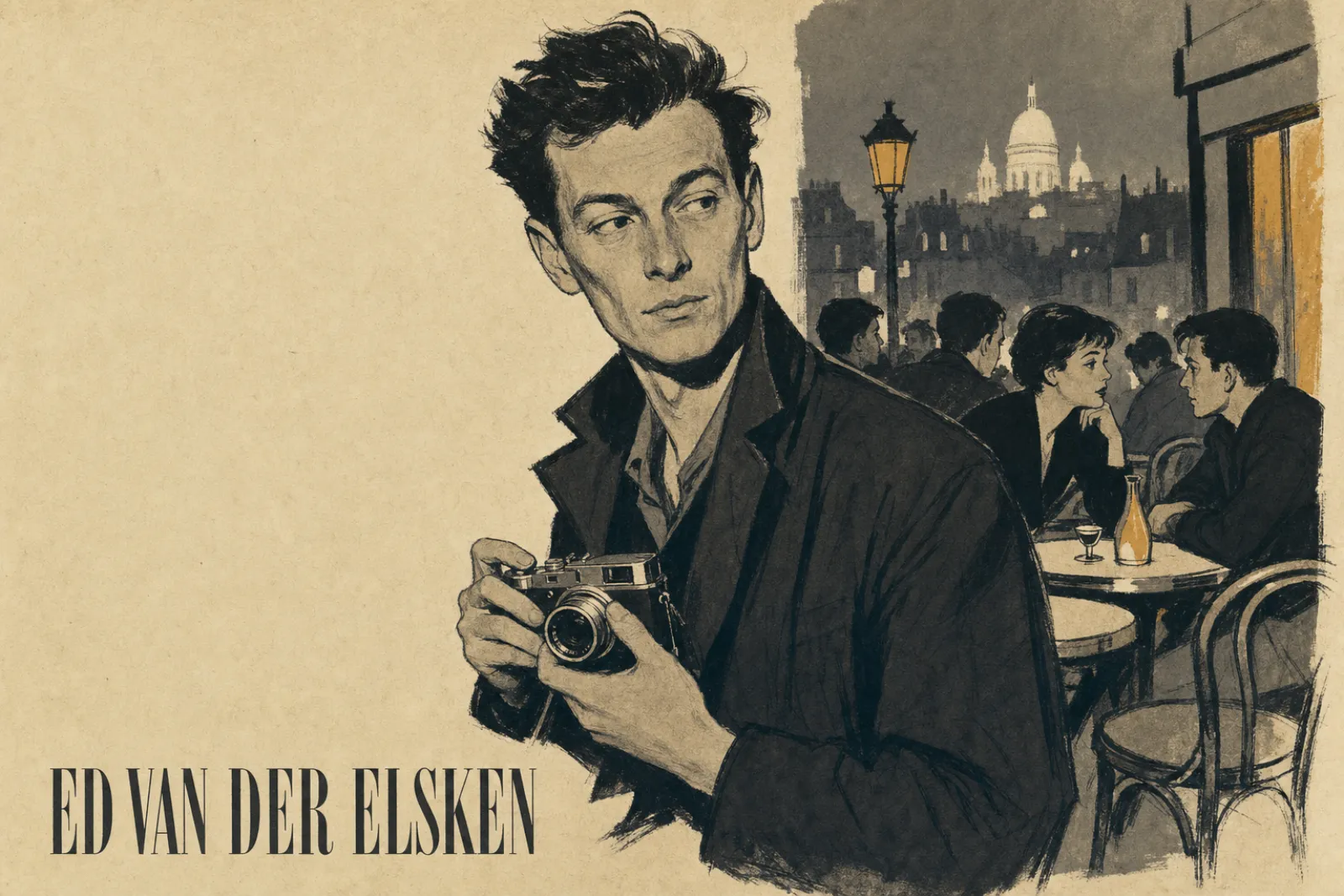
Ed van der Elsken (1925 to 1990) was a Dutch photographer and filmmaker who worked in Paris, Amsterdam and on long journeys through Africa and Asia. He photographed people in streets, cafes and clubs from close by, and he made no claim to be neutral about them. He is best known for Love on the Left Bank, a 1956 photobook that tells a partly invented love story with photographs of real young people in Paris.
He came to photography in 1947, when he saw Naked City, the book of New York press pictures by Weegee. In Paris he worked as a darkroom printer for the Magnum agency, making prints for Henri Cartier-Bresson, Robert Capa and Ernst Haas. Cartier-Bresson was impressed by his street pictures. Van der Elsken took the opposite position from the detached reporter, and his books read like speech in the first person.
From stone cutting in Amsterdam to a Paris darkroom
He was born in Amsterdam on 10 March 1925. As a boy he learned stone cutting, meaning to become a sculptor, and he began art training in the city. In 1944 he abandoned a sculpture course to avoid forced labour under the German occupation. After the Battle of Arnhem he served in a mine disposal unit, where British soldiers showed him the magazine Picture Post.
In 1947 he took a job in photo sales and tried a correspondence course in photography, failing the final exam. He was admitted to the GKf, the photographers’ section of the Dutch federation of applied arts. In 1950, on the advice of the photographer Emmy Andriesse, he moved to Paris.
Saint-Germain-des-Prés and Love on the Left Bank
From 1950 to 1954 he photographed a circle of young people who spent their days and nights in the cafes and clubs of Saint-Germain-des-Prés. Vali Myers, who danced in the jazz cellars, became the central figure of the pictures. Edward Steichen chose eighteen of these pictures for the 1953 survey exhibition Postwar European Photography and showed his work again in The Family of Man.
Van der Elsken then turned the pictures into a story. In 1954 Picture Post ran it in four parts, telling readers that these were not stills from a film but pictures of people who really existed. In 1956 it appeared as a book, designed by Jurriaan Schrofer, with the English title Love on the Left Bank. It follows Manuel, a young Mexican, and his unreturned love for Ann, a dancer, who is played by Myers. The story is partly autobiographical and partly fiction. The people and places are real.
The book sold out quickly in Europe and in Britain, and it influenced later generations of photographers. Nan Goldin is one of those named as following his lead.
How do separate photographs become a story with a beginning and an end? Visual storytelling in photography covers character, setting and the order of events.
Africa, Japan, Amsterdam and film
He married the Hungarian photographer Ata Kandó in 1954. They returned to Amsterdam in 1955 and separated. There he photographed the artists of the COBRA movement, among them Karel Appel. In 1957 he married the photographer Gerda van der Veen. That year he worked in Bagara, in the present Central African Republic, and the book Bagara followed in 1958, again designed by Schrofer. Jazz was published in 1959. In 1959 and 1960 he and van der Veen travelled to Tokyo and Hong Kong. Sweet Life appeared in 1966.
He was making films from 1955. Welkom in het leven, lieve kleine (1963) records the home birth of his second child in Amsterdam. It is an early example of filming with a small camera carried on the shoulder and recording sound in sync. From 1971 he lived in the countryside near Edam with the photographer Anneke Hilhorst, who worked with him on the later books and films. Eye Love You came out in 1977 and Amsterdam! in 1979. His last film, Bye (1990), is about his own terminal illness. He died of prostate cancer in Edam on 28 December 1990.
In 2019 the Rijksmuseum and the Nederlands Fotomuseum jointly acquired his estate. The Nederlands Fotomuseum looks after the negatives, slides and contact sheets.
How van der Elsken got close and built a book
Two skills carry the work. The first is contact with people. The Nederlands Fotomuseum calls him a true people photographer: he talked to those he photographed and dealt with them directly instead of keeping his distance. This is street photography practised as an encounter, with interaction and conversation as part of the method. He worked with hand cameras: 35mm Nikon and Leica bodies and a Rolleicord that made square 6×6 negatives.
How do you approach someone you do not know and come away with a good picture? Street portraits covers how to ask, what to say and how to work quickly once they agree.
The second skill is the edit. Love on the Left Bank borrows from cinema. It gives away the unhappy ending first, then tells the story as a long flashback in the first person. The picture sizes change constantly. A close-up may run across two pages, and small photographs are set in rows like strips from a contact sheet. Rectangular 35mm frames sit beside square ones. The book ends with a dream sequence. All of this is photo sequencing used to control pace, in the way a film editor would.
His archive shows how much of that was worked out by hand. It holds contact sheets marked with the frames he chose and those he rejected, darkroom experiments, notes, and trial versions of the books in which he arranged, resized and moved the photographs.
Want to turn a set of pictures into pages? Photo book design covers layout, picture size, pairing and pacing across spreads.
He did not stay with one medium. He shot black and white and colour slides, made books and made films, and carried the same close, personal approach from one to the next. His journeys produced what is, in a loose sense, travel photography, but the subject was always the people he met.
Books, pictures and films to look for
- Love on the Left Bank (1956). The photobook made from his Paris pictures of 1950 to 1954. Read it in order, from cover to cover, and watch how the changes in picture size speed the story up and slow it down.
- Vali Myers, Paris (1951). A portrait of Myers looking at herself in an old, spotted mirror. The Nederlands Fotomuseum describes it as standing for the restless unhappiness of the lives in the Paris series.
- Bagara (1958). The book from his 1957 stay in central Africa, his second with the designer Jurriaan Schrofer. Compare how the same designer handles a very different subject.
- Welkom in het leven, lieve kleine (1963). A 36 minute film of a birth at home in Amsterdam. It shows his method moving from still pictures into film with a light camera and live sound.
- South Moluccans, Tiel (1970). A colour slide of a group of Moluccan youths at ease on what looks like a Sunday afternoon. It was found during the restoration of his colour slide archive and probably belonged to a reportage that was never published.
- Bye (1990). His final film, in which he turned the camera on himself during his last illness. It was broadcast in the Netherlands in January 1991.
How do you photograph people as they are, without posing them? Candid photography covers timing, distance and staying unobtrusive.
Try this: a one page story about one person
This takes about twenty minutes with a camera or phone and a willing friend or family member.
- Talk first. Spend two minutes in conversation before you take any picture, and keep talking while you photograph.
- Stay within two metres the whole time. Do not zoom.
- Make exactly twelve frames while the person does something ordinary: makes coffee, reads, gets ready to go out.
- Choose five. Decide which one is the ending and put it first.
- Lay the five out on one page or screen. Make one picture large and the other four small, in a row.
Ask what the large picture does to the small ones. Swap a different frame into the large position and see how the story changes.
Questions people ask about Ed van der Elsken
Is Love on the Left Bank a true story?
Partly. The people, the cafes and the nights out were real, and van der Elsken photographed them in Paris between 1950 and 1954. The plot about Manuel and Ann was his own construction, part autobiography and part fiction.
What camera did Ed van der Elsken use?
He used 35mm Nikon and Leica cameras and a Rolleicord, which takes 6×6 square negatives. Both formats appear together in Love on the Left Bank.
Who was Vali Myers?
Vali Myers (1930 to 2003) was the dancer who appears as Ann, the central figure of Love on the Left Bank. Van der Elsken returned to her twenty years later in the 1972 film Death in the Port Jackson Hotel.
Where is Ed van der Elsken’s archive?
The Nederlands Fotomuseum manages his negatives, slides and contact sheets. The Rijksmuseum holds a large group of prints, and work is also held by the Stedelijk Museum Amsterdam and Leiden University Libraries.
Van der Elsken is one of the photographers in the A to Z of photographers.