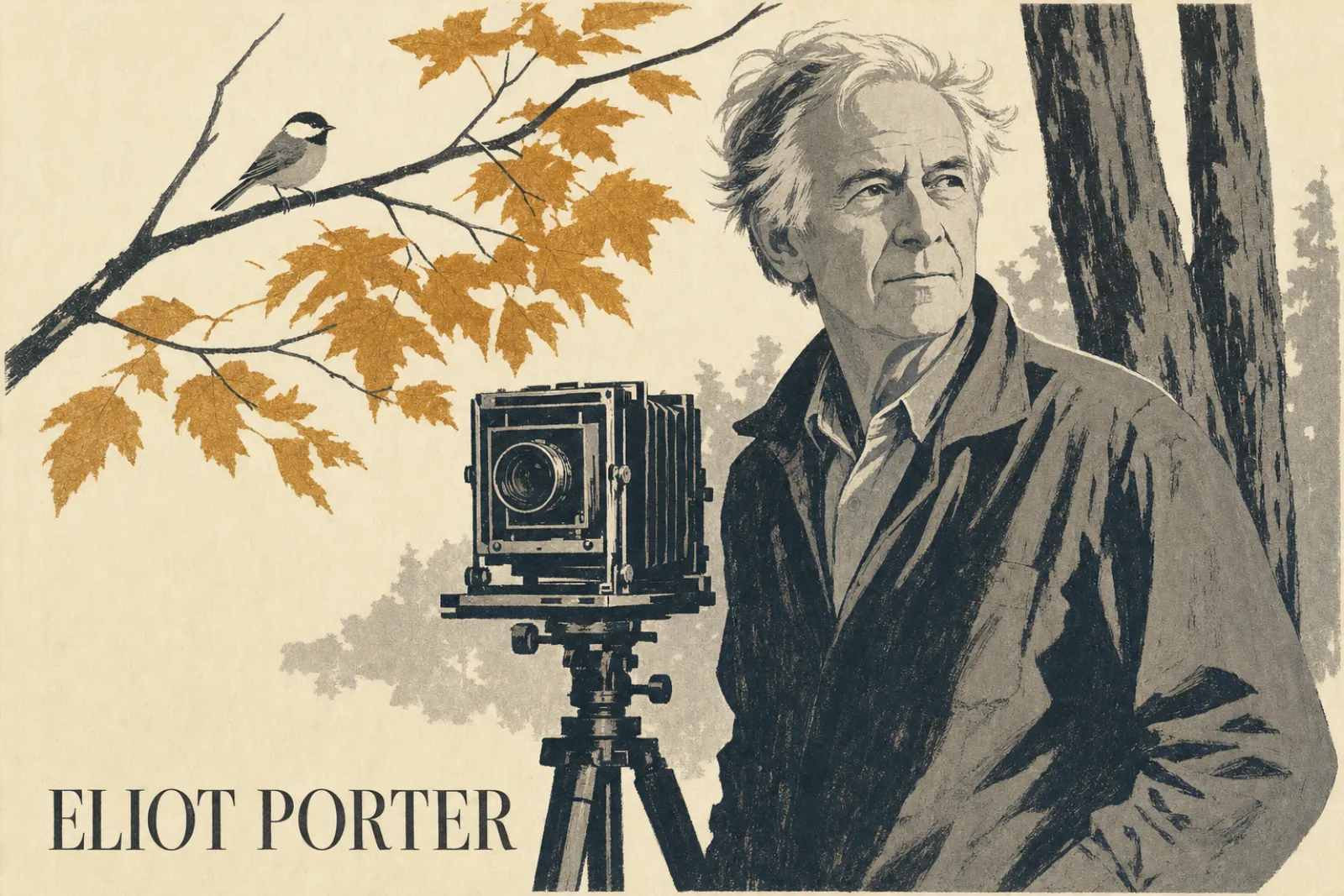
Eliot Porter (1901 to 1990) was an American photographer who trained as a chemical engineer and a doctor, then gave up medical research to photograph birds and wild places in colour. He worked in Maine and the American Southwest and later in the Galápagos, Antarctica, Iceland and East Africa. He is known for making colour a serious medium for nature photography at a time when art photographers worked in black and white, and for the Sierra Club book In Wildness Is the Preservation of the World.
Porter’s start came through two black and white photographers. His brother, the painter Fairfield Porter, introduced him to Alfred Stieglitz around 1930, and in 1933 he saw the photographs of Ansel Adams, which influenced him. Stieglitz showed Porter’s prints at his New York gallery, An American Place, at the end of the 1930s, and Porter left medical research for photography. He then went where neither of them had gone, into colour. Edward Steichen later included him in the group exhibition Diogenes with a Camera at the Museum of Modern Art in 1952.
A Harvard researcher with a camera
Porter was born in Winnetka, Illinois, on December 6, 1901. As a child he photographed birds and landscapes with a Kodak box camera at his family’s summer home in Maine. He took a degree in chemical engineering at Harvard in 1924 and a medical degree at Harvard Medical School in 1929, then stayed on to teach and do research until 1938.
He bought a Leica in 1930. The photographs Stieglitz exhibited were made with a Linhof view camera. That exhibition was the point at which he took up photography full time.
Why the birds had to be in colour
Porter’s move to colour had a practical cause. A publisher turned down his proposal for a bird book because black and white pictures would not clearly tell one species from another. He began experimenting with Kodachrome, the colour film introduced in 1935, and drew on his chemical engineering and research training to work through the technical problems of photographing fast-moving birds in colour.
From 1940 he specialised in colour, working from separation negatives and making dye transfer prints. He won a Guggenheim Fellowship in 1941 for his bird photography, and it was later renewed. In 1943 the Museum of Modern Art in New York exhibited his bird photographs in colour, the first exhibition of colour photographs held there. American Birds: 10 Photographs in Color was published in 1953. From 1946 he lived at Tesuque, near Santa Fe, New Mexico.
Thinking about photographing birds yourself? How to photograph birds covers the approach, the settings and the patience involved.
The Sierra Club books and Glen Canyon
In 1962 the Sierra Club published In Wildness Is the Preservation of the World, which set Porter’s nature photographs beside passages from Henry David Thoreau. It appeared in the club’s Exhibit Format series, which had begun in 1960 and took on colour that year. The series sold fifty thousand copies in its first four years.
The Place No One Knew: Glen Canyon on the Colorado came out in 1963. It recorded Glen Canyon in Utah before the Glen Canyon Dam created Lake Powell and put much of the canyon hundreds of feet under water. The book was a memorial to the canyon. Porter also served as a director of the Sierra Club, and his books are an early example of conservation photography, where pictures are made to argue for protecting a place.
More Sierra Club books followed: Summer Island: Penobscot Country (1966) and the two volumes of Galápagos: The Flow of Wildness (1968). He also photographed in Baja California, Antarctica, East Africa, Iceland, Mexico, Egypt, China, Czechoslovakia and at ancient Greek sites.
In 1979 the Metropolitan Museum of Art in New York showed Intimate Landscapes, its first one-person exhibition of colour photography. It was credited with giving colour photography credibility as fine art. Late in life, after reading James Gleick’s 1987 book Chaos: Making a New Science, Porter looked again at his own pictures in the light of chaos theory, and his photographs were published with a new essay by Gleick as Nature’s Chaos (1990). He was elected a Fellow of the American Academy of Arts and Sciences in 1971. He died in Santa Fe on November 2, 1990, and left his archive to the Amon Carter Museum of American Art in Fort Worth, Texas.
How an intimate landscape is put together
The Metropolitan exhibition gave a name to the kind of picture Porter made. An intimate landscape is a close-range, quiet composition of natural elements, with muted colour and dense texture. The choices behind it are specific.
- Close range instead of the grand view. The subject is a patch of ground, a stretch of water or a group of trunks. This is the opposite of the wide scenic view that most landscape photography starts from.
- Colour that is quiet. The colours are muted, not loud. A picture can be built from a few related colours with one small accent, an idea explained in colour theory for photographers.
- Texture across the whole frame. The pictures are dense with texture from edge to edge, so the surface itself becomes the subject.
- A slow camera. Porter worked with a view camera, a kind of camera that makes every frame a deliberate decision. Large format photography rewards the same patience now.
- Colour controlled in the print. Dye transfer printing starts with three separation negatives, made through red, green and blue filters. Each is used to make a gelatin matrix that soaks up one dye, and the three dyed matrices are pressed onto the paper in turn. It was slow, about a day for one print, but it gave the printer more control over colour than any other photographic colour process, and the dyes were very stable. Porter’s colour prints were made this way.
- Pictures made to be read in a book. In Wildness sets photographs beside passages of text, so the page carries part of the meaning. Photo book design deals with the same decisions.
Wondering why colours shift between screen and paper? How to get great colour when making prints covers the steps that keep a print faithful.
Want a wider view of colour as a tool? Colour in photography covers using colour creatively across subjects.
Books and bodies of work to look for
- American Birds: 10 Photographs in Color (1953). The bird work is where his need for colour began. The point was to tell one species from another.
- In Wildness Is the Preservation of the World (1962). Nature photographs paired with words by Thoreau. The words and the pictures are meant to be read together. It was the first book in the Sierra Club’s Exhibit Format series to use colour.
- The Place No One Knew: Glen Canyon on the Colorado (1963). A record of a canyon made before it was flooded. It matters as much for what it argued as for how it looks.
- Galápagos: The Flow of Wildness (1968). Two Sierra Club volumes on the islands, subtitled Discovery and Prospect.
- Intimate Landscapes (1979). The Metropolitan Museum exhibition that named his way of seeing and brought colour photography into that museum as a solo show for the first time.
- Nature’s Chaos (1990). Photographs published with an essay by James Gleick, made after Porter reconsidered his own work in the light of chaos theory.
Try this: ten paces, no sky
Take 15 minutes in a park, garden or patch of woods. Stand still and choose an area no more than ten paces across. Make eight photographs inside it under one rule: no sky and no horizon in any frame. Get close enough that leaves, bark, stones or water fill the picture from edge to edge. Before each frame, name the two or three colours in it and check that none of them shouts. Review the eight and keep the one where the whole surface holds attention without a single obvious subject.
Questions people ask about Eliot Porter
Why did Eliot Porter photograph in colour?
A publisher rejected his bird book because black and white pictures could not clearly separate the species. He began working with Kodachrome, and from 1940 colour was his speciality.
What printing process did Eliot Porter use?
He made dye transfer prints from separation negatives. The process is slow but gives a wide range of colour, a high degree of control and dyes that resist fading. Kodak stopped making the materials in 1994.
What is an intimate landscape?
The term comes from Porter’s 1979 exhibition at the Metropolitan Museum of Art. It describes a close-range, quiet composition of natural elements with muted colours and dense textures.
Where is Eliot Porter’s archive?
He bequeathed it to the Amon Carter Museum of American Art in Fort Worth, Texas. It holds more than 9,000 prints, about 90,000 negatives, slides and transparencies, his papers, his library and his cameras and printing equipment.
Eliot Porter is one of the photographers in the A to Z of photographers, and he is quoted on the photography quotes page.