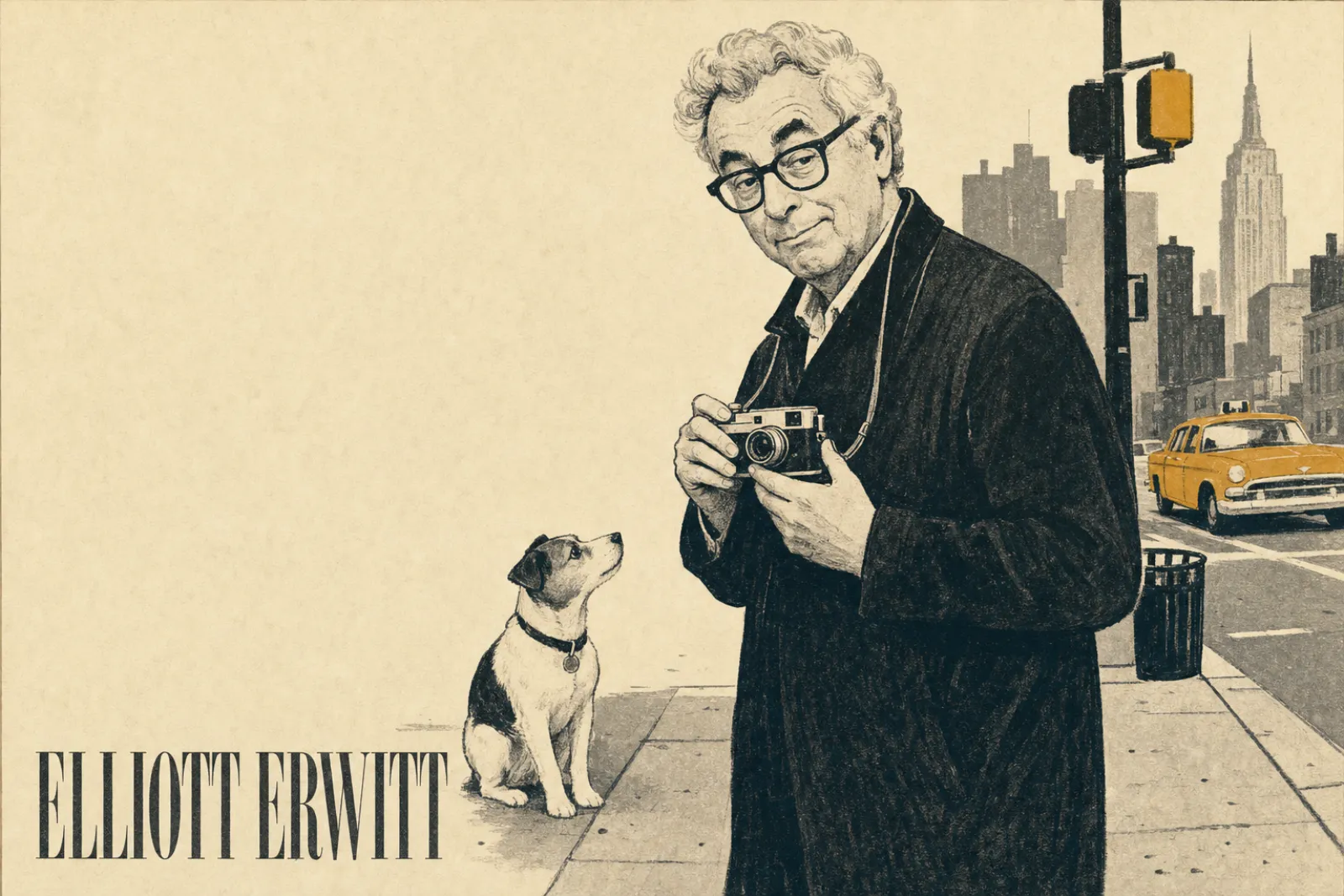
Elliott Erwitt (1928 to 2023) was an American photographer, born in Paris and raised in Milan, who worked from New York as a magazine photojournalist, advertising photographer and film maker. A member of Magnum Photos from 1953, he photographed presidents and premiers on assignment and dogs, couples and passers-by for himself. He is known for humour: pictures that turn an ordinary street scene into a visual joke without being unkind to anyone in it.
Erwitt arrived in New York in 1948 and met three people who shaped his start: Edward Steichen, Robert Capa and Roy Stryker, the former head of the Farm Security Administration’s photography project. Stryker gave him work, and Capa invited him into Magnum, the agency Capa had founded with Henri Cartier-Bresson and others. Erwitt shared that circle’s humanist outlook. What he added was irony.
Paris, Milan, Hollywood and a darkroom job
He was born Elio Romano Erwitz in Paris on July 26, 1928, to Russian parents, and spent his childhood in Milan. The family emigrated to the United States by way of France in 1939. As a teenager in Hollywood he became interested in photography and worked in a commercial darkroom, then experimented with the medium at Los Angeles City College.
In 1948 he moved to New York, where he did janitorial work in exchange for film classes at the New School for Social Research. In 1949 he travelled in France and Italy with a Rolleiflex. Stryker hired him to photograph for the Standard Oil Company and then commissioned him to document the city of Pittsburgh. Drafted in 1951, he served with the Army Signal Corps in Germany and France, where his duties were photographic, and was discharged in 1953.
Magnum, the magazines and a finger in Moscow
Erwitt joined Magnum Photos in 1953 and stayed for the rest of his career, serving as its president for three years in the late 1960s. He worked as a freelance for Collier’s, Look, Life and Holiday in the years when illustrated magazines were at their height. This was photojournalism as a trade: an editor’s brief, a deadline and a story to bring back.
The assignments put him in front of history. In 1959 he covered Vice President Richard Nixon’s visit to the Soviet Union, where Nixon and the Soviet leader Nikita Khrushchev argued at the American National Exhibition in Moscow, an exchange known as the kitchen debate. He photographed the funeral of President John F. Kennedy in 1963 and, decades later, the inauguration of Barack Obama in 2009.
He also changed the business. Erwitt insisted that the person who makes a picture, not the magazine that publishes it, should hold the copyright, and that insistence affected the whole magazine photography industry.
Who owns a photograph once it is published? Copyright basics for photographers sets out what the maker of a picture keeps and what can be licensed.
Dogs, films and an invented artist
Alongside assignments Erwitt kept photographing for himself, and dogs became his best known subject. He published a run of dog books: Son of Bitch (1974), To the Dogs (1992), Dog Dogs (1998), Woof (2005) and Elliott Erwitt’s Dogs (2008). The pictures combine people and dogs in visual puns, as in the pictures where only a person’s feet appear beside the animal.
From the 1970s he also made films. His documentaries include Arthur Penn: the Director (1970), Beauty Knows No Pain (1971), Red, White and Bluegrass (1973) and Glassmakers of Herat, Afghanistan (1977). He was a camera operator on Gimme Shelter (1970), and in the 1980s he made eighteen comedy films for HBO.
In 2009 he published The Art of André S. Solidor, the work of an alter ego he invented: a pretentious, beret-wearing artist, created to satirise contemporary photography. The joke was shown as an exhibition in London in 2011. Erwitt received the Royal Photographic Society’s Centenary Medal in 2002 and the International Center of Photography’s Infinity Award for lifetime achievement in 2011. He died at his home in New York on November 29, 2023, aged 95.
Thinking about photographing a dog of your own? How to photograph pets covers getting sharp, expressive pictures of animals.
How an Erwitt picture gets its laugh
The International Center of Photography describes his work as showing a graphic sensibility that instinctively organises the formal elements of a scene. The jokes work because the frames are well built. These are the choices to study.
- Two things that should not match, placed side by side. A woman’s feet and a tiny dog. A statesman’s lapel and a pointing finger. The picture is a comparison, and the viewer completes it. Juxtaposition in photography explains how contrast between two elements creates meaning.
- The camera at the dog’s height. The 1946 New York picture is made from street level. From there a small dog becomes a full character and a person is reduced to a pair of feet. Changing the camera’s angle and position changes who the picture is about.
- Size as the subject. In Felix, Gladys and Rover a chihuahua shares the frame with the legs of a Great Dane. The joke is entirely one of scale.
- The exact instant of a gesture. The Moscow picture depends on the fraction of a second when the finger is at the lapel. A moment earlier or later there is no picture. The decisive moment covers timing, anticipation and gesture.
- A frame inside the frame. In California the couple appear in a car’s side mirror. A mirror is a simple way to put a second, smaller picture inside the first. Creative reflection photography covers mirrors, glass and puddles.
- Humour without cruelty. His own agency describes the work as marked by benevolent irony and a humanistic sensibility. The people and animals in the pictures are not mocked. The situation is what is funny.
Want to practise seeing funny moments? Humour in photography covers how to notice and catch them.
How do photographers work unnoticed among strangers? Candid photography explains capturing natural moments without posing anyone.
Photographs to look for
Most of the titles below are only a place and a year.
- New York City (1946). A street-level view that compares a woman’s feet with a chihuahua wearing a sweater. Notice how low the camera is and how little of the person is needed.
- North Carolina (1950). A picture of segregated water fountains. It shows that the same eye for a telling comparison could be used with complete seriousness.
- New York City (1953). His wife with a baby on a bed, lit by light from a window. A family picture made with the care of an assignment.
- California (1955). The side mirror of a car parked facing a beach sunset, with a playful couple seen in the mirror. Notice that the subject is in the mirror, not in front of the lens.
- Moscow (1959). Richard Nixon poking his index finger at Nikita Khrushchev’s lapel. A powerful image of the Cold War, made at the American National Exhibition.
- Felix, Gladys and Rover (1974). A woman’s booted feet between the legs of a Great Dane and a chihuahua. Boots, legs and one very small dog are the whole picture.
Try this: fifteen minutes at ankle height
Go to a pavement, a park path or a market where people walk dogs or carry things. For 15 minutes hold the camera or phone no higher than your knee. Photograph only where two things of very different size share the frame: a small dog and a pair of boots, a child’s scooter and a lorry wheel, a pigeon and a statue’s foot. Keep both on the same level and wait until they line up. Do not photograph faces. Make at least twelve frames and choose the one where the comparison is clearest without a caption.
Questions people ask about Elliott Erwitt
What is Elliott Erwitt best known for?
He is best known for humorous pictures of everyday life, especially of dogs and their owners, and for his 1959 photograph of Richard Nixon and Nikita Khrushchev in Moscow. He was a member of Magnum Photos from 1953.
Why did Elliott Erwitt photograph dogs?
Dogs gave him a subject for visual puns about people. He returned to them across his career and published five books of dog photographs between 1974 and 2008, beginning with Son of Bitch.
When did Elliott Erwitt join Magnum?
He joined in 1953, at the invitation of Robert Capa, in the year he left the Army. He remained a member for the rest of his career and was the agency’s president for three years in the late 1960s.
Who was André S. Solidor?
André S. Solidor was a fictional artist invented by Erwitt to make fun of contemporary photography. The work was published as The Art of André S. Solidor in 2009 and exhibited in London in 2011.
Elliott Erwitt is one of the photographers in the A to Z of photographers, and he is quoted on the photography quotes page.