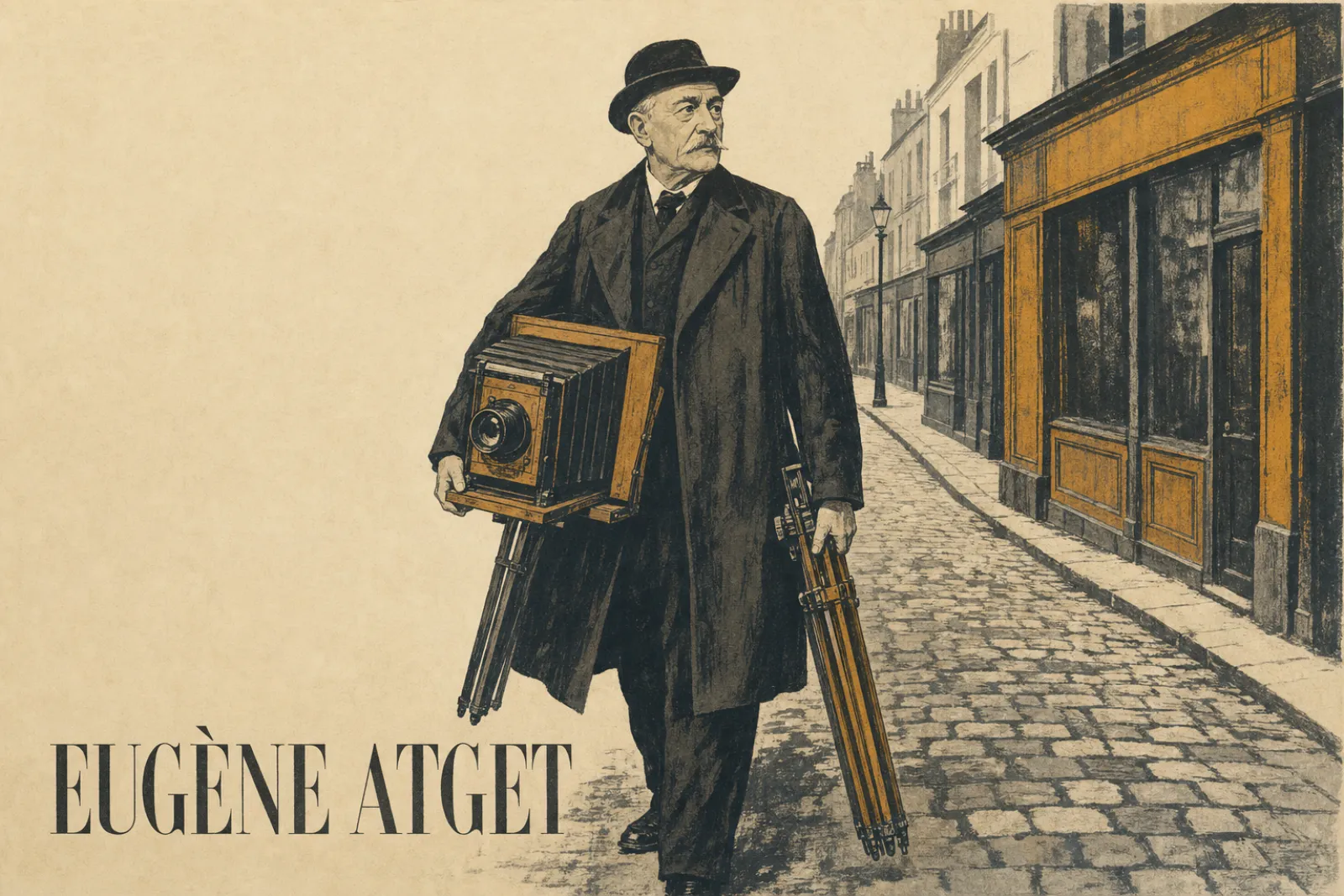
Eugène Atget (1857 to 1927) was a French photographer who spent about thirty years recording Paris and the towns and parks around it. He worked alone with a large wooden camera on a tripod and sold his prints as reference material to painters, architects, craftsmen and libraries. He is known for an archive of roughly 10,000 photographs of streets, shopfronts, courtyards, staircases and gardens, most of them empty of people.
Atget did not think of himself as an artist. The sign on his door read “Documents pour Artistes”, and that is how he sold his work. The people who turned him into a figure in the history of art came later and from a different world. Man Ray, who lived on the same street in Montparnasse, bought nearly fifty of his prints and put some of them in a Surrealist magazine. Man Ray’s assistant, Berenice Abbott, saw the pictures in 1925, bought much of the archive after Atget died and spent forty years getting it published and shown.
From the stage to a trade in documents
Jean Eugène Auguste Atget was born on 12 February 1857 in Libourne, near Bordeaux. His father, a carriage builder, died in 1862 and his mother soon after, and he was raised by his grandparents in Bordeaux. After school he went to sea in the merchant navy.
He moved to Paris in 1878 to become an actor. He got into acting school on his second attempt, lost his place when military service interrupted his studies, and then worked for years with travelling companies in the suburbs and provinces. On tour he met the actress Valentine Delafosse Compagnon, who stayed with him for the rest of her life. An infection of the vocal cords ended his stage career in 1887. He tried painting, without success.
He made his first photographs in 1888, in Amiens and Beauvais, and in 1890 he settled in Paris as a professional photographer. His early stock was what painters and illustrators needed to copy from: flowers, animals, landscapes, monuments. From 1899 he lived and worked at 17 bis rue Campagne-Première in Montparnasse, developing and printing in his apartment and filing the prints in albums that he showed to clients.
What does it mean to photograph a place as a record first? Documentary photography covers how that approach works and what it asks of the photographer.
Thirty years of Old Paris, street by street
Around the end of the 1890s Atget turned to the subject that occupied the rest of his life: the parts of Paris that were older than the Revolution and were being lost to modernisation. He photographed doors, door knockers, staircases, courtyards, fountains, shop signs, market stalls and street traders. He organised the work in numbered series that ran side by side for years, among them Art in Old Paris, Picturesque Paris, Topography of Old Paris, Landscape Documents and Environs. The street traders formed a group known as the Petits Métiers, the small trades.
His buyers were practical people and public collections. A surviving notebook lists some 460 clients, including architects, decorators, set designers, illustrators, publishers and painters such as Georges Braque and Maurice de Vlaminck. From 1898 the Musée Carnavalet and the Bibliothèque historique de la ville de Paris bought his prints, and around 1906 the library commissioned him to document Old Paris systematically. The Bibliothèque Nationale bought albums from him as well. In 1920 he sold 2,621 negatives to the French state body responsible for historic monuments for 10,000 francs.
Outside the city he returned again and again to the royal parks. He began photographing at Versailles in 1901 and went back until the last years of his life. Saint-Cloud and Sceaux followed. These garden pictures, especially the late ones from the 1920s, are where his work moves furthest from plain record.
Old equipment, kept on purpose
Atget used a wooden bellows camera on a tripod, a large format instrument that exposed glass plates measuring 18 by 24 centimetres. The lens was a rapid rectilinear design. The outfit was current when he took it up. Hand-held, more efficient cameras became available later and he ignored them.
He never used an enlarger. Every print was a contact print, the same size as the negative, made by laying the glass plate on sensitised paper in a printing frame and leaving it in the sun. He printed on albumen paper and on gelatin silver printing-out paper and toned the prints with gold. The results are warm in colour, running from sepia to a brown violet.
Two marks of the equipment show in the pictures. The plates were slow, so exposures were long, and anything that moved during the exposure blurred or disappeared. And when he shifted the lens to keep the verticals of a building straight, the corners of the plate fell outside the circle of light the lens could cover, leaving dark curved corners.
Why do the corners of some of his prints go dark? Vignetting explains what causes it in any lens and when it is worth keeping.
How an Atget picture is put together
The first choice was the hour. Many of the photographs were made at dawn or soon after. A street that was normally crowded was empty then, which suited clients who wanted the architecture and nothing else, and the light was soft and even. One museum caption for a late garden picture records the time in its title: April 1925, 7 a.m. Anyone who has tried photographing a busy landmark without the crowds is using the same solution.
The second was the long exposure. Because the plate needed time, the camera recorded what stayed still: stone, iron, glass, trees. Where people do appear they are often soft, half present figures. The same effect is the basis of modern long exposure photography, although Atget arrived at it through slow materials and not by choice of style.
The third was where he stood. His architectural photographs are noted for their wide views, which give a sense of the space around the subject. At Versailles he lined up statues, plinths, steps and hedges so that each element sits clear of the others. The early pictures are sharp from front to back and packed with detail, because detail was what the customer was paying for.
The fourth was the series. A single Atget print is modest. The power is in the accumulation: the same kind of doorway, the same kind of shop, the same park in different seasons, numbered and filed. He treated the city as something to be covered completely, and the archive was the finished work.
Want to work on one subject for years the way he did? Building a long-term photography project sets out how to plan one and keep it going.
Photographs to look for
- Rue de la Montagne-Sainte-Geneviève (1898). A narrow old street that ends in a church. It is normally busy and here it is empty, which is the early morning method in one frame.
- Mullein in Bloom (about 1897 to 1899). A common plant photographed for illustrators, with a sheet and a landscape background in the frame. The buyer was meant to ignore everything but the plant. The odd meeting of sheet, plant and background is the kind of accident the Surrealists later prized.
- Pendant l’éclipse (1912). A crowd gathered at the Colonne de Juillet in Paris to watch a solar eclipse. It was published in the magazine La Révolution surréaliste in June 1926, and it is unusual for Atget because people are the subject.
- Versailles, Chaste Venus (1922 to 1923). A bronze Venus on a raised plinth facing the garden front of the palace. Notice how the camera position lines up sculpture and architecture into a calm, ordered whole.
- Nymphéa (1922 to 1923). A mass of white water lilies in early morning light. The pattern of light and shadow reads as flat shapes and as deep space at the same time.
- The Park at Sceaux (1925). Bare trees with the first spring growth, photographed straight into the morning light, with long reflections on a still pond. Background and foreground seem pressed onto one plane.
Curious how trees and water turn into flat pattern in those late garden pictures? Reflection photography shows how to find and frame reflections.
Try this: one street at first light
Pick one short street, courtyard or path near home. Go there within half an hour of sunrise, when it is empty. Give yourself 15 minutes and these rules.
- Make exactly six photographs: the whole street from one end, then five details. A door, a sign, a set of steps, a window, a corner.
- Hold the camera or phone level so that vertical lines stay vertical. Step back instead of tilting up.
- No people, no cars moving through. Wait until the frame is clear.
- Keep everything sharp from front to back. On a camera, stop the lens down and use a support.
Put the six pictures side by side afterwards. Ask whether someone who had never been there could rebuild the place from them. That is the test Atget’s clients applied.
Questions people ask about Eugène Atget
What camera did Eugène Atget use?
A wooden bellows view camera on a tripod, with a rapid rectilinear lens and 18 by 24 centimetre glass plates. He kept this equipment for his whole career, even after smaller and faster cameras became common. All his prints were contact prints the same size as the plate.
Why are there so few people in his photographs?
He often worked at dawn, when the streets were empty, and his plates needed long exposures, so moving figures blurred or did not register. His customers also wanted clear views of buildings and details to work from. People were the subject only in particular groups of pictures, such as the street traders.
Was Atget a Surrealist?
No. Man Ray and other Surrealists admired his pictures of shop windows, doorways and staircases and published several in 1926. By Man Ray’s account, Atget asked that his name not be printed with the picture and said that what he made were simply documents.
What happened to his photographs after he died?
Atget died in Paris on 4 August 1927. Berenice Abbott bought the prints and negatives that remained in his studio, completing the purchase in June 1928, with the New York gallery owner Julien Levy taking a half share, and promoted the work through the 1930 book Atget, Photographe de Paris and later The World of Atget (1964). In 1968 the collection, 1,415 glass negatives and nearly 8,000 prints, was sold to the Museum of Modern Art in New York.
For more lives like this one, see the A to Z of photographers.