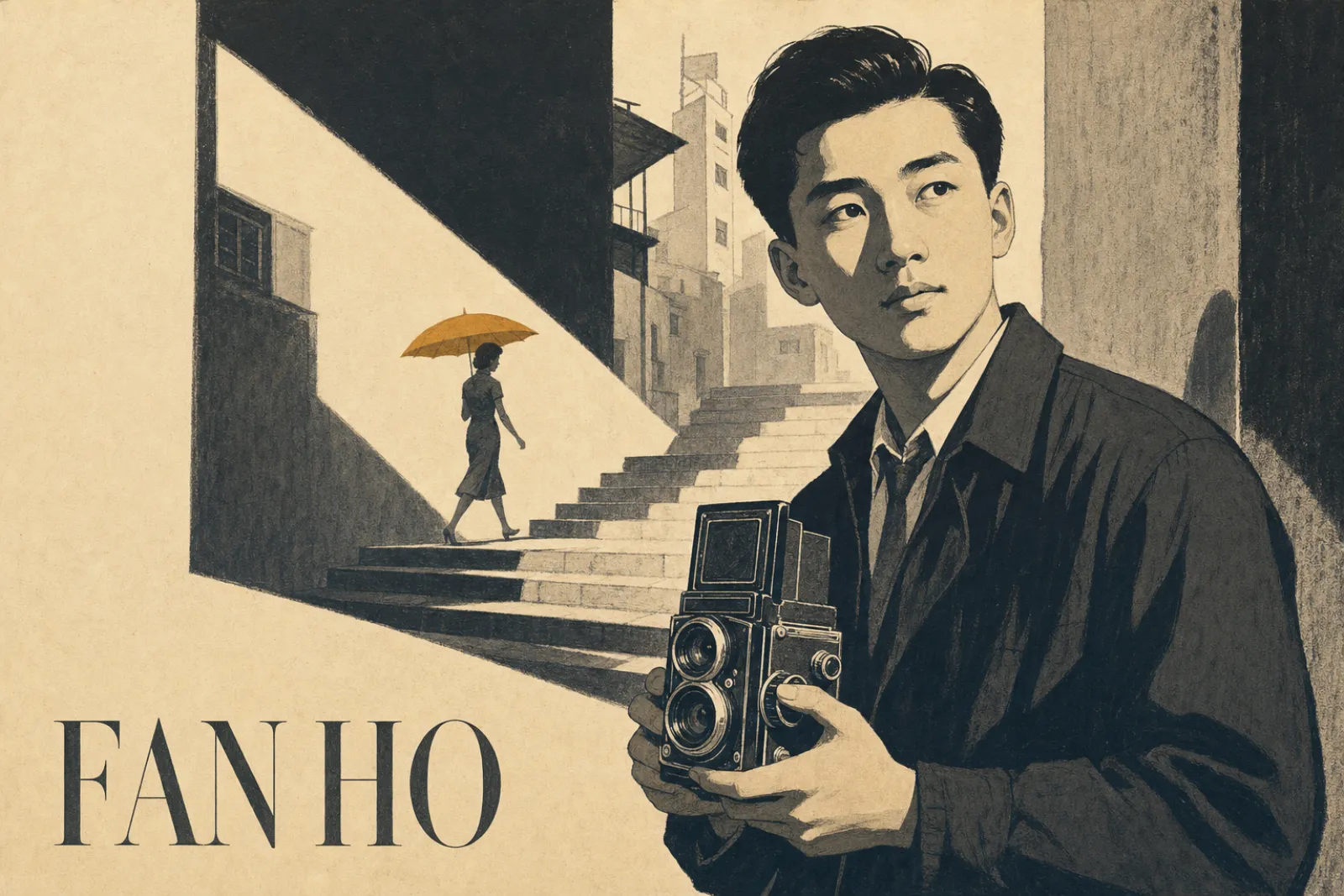
Fan Ho (1931 to 2016) was a photographer and film director who was born in Shanghai and worked in Hong Kong. In the 1950s and 1960s he photographed the city’s streets, alleys, markets and harbour in black and white with a Rolleiflex twin lens reflex camera. He is known for pictures in which one small figure crosses a stage built from hard light, deep shadow and geometry, and for winning more than 280 awards in international salons.
He was largely self taught. His estate describes him as “the Cartier-Bresson of the East”, a label that points to the idea he shared with Henri Cartier-Bresson: wait for the instant when everything in the frame falls into place. The difference is in what came before and after that instant. Fan Ho chose his background first and composed it with great care, and he was willing to keep working on a picture in the darkroom. He also thought like a film maker. He spent decades in the Hong Kong film industry and said that photography and film were like sisters, both using images to tell a story and express feeling.
Shanghai, a camera at 14, and Hong Kong at 18
Fan Ho was born in Shanghai on 8 October 1931. He began photographing as a boy and, by his estate’s account, won his first award in Shanghai at 14. He learned by doing, and developed his early pictures in the family bathtub.
In 1949 the family moved to Hong Kong. He was 18. The camera he is associated with from then on is the Rolleiflex, a twin lens reflex. His estate says he made all his best known photographs with it.
Hong Kong in those years was growing fast. Fan Ho walked its alleys, slums, markets and streets and photographed street vendors, labourers, children and families, as well as life on the boats and along the waterfront. His estate notes that he was most productive in his teens and twenties, before the age of 28.
New to photographing strangers in public places? Street photography covers the approach, the settings and the etiquette.
The salon years
The route to recognition for a photographer in 1950s Hong Kong ran through salons, the juried exhibitions held by photographic societies around the world. Fan Ho entered them in great numbers. From 1956 he won more than 280 awards, and his estate puts the lifetime total at close to 300. The Photographic Society of America named him one of its top ten photographers of the world between 1958 and 1965. He became a Fellow of the Photographic Society of America and of the Royal Photographic Society, and an honorary member of photographic societies in Singapore, Argentina, Brazil, Germany, France, Italy and Belgium.
He also wrote. Thoughts on Street Photography first appeared in 1960 and was reissued in 2025.
Three decades in film, then back to the negatives
In the early 1960s Fan Ho joined the Shaw Brothers studio, first in continuity and then as an actor. He played the monk Tripitaka in the studio’s cycle of four Journey to the West films in the 1960s. Alongside the studio work he made short experimental films of his own. Big City Little Man (1963) won an award at a film festival in Japan in 1964.
He left Shaw Brothers in 1969 to direct, and made more than 20 films for studios in Hong Kong and Taiwan. His first feature, Lost, dated 1970 by his estate, was shown at the Cannes Film Festival. It was long considered lost before the one surviving print was found and restored.
His wife and children had moved to San Jose, California, in 1979. He joined them in 1995 after retiring from cinema. Encouraged by his family, he returned to photography, and what he returned to was his own archive of Hong Kong negatives from decades earlier. A show at Modernbook Gallery in Palo Alto in 2000 was his first exhibition since the 1960s. In 2006 the New York dealer Laurence Miller saw the work, acquired 26 prints and gave him a solo exhibition. Three books followed: Hong Kong Yesterday (2006), The Living Theatre (2009) and A Hong Kong Memoir (2014).
Fan Ho died in San Jose on 19 June 2016, aged 84. His photographs are held by M+ and the Heritage Museum in Hong Kong, the Bibliothèque Nationale de France and the San Francisco Museum of Modern Art, among others.
Set the stage, then wait for the actor
The method starts with the background. Fan Ho looked for a setting with strong geometrical construction, pattern and texture: a wall, a stairway, a street cut by a shaft of light. He treated it as a stage. Then he waited, patiently, for a person to walk into the right spot. This is the idea usually called the decisive moment, but with the composition fixed in advance, so that the only thing left to chance is the figure.
The light did most of the work. He favoured the hours around dusk, when the sun is low and shadows are long, and he often shot towards the light. Backlighting turned people into dark shapes with bright edges and separated them from the ground behind. Where there was smoke or steam in the air, the light became visible as beams, and he used that combination of smoke and light again and again to build atmosphere.
Wondering how a dark figure against a bright ground is exposed? Silhouette photography explains where to meter and what to leave black.
Shadow is a subject in its own right in these pictures. Large areas of the frame are simply black, and the black areas have shape. A photograph may be half shadow, with a single small person in the lit part. The contrast in scale between the figure and the space around it is what gives the pictures their feeling of solitude.
Want to make the dark half of the frame do more? Shadow photography shows how to treat shadows as the subject.
The darkroom was part of the picture making. His best known photograph, Approaching Shadow, is not a caught moment at all: the figure was posed and the shadow was added during printing. In his later years he went further, combining old negatives to make new composite prints of a Hong Kong that had vanished. Anyone studying him should hold both ideas together. He waited for real moments, and he also constructed images when the picture in his mind required it.
Laurence Miller, on first seeing the prints, said they felt like direct descendants of the Bauhaus, although they were made in Hong Kong. The remark fits. The pictures are built from line, diagonal and block, in the manner of modernist design, and filled with ordinary life.
How do lines and blocks of tone hold a frame together? Photography composition sets out the main techniques with examples.
Photographs and books to look for
- Approaching Shadow (1954). Fan Ho posed his cousin against a wall at Queen’s College in Causeway Bay and added a diagonal shadow in the darkroom. He said it stood for the fading of youth, a fate everyone shares. A print sold for HK$375,000 in 2015.
- A Play of Light and Shadow. Dated 1959 by his gallery. The title states his subject plainly, and it is a good first picture to compare with Approaching Shadow.
- Hong Kong Yesterday (2006). The first of the late books. The photographs span 1949 to 1968 and show working people, children, slums, markets and the harbour.
- The Living Theatre (2009). The title is the method: the street as a stage and passers-by as the cast.
- Portrait of Hong Kong (2017). Published after his death, with 153 photographs selected from 500 negatives and a preface by the film director John Woo.
Try this: fifteen minutes at one patch of light
Go out late in the day when the sun is low. Find one place where a hard edge of light falls across a wall, a pavement or a stairway. Then follow these steps.
- Compose the empty scene first. Decide exactly where the edges of the frame go and do not move.
- Expose for the bright area so that the shadows go fully black. On a phone, tap the brightest part and pull the exposure down.
- Decide on the one spot where a person should be. It should be in the light, small, and clear of any dark shape behind.
- Wait. Photograph only when someone reaches that spot. Take no more than ten frames in 15 minutes.
Convert the best frame to black and white and crop it tight. Check whether the figure reads at a glance. If it does not, the stage was too busy or the figure was in the wrong place.
Questions people ask about Fan Ho
What camera did Fan Ho use?
A Rolleiflex twin lens reflex, the camera behind the Hong Kong photographs he is known for. His first camera, as a boy in Shanghai, was a Kodak Brownie. His Rolleiflex was exhibited with 32 of his photographs at Sotheby’s in Hong Kong in June 2017.
Was Approaching Shadow staged?
Yes. The woman was his cousin, posed against a wall at Queen’s College in Causeway Bay, and the large diagonal shadow was created in the darkroom. It was made in 1954.
Did Fan Ho make films?
Yes. He worked at Shaw Brothers as an actor in the 1960s, then left in 1969 and directed more than 20 films in Hong Kong and Taiwan. He retired from film and moved to California in 1995.
When did Fan Ho die?
He died on 19 June 2016 in San Jose, California, at the age of 84. Books of his Hong Kong photographs have continued to be published since then, among them Portrait of Hong Kong (2017).
To find other photographers who worked the street, browse the A to Z of photographers.