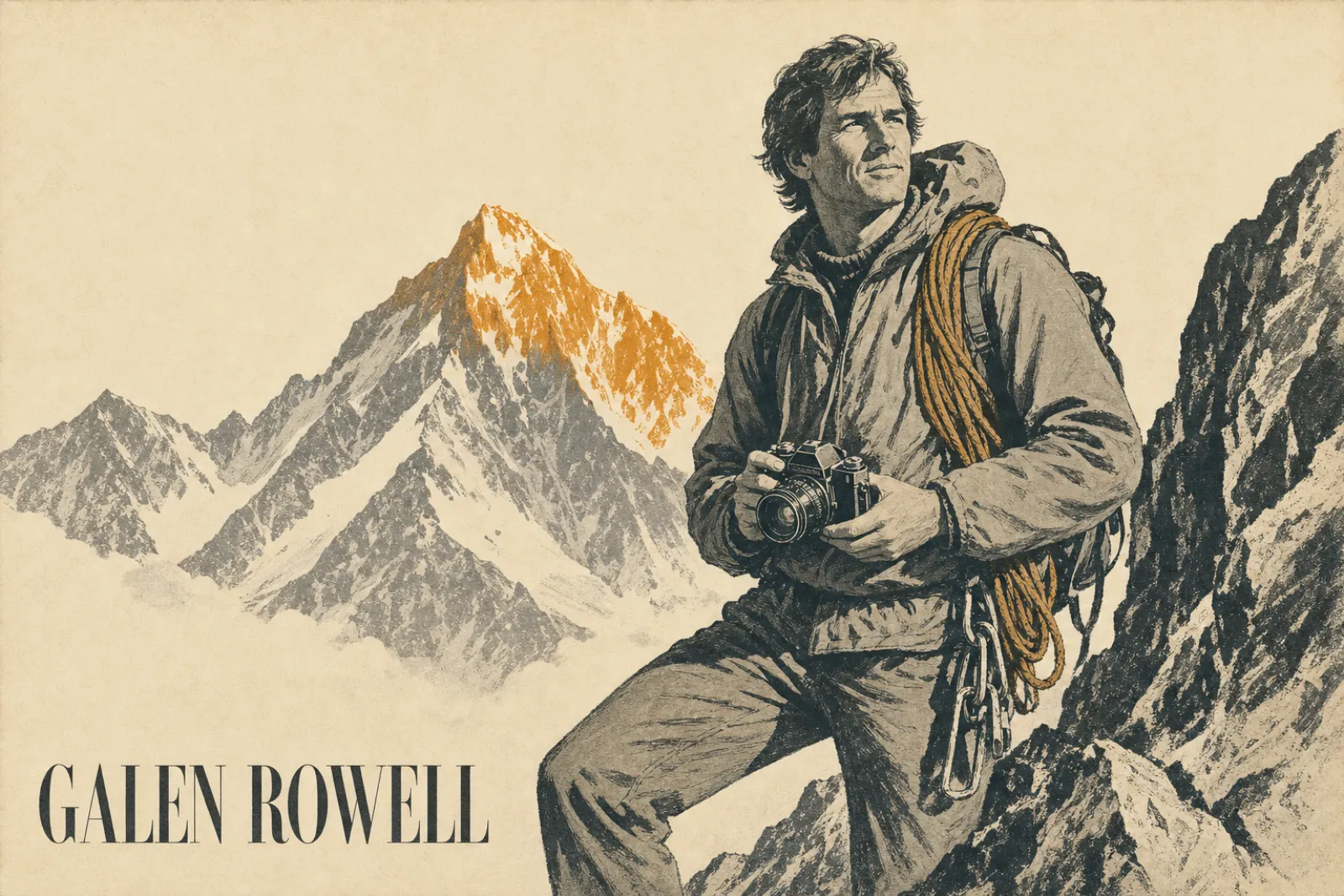
Galen Rowell (1940 to 2002) was an American photographer, writer and mountaineer from California. He photographed mountains and wild places on 35mm colour slide film, often while climbing or skiing through them himself. He is known for what he called dynamic landscapes: pictures made by getting to the right place at the moment the light peaked, and for the graduated filters and fill flash methods he worked out to hold that light on film.
Rowell came to photography from climbing, not from art school, and had no formal training in it. In 1984 he received the conservation photography award named for Ansel Adams, but his working method was his own. He carried a small camera and went where a climber could go. He did not see himself as an observer of the scene. He considered himself a participant in it, with the landscape part of the adventure and the adventure part of the landscape.
A Yosemite climber with a car repair business
Rowell was born in Oakland, California, on 23 August 1940 and was taken into the wilderness from a very young age. He made his first roped climb in Yosemite Valley at 16. He graduated from Berkeley High School in 1958 and went on to the University of California, Berkeley, but left without finishing in order to climb.
He ran a small automotive business and climbed. He made more than 100 first ascents in the Sierra Nevada. In 1970 he and Warren Harding climbed the south face of Half Dome, a route listed among Harding’s first ascents. From 1968 he used Nikon 35mm cameras and lenses and nothing else.
Heading into high country with a camera? How to photograph mountains covers light, scale and settings.
1972: the business sold, the camera full time
In 1972 Rowell sold the business and became a full-time photographer. His first major assignment was a National Geographic cover story on Half Dome in Yosemite National Park. Over the next thirty years he photographed and wrote for Life, National Geographic and Outdoor Photographer, and published eighteen books.
The climbing went on at the same level as the photography, and the two fed each other. In 1977 he was on the first ascent of Great Trango Tower in the Karakoram, in Pakistan, with John Roskelley, Kim Schmitz, Jim Morrissey and Dennis Hennek. In June 1981 he made the second ascent of Amne Machin in China with Harold Knutsen and Kim Schmitz, by the east ridge, less than three weeks after a Japanese expedition had reached the summit. On 22 April 1982 he was one of five climbers on the first ascent of Cholatse in the Everest region of Nepal. He made the first one-day ascents of Denali and of Kilimanjaro, and the first circuit of Denali on skis. On the one-day Denali climb his camera froze. At 57 he climbed El Capitan in a day.
His first widely read book was about mountaineering. In the Throne Room of the Mountain Gods (1977) is a history of climbing on K2. The same year he received the Sierra Club’s Francis P. Farquhar Mountaineering Award. In 1984 came the Ansel Adams Award for Conservation Photography. He also gave time to Tibetan causes. In 1989 he and the Dalai Lama produced the book My Tibet.
What makes a photograph a conservation photograph? What is conservation photography explains the idea and how it is practised.
Mountain Light, in print and in Bishop
Mountain Light: In Search of the Dynamic Landscape was published in 1986. Galen Rowell’s Vision followed in 1993 and Inner Game of Outdoor Photography in 2001. His wife, Barbara Cushman Rowell, was a photographer, author and pilot. The Mountain Light Photography Gallery in Bishop, California, shared its name with the 1986 book and stayed open until October 2017.
Galen and Barbara Rowell died on 11 August 2002 when the small plane bringing them home from a photography workshop in Alaska crashed on its approach to the airport near Bishop. The pilot and one other passenger also died. Rowell was 61. Galen Rowell: A Retrospective was published in 2006.
Being there when the light happens
The phrase dynamic landscape had two meanings for Rowell. The first was that light and conditions in the mountains change fast. The second was that the photographer must move just as fast, in energetic pursuit of the best camera position at the best moment. A view of a peak is always available. The same peak under a clearing storm at sunset lasts a few minutes, and the right foreground for it may be a hard scramble away.
That is where the 35mm camera fits. A small camera can go up a climb with the climber, and a photographer who is part of the action needs one that does not slow him down. He was especially keen on optical phenomena in the natural world, the kind of event that appears with little warning and is gone before a slow photographer has set up.
How do you know in advance where the light will fall? Planning a photo around the sun, moon, tides and weather shows the tools for working it out.
The technical problem was film, and film stocks differ in how much contrast they can take. Colour slide film records a narrow range of brightness. A glowing sky above a shadowed valley is more than it can hold, so either the sky burns out or the land goes black. Rowell shot Kodachrome through the 1980s and Fuji Velvia after 1990, and he attacked the problem in two ways.
The first was the graduated neutral density filter. Half of the filter is grey and cuts the light, and half is clear, with a soft or hard transition between. Placed with the dark half over the sky, it brings sky and land within the range the film can record in a single exposure. Rowell developed a set of these filters, which Singh-Ray manufactured and sold under his name, and he is credited with making them popular. The same idea is covered in how to use graduated neutral density filters.
The second was balanced fill flash: a small, controlled amount of flash to lift a shadowed foreground or a person close to the camera, set low enough that the daylight still looks like daylight. Both methods do one job. They squeeze a scene with a wide dynamic range into a medium with a narrow one, at the moment of exposure, with no later editing to lean on.
Want the wider picture of the genre he worked in? Landscape photography goes through technique, light and composition.
Books and stories to look for
- The Half Dome cover story in National Geographic. His first major assignment after he turned professional in 1972, published as the cover story of the June 1974 issue.
- In the Throne Room of the Mountain Gods (1977). A mountaineering history of K2, published the year he climbed Great Trango Tower.
- Mountain Light: In Search of the Dynamic Landscape (1986). The subtitle is his method in one phrase. Look at each picture and ask what was changing when it was made: the light, the weather or the photographer’s position.
- Galen Rowell’s Vision (1993). A later book on photography, seven years after Mountain Light.
- Inner Game of Outdoor Photography (2001). A book on photography from the year before he died.
- Galen Rowell: A Retrospective (2006). The posthumous overview, and the simplest way to see the range of a thirty year career in one volume.
Try this: fifteen minutes of changing light
Pick an evening with broken cloud. Choose an open view within a short walk of home: a hill, a park, a waterfront. Arrive 20 minutes before sunset with a camera or phone.
- Do not stand still. In 15 minutes, photograph the same subject from five positions that are at least 30 steps apart.
- At each position, put something close in the bottom of the frame: a rock, a plant, a fence post.
- At each position take two frames, one exposed for the sky and one for the ground. Notice how far apart they are.
- When the light on the subject is at its strongest, be moving towards the best of your five positions, not away from it.
Afterwards, compare the five. The exercise shows how much the picture depends on where you were standing when the light peaked, and how large the gap between sky and ground is that a graduated filter is made to close.
Questions people ask about Galen Rowell
What camera and film did Galen Rowell use?
He used Nikon 35mm cameras and lenses exclusively from 1968. He shot colour slide film: Kodachrome through the 1980s and Fuji Velvia after 1990.
What is a Galen Rowell graduated filter?
It is a graduated neutral density filter, dark in one half and clear in the other, used to darken a bright sky so that sky and foreground can be recorded in one exposure. Rowell developed a set of four with the filter maker Singh-Ray, which sold them under his name.
What did Rowell mean by a dynamic landscape?
He used the term for his own landscape photographs. It referred both to the fast-changing light and conditions he sought and to his energetic pursuit of the best camera position at the best moment.
How did Galen Rowell die?
He died in a plane crash near Bishop, California, on 11 August 2002, with his wife Barbara and two others. They were returning from a photography workshop in Alaska. He was 61.
Rowell is among the photographers quoted on the photography quotes page, and the A to Z of photographers lists everyone covered on this site.