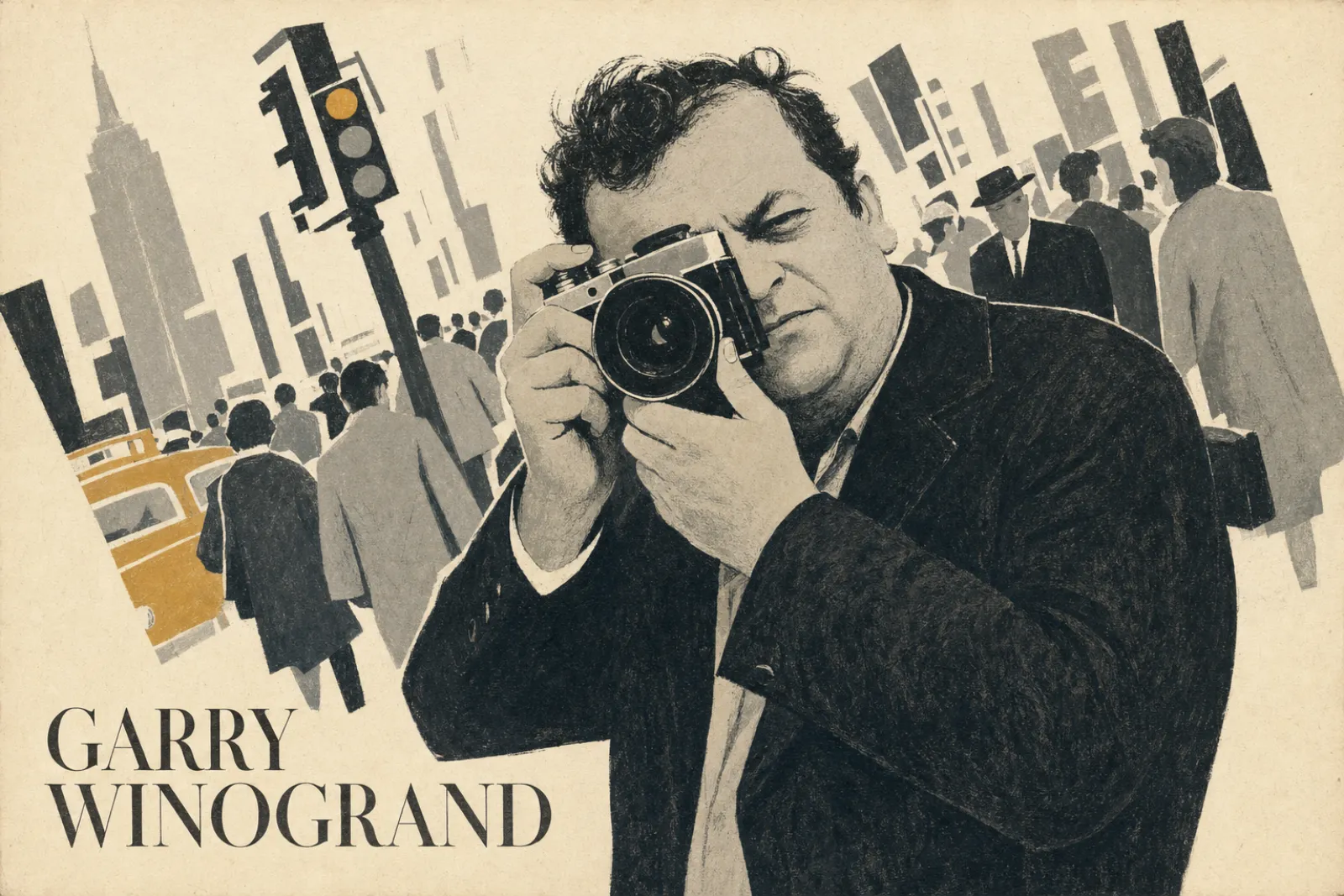
Garry Winogrand (1928 to 1984) was an American photographer who worked on the streets of New York and, later, across Texas and Los Angeles. He used a 35mm camera with a wide lens, at close range, and he photographed at a pace few have matched. He is known for crowded, tilted, fast pictures of American public life in the 1960s and 1970s, and for the mountain of unexamined film he left when he died.
He trained as a painter and then as a magazine photographer, and his starting point was photojournalism. Two older photographers changed his direction: the work of Walker Evans, which he came to know in the mid 1950s, and that of Robert Frank. In 1967 the Museum of Modern Art showed him alongside Diane Arbus and Lee Friedlander in an exhibition called New Documents. The curator, John Szarkowski, wrote that these photographers had turned the documentary approach to more personal ends, and that their aim was not to reform life but to know it. Szarkowski later called Winogrand the central photographer of his generation.
The Bronx, painting classes and the picture agencies
Winogrand was born in New York City on 14 January 1928 and grew up in the Bronx. He finished high school in 1946 and served in the Army Air Force until 1947. He then studied painting at City College of New York, and painting and photography at Columbia University, where he learned to work in a darkroom. In 1951 he took a photojournalism class with the art director Alexey Brodovitch at the New School for Social Research.
Through the 1950s and into the 1960s he earned his living as a freelance photojournalist and advertising photographer. He worked through the PIX agency from 1952 to 1954 and Brackman Associates from 1954, covering human interest stories for popular magazines. One of his photographs was included in The Family of Man at the Museum of Modern Art in 1955. His first solo exhibition was at the Image Gallery in New York in 1959.
Want to know what that kind of magazine work involves? Photojournalism looks at how news and feature photographers work.
1964 and the public life of a country
In the early 1960s Winogrand’s own pictures took over from the assignments. The Museum of Modern Art included him in Five Unrelated Photographers in 1963. In 1964 he received a Guggenheim Fellowship for photographic studies of American life and drove across the country, making almost 20,000 exposures on the trip. Some of the strongest pictures of that year were made at home in New York.
New Documents ran from 28 February to 7 May 1967 and included 32 of his black and white prints. He had also prepared a tray of 80 colour slides for it. The slides were later withdrawn from the show because of technical problems, and his colour work, more than 45,000 slides from the 1950s and 1960s, was not given a full exhibition until 2019.
His books followed his interests one at a time. The Animals (1969) came from New York’s zoos and the Coney Island aquarium, where he spent time with his children and watched people watching animals. A second Guggenheim Fellowship in 1969 was for a study of the effect of the media on events, and the result was Public Relations (1977), made at demonstrations, parties and political events. Women Are Beautiful (1975) gathered photographs of women he had encountered on the street, and it drew criticism because the women were photographed without their knowledge.
Texas, Los Angeles and the film he never saw
Winogrand taught at the Institute of Design in Chicago in 1971 and 1972 and at the University of Texas at Austin from 1973 to 1978. In 1974 the Fort Worth Art Museum commissioned him to photograph the city’s stock show and rodeo, which became Stock Photographs (1980). A third Guggenheim Fellowship came in 1979. He moved to Los Angeles in 1978 and kept photographing there.
He was diagnosed with cancer on 1 February 1984 and died on 19 March in Tijuana, Mexico, where he had gone to a clinic for treatment. He was 56. He left about 2,500 rolls of film undeveloped, about 6,500 rolls developed but never proofed, and about 3,000 rolls taken only as far as contact sheets: close to 300,000 pictures he had never edited.
The Museum of Modern Art mounted a retrospective in 1988 with the book Figments from the Real World, which included 25 pictures chosen from the unedited film. A larger retrospective opened at the San Francisco Museum of Modern Art in 2013 and travelled to Washington, New York and Paris. Its curator, Leo Rubinfien, argued that Winogrand was at his best from 1960 to 1964. His archive is held by the Center for Creative Photography at the University of Arizona.
Close, wide, tilted and fast
The equipment set the terms. Winogrand’s preferred lens was a 28mm, a wide-angle lens on a small 35mm camera. A lens that wide takes in a lot, so to make any one person large in the frame he had to be near them, and to avoid distortion he had to be in front of them. Distance was the first decision, and he chose close.
How do you keep a wide lens sharp when there is no time to focus? Zone focusing explains how to set the focus in advance.
The wide view also filled the frame with more than one thing. A Winogrand photograph often has several people doing unrelated things, and the picture is in how they line up: a gesture repeated by two strangers, a glance that crosses another glance. The critic Andy Grundberg wrote that the pictures offer many viewpoints in place of a single subject, and that an almost subliminal order lies under their chaotic surface. Learning to see those meetings is the skill behind juxtaposition in photography, and it is why his pictures reward a slow look.
He tilted the camera. Tilted exposures are one of the marks of his work that museum biographies single out. In the catalogue of the 1988 retrospective Szarkowski wrote of the electric character of his drawing and the kinetic nature of his pictorial structure. In plain terms, the frame feels as if it is moving along with the people in it.
He shot rapidly, in great quantity and from angles that could look arbitrary. Intuition and luck were part of the method. He did not frame one careful composition. He made thousands of exposures and then chose the few that struck him as unfamiliar or mysterious. He said, in several versions, that he photographed to find out what things looked like photographed. The idea is worth taking literally. He did not claim to know what the picture would be until he saw it, so the second half of the work was editing.
Not sure how to choose from hundreds of frames? Photo culling workflow gives a system for picking the few that hold up.
There is humour in the pictures, much of it built on visual puns, and there is unease as well. Both come from the same habit of watching candid public behaviour without stepping in.
Does the idea of standing that close to strangers put you off? Overcoming your fear in street photography offers ways to start.
Photographs to look for
- Two Chorus Girls Relaxing Between Shows (1954). An early magazine era picture, dark and grainy, lit by a window. He worked at close range and tilted the camera upward, so the seated dancer’s legs loom out of proportion. The cropping is hard, yet the scene reads as a moment of friendship.
- New York City (1964). One of the zoo pictures. Visitors are absorbed in a walrus, and the walrus appears to look straight at the camera. He kept the barriers between people and animals in view, which zoo photographs usually hide.
- World’s Fair, New York City (1964). Made in the year of his first Guggenheim Fellowship. Szarkowski selected it for Women Are Beautiful.
- Utah (1964). Taken on the cross country trip, from the driver’s seat. A cow stumbles in the road ahead of the car, and the viewer is placed behind the wheel with no time to brake.
- Fort Worth, Texas (1974). From the stock show commission. A horse rears above the cowboys trying to control it. The animal’s eye is the fixed point in a frame full of frantic movement.
- Austin, Texas (1974). A college football game photographed from the sidelines, as close to the play as he could get, with the 28mm lens.
Planning to photograph at a zoo yourself? Zoo and aquarium photography covers shooting through glass and fences.
Try this: one corner, one wide lens, 36 frames
Choose a busy corner, a market or a transit entrance. Set your widest lens, or the main camera on a phone with no zoom. Give yourself 15 minutes and these rules.
- Stand where people pass within three or four steps of you, and face them.
- Every frame must contain at least three people. No single portraits.
- Do not level the camera on purpose. Let the frame tilt if that fits more in.
- Take exactly 36 frames, the length of one roll of 35mm film, and do not look at the screen until you are finished.
Leave the pictures alone until the next day. Then pick two. Look for frames where separate people echo each other in gesture or direction. Those are the ones built the way his were.
Questions people ask about Garry Winogrand
What lens did Garry Winogrand use?
His preferred lens was a 28mm wide angle on a 35mm camera. It forced him to work close to people and from the front, and it is the reason his frames hold so many figures at once.
How many photographs did Winogrand leave undeveloped?
At his death in 1984 there were about 2,500 undeveloped rolls, about 6,500 developed rolls that had never been proofed and about 3,000 more that existed only as contact sheets. Together that is nearly 300,000 unedited pictures.
What was New Documents?
It was a 1967 exhibition at the Museum of Modern Art in New York, curated by John Szarkowski, with work by Diane Arbus, Lee Friedlander and Garry Winogrand. It presented documentary photography made for personal reasons and not to argue for social reform. Critics were sceptical at first, and all three were later counted among the leading photographers of their generation.
What books did Garry Winogrand publish?
Four in his lifetime are best known: The Animals (1969), Women Are Beautiful (1975), Public Relations (1977) and Stock Photographs: The Fort Worth Fat Stock Show and Rodeo (1980). Figments from the Real World followed in 1988, after his death.
Winogrand is among the photographers quoted on the photography quotes page, and the A to Z of photographers lists the others covered on this site.