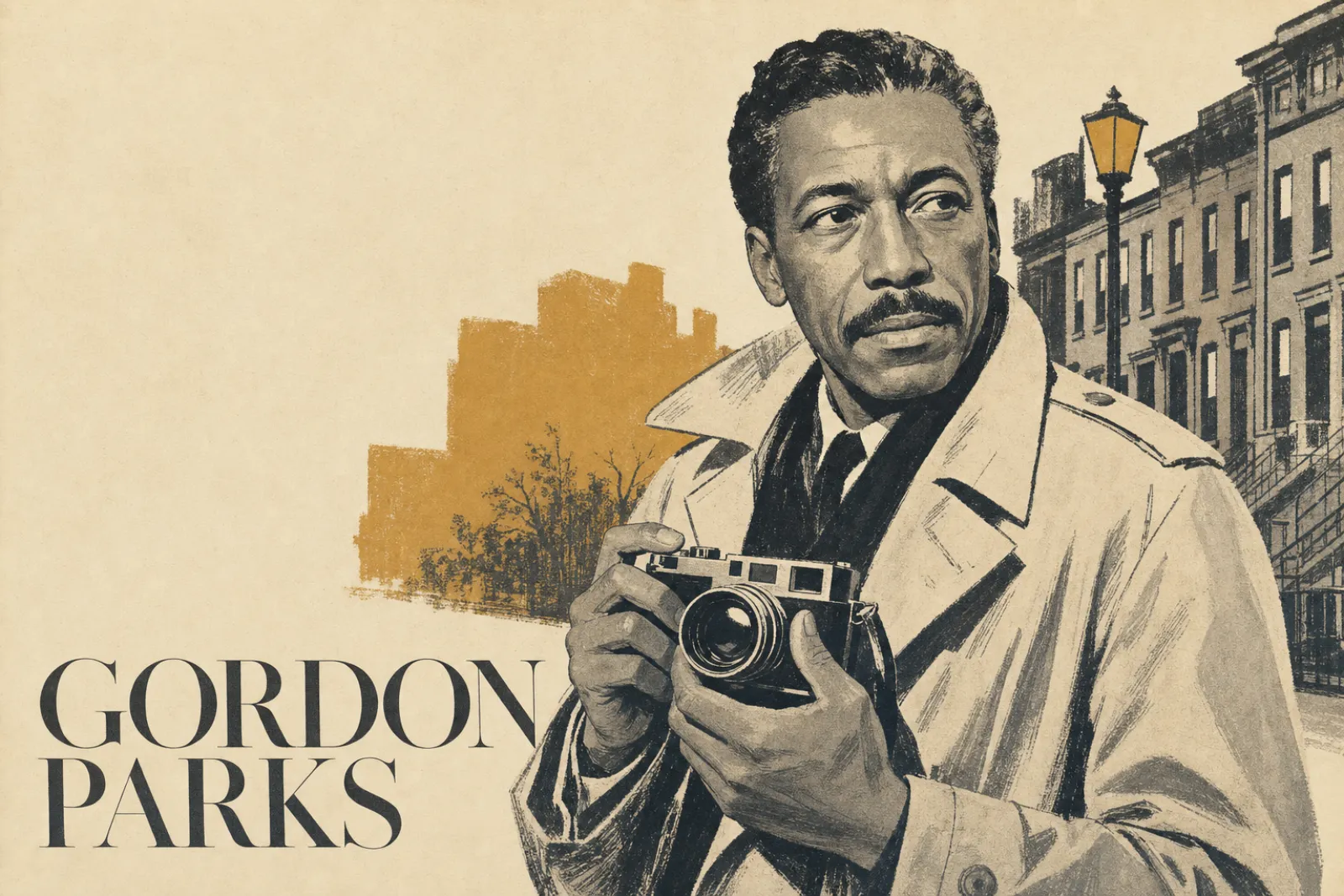
Gordon Parks (1912 to 2006) was an American photographer, writer, composer and film director. Born in Fort Scott, Kansas, he worked for the Farm Security Administration in Washington in 1942, then became the first African American staff photographer at Life magazine, where he stayed for about two decades. He is best known for American Gothic, his 1942 portrait of the government cleaner Ella Watson, and for photo essays on poverty and segregation.
Parks decided to become a photographer after seeing Farm Security Administration pictures in a magazine. That agency’s photography unit, directed by Roy Stryker, had set out to record rural poverty during the Depression, and its best known photographers included Dorothea Lange and Walker Evans. Parks joined the same unit as a trainee in 1942 and carried its method, the long look at one family or one person, into magazine work for the rest of his career.
From a pawnshop camera to Roy Stryker’s office
Parks left Fort Scott for Minnesota in 1928. His first camera was a Voigtländer Brillant bought at a pawnshop in Seattle. He found paid work making portraits and fashion pictures in St. Paul and Chicago. In Chicago he also photographed the South Side. An exhibition of those pictures in 1941 led to a Julius Rosenwald Fellowship in 1942, and the fellowship took him to Washington.
He arrived at the Farm Security Administration in January 1942. Stryker first told him to walk around Washington without a camera and see how the city treated him. Parks met discrimination in its shops and restaurants. Parks then approached Ella Watson, a Black woman who worked as a cleaner in the government building, and asked to photograph her. She agreed, and for about four months she gave him access to her home, her family and her church.
When the unit was absorbed into the Office of War Information, Parks went with it and photographed the 332d Fighter Group, the Tuskegee Airmen. He later followed Stryker to a documentary project for the Standard Oil Company of New Jersey, photographing small towns and industrial sites. In the same years he began to shoot fashion for Vogue.
What makes a set of pictures a documentary project and not a pile of single frames? Documentary photography: telling stories with images covers access, time and structure.
The Life essays: one person at the center
In 1948 Parks photographed a story for Life on a gang in Harlem. He won the trust of Red Jackson, the young leader of a gang called the Midtowners, by spending a week driving Jackson and his companions around in his own car before he ever asked to take a picture. The published essay, Harlem Gang Leader, brought him a staff job at Life.
The pattern held for the next twenty years. In 1952 he worked with the novelist Ralph Ellison on A Man Becomes Invisible, a set of staged pictures based on Ellison’s novel Invisible Man. In 1956 Life sent him to Alabama, where he photographed the daily life of an extended Black family under segregation, in color. In 1961 he went to Rio de Janeiro to report on poverty and built the story around Flavio da Silva, a boy with severe asthma who was the eldest of eight children in the Catacumba favela. Readers sent about 30,000 dollars within a month, which paid for the family to move and for Flavio to be treated at a hospital in Denver. In 1968 Life published his essay on the Fontenelle family of Harlem, parents and nine children living in severe poverty.
Parks also photographed fashion for Life from 1948 to 1951, including the Paris collections, and made portraits of Malcolm X, Muhammad Ali and Stokely Carmichael. Not every story ran. In 1950 Life sent him back to Fort Scott to find the eleven members of his junior high school class. Some had stayed in Fort Scott and others had moved to cities such as Chicago, Detroit and St. Louis. The magazine never published the result.
How do you plan a story in pictures, from opening frame to closing frame? How to create a photo essay walks through the shots a story needs and the order to put them in.
Books, films and a second career
Parks wrote throughout his life. The Learning Tree, a novel drawn from his Kansas childhood, appeared in 1963, and the memoir A Choice of Weapons in 1966. In 1969 he turned The Learning Tree into a film, becoming the first African American to write and direct a feature for a major Hollywood studio. Shaft followed in 1971 and Leadbelly in 1976. He received the Spingarn Medal in 1972, the National Medal of Arts in 1988 and the International Center of Photography’s Infinity Award for Lifetime Achievement in 1990. In the 1990s he made a group of abstract photographs.
How Parks made a picture carry an argument
The first choice was time. Parks spent four months with Ella Watson and a week with Red Jackson before he took a single frame. Long access changes what people do in front of a camera. The pictures of Watson’s household show families at the table and children in sparsely furnished rooms, scenes that only happen once the photographer has stopped being a visitor.
The second choice was to tell a large subject through one named person. Segregation became one family. Poverty in Latin America became one boy. This is the basic structure of visual storytelling: a reader who knows a face follows it through the pages.
Third, Parks was willing to direct. American Gothic is a posed picture. Watson stands in front of an American flag holding a broom and a mop, and the title points at Grant Wood’s 1930 painting of the same name. The picture works by juxtaposition: the flag and the tools of her job are in the same frame, and the viewer is left to connect them. It is also an environmental portrait, a person shown with the place and objects that explain her life.
Fourth, he used whatever the story needed. The 1956 segregation pictures are in color, which keeps the scenes ordinary and close. For the Ellison essay he built sets, and for one scene combined a negative of a set with a negative of the New York skyline at night, a darkroom form of double exposure. His fashion work used the movement of the street and gave him a second set of skills to draw on.
Where is the line between photographing hardship and using it? Photography etiquette and ethics sets out the questions of consent and respect that this kind of work raises.
Photographs and essays to look for
- American Gothic, Washington, D.C. (1942). Ella Watson with broom and mop in front of the flag. Notice how little is in the frame: one person, two tools, one symbol. Then look for the other Watson pictures, such as Neighborhood Children, to see the same subject without the staging.
- Harlem Gang Leader (1948). The essay moves between quiet portraits of Red Jackson and blurred frames of fights. Notice how the still pictures make the violent ones harder to dismiss.
- Emerging Man (1952). The opening picture of A Man Becomes Invisible. It shows the novel’s narrator coming up above ground, played by John Bates, a friend of Ellison. It is fiction made with a camera, and it sits beside Parks’s reportage without apology.
- Segregation Story (1956). Look for At Segregated Drinking Fountain, Outside Looking In and Ondria Tanner and Her Grandmother Window-Shopping. The essay was shot on color transparencies and ran in Life on September 24, 1956.
- Flavio (1961). Published in Life on June 16, 1961. Flavio After Asthma Attack and Flavio Feeds Zacarias show a child doing an adult’s work in a home with almost nothing in it.
- The Fontenelle Family (1967). Published in March 1968. Family Crowds Around Open Oven for Warmth states the conditions in a single frame.
Try this: one person, six frames
Give yourself 20 minutes with one person you know, at their work or in their home. Make exactly six pictures and no more.
- One of the place with the person small in it.
- One of their hands doing the thing they do most.
- One object that explains them.
- One unposed frame while they are busy.
- One with another person.
- One posed portrait in which you choose what they hold and what is behind them.
Put the six in order on your screen. Ask which picture you would open with, and what the posed one says that the others do not.
Questions people ask about Gordon Parks
What is Gordon Parks best known for?
As a photographer, for American Gothic (1942) and for his Life magazine essays on Harlem, segregation in Alabama and the da Silva family in Rio de Janeiro. As a filmmaker, for The Learning Tree (1969) and Shaft (1971).
Who is the woman in American Gothic?
Ella Watson, a Black woman who worked as a cleaner in a government building in Washington. Parks photographed her, her family and her church over about four months in 1942 while he was a trainee at the Farm Security Administration.
Was Gordon Parks the first Black photographer at Life?
Yes. After the Harlem Gang Leader essay in 1948 he became the first African American staff photographer at Life, and he worked for the magazine for about two decades.
Where can his work be seen?
His photographs are held by The Gordon Parks Foundation, the Gordon Parks Museum in Fort Scott, Kansas, Wichita State University, the Library of Congress, the National Archives and the Smithsonian.
Gordon Parks is one of the photographers in the A to Z of photographers, and he is quoted on the photography quotes page.