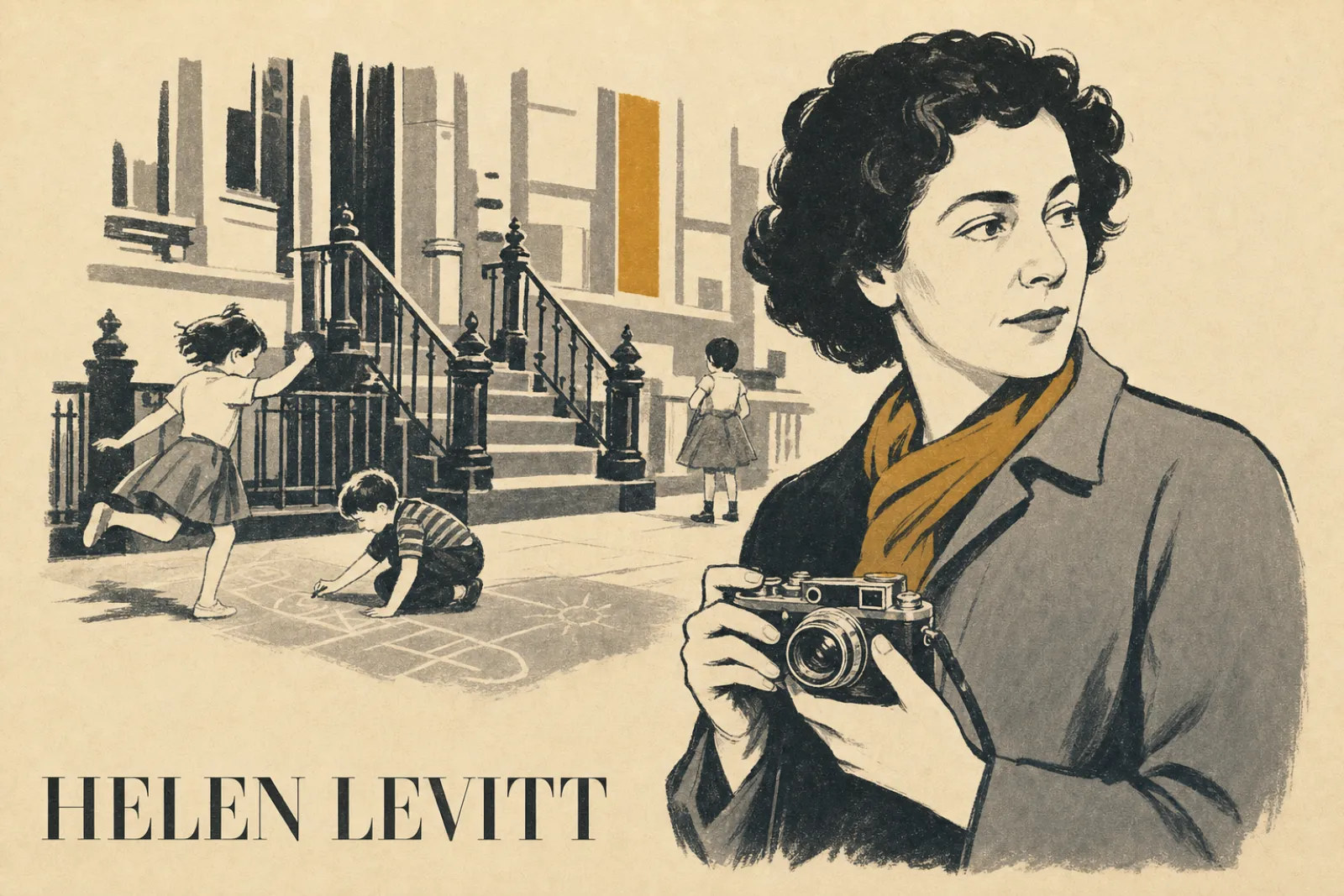
Helen Levitt (1913 to 2009) was an American photographer who spent nearly seventy years photographing the streets of New York City. Working with a 35mm Leica in neighborhoods such as Spanish Harlem and the Lower East Side, she photographed children at play, neighbors on stoops and the chalk drawings on the pavement. She is known for those black and white pictures of the late 1930s and 1940s, and for being one of the first to photograph the street in color.
Levitt learned the trade in a commercial portrait studio and then turned away from it. The turn came from two people. She met Henri Cartier-Bresson in 1935 through the Film and Photo League, went out photographing with him, and took up a 35mm camera after his example. Walker Evans became a close friend and showed her a way to work unnoticed. Both men photographed the world as they found it, and so did she, but her subject was narrower and nearer: a few blocks of her own city.
A Bronx darkroom, a Leica and the chalk drawings
Levitt was born in Bensonhurst, Brooklyn, on August 31, 1913. She left high school in 1931 and went to work for J. Florian Mitchell, a commercial portrait photographer in the Bronx, where she learned darkroom technique. She also learned by going to exhibitions.
In 1936 she bought a 35mm rangefinder camera. In 1937 she was teaching art to children for New York City’s Federal Art Project, and she became interested in the chalk drawings children made in the street, pictures that were never meant to last. She photographed the drawings, and the children who made them, from 1938 to 1948. That work was published much later, in 1987, as In the Street: Chalk Drawings and Messages, New York City 1938 to 1948.
Recognition came early. Her pictures appeared in Fortune in July 1939 and in a photography exhibition at the Museum of Modern Art the same month. In 1941 she traveled to Mexico City with Alma Mailman and photographed in Tacubaya, a working class district. It was the only body of work she made outside New York. In 1943 the Museum of Modern Art gave her a first solo exhibition, Helen Levitt: Photographs of Children, organized by Nancy Newhall, with pictures from Harlem and Mexico City.
New to photographing strangers in public? Street photography: capture life in public spaces covers the approach, the settings and the questions of law and manners.
Twenty five years in film, then the street in color
From the mid 1940s Levitt worked largely in film. With the painter Janice Loeb and the writer James Agee she shot In the Street in Spanish Harlem, using small hidden 16mm cameras to record street life, above all children. It is a silent film of about sixteen minutes, and Levitt edited it. It was added to the United States National Film Registry in 2006. She was also a cinematographer and writer on The Quiet One (1948), a documentary directed by Sidney Meyers that was nominated for Academy Awards for documentary feature and for its screenplay. Her film work continued for about twenty five years.
She returned to still photography with Guggenheim grants in 1959 and 1960, awarded for work in color. She went back to the kinds of streets she had photographed twenty years before. In 1970 her apartment on East 12th Street was burgled and much of the color work from 1959 and 1960 was stolen. She kept going. In 1974 the Museum of Modern Art showed Projects: Helen Levitt in Color, a continuous projection of forty color slides.
The book most associated with her, A Way of Seeing, was put together in the 1940s with an essay by Agee and not published until 1965. Later books include Mexico City (1997), Crosstown (2001), Here and There (2004) and Slide Show: The Color Photographs of Helen Levitt (2005). The International Center of Photography gave her an Infinity Award in 1997. In the 1990s sciatica forced her to stop making her own prints and made the Leica hard to carry, and she changed to a small automatic Contax. She died in New York on March 29, 2009, aged 95.
How Levitt’s street pictures are made to work
She worked where life was already outdoors. In the 1930s and 1940s, before air conditioning, people in these neighborhoods spent much of their time outdoors, and children played in the street. Levitt chose those blocks and went back to them. A photographer who returns to the same streets learns where things happen.
She stayed unnoticed. Evans taught her to use a right angle viewfinder, an attachment that lets the photographer face one way while the lens points another. People who do not know they are being photographed carry on with what they are doing, which is the whole basis of candid photography. A small 35mm camera helped for the same reason. She used the same idea in film, with hidden cameras.
She photographed gesture, not event. Almost nothing newsworthy happens in a Levitt picture. Children put on masks, hold up a broken mirror, watch soap bubbles drift. What makes the frame is the position of bodies at one instant, which is the lesson of the decisive moment applied to play. Her eye was also shaped by surrealism and by silent film, and many of the pictures are funny in the way a silent film is funny: a pose, a mismatch, a body caught mid action. That is worth studying if you are interested in humor in photography.
Children were her most frequent subject, and she photographed them without arranging them. The games in her pictures are the children’s own. For anyone photographing children, that is the hard and useful discipline: wait, stay back, and let the game continue.
In color she did not change subject. She changed what held the frame together. In one 1980 picture a green car and a turquoise car behind a crouching girl become the structure of the frame. This is color used as composition, not as decoration.
Nervous about raising a camera near people you do not know? Overcoming your fear in street photography deals with exactly that hesitation.
Want to stay with one promising spot until it gives you a picture? Working the scene in street photography explains how to keep shooting one situation as it develops.
Photographs and films to look for
Levitt gave most of her pictures no title beyond the place and the year, so they are usually listed as New York with a date and a short description.
- New York, children with a broken mirror (1939). Two children hold up the glass of a broken mirror while a boy on a bicycle comes in at the edge of the frame. Notice how many separate actions share one frame without colliding.
- New York, masked children on a stoop (1939). Three children in masks stand on the steps of a brownstone, the youngest still fixing her mask in place. It looks like theater, and nobody directed it.
- New York, girls and bubbles (1945). Four girls on a sidewalk watch soap bubbles. The subject of the picture is their attention.
- The chalk drawings (1938 to 1948). Photographs of children’s street drawings and messages. They are records of something made to disappear.
- New York (1980), in color. A girl crouches at the curb with a green car and a turquoise one behind her. Look at how the two blocks of color do the framing.
- In the Street. The short silent film shot in Spanish Harlem with Loeb and Agee. It shows the same subject as the photographs, in motion.
How do you arrange people and background in a street frame? Composition in street photography looks at placing figures, layers and edges on the move.
Try this: one block, twenty minutes, no faces toward you
Pick one block where people are outside: a playground edge, a market, a row of front steps. Stay on that block for 20 minutes. Do not move on.
- Hold the camera or phone at chest height and do not lift it to your eye.
- Photograph only people who are busy with something or with each other, never anyone looking at you.
- Look for gestures: a reach, a lean, a jump, a hand on a shoulder.
- Take no more than 24 frames.
At home, keep the three frames in which a body position tells you what was going on without any caption.
Questions people ask about Helen Levitt
What camera did Helen Levitt use?
A 35mm Leica rangefinder, which she bought in 1936 after seeing how Henri Cartier-Bresson worked. In the 1990s she changed to a small automatic Contax because the Leica had become difficult to carry.
Where did Helen Levitt take her photographs?
Almost all of them in New York City, mainly in Spanish Harlem, the Lower East Side, the Bronx and the Garment District. The one exception is the work she made in Mexico City in 1941.
Did Helen Levitt photograph in color?
Yes. She began serious color work with Guggenheim grants in 1959 and 1960. Much of that early work was stolen in a burglary in 1970, and her later color pictures were shown as a slide projection at the Museum of Modern Art in 1974.
What is A Way of Seeing?
It is her first major book of photographs, with an essay by James Agee. It was prepared in the 1940s and published in 1965.
Photographers who came after her and worked the American street, among them Lee Friedlander, have been named as influenced by her. More names are in the A to Z of photographers.