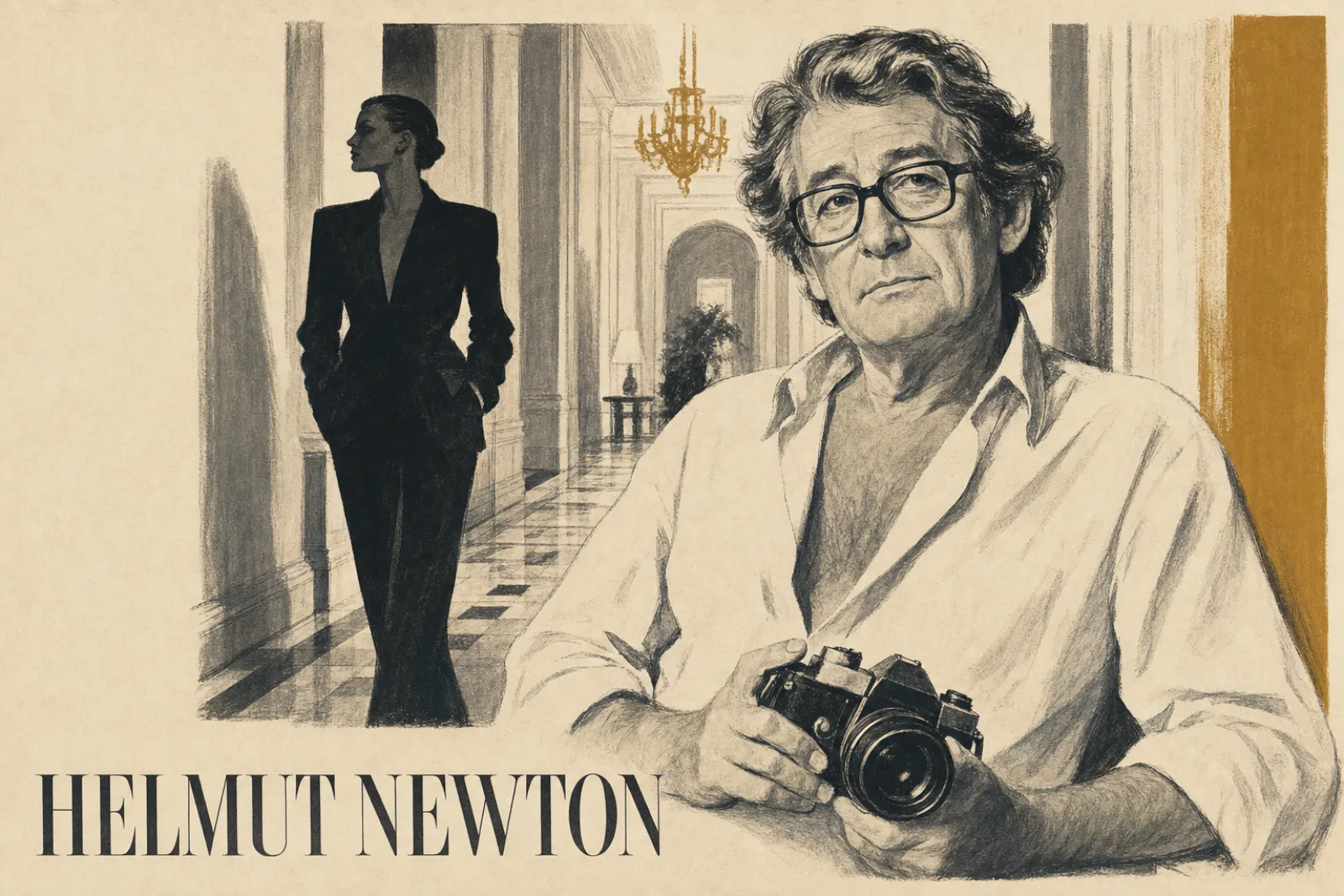
Helmut Newton (1920 to 2004) was a German born fashion and portrait photographer who worked in Melbourne, London, Paris, Monaco and Los Angeles. From the 1960s he was a mainstay of French Vogue and other fashion magazines. He is known for taking fashion out of the studio and staging it like a scene from a film, with powerful looking women in hotels, villas and city streets, and for pictures whose adult, provocative tone divided opinion throughout his career.
Newton trained in Berlin under Yva, a fashion, portrait and advertising photographer with a studio in the Charlottenburg district. He was her apprentice from 1936 to 1938. Decades later he was counted among the leading fashion photographers of his time, alongside Richard Avedon and Irving Penn. Newton preferred to work outside the studio, and his pictures drew on film noir, Expressionist cinema and surrealism.
Berlin, Singapore and a studio in Melbourne
He was born Helmut Neustädter in Berlin on 31 October 1920, into a Jewish family. His apprenticeship with Yva ended in 1938, the year the Nazi authorities banned her from working as a photographer. She was deported in 1942 and murdered. Newton left Germany in December 1938, sailing from Trieste. He stopped in Singapore, where he worked briefly for the Straits Times and then as a portrait photographer.
In 1940 he was interned and sent to Australia. After his release he served in the Australian army. In 1946 he changed his name to Newton and opened a studio in Flinders Lane, Melbourne. In 1948 he married the actress June Browne. She later became a photographer herself, from 1970, under the name Alice Springs, and she acted as art director and editor of his work for the rest of his life.
He later ran the Melbourne studio in partnership with Henry Talbot. In 1956 he was commissioned for an Australian supplement of Vogue. A contract with British Vogue took him to London for most of a year. He did not stay, and went on to work for French and German magazines.
Paris, French Vogue and the books
In 1961 Newton settled in Paris, in the Rue Aubriot in the Marais, and began working full time for French Vogue. He also shot for Elle in the mid 1960s and, over the years, for other editions of Vogue, for Harper’s Bazaar and for Playboy. A heart attack at the start of the 1970s slowed him for a time. June Newton’s own photographic career began when she stood in for him on a job while he was ill.
The work that followed is the work he is remembered for. His first solo exhibition was held at the Nikon Gallery in Paris in 1975. His first book, White Women, came out in 1976 and won the Kodak Photo Book Award. Sleepless Nights followed in 1978 and Big Nudes in 1981. That year he moved from Paris to Monaco, and he spent winters in Los Angeles. World Without Men appeared in 1984 and Pola Woman, a book of his Polaroids, in 1992.
He also photographed public figures, among them Margaret Thatcher, Helmut Kohl, Catherine Deneuve and Elizabeth Taylor. France awarded him its Grand Prix National de la Photographie in 1990 and made him a Commandeur de l’Ordre des Arts et des Lettres in 1996. For his eightieth birthday in 2000 the Neue Nationalgalerie in Berlin mounted a large retrospective that traveled to London, New York, Tokyo, Moscow and Prague. Newton died in Los Angeles on 23 January 2004 and is buried in Berlin.
Curious how a magazine fashion shoot is put together, from concept to final frame? How a fashion photo shoot happens follows the stages and the people involved.
How a Newton picture is built
The location does half the work. Newton chose the ornate interiors of old mansions, elegant villas and grand hotels, or the street outside his own door. A studio backdrop says nothing about who a person is or what has just happened. A hotel corridor does. Choosing the place first, and letting it suggest the scene, is the starting point of cinematic photography, and it is a habit any photographer can practice by scouting locations before a shoot.
The picture implies a story. His fashion photographs look like single frames from a film whose plot the viewer has to guess. The clothes are shown, but they are worn by a character in a situation. That is the difference between a catalog picture and an editorial one, and it is the central idea in fashion photography and its creative direction.
The women are in charge of the frame. Newton’s pictures are built around women who appear powerful, placed in staged and often ambiguous situations. His photographs of a model in a man’s style suit, with slicked back hair, set a look that fashion photography has repeated ever since. Posture and stance carry the meaning, which makes his work a useful study alongside any guide to posing.
He sketched with instant film. From the 1960s until his death Newton used Polaroid cameras and instant film backs fitted to his medium format cameras. He made a test picture, checked the light and the composition, adjusted, and only then shot the final frames. The Polaroids were his sketchbook. Some were later signed and sold as works in their own right. The same check and adjust routine is what a camera screen gives a photographer for free, and the older method is covered in the guide to instant film.
He worked in pairs and at scale. White Women introduced diptychs: a model photographed in the clothes in one frame and without them in the next. The comparison is the subject. The same structure, used with any two related frames, is explained in the guide to diptychs and triptychs. For Big Nudes he did the opposite of his location work. He photographed full length figures in the studio on medium format film and had them printed life size, an idea he took from the oversized wanted posters issued by the German police.
Want to know how fashion light is shaped on a face and a garment? How to light for fashion and beauty explains the common setups.
The argument about his work
Much of Newton’s work is erotic in tone and a good deal of it includes nudity. It was controversial in his lifetime and still is. Feminist critics objected that the pictures were needlessly suggestive. In 1993 the German writer Alice Schwarzer attacked his photographs in the magazine Emma as sexist. Others have read the same pictures as showing women who hold the power in the scene. A viewer does not have to settle that argument to learn from the craft: the use of place, the direction of a pose and the careful testing of light are all visible in his fully clothed fashion and portrait work.
Where should a photographer draw the line on consent and respect for the person in front of the lens? Photography etiquette and ethics sets out the questions to ask.
Photographs and books to look for
- Yves Saint Laurent, Rue Aubriot (1975). Made for French Vogue on the Paris street where Newton lived. The fashion is by Yves Saint Laurent. Notice that a fashion picture has been made with a street and a stance and no studio at all.
- White Women (1976). His first book, which sits between fashion and the nude. It is where the paired, two frame pictures first appear, and it shows how much of his fashion work depends on comparison.
- The store dummies (mid 1970s). A series for French Vogue using shop mannequins, one of them photographed on the Pont Alexandre III over the Seine. It shows his interest in the artificial and the staged.
- Sie kommen, or Here They Come (1981). A diptych from the Naked and Dressed series, published in French Vogue. It is one of his paired pictures, and it shows the diptych idea at full scale.
- Big Nudes (1979 to 1981). Full length studio figures printed life size, made in Paris, Monaco, Los Angeles and elsewhere. Notice how plain the background is compared with everything else he did.
- Sumo (1999). A book, published by Taschen, that measured 50 by 70 centimeters and weighed more than 30 kilograms. It came in an edition of 10,000 signed copies with its own stand designed by Philippe Starck.
Try this: let the place write the scene
This takes 20 minutes and one willing person, fully dressed in whatever they would wear to go out.
- Pick one location with character: a stairwell, a hotel lobby, a doorway, a parked car at dusk.
- Before you take anything, decide in one sentence what has just happened to this person. They are waiting for someone who is late. They have just left a party.
- Make one test frame. Look at it. Change one thing only: where they stand, where they look, or where the light falls.
- Repeat the test and the single change five times, then take your final picture.
Compare the first test with the final frame. The exercise is the series of small corrections in between.
Questions people ask about Helmut Newton
What was Helmut Newton known for?
For fashion photography, mainly for French Vogue, that was staged on location like a film scene, and for books such as White Women (1976) and Big Nudes (1981). His work was widely imitated and widely argued over.
Who taught Helmut Newton?
He was apprenticed from 1936 to 1938 to Yva, the professional name of Else Neuländer-Simon, a Berlin photographer known for fashion, portraits and advertising work.
Where is the Helmut Newton Foundation?
In Berlin, in the Museum für Fotografie at Jebensstrasse 2, next to the Zoologischer Garten station. Newton set up the foundation in 2003 and it opened to the public in June 2004, a few months after his death.
Who was Alice Springs?
Alice Springs was the professional name of June Newton, his wife from 1948. She worked as a portrait photographer from 1970 and was the art director and editor of his work.
More fashion, portrait and street photographers are listed in the A to Z of photographers.