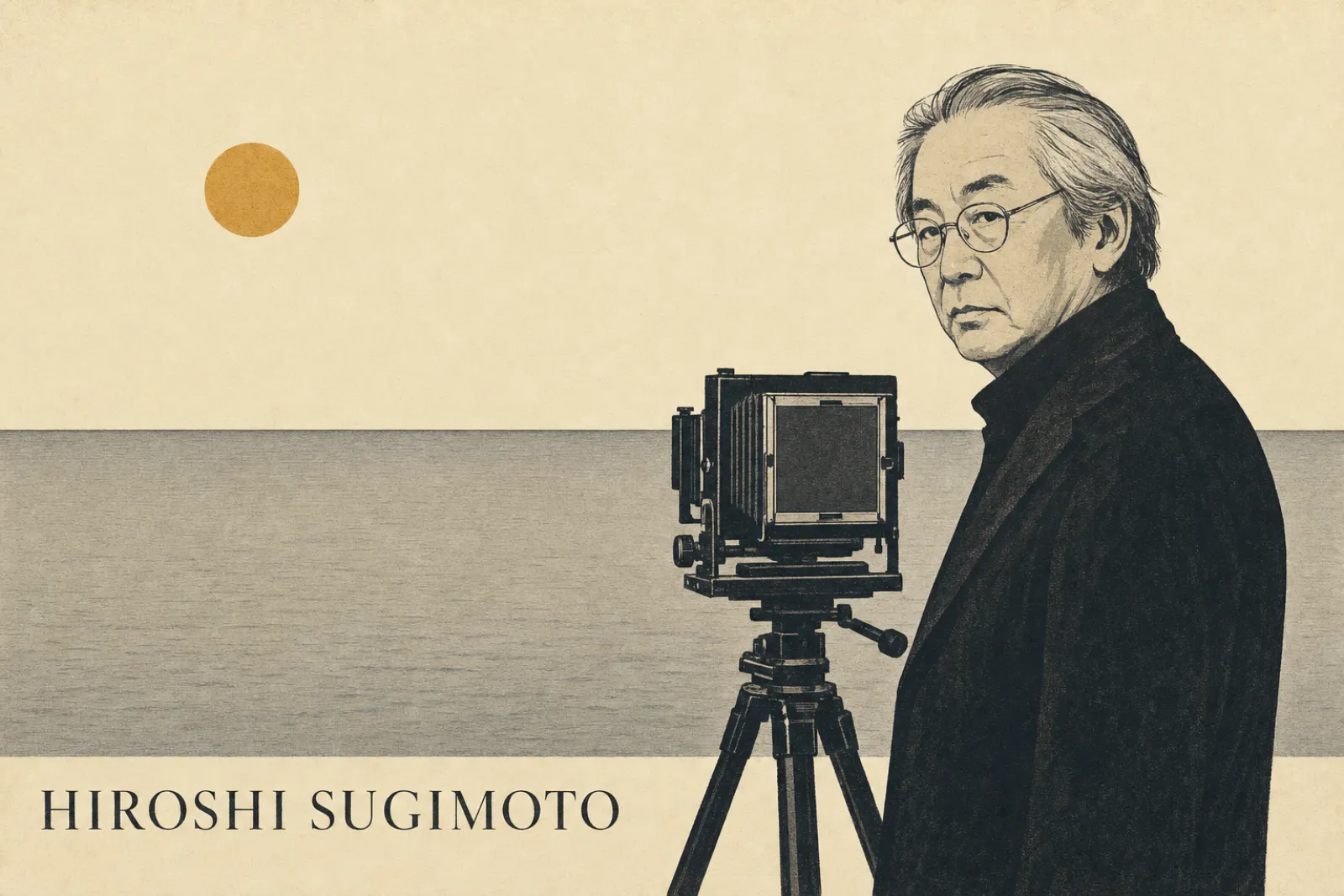
Hiroshi Sugimoto (born 1948) is a Japanese photographer and architect who moved from Tokyo to the United States in the 1970s and settled in New York in 1974. Using a large format camera, black and white film and very long exposures, he made a small number of series that he returned to for decades: museum dioramas, cinema interiors, and the sea. He is best known for the Theaters, each exposed for the full length of a film, and the Seascapes.
Sugimoto’s work belongs to conceptual art as much as to photography. Each series begins as a question about time and is carried out with nineteenth century patience and equipment. He looked back to the medium’s beginnings directly: he collected early negatives by William Henry Fox Talbot and, in works dated 2008 and 2009, printed positives from them that Talbot himself never saw. Among photographers who also work with long exposures in black and white, Michael Kenna makes a useful comparison. Kenna looks for atmosphere at dawn and at night, while Sugimoto strips the subject down to an idea.
Tokyo, Los Angeles and a camera in the natural history museum
Sugimoto was born in Tokyo on February 23, 1948. He studied politics and sociology at Rikkyo University, also known as Saint Paul’s, and graduated in 1970. He then studied at the Art Center College of Design in California, graduated in 1974 and moved to New York the same year. In his early New York years he also dealt in Japanese antiquities.
His first major series, the Dioramas, began in the mid 1970s at the American Museum of Natural History. The museum’s displays place stuffed animals in front of painted backdrops. Sugimoto photographed them with a large format camera in black and white, so that the frame of the display disappears and the scene reads, for a moment, as a photograph of living animals. Polar Bear (1976) was the first. He came back to the museum’s displays several times, as late as 2012.
A Guggenheim Fellowship followed in 1980. The Hasselblad Foundation gave him its International Award in Photography in 2001, and he received the Praemium Imperiale in 2009.
Wondering what a large format camera is and why anyone still uses one? Large format photography explains sheet film, the size of the negative and what it gives the print.
A whole film in one frame, and the sea cut in half
The Theaters began in 1978. Sugimoto has described asking himself what would happen if he shot a whole movie in a single frame, and answering that he would get a shining screen. He took a large format camera on a tripod into a cinema, opened the shutter when the film began and closed it when the film ended, about two hours later. The projector was the only light. On the negative the screen is a blank white rectangle, and its light is what reveals the architecture of the auditorium. He went on to photograph drive-in theaters and abandoned ones.
The Seascapes began in 1980, the year of Caribbean Sea, Jamaica. Every picture in the series has the same design: water below, air above, and the horizon dividing the frame exactly in half. The prints are all the same size. Sugimoto made them in many parts of the world, including the English Channel, the Arctic Ocean and the Black Sea, with exposures that ran as long as three hours. In 2009 the band U2 used one of them, Boden Sea, Uttwil (1993), as the cover of the album No Line on the Horizon.
Other series follow the same logic. In 1995 he photographed the thousand and one gilded Buddhist figures in the Sanjusangendo temple in Kyoto, after having later decorations removed and the fluorescent lights turned off so that the hall was lit by the rising sun. In 1998, for In Praise of Shadows, he left the shutter open for the entire life of a burning candle. In 1999, for Portraits, he photographed wax figures of historical people on 8×10 inch negatives against black, trying to recreate the light a portrait painter would have used. From 1997 to 2003 he photographed well known modernist buildings blurred. For Conceptual Forms (2004) he photographed old mathematical and mechanical teaching models held at the University of Tokyo. For Lightning Fields (2009) he gave up the camera and applied an electrical charge from a 400,000 volt generator directly to sheets of film. From 2018, in Opticks, he recorded the colors of light passed through a prism on Polaroid film.
How do you keep a shutter open for minutes or hours without ruining the picture? Long exposure photography: settings, gear and techniques covers the tripod, the filters and the arithmetic.
From photographs to buildings
Sugimoto also worked in architecture through the Tokyo firm New Material Research Laboratory. He established the Odawara Art Foundation in 2009 to support traditional Japanese and contemporary performing arts. Its home, the Enoura Observatory, opened in October 2017 on a hillside citrus grove above Sagami Bay in Odawara. The site includes a gallery, a noh stage and a tea room, and its buildings are laid out in relation to the sun at the solstices and equinoxes. It is the Seascapes turned into a place: a structure for looking at the horizon and at time passing.
How Sugimoto’s pictures are made to work
One rule per series. Each body of work has a rule fixed before the camera comes out. The horizon goes in the middle. The exposure lasts as long as the film. The candle burns to the end. The rule removes every decision about style and leaves only the subject. This is previsualization taken to its limit: the picture is designed in the mind and the exposure confirms it.
Time as the material. A normal photograph records an instant. A Theaters picture records two hours, and everything that moved in that time, every image on the screen, adds up to plain white. The technique is the same one used for any super long exposure, but the purpose is different. The motion is not smoothed for effect. It is erased, and what remains is the room.
Almost nothing in the frame. A Seascape contains two tones and one line. There is no boat, no bird, no shore. It is an extreme case of minimalist photography, and the centered horizon, which most composition advice warns against, gives the frame a strict symmetry. Compare it with a conventional seascape photograph, with its waves, rocks and timing, to see how much has been left out.
Focus as a choice. Sharpness is not treated as a duty. The modernist buildings of the Architecture series are blurred until only their basic forms remain. For Joe (2003), photographs of a Richard Serra sculpture, he set the lens at half its focal length from the film, a setting described as twice infinity, which blurs everything on purpose.
Black and white, printed traditionally. Most of the work is in black and white and exists as gelatin silver prints. Tone carries everything, so the fine gradation of a large negative matters. The Portraits depend on controlled light against a black ground, and Stylized Sculpture (2007), a series on garments from the Kyoto Costume Institute, was lit with strong chiaroscuro.
Want to try the diorama idea yourself on a museum visit? Photographing museums, churches and interiors without flash or a tripod deals with working indoors in low light.
Photographs and series to look for
- Polar Bear (1976). The first Diorama. A museum display photographed so that it passes, briefly, for a wildlife photograph. Ask yourself what gives it away.
- U.A. Play House, New York (1978). A Theaters picture from the first year of the series. The screen is pure white and the room is lit only by the film that played on it.
- Cinerama Dome, Hollywood (1993). A later Theaters picture, made with the same rule fifteen years on. The method does not change. The building does.
- Caribbean Sea, Jamaica (1980). A Seascape from the first year of the series. Sea and sky meet at a horizon in the exact middle of the frame.
- Boden Sea, Uttwil (1993). The Seascape that became a U2 album cover. Set it beside another from the series and look at how different two pictures with the same design can be.
- Sea of Buddha (1995). Forty eight photographs of the gilded figures in the Sanjusangendo temple in Kyoto, made by daylight alone.
Try this: ten horizons, one rule
This takes 15 minutes and works with a phone. Find any clear horizon: the sea, a lake, a field, a flat rooftop against the sky.
- Turn on the grid in your camera and put the horizon exactly on the center line. Keep it level.
- Allow nothing else in the frame. If a boat, a bird or a pole is there, move or wait.
- Make ten frames of ten different patches of sky and surface without changing the design.
- Convert all ten to black and white and view them side by side.
The design is identical in every frame, so every difference you see comes from light and weather. That is the lesson of working inside a fixed rule.
Questions people ask about Hiroshi Sugimoto
How did Hiroshi Sugimoto photograph the movie theaters?
He set up a large format camera on a tripod inside the cinema and kept the shutter open for the whole running time of a feature film, about two hours. The light of the film exposed the room, and the changing images on the screen added up to white.
What camera did Hiroshi Sugimoto use for these series?
Large format cameras that take sheet film: a folding 4×5 camera on a tripod for the Theaters and 8×10 inch negatives for the Portraits. The results were printed as traditional gelatin silver prints. One series, Lightning Fields, was made with no camera at all.
Which Sugimoto photograph is on the U2 album cover?
Boden Sea, Uttwil, a Seascape from 1993. U2 used it in 2009 for the album No Line on the Horizon.
What is the Enoura Observatory?
It is an arts site in Odawara, Japan, designed by Sugimoto as the home of his Odawara Art Foundation. It opened in October 2017 and includes a gallery, a noh stage and a tea room overlooking Sagami Bay.
Photographers from the first days of the medium to the digital era are listed in the A to Z of photographers.