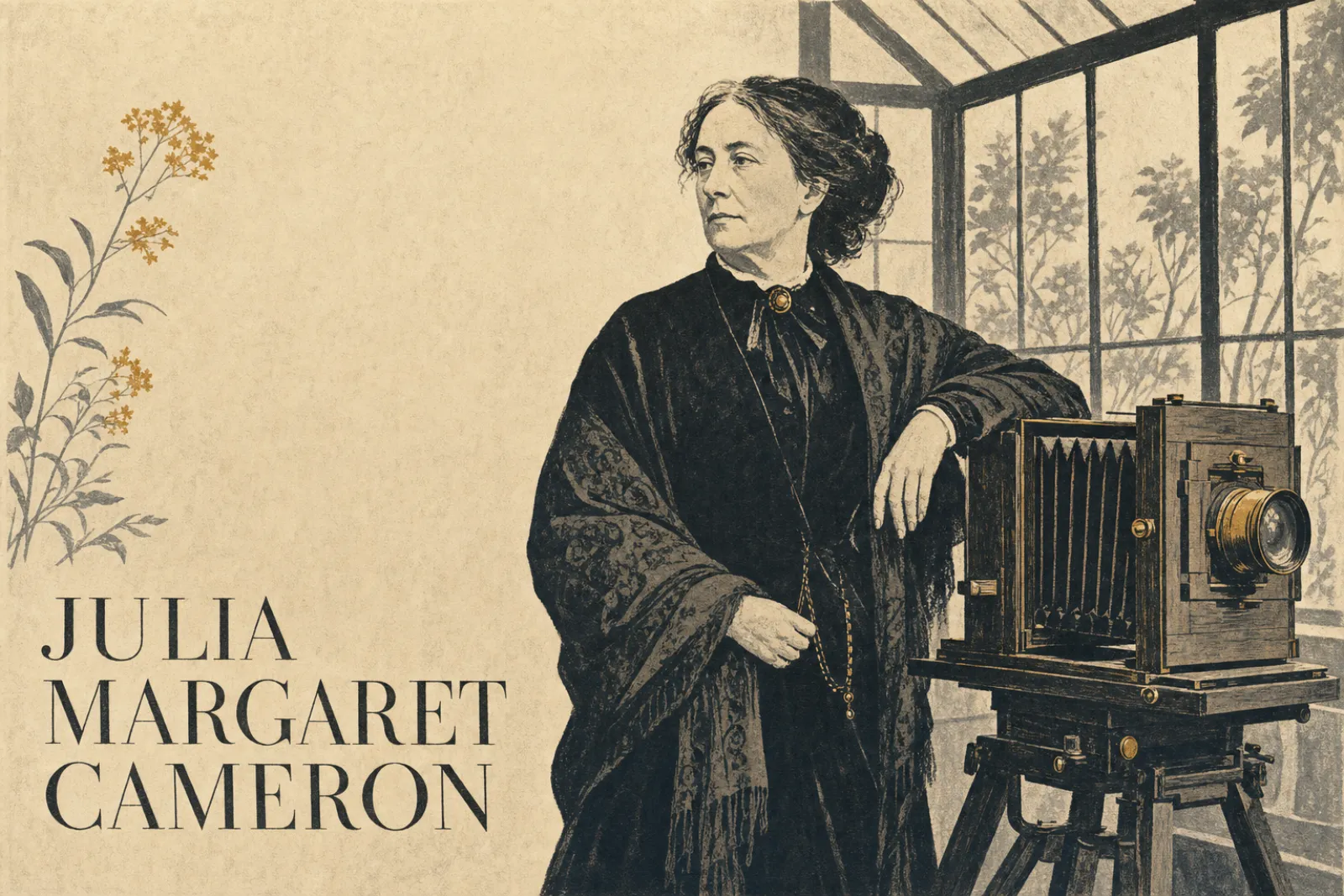
Julia Margaret Cameron was a British photographer, born in Calcutta in 1815, who took up the camera at the age of 48 and worked for about twelve years, mostly at her home on the Isle of Wight. She made large, close portraits of the writers and scientists of Victorian Britain, and staged scenes from the Bible and from poetry. She is known for soft focus used on purpose, at a time when sharpness was the rule.
Cameron had no formal training. She credited the astronomer Sir John Herschel, a lifelong friend, as her first teacher, and she took a lesson from the painter and photographer David Wilkie Wynfield, whose softly focused portraits of friends in costume she said she owed her success to. In her artistic ideals she was close to the painter George Frederic Watts. She worked against the expectation of her day that a good photograph was a sharp one, and she set out to win portrait photography a place as high art. Later writers placed her beside Nadar as one of the great portraitists of the nineteenth century.
A camera at 48 and a henhouse for a studio
Cameron was born Julia Margaret Pattle on 11 June 1815, the daughter of an East India Company official, and was educated in France. She married Charles Hay Cameron in Calcutta in 1838. The family moved to England in the 1840s, and in 1860 she bought two cottages next to the home of the poet Alfred Tennyson at Freshwater on the Isle of Wight. She named the house Dimbola, after a family plantation in Ceylon.
Around Christmas 1863 her daughter and son-in-law gave her a sliding box camera, thinking it might amuse her while her husband was away. She turned the coal house into a darkroom and a glazed chicken house into a studio, which she called her glass house. On 29 January 1864 she made a portrait of a nine-year-old girl, Annie Philpot, and called it her first success. By her own note she printed, toned, fixed and framed it the same day.
She moved fast after that. In 1864 she registered her pictures for copyright and joined the Photographic Society of London. From 1865 she sold prints through the London dealers P. and D. Colnaghi. She thought of herself as an artist, but she copyrighted, published and marketed her work as a professional would.
Poets, scientists and the South Kensington Museum
Cameron’s work falls into three groups: portraits of distinguished men, portraits of women, and illustrations of religious and literary subjects. The men were scientists, writers and clergymen, among them Tennyson, Herschel, Charles Darwin, Thomas Carlyle and the American poet Henry Wadsworth Longfellow. The women included relatives and household staff. Her servant Mary Hillier posed again and again as the Virgin Mary.
The South Kensington Museum, which became the Victoria and Albert Museum, backed her early. Its founding director, Henry Cole, bought 63 prints in June 1865, her first sale to a public institution, and showed her work the same year. In 1868 the museum gave her two rooms to use as a portrait studio. It was the only museum to exhibit her photographs in her lifetime.
The photographic press was much less kind. Reviewers there called her portraits out of focus and complained that the prints were smudged and dirty. The Illustrated London News took the other side and praised her pictures as art.
In 1874 Tennyson asked her to illustrate a new edition of his Arthurian poems, Idylls of the King. She worked on it for three months, was unhappy with how small the reproductions were, and issued her own edition with twelve full-size prints. It was her last large project. In 1875 the Camerons moved to Ceylon, where the heat made collodion hard to handle and clean water for washing prints was scarce. Fewer than 30 pictures survive from those years. She died there on 26 January 1879.
Where does Cameron sit in the longer story? The history of photography runs from the first processes to digital and shows what came before and after her.
Why her pictures look the way they do
Cameron used the wet collodion process. A glass plate was coated with light-sensitive chemicals in the darkroom, exposed in the camera while still damp, then developed, washed and varnished. Prints were made by laying the negative directly on sensitised albumen paper and leaving it in sunlight. The print was therefore exactly the size of the negative. Her first camera took plates of about 12 by 10 inches. In the summer of 1865 she moved up to one that held plates of 15 by 12 inches.
Those facts explain most of her style.
- She went close. On a plate that large, a head could be recorded near life size. She wrote “From life not enlarged” on an 1866 print, a head of her niece May Prinsep. Historians have called her portraits the first close-ups in photography. The modern equivalent is to fill the frame with the face and leave out the room.
- Focus was shallow and soft. A big plate and a close subject leave very little in focus. Cameron accepted that, and her soft focus was a deliberate choice. A camera that takes plates this big belongs to large format photography. The page on depth of field explains why close, large-format pictures behave this way.
- Light was dramatic. Her portraits set strong light against deep shadow, in a way that has been compared to Rembrandt. Writers have praised her command of chiaroscuro, the dramatic use of light and shadow.
- Movement was a risk. Groups were harder than single heads, because more light was needed to shorten the exposure and stop the sitters’ movement.
- Flaws were left in. Streaks, swirls of collodion and fingerprints appear in her prints. She scratched into negatives, printed from broken ones and sometimes combined more than one negative. She did not retouch to tidy a face.
- Hair was let down. She had women and girls undo their buns and wear their hair loose, for a poetic effect in place of a tidy one.
Want to put one hard light to the side of a face yourself? Direction of light shows what front, side and back light each do to a subject.
Interested in hand-made processes like hers? Alternative photography processes surveys the historical methods people still practise.
Photographs to look for
- Annie (1864). The portrait of Annie Philpot that Cameron called her first success, made a month after she got her camera. It matters as the starting point of everything that followed.
- Julia Jackson (1867). A portrait of her niece and godchild, held as an albumen print by the Victoria and Albert Museum. Look at where the light comes from and how it shapes the face.
- J. F. W. Herschel (1867). Her portrait of the astronomer who first taught her. The playwright George Bernard Shaw later ranked it, with her Tennyson and Carlyle, above any portraits he had seen.
- Charles Darwin (1868). One of her portraits of eminent men. The Victoria and Albert Museum holds it as a carbon print.
- The Kiss of Peace (1869). The picture Cameron herself considered her finest.
- The Parting of Sir Lancelot and Queen Guinevere (1874). From the Idylls of the King series. It appeared as a wood engraving on the cover of Harper’s Weekly in 1877. Compare its staging with the directness of the single heads.
Try this: a head, one window, nothing else
Allow 15 minutes. Use a camera or a phone and one patient sitter.
- Sit the person side on to a single window, in a room with the lights off. Hang or hold something dark behind them.
- Ask them to take off glasses, jewellery and anything with a logo, and to drape a dark scarf or blanket over their shoulders.
- Move in until the head fills the frame from the top of the hair to the chin. Do not zoom. Walk closer.
- Make ten exposures. For each one, ask the sitter to turn their face slightly more toward or away from the window.
- Do not ask for a smile. Ask them to keep still and look at one fixed point.
- Choose the frame where the shadow side of the face still shows a little detail.
The constraint is that only the head may appear. The window light portraits page goes further into placing a sitter by a window.
Questions people ask about Julia Margaret Cameron
Why are Julia Margaret Cameron’s photographs out of focus?
The softness was a choice. She worked close with large plates, which left little in focus, and she preferred the result to hard detail. Critics in the 1860s attacked her for it, and it became the quality she is best known for.
When did Julia Margaret Cameron start taking photographs?
She received her first camera around Christmas 1863, aged 48, as a present from her daughter and son-in-law. Her first successful portrait is dated 29 January 1864. She took few photographs after she moved to Ceylon in 1875.
Who did Julia Margaret Cameron photograph?
Her sitters included Alfred Tennyson, Charles Darwin, Sir John Herschel, Thomas Carlyle, Henry Wadsworth Longfellow and Ellen Terry. She also photographed her family, neighbours and servants, often in costume as figures from the Bible or from poetry. The writer Virginia Woolf was her great-niece.
Where can her photographs be seen?
The Victoria and Albert Museum in London holds more than 900 of her prints. Dimbola, her house at Freshwater on the Isle of Wight, is run as a museum by the Julia Margaret Cameron Trust. It shows her work beside exhibitions by later photographers, Annie Leibovitz among them.
Cameron is one of many portraitists in the A to Z of photographers.