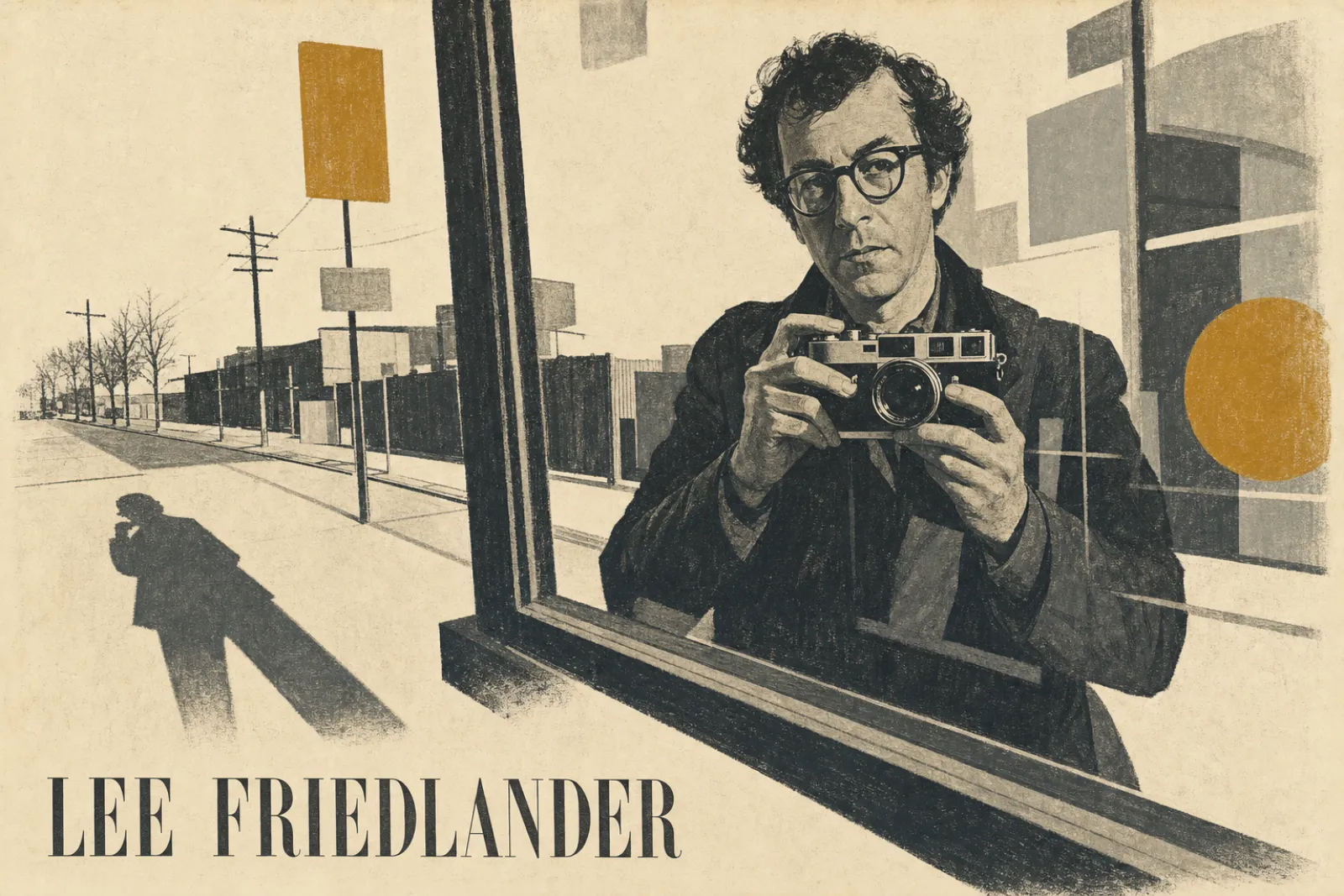
Lee Friedlander is an American photographer, born in Aberdeen, Washington, in 1934. From the late 1950s he photographed American streets, shop windows, monuments, parks and roads in black and white, first with a 35mm Leica and later with a square-format Hasselblad. He is known for crowded, layered frames in which reflections, signs, fences and his own shadow all share the picture, a way of seeing that came to be called the social landscape.
Friedlander’s early work drew on Eugène Atget, Walker Evans and Robert Frank, three photographers who looked hard at ordinary places. In 1967 the Museum of Modern Art in New York showed him with Garry Winogrand and Diane Arbus in an exhibition called New Documents. The curator, John Szarkowski, argued that a new generation had turned the documentary approach toward personal ends, away from social reform. Friedlander’s pictures were closer in style to Winogrand’s than to those of Arbus.
From jazz album covers to the street
Friedlander was already earning pocket money as a photographer at 14. He studied photography at Art Center in California in the 1950s and moved to New York in 1956. There he photographed jazz musicians for record album covers and freelanced for magazines, with work appearing in Esquire, Art in America and Sports Illustrated. His pictures of jazz, country and blues musicians were later collected in books such as The Jazz People of New Orleans (1992) and American Musicians (1998).
Alongside the paid jobs he walked the streets with a hand-held Leica and black and white film. His first solo exhibition was at George Eastman House in Rochester in 1963. In 1966 the same museum included him in Toward a Social Landscape with Winogrand, Bruce Davidson, Danny Lyon and Duane Michals. He received Guggenheim Fellowships in 1960, 1962 and 1977.
The street pictures do not isolate a subject. A typical Friedlander frame from these years holds fragments: part of a shopfront, a reflection in its glass, a pole, a poster, a sign. He photographed empty streets, store windows and the statues in small-town squares. Very often his own shadow or reflection is in the picture too.
How does anyone start photographing in public? Street photography covers the approach, the settings and the habits that the genre rests on.
Series, books and a second camera
Friedlander worked in long series and turned them into books. Self Portrait came out in 1970, self-published under the imprint Haywire Press. The American Monument, on public statues and memorials, followed in 1976. Factory Valleys (1982) looked at industrial Ohio and Pennsylvania. Later books covered nudes, the desert, cherry blossom time in Japan, and American architecture in Sticks and Stones (2004).
One project was about another photographer’s work. In 1967 Friedlander acquired the surviving 8 by 10 inch glass negatives of E. J. Bellocq, who had made portraits in the Storyville district of New Orleans around 1912. He printed them on gold-toned printing-out paper. The Museum of Modern Art showed his prints in 1970, and the book E. J. Bellocq: Storyville Portraits appeared the same year.
In later decades he worked mainly with medium format cameras, in particular the Hasselblad Superwide, and much of the later work is square. Beginning in 1988 he photographed parks designed by Frederick Law Olmsted, among them Central Park and Prospect Park in New York, first on a six-year commission from the Canadian Centre for Architecture in Montreal and then for many years more. From 1995 to 2009 he drove through most of the fifty states in rental cars and photographed the country from inside the car. The result was America by Car, shown at the Whitney Museum of American Art in 2010.
The Museum of Modern Art gave him a retrospective of nearly 400 photographs in 2005. That year he also received the Hasselblad Award, whose citation described him as a central figure in defining the social landscape. He had received a MacArthur Fellowship in 1990.
How a Friedlander frame is put together
Most composition advice says to simplify. Friedlander did the opposite, and his pictures still hold together. These are the choices to study.
- Glass as a second picture. A shop window shows what is behind it and what is in front of it at once. He used that to put two scenes in one frame. The page on reflection photography explains how to see and expose for both layers.
- The photographer stays in. Most people step aside to keep their shadow out of the picture. He let it fall across the subject, or let his reflection sit in the window. It turns a street view into a kind of self-portrait, and it is a direct lesson in using a shadow as a subject.
- Obstacles as structure. Poles, fences, door frames and car windows cut his pictures into panels. This is framing pushed to an extreme, where the frame within the frame takes up as much room as the thing framed.
- Everything sharp, near to far. A wide lens on a small or medium format camera keeps close and distant things in focus together. The eye cannot retreat into a blurred background, so the foreground, midground and background all have to earn their place.
- Collisions on purpose. A sign that appears to sit on a head, or a pole that splits a figure, is normally treated as a mistake. The guide to tangents and mergers teaches how to avoid them. His layered frames are full of such overlaps, and his gallery describes the results as humorous and poignant.
- The square and the wide lens. In America by Car the windscreen, side windows and mirrors act as picture frames, and the steering wheel and dashboard fill the foreground. A wide-angle lens exaggerates the nearest things, which is why the car interior looms so large.
Not sure where the eye lands first in a busy frame? Visual hierarchy sets out what pulls attention first, second and last.
Books and series to look for
- The Little Screens (1960s). Pictures of television sets in motel rooms. Notice that the screen is one more frame inside the frame.
- Self Portrait (1970). The self portraits he began in the 1960s. Look for the ones where he appears only as a shadow or a reflection.
- The American Monument (1976). Statues and memorials across the United States. The lesson is in what surrounds each monument and is allowed to share the frame.
- Maria (1992). Portraits of his wife, whom he married in 1958 and photographed often. It shows what a long series about one person can hold.
- America by Car (2010). Square photographs made from inside rental cars between 1995 and 2009. Roadside bars, motels, churches, bridges and open country appear through windows and in mirrors.
- The Human Clay. A suite of books from Yale University Press that sorted his pictures of people by subject: portraits, children, the street and more.
Thinking about ordering your own pictures into a book or set? Photo sequencing explains how to edit and order a body of work.
Try this: stay in the picture
Give this 20 minutes on a sunny day, on any street with shop windows. A phone is fine.
- For the first ten minutes, make ten photographs in which your own shadow falls on or beside the subject. Do not hide it. Decide where it goes.
- For the next ten minutes, make ten photographs through or into glass, so that the reflection and what lies behind the glass are both visible. Your reflection may be in them.
- Use the widest lens you have and do not crop afterwards.
- In every frame, put something close to the camera at one edge: a pole, a doorway, a parked car.
- At the end, pick the three frames with the most separate things in them that are still readable.
The constraint is that you may not move to clean up the frame. Work with what is in the way.
Questions people ask about Lee Friedlander
What is Lee Friedlander known for?
He is known for black and white photographs of the American social landscape: streets, storefronts, signs, monuments and roads, built from reflections and overlapping layers. His own shadow and reflection appear in many of them.
What camera did Lee Friedlander use?
His early work was made mostly with hand-held 35mm Leica cameras and black and white film. Later he worked mainly in medium format, in particular with the Hasselblad Superwide, which gives a square picture.
What was the New Documents exhibition?
New Documents ran at the Museum of Modern Art in New York from 28 February to 7 May 1967. John Szarkowski curated it and showed 94 black and white photographs: 30 by Friedlander, 32 by Garry Winogrand and 32 by Diane Arbus. It presented documentary photography as a personal way of looking at the world.
What awards did Lee Friedlander receive?
He received three Guggenheim Fellowships, in 1960, 1962 and 1977, a MacArthur Fellowship in 1990 and the Hasselblad Award in 2005. The International Center of Photography gave him its Infinity Award for lifetime achievement in 2006.
Friedlander’s peers and influences are all in the A to Z of photographers.