To photograph light trails, put the camera on a tripod above or beside a busy road at dusk, set ISO 100 and f/8 to f/11, and use a shutter speed of 10 to 30 seconds so that each vehicle’s lights are drawn as a continuous line. Focus manually on something lit, fire the shutter with a remote, and start each exposure just before traffic enters the frame. Aperture sets how bright the trails are. Shutter speed sets how long they are.
The long exposure photography guide covers tripods, filters and exposure in general, and the cityscape guide shows trails as one element of a skyline. This page is about the trails themselves: why they behave differently from the rest of the scene, how to choose the shutter speed from the speed of the traffic, how to time and stack exposures, and how to fix trails that are blown out or broken.
How a light trail forms, and what controls its brightness
During a long exposure, a headlamp is a bright point moving across the sensor. Each part of its path is lit only for the instant the point passes over it. The road, the buildings and the sky stay where they are and collect light for the whole exposure. That difference gives light trails a rule that surprises most people:
- Shutter speed changes the brightness of everything that stands still and the length of the trails. It does not change how bright a trail is.
- Aperture and ISO change the brightness of the trails and of the still parts together.
Doubling the exposure from 10 to 20 seconds makes the sky and street one stop brighter and the trails twice as long, but each line is exactly as bright as before. This gives you two separate controls. If the trails are too bright, close the aperture, then lengthen the shutter to bring the background back. If the trails look weak against a bright scene, open the aperture one stop and halve the time: the background stays the same and the trails gain a stop.
Three more effects follow from the same idea:
- Slow lights make brighter trails. A light that crawls across the frame spends longer on every pixel. This is why a queue edging forward burns out while fast traffic leaves fine lines.
- Distant trails pile up. Far down a road the lanes converge, and every car crosses the same few pixels slowly, so the light accumulates. The far end of a road is usually the first place to blow out.
- Trails add together. Twenty cars in the same lane lay twenty lines on top of each other. Heavy traffic needs a smaller aperture than a single car does.
The vehicle itself disappears because it is dark and never stays on one part of the sensor long enough to register. Anything that stops for part of the exposure, such as a car waiting at a red light, shows up as a faint ghost.
Where to stand and when: vantage points and blue hour
A trail is a line, and it is only as interesting as the shape of the road it follows. Choose the road first and the camera position second.
Roads that draw good lines
- Curves and S-bends. A bend gives the line a shape. A hairpin on a hill road, seen from the slope above, is the classic case.
- Junctions and roundabouts. Turning traffic draws arcs and loops, and several streams cross each other.
- Two-way roads. From one side you get white lines approaching and red lines leaving, side by side.
- Roads that lead to something. A lit building, a bridge tower or a gap in the hills at the end of the line gives the eye a destination. The trails act as leading lines.
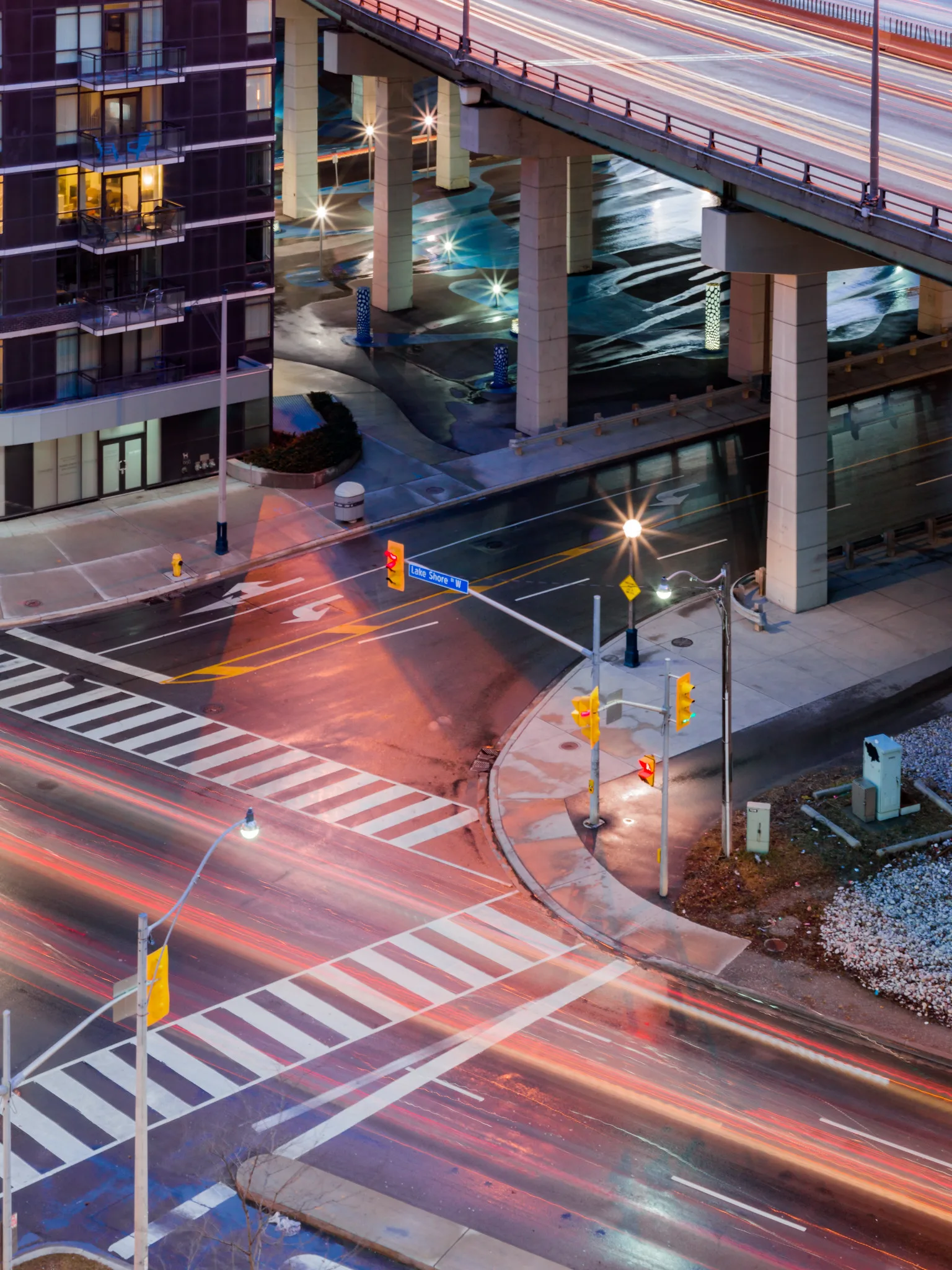
- Wet roads. After rain the surface mirrors every trail and fills the dark tarmac with colour.
Height and angle
From a footbridge or overpass directly above the road, the trails run straight away from you and converge toward a point: symmetrical and strong. From a hillside, a car park roof or a window above a junction, you see the trails as a pattern on the ground. At pavement level, close to the kerb with a wide lens, the nearest trails sweep past at full height. Buses and lorries add lines at several levels from their upper lights.
Stay on pavements, footbridges and other places meant for people on foot, behind the barrier, with the tripod legs out of the way of others. Wear something visible. On bridges with safety mesh, put the lens close to a gap in the mesh. Check local rules before setting up a tripod on a bridge or on private property such as a car park.
Why blue hour beats full darkness
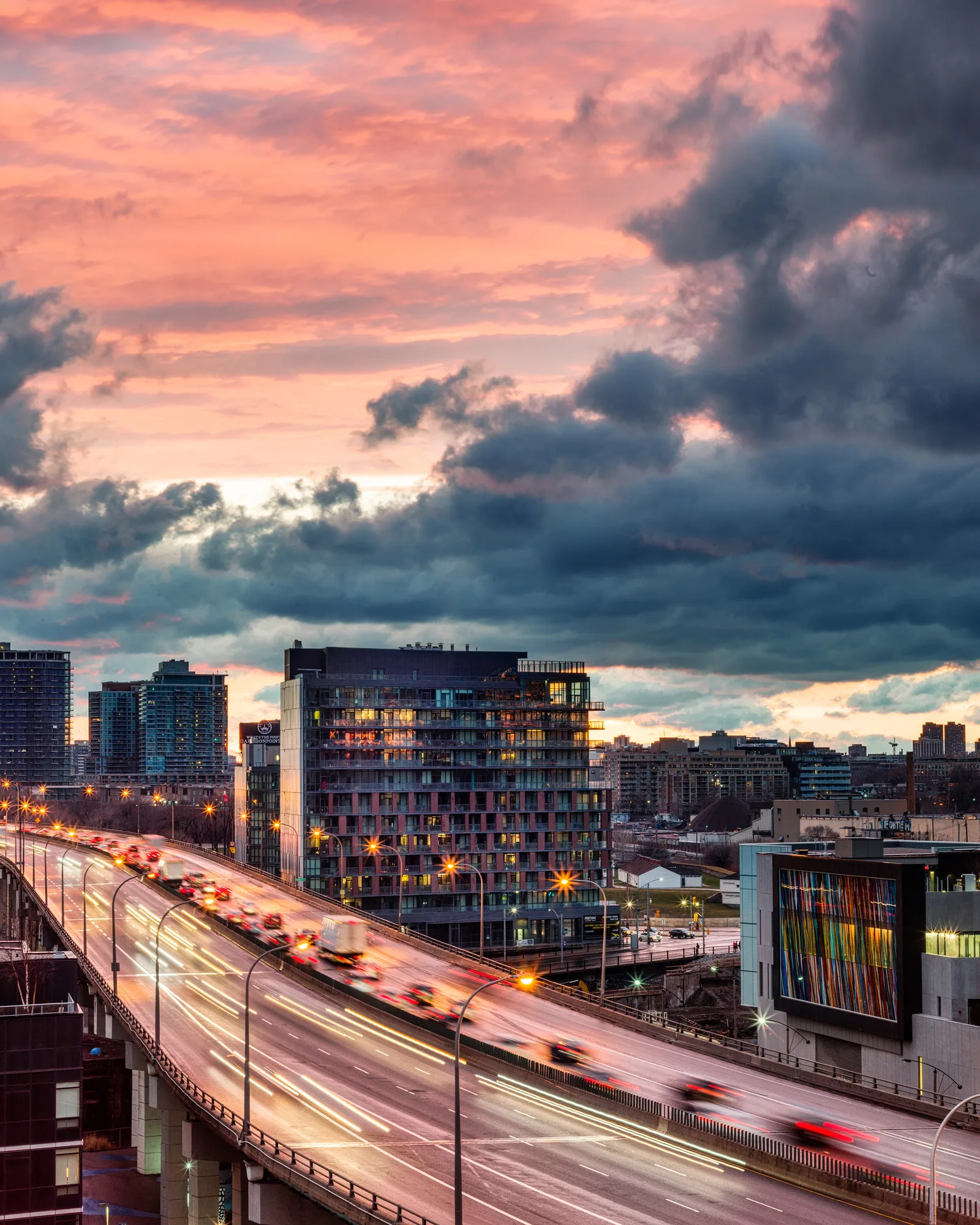
In full darkness the sky is black and the trails float in a void. In the half hour or so after sunset, the sky still holds a deep blue that is close in brightness to the lit street, so one exposure records sky, buildings and trails together. The blue hour page explains the light itself. For trails, the window divides into three parts:
- Too early. Around sunset the scene is so bright that a correct exposure is a second or less, even at a small aperture. Cars show as blurred shapes with short streaks.
- The window. Roughly 20 to 40 minutes after sunset at middle latitudes, exposures of 5 to 20 seconds become possible while the sky still has colour. This is when to shoot your main frames.
- Full dark. Exposures of 30 seconds are easy, but the sky has gone. Keep shooting trails now if you plan to blend them into a frame taken earlier from the same spot.
Traffic matters as much as light. In the darker months, blue hour falls during the evening rush, which gives the densest trails of the year. In summer it comes late, when roads are quieter, and you may need to stack several frames. The same window exists before sunrise, in reverse and with less traffic. Arrive half an hour before sunset to set up while you can still see.
Shutter speed by traffic speed and trail length
A trail is as long as the distance the vehicle covers while the shutter is open. To get an unbroken line from one edge of the frame to the other, the exposure must last at least as long as a car takes to cross the stretch of road you can see. The table gives that time.
| Traffic speed | 50 m of road | 150 m of road | 300 m of road |
|---|---|---|---|
| 20 km/h (12 mph): crawling city traffic, trams | 9 s | 27 s | 54 s |
| 50 km/h (30 mph): city streets | 4 s | 11 s | 22 s |
| 80 km/h (50 mph): main roads | 2 s | 7 s | 14 s |
| 110 km/h (70 mph): motorways | 1.6 s | 5 s | 10 s |
You do not need to measure anything. Watch one car and count the seconds it takes to travel from where it enters your frame to where it leaves. That is your minimum. Double it if you can, so that cars already part-way through when the shutter opens are joined by others that complete the whole run. For short dashes that suggest speed without filling the road, use a quarter of the crossing time.
Then set the exposure around that time. These are starting points for ISO 100:
| Light | Aperture | Shutter speed | Notes |
|---|---|---|---|
| Early blue hour, bright sky | f/11 to f/16 | 1 to 4 s | Add a 3 stop ND filter to reach 8 to 30 s |
| Late blue hour, lit city street | f/8 to f/11 | 8 to 20 s | The easiest conditions of the evening |
| Full dark, lit city street | f/8 to f/11 | 15 to 30 s | Watch street lamps and signs for clipping |
| Unlit rural road | f/5.6 to f/8 | 30 s to several minutes | The trails are the only light, so the land needs moonlight or a long exposure in bulb mode |
Use manual exposure, shoot RAW and take a test frame. Judge the still parts of the scene on the histogram and the trails by eye at full magnification. If the required time is longer than the light allows, fit an ND filter or wait ten minutes. Avoid going past f/16 just to lengthen the exposure: diffraction softens the whole frame, and a small aperture dims the trails as well.
Setting up the camera
- Lock the tripod down and turn off image stabilization if your camera or lens maker advises it on a tripod. How to use a tripod covers stability in detail.
- Focus with magnified live view on a lit sign or street lamp about a third of the way into the scene, then switch to manual focus so the camera cannot hunt between frames.
- Set a fixed white balance, such as daylight, so that every frame matches. This matters if you stack.
- Turn off long exposure noise reduction for exposures under about 30 seconds. It doubles the wait after every frame, and traffic will not wait. The trade-offs are explained in speeding up a long exposure workflow.
- Remove any filter you are not using. At night, a filter in front of bright lamps adds faint reflected copies of them to the picture.
Fixing blown highlights
A trail that is overexposed loses its colour. Red tail lights turn orange, then yellow, then white at the core. Headlamps become thick bands with no edge. Longer or shorter shutter speeds will not cure it, for the reason given earlier. What works:
- Close the aperture one stop at a time until the red returns, then lengthen the shutter by the same amount to hold the background.
- Make sure the ISO is at its base value.
- Reframe to cut out the distant end of the road, where trails pile up.
- Avoid headlamps aimed straight into the lens from close range. Step to one side, or shoot from the side on which traffic is moving away.
- For street lamps and signs that clip while the rest is correct, take a second, shorter frame and combine the two, as described in exposure blending. Small clipped lamps are normal and need no repair. Blown highlights explains what can and cannot be recovered.
Bulb mode, remotes and avoiding gaps
Most cameras time exposures up to 30 seconds. Beyond that, bulb mode holds the shutter open for as long as the release is pressed. Bulb is useful for trails even at shorter times, because it lets you match the exposure to the traffic instead of to a number.
- A locking remote release, wired or wireless, starts and ends the exposure without touching the camera. An intervalometer can also repeat an exposure of fixed length for a stack.
- A phone app from the camera maker usually offers a timed bulb function.
- The self-timer works if you have no remote, but only up to the camera’s longest timed speed, and its delay makes precise timing harder.
Timing each exposure
Gaps and half-finished lines come from when the exposure starts and ends, not from the settings. Open the shutter just before the first lights enter the frame and close it just after the last have left. Where traffic signals control the road, watch a full cycle first. Start as the lights turn green, when a platoon of cars sets off together, and stop before the next queue forms, because braking and waiting cars leave bright blobs and ghosts at the stop line.
When traffic is thin, cover the lens between vehicles. In bulb mode, hold a piece of black card just in front of the lens without touching it. Lift it away when a vehicle approaches and put it back when the road empties. The sensor collects trails from several vehicles while the background receives only the uncovered seconds, so the sky does not overexpose.
| What you see | Cause | What to do |
|---|---|---|
| Trail starts or stops part-way along the road | The vehicle was mid-frame when the shutter opened or closed | Lengthen the exposure, or time it to the gaps in traffic |
| Dashed or dotted line | A flashing indicator, a cyclist’s flashing lamp, or LED lamps that pulse rapidly | Nothing in camera. Reshoot, or replace that lane from another frame when stacking |
| Wavy line | The vehicle bounced on an uneven surface | It is a true record. If the street lamps are wavy too, the camera moved |
| Bright patch on the road | A vehicle stopped or slowed with brake lights on | Shoot while traffic is flowing, or frame away from the stop line |
| Empty lanes | Too little traffic during the exposure | Use the black card, or stack several frames |
Stacking several exposures into one
Stacking builds a full road from a quiet one, and it lets you keep blue hour colour in the sky while collecting trails for longer than blue hour lasts.
- Shoot the base frame. At the best moment for the sky, take a well exposed frame of the scene.
- Do not move anything. Keep the same position, focus, focal length, aperture and white balance.
- Collect trails. Take 10 to 30 frames as vehicles pass. As the sky darkens, keep the aperture and ISO fixed so that the trails match in brightness, and let the background go dark.
- Load the frames as layers in an editor that supports them, with the base frame at the bottom.
- Set every layer above the base to the Lighten blend mode. At each pixel the editor keeps the brightest value from any layer, so every trail shows through while the dark road of one frame cannot hide a trail in another. Blend modes explains how Lighten works.
- Mask out what you do not want. Paint black on a layer’s mask over a ghost car, a dashed line or a blown patch.
Lighten also keeps the brightest version of every street lamp and window, so the stack will look slightly brighter than any single frame. Reduce the opacity of the later layers, or mask them to the road only. Some cameras offer a composite mode that does the same thing internally, adding only pixels that become brighter. If you already have a time-lapse sequence of a road, it can be merged the same way, as shown in making a long exposure from time-lapse photos.
Trails from boats, trains, rides and stars
Every moving light obeys the same rules. What changes is the speed, and so the time.
- Boats. Slow, so plan on 30 seconds to several minutes. Ferries on a fixed route are predictable. Navigation lights give red, green and white lines, and a rocking hull draws them as gentle waves.
- Trains and trams. Lit windows make a broad band instead of thin lines. A timetable tells you when to open the shutter. Photograph only from platforms, bridges and public paths, well back from the track.
- Fairground rides. They are bright and fast, so half a second to 4 seconds is often enough. Time one rotation of a big wheel and expose for at least that long to draw a full disc. Photographing light displays covers exposure for coloured LEDs.
- Aircraft. Flashing strobes draw dotted lines and steady lights draw solid ones along the approach path.
- Stars. The sky turns 15 degrees an hour, so trails need many minutes, a dark site and usually a stack. See star trail photography.
- Lights you move yourself. Torches, sparklers and LED tools are covered in light painting.
Common mistakes
- Lengthening the shutter to brighten faint trails. The background brightens and the trails do not. Fix: open the aperture a stop and shorten the time to match.
- Waiting for full darkness. Trails end up on a black frame with no sky. Fix: shoot during blue hour, or stack later trails onto a blue hour base frame.
- Thick white trails with no colour. They are overexposed. Fix: close the aperture until tail lights are red again.
- Lines that stop in the middle of the road. The exposure was shorter than the crossing time. Fix: count how long a car takes to cross the frame and expose for at least that.
- A soft frame from a road bridge. Heavy vehicles shake the deck you are standing on. Fix: use a footbridge or solid ground, or take shorter frames between lorries and stack them.
- Touching the camera. Pressing the button blurs the first second. Fix: use a remote release or the self-timer.
- Autofocus left on. The lens hunts in the dark and the next frame is soft. Fix: focus once, then switch to manual.
- A dull road. A straight, empty road gives straight, dull lines. Fix: find a curve, a junction or a destination for the lines.
Try this
Stand on a footbridge or beside a road with steady traffic, twenty minutes after sunset, with the camera on a tripod at ISO 100. First, count how many seconds a car takes to cross your frame. Second, take three frames at that shutter speed with the aperture at f/5.6, f/8 and f/11, and compare the colour in the tail light trails. Third, hold the aperture that kept the red and take frames at half, one and two times the crossing time. Compare how the trail length and the sky change while the brightness of each line stays the same. Fifteen minutes of this teaches the two separate controls better than any table.
Frequently asked questions
What shutter speed do I need for light trails?
Long enough for a vehicle to cross your frame: usually 5 to 30 seconds. Fast traffic on a short stretch of road needs only a few seconds, and slow traffic over a long view needs 30 seconds or more.
Why are my light trails too bright or white?
The aperture is too wide or the ISO too high for the amount of traffic. Close the aperture a stop or two and use base ISO. Changing the shutter speed alters the background and the trail length, not the brightness of the lines.
Can I shoot light trails without a tripod?
You need the camera to stay perfectly still for several seconds, so some support is essential. A wall, a railing or a bag on a ledge will do, with the self-timer to fire the shutter.
Can I photograph light trails with a phone?
Yes, if it has a long exposure, light trail or manual shutter mode, and if it is held on a small tripod or clamp. Night photography with a smartphone lists the modes to look for.
Do I need an ND filter for light trails?
Not after dark. It helps early in blue hour, when the scene is too bright for an exposure of several seconds, and on very busy roads where you want a longer exposure without closing the aperture too far.
Why can I not see the cars in the photo?
A moving car is dark compared with its lamps and never stays over one part of the sensor long enough to register. Only its lights are bright enough to leave a mark.
Related guides
- Long exposure photography: tripods, ND filters and exposure for water, clouds and night scenes.
- Cityscape photography: skylines, vantage points and trails as part of a city view.
- Night photography: focusing, noise and exposure after dark.
- Blue hour photography: timing and colour in the half hour after sunset.
- Bulb mode: exposures longer than the camera’s timed speeds.
- Star trail photography: the same idea applied to the turning sky.
- Light painting: drawing your own trails with handheld lights.
- How to photograph fireworks: timing bulb exposures to bursts of moving light.