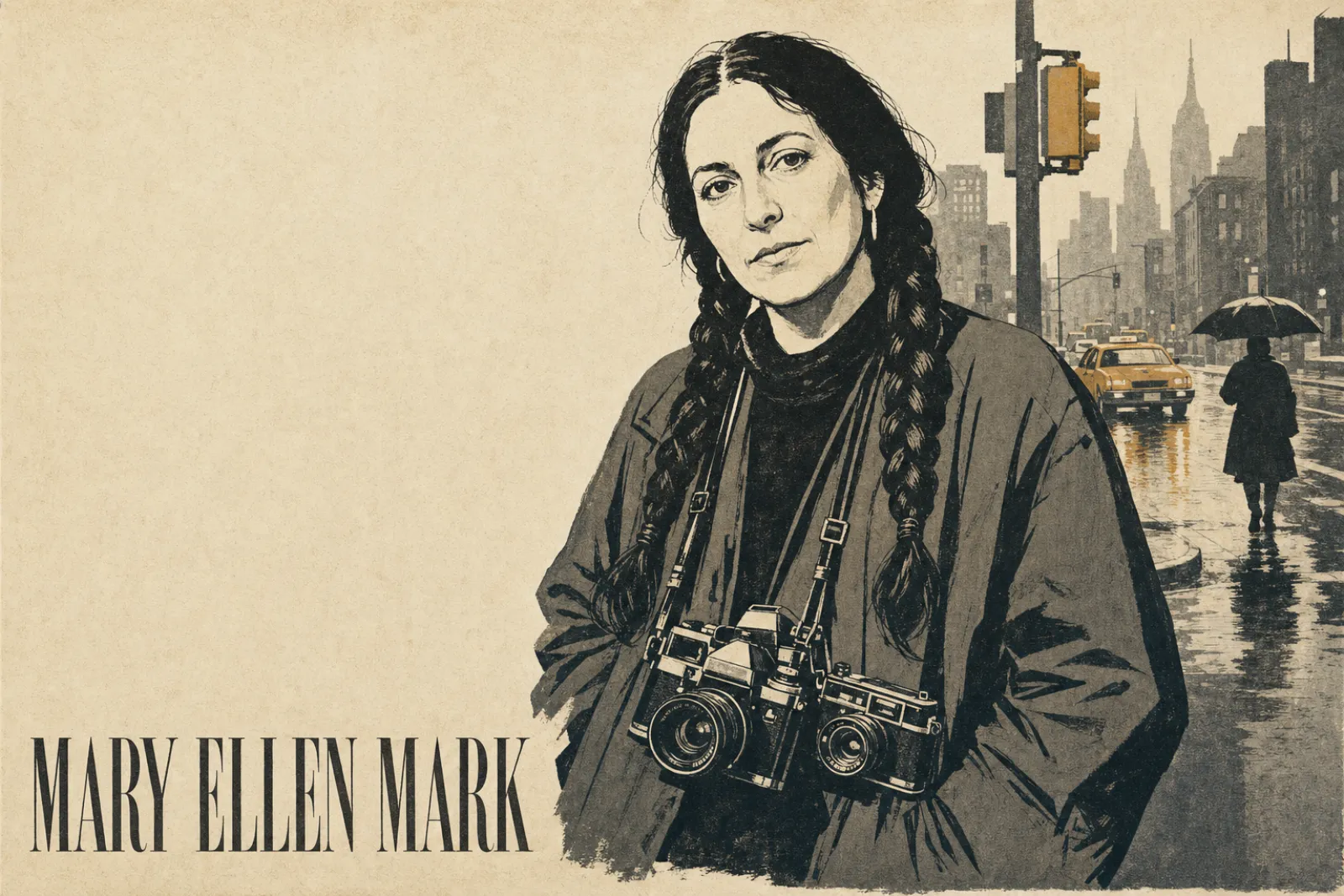
Mary Ellen Mark (1940 to 2015) was an American documentary photographer and photojournalist. From the 1960s until her death she worked mostly in black and white for magazines including Life, Rolling Stone, The New Yorker and Vanity Fair. She is known for long projects made with people at the edges of society, above all Streetwise, her pictures of homeless teenagers in Seattle, and for staying in touch with one of those teenagers for thirty years.
Mark came to photography from painting and from a graduate course in photojournalism, and she spent her working life inside the magazine picture story. Early on she shared a book with Annie Leibovitz, Photojournalism: Mary Ellen Mark and Annie Leibovitz: The Woman’s Perspective, published in 1974. Her subjects were different from the celebrities Leibovitz became known for. Mark said she felt an affinity for people who had not had the best breaks in society, and she kept returning to institutions, streets and travelling shows where such people lived. Readers who want to compare another photographer of people outside the mainstream can look at Diane Arbus.
From painting at Penn to a Fulbright year in Turkey
Mark was born in 1940 in the Philadelphia area and went to Cheltenham High School in Pennsylvania. At the University of Pennsylvania she took a degree in painting and art history in 1962, then a master’s degree in photojournalism from the university’s Annenberg School for Communication in 1964.
A Fulbright Scholarship sent her to Turkey to photograph for a year in 1965 and 1966. She used the year to travel as well, and photographed in England, Germany, Greece, Italy and Spain. Pictures from this period went into her first book, Passport, published by Lustrum Press in 1974.
In the later 1960s she moved to New York City. There she photographed demonstrations against the Vietnam War, the women’s liberation movement and Times Square. She also found a second line of work on film sets. Mark was a stills photographer on more than 100 films, among them Arthur Penn’s Alice’s Restaurant (1969), Mike Nichols’s Catch-22 (1970) and Carnal Knowledge (1971), Francis Ford Coppola’s Apocalypse Now (1979) and Baz Luhrmann’s Australia (2008). For Look magazine she photographed Federico Fellini at work on Satyricon in 1969. A later book, Seen Behind the Scene (2008), collected the film set pictures.
She joined the Magnum Photos agency in 1977 and left in the early 1980s. After that she worked with Archive Pictures, and in 1988 she opened her own agency.
What turns a set of pictures into a story a magazine can run? How to create a photo essay covers the form Mark worked in for most of her career.
Ward 81 and Falkland Road: moving in with the subject
Two projects set the pattern for the rest of her work. The first was made at Oregon State Hospital, the psychiatric hospital where Miloš Forman’s 1975 film One Flew Over the Cuckoo’s Nest was shot. In 1976 Mark and a writer were commissioned by The Pennsylvania Gazette to report on the hospital. They lived for more than a month in Ward 81, a locked security ward for women, alongside the patients. The book Ward 81 was published by Simon and Schuster in 1979, with an introduction by Forman.
The second was in India. For the book Falkland Road: Prostitutes of Bombay, published by Knopf in 1981, Mark spent three months getting to know women who worked in the brothels of a single long street. The work won the Leica Medal of Excellence in 1982. India stayed in her work for years. She photographed Mother Teresa’s Missions of Charity in Calcutta for Life, which brought her Robert F. Kennedy Journalism Awards in 1980 and 1981, and she photographed travelling circuses for the book Indian Circus (1993).
What the two projects share is the method. She did not visit for an afternoon. She arranged to stay, and she was open with people about what she was doing. Mark said it was important to be direct and honest with people about why you are photographing them.
Is it fair to photograph people who are ill, poor or vulnerable? Photography etiquette and ethics sets out the questions of consent and respect that this kind of work raises.
Streets of the Lost, Streetwise and thirty years with Tiny
In 1983 Life magazine sent Mark and the writer Cheryl McCall to Seattle to report on teenagers living on the street. The article ran in July 1983 under the title Streets of the Lost. It did not end there. Mark’s husband, the filmmaker Martin Bell, directed a documentary about the same young people. Streetwise was released in 1984 and was nominated for the Academy Award for Best Documentary Feature. Mark’s book of the photographs, also called Streetwise, followed in 1988.
One of the teenagers was Erin Blackwell, known as Tiny, who was in her early teens when Mark met her. Mark went on photographing her for three decades, as Tiny grew up and became a mother of ten. The book Tiny: Streetwise Revisited was published by Aperture in 2015, the year Mark died. She chose the pictures for it with the Aperture editor Melissa Harris before her death. Bell’s second film about the same life, Tiny: The Life of Erin Blackwell, premiered at the Seattle International Film Festival in 2016.
Mark and Bell worked side by side on other subjects too. She was associate producer and stills photographer on his feature film American Heart (1992), and several of her later books, including Twins (2003) and Prom (2012), had films by Bell made alongside them. Prom was photographed at thirteen American high schools.
How do you keep a project going for years? How to build a long-term photography project looks at planning and keeping up work that will not be finished quickly.
How her pictures are made to work
The first choice is time. Six weeks in a hospital ward, three months on one street, thirty years with one person. Time is what moved her from an outsider with a camera to someone the subjects knew, and that is the basis of documentary photography as she practised it. A visitor gets the first thing people show. Someone who stays gets what comes after.
The second is honesty about the purpose. Mark told people why she was there. Being open is slower than taking pictures unobserved, but it gives a different kind of picture: the subject knows the camera is present and agrees to it. The same attitude shaped how she photographed children. She said she looked at them as small people.
The third is the material. Mark worked mainly in black and white, on Kodak Tri-X film. Taking colour away leaves faces, gesture and light to carry the picture, and it gives projects shot years apart a common look. She did not hold to one camera. She used 35mm, the larger 120 and 220 roll film sizes of medium format, a 4×5 inch view camera and the 20×24 Polaroid Land Camera. The small camera suits fast, unplanned situations. The big cameras are slow and formal, and they make a sitting into an event that the subject takes part in. Anyone curious about why photographers still choose film for this can read about shooting on film.
The fourth is the form. Most of her work was made as a set of pictures meant to be read together, in a magazine and then in a book. Single frames mattered less than the group. That is why the same people appear again and again, and why editing and ordering a body of work is part of the job, not an afterthought.
The last is the portrait in its setting. Her subjects are shown where they lived or worked: a ward, a brothel, a circus, a street corner, a school dance. The place is part of the description of the person, which is the idea behind the environmental portrait.
Want to make a portrait of someone you have only just met? Street portraits explains how to ask a stranger and get a good frame once they say yes.
Books and series to look for
- Ward 81 (book 1979). Made over more than a month living in a women’s security ward at Oregon State Hospital in 1976. Look at how much the pictures depend on the photographer being accepted as part of the ward’s daily life.
- Falkland Road: Prostitutes of Bombay (1981). Three months on one street. Notice the narrow scope: one place, one group of women, returned to day after day until she was trusted.
- Streetwise (Life article 1983, book 1988). Homeless and runaway teenagers in Seattle. See how the same few young people recur through the set, so that the reader comes to know them as individuals.
- Indian Circus (1993). Travelling circuses in India, with a foreword by the novelist John Irving. It shows another side of her long work in India, alongside Falkland Road and the Mother Teresa pictures.
- Twins (2003). A series that won first prize in the Arts category of the World Press Photo awards in 2003. Martin Bell made a film alongside the book, as he did for Prom and Indian Circus.
- Tiny: Streetwise Revisited (2015). Thirty years of one life, from the Seattle streets onward. The lesson is in the length: pictures of the same person taken decades apart explain each other.
Try this: twenty minutes with one person, asked first
This exercise practises the two things Mark insisted on: saying honestly why you want the picture, and staying longer than is comfortable.
- Choose one person in the place where they spend their day: a shopkeeper, a neighbour in their garden, a relative in their kitchen.
- Before you lift the camera or phone, tell them in one sentence why you would like to photograph them there. If they say no, thank them and ask someone else.
- Set the camera to black and white so that you see in tones while you work.
- Stay for the full twenty minutes. Take no more than twelve pictures. Spend the rest of the time talking and watching.
- Keep the place in every frame. Do not crop to the face alone.
- Afterwards compare the first frame with the last. Note what changed in the person’s face and posture once they were used to you.
Questions people ask about Mary Ellen Mark
What is Mary Ellen Mark best known for?
She is best known for Streetwise, her photographs of homeless teenagers in Seattle, which began as a 1983 Life magazine article and became a 1984 documentary film and a 1988 book. Ward 81 and Falkland Road, both made by living close to her subjects for weeks or months, are the other projects most often cited.
What camera and film did Mary Ellen Mark use?
She worked mostly in black and white on Kodak Tri-X film. She used several formats: 35mm, 120 and 220 roll film, a 4×5 inch view camera and the 20×24 Polaroid Land Camera.
Was Mary Ellen Mark a member of Magnum?
Yes. She joined Magnum Photos in 1977 and left in the early 1980s. She then worked with Archive Pictures and opened her own agency in 1988.
When did Mary Ellen Mark die?
She died in Manhattan on May 25, 2015, aged 75. Her honours included a Guggenheim Fellowship in 1994, the Cornell Capa Award from the International Center of Photography in 2001 and a lifetime achievement award from George Eastman House in 2014.
Mary Ellen Mark is one of the photographers listed in the A to Z of photographers.