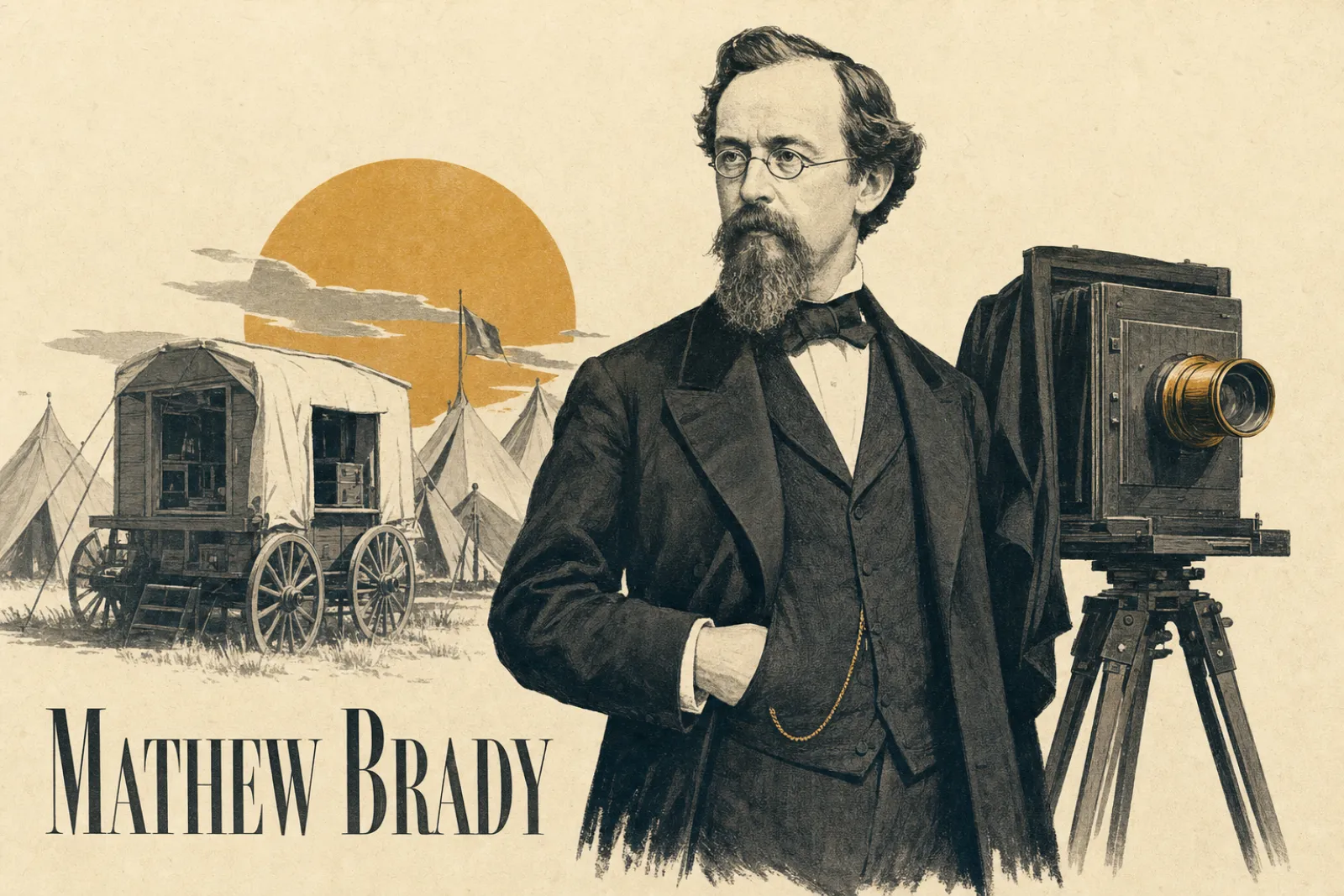
Mathew Brady (about 1822 to 1896) was an American photographer and studio owner who worked in New York and Washington from the 1840s. He made portraits of the country’s politicians, generals and writers, including Abraham Lincoln, and during the Civil War he paid teams of photographers to record the camps and battlefields. The war pictures published under his name are the reason he is remembered.
Brady learned from painters before he learned photography. As a teenager he met the portrait painter William Page, and in New York he is thought to have been taught the daguerreotype process by Samuel Morse, who had met Louis Daguerre in France. Brady treated the new medium as a way of doing what portrait painters did, only for many more people. He was also a businessman who hired skilled operators and put his own name on what they made. For war photography from a few years before Brady’s, compare Roger Fenton, who was commissioned in 1854 to photograph the Crimean War.
A Broadway gallery and a book of famous faces
Brady’s birth is not firmly recorded. The usual account is that he was born in Warren County, New York, to Irish immigrant parents. He himself put the year between 1822 and 1824, and on official papers during the Civil War he gave Ireland as his birthplace. In New York City he made cases for daguerreotypes and jewellery before he opened a studio of his own in 1844, at the corner of Broadway and Fulton Street. He called it the Daguerrean Miniature Gallery.
Recognition came fast. He won the highest award at the American Institute’s annual fair in 1844, 1845, 1846, 1849 and 1857, and a medal in London in 1851. He opened a second studio in Washington in 1849, which put him within reach of Congress and the White House. His sitters over the years included Edgar Allan Poe, James Fenimore Cooper, Henry Clay, Daniel Webster, John C. Calhoun, Jefferson Davis, Walt Whitman and Robert E. Lee. He or his studio photographed 18 of the 19 presidents from John Quincy Adams to William McKinley.
In 1850 he published The Gallery of Illustrious Americans, a set of portraits of prominent men. It did not make money, but it made him better known. In the same year he married Juliet Handy.
His materials changed with the trade. The early work was daguerreotypes, each one a unique image. In the 1850s the studio moved to ambrotypes and then to albumen prints made from glass negatives, which could be printed many times. That mattered commercially, because a portrait of a famous person could be sold to the public. The small card portrait known as the carte de visite, an albumen print pasted on a card, made such pictures cheap enough to collect.
Where do daguerreotypes, glass plates and paper prints fit in the larger story? The history of photography follows the medium from the daguerreotype to digital.
The Lincoln portrait of February 1860
On February 27, 1860, Abraham Lincoln came to New York to speak at the Cooper Union, and Brady photographed him the same day. The portrait became the best known of the many that Brady’s studio made of Lincoln. Brady portraits of Lincoln were later used for the five dollar bill and the Lincoln cent, and one was the basis of a 90 cent postage stamp in 1869.
Brady’s own part in the studio work was shrinking by then. His eyesight had been failing since the 1850s. Alexander Gardner joined him in 1856, took charge of the Washington gallery in 1858 and made the studio’s large Imperial photographs. Brady dealt in person with the distinguished sitters. Much of the camera work was done by the people he employed, which is one reason it is often hard to say who made a particular Brady picture.
Sending cameras to the Civil War
When the war began in 1861 Brady got Lincoln’s permission to photograph the armies, on the condition that he pay for it himself. He went to the First Battle of Bull Run that year and came under fire there, as he later did at Fredericksburg and Petersburg. For the most part, though, he stayed in Washington and organised. He equipped photographers with cameras and travelling darkrooms and sent them out. The men who worked for him included Alexander Gardner, James Gardner, James F. Gibson, Timothy O’Sullivan, George N. Barnard, William Pywell and Thomas C. Roche.
The process set the limits. Wet plate collodion negatives needed exposures of roughly 5 to 20 seconds, so nothing that moved could be recorded. There are no photographs of fighting. What exists is the before and after: camps, officers, guns, bridges, ruins and the dead. Each photographer Brady sent out was given a travelling darkroom for working in the field.
In October 1862 Brady hung an exhibition in his New York gallery called The Dead of Antietam. The pictures had been taken by Gardner and Gibson, whom Brady sent to the battlefield two days after the battle of September 17, 1862. For many Americans it was the first time they had seen the realities of war in photographs. The New York Times reviewed the show that month and credited Brady with bringing the reality of the war home to people who had only read about it.
Everything carried the credit “Photo by Brady”, whoever had exposed the plate. Gardner left, partly over this practice, and opened his own Washington studio with his brother in May 1863, taking several of Brady’s staff with him. When Gardner published his Photographic Sketch Book of the War in 1866, he named the maker of each negative.
Who owns a picture, the person who took it or the person who paid for it? Copyright basics for photographers explains how ownership and credit are handled in modern practice.
Debt, a sale to the government and a charity ward
Brady spent more than 100,000 dollars on the war project and gathered more than 10,000 plates. He expected the government to buy them when the war ended. It declined, and the public showed little wish to look at the war again. He had to sell his New York studio and went bankrupt. In 1875 Congress granted him 25,000 dollars for the collection, which did not clear his debts. Other negatives had already gone to the photographic supplier E. and H. T. Anthony and Company in place of money he owed.
His wife died in 1887. Her nephew Levin Handy, also a photographer, carried on Brady’s studio. Brady was hurt in a traffic accident in 1894. He died on January 15, 1896, in the charity ward of Presbyterian Hospital in New York. Veterans of the 7th New York Regiment paid for the funeral, and he was buried in Congressional Cemetery in Washington. The surviving photographs are held mainly by the National Archives and the Library of Congress.
Why the pictures look the way they do
Stillness is built in. With exposures counted in seconds, a sitter had to hold a pose and a field photographer had to choose subjects that would not move. The grave, composed look of the portraits and the quiet of the battlefield views come from the length of the exposure, not from taste alone.
The portrait was planned like a painting. Brady’s training was with painters, and his studio made formal likenesses of people who wanted to be seen as serious. Pose, dress and a plain setting did the work. The same decisions still shape portrait photography, and they can be studied in a guide to posing.
The plate was large. The negatives were sheets of glass, and the studio was known for its large Imperial portraits. A big negative holds fine detail. The modern relative of that way of working is large format photography.
Choosing the scene counted as authorship. In the field the photographer could not catch an event. He could only decide where to stand and what to include once it was over. That makes every war view a deliberate statement about what had happened there, which is the root of photojournalism and of documentary photography.
The pictures were made to be multiplied. Glass negatives, albumen prints and card portraits all served one aim: many copies of one image, sold to the public. Brady understood early that a photograph’s reach depends on how it is published.
Curious about making pictures with nineteenth century methods? Alternative photography processes introduces the hand made techniques that sit outside digital and ordinary film.
Brady pictures to look for
- Abraham Lincoln, February 27, 1860. Taken in New York on the day of the Cooper Union speech. It is the most famous of the Lincoln portraits made by Brady’s studio and shows how much a studio portrait could do for a public figure.
- The Gallery of Illustrious Americans (1850). Brady’s published set of portraits of leading Americans. It was a commercial failure and a reputational success, and it shows his idea of the camera as a recorder of national figures.
- The Dead of Antietam (1862). The exhibition at Brady’s New York gallery of battlefield photographs taken by Alexander Gardner and James F. Gibson. These pictures showed the dead on the field, and for many Americans they were the first sight of the realities of war in photographs.
- Portraits of Robert E. Lee and Jefferson Davis. Brady’s studio photographed leaders of both sides. Put them beside the Union generals, such as Grant and Sherman, and note how the same formal treatment is given to each.
- Portraits of Walt Whitman and Edgar Allan Poe. Brady’s sitters were not only soldiers and politicians. The two writers show the studio’s everyday trade in likenesses of the famous.
Have old family prints or negatives of your own? How to store and care for old prints, negatives and slides covers keeping them safe.
Try this: a portrait that has to hold still
This exercise reproduces the main constraint of Brady’s studio: a long exposure and a sitter who must keep a pose.
- Work indoors by a window in dim light, with the camera or phone on a tripod or a stack of books.
- Set the lowest ISO and a small aperture so that the exposure is about one second. On a phone, use a manual or night mode that allows a slow shutter.
- Seat your sitter. Ask them to rest an arm on a table or chair back, as studio sitters did, and to keep their face still.
- Make six exposures. Change only the pose between them: hands, shoulders, direction of the gaze.
- Compare the frames. Note which poses stayed sharp, and how the need to keep still changed the expression.
Questions people ask about Mathew Brady
Did Mathew Brady take the Civil War photographs himself?
He took few of them. Brady planned and paid for the project and mostly stayed in Washington, while employees such as Alexander Gardner, James F. Gibson and Timothy O’Sullivan worked in the field. The pictures were published with the credit “Photo by Brady” regardless of who made them.
Why are there no Brady photographs of battles in progress?
The wet plate collodion process needed exposures of about 5 to 20 seconds. Moving soldiers could not be recorded, so the photographs show camps, portraits and the aftermath of fighting.
How did Mathew Brady die?
He died on January 15, 1896, in the charity ward of Presbyterian Hospital in New York, from complications that followed a streetcar accident. He had been in debt since the war, having spent more than 100,000 dollars on photographs for which Congress granted him 25,000 dollars in 1875.
Where are Mathew Brady’s photographs kept?
The main collections are in the National Archives and the Library of Congress in the United States.
Mathew Brady appears in the A to Z of photographers, and he is quoted on the photography quotes page.