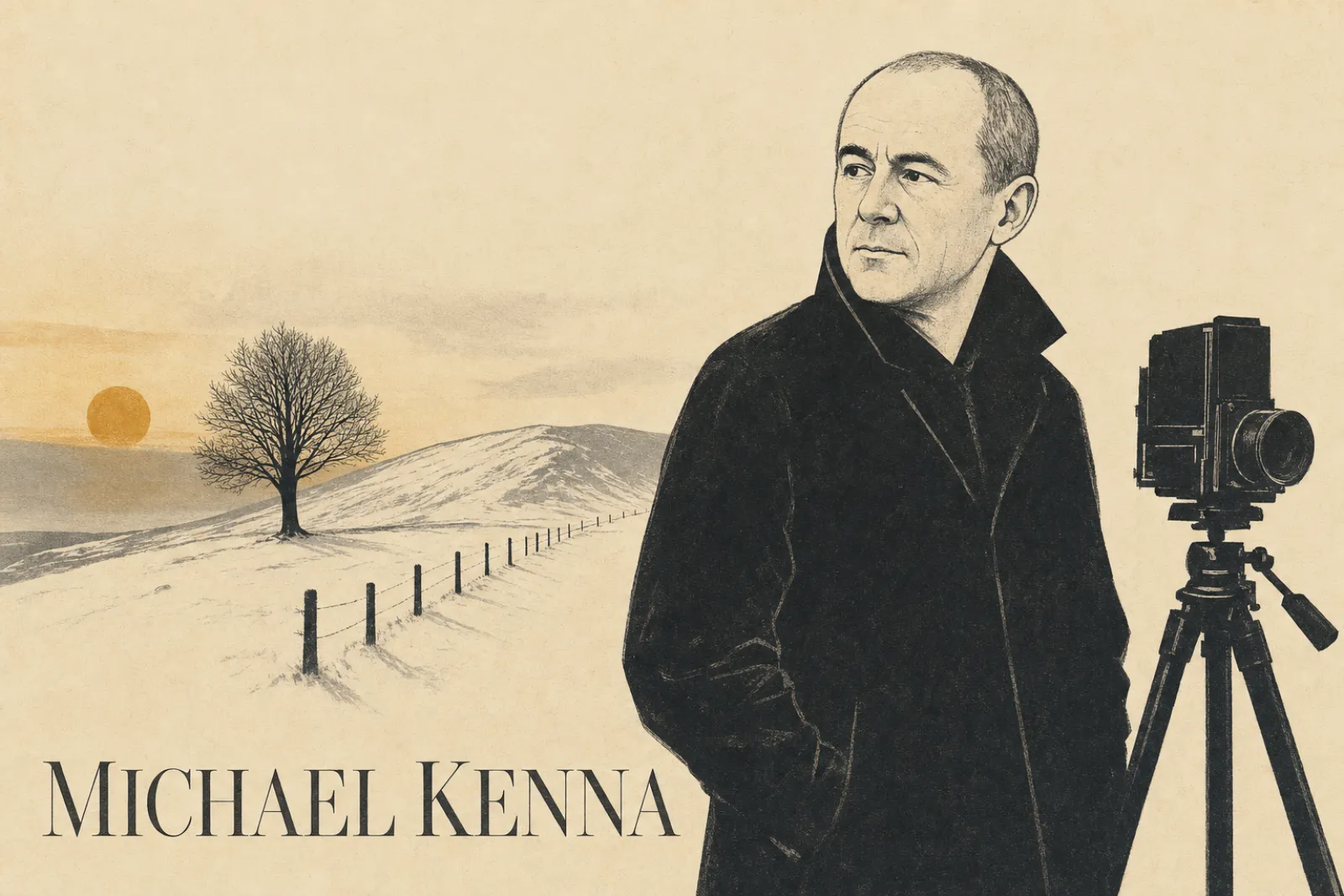
Michael Kenna is an English photographer, born in 1953, who made black and white landscapes across Europe, the United States and Asia from the 1970s onward. He photographed at dawn and at night on film, often with very long exposures, and printed the results himself as small square prints. He is known for spare, quiet pictures of places such as Hokkaido in Japan, and for returning to the same subjects over many years.
Kenna has named the photographers he learned from. In a 2003 interview with LensWork he listed Bill Brandt, Josef Sudek, Eugène Atget and Alfred Stieglitz, along with Charles Sheeler. He said he had gone to places those earlier photographers had worked and photographed them again. His practical training came from the photographer Ruth Bernhard, whose negatives he printed in San Francisco. For a later series of nudes he also cited Edward Weston and Man Ray.
From a seminary in Lancashire to a darkroom in San Francisco
Kenna was born in Widnes, Lancashire, in the north west of England, and grew up with five siblings in a working class Irish Catholic family. From 1964 to 1972 he was a pupil at St Joseph’s College, Upholland, a seminary school. He then spent a year at Banbury School of Art in Oxfordshire, from 1972 to 1973, and three years at the London College of Printing, where he studied commercial photography and finished in 1976.
In 1977 he moved to San Francisco. There he met Ruth Bernhard and went to work for her as a printer in the late 1970s. Kenna has said that working for her showed him how little he knew about printing. She treated a negative as raw material, something to be interpreted in the darkroom and not simply reproduced. That idea stayed with him. He won the Imogen Cunningham Award in 1981.
What happens between a negative and a finished print? Darkroom basics explains setting up and processing, the craft Kenna learned by printing another photographer’s work.
Power stations, a car plant and a kindergarten
Kenna is usually described as a landscape photographer, but much of his early and middle work is about what people have built. He photographed Ratcliffe Power Station in England from the early 1980s and was still preparing a book on it some twenty years later. He photographed the Ford Rouge plant at Dearborn, Michigan, and published the pictures as The Rouge in 1995. An early book was an illustrated edition of The Hound of the Baskervilles for Arion Press in 1985, and Le Desert de Retz followed in 1990.
Two projects stand apart. In one he photographed the former concentration camps of Europe. He described the aim as translating memories and stories into visual terms, which he distinguished from making a documentary record. The other is Monique’s Kindergarten, published in 1997. It is the exception in his equipment too: he made it with a 4×5 large format camera.
He also took commercial commissions. His clients included Volvo, Rolls-Royce, Audi, Sprint, Dom Perignon and the Spanish Tourism Board.
Japan, Hokkaido and fifty years of exhibitions
Japan became the place most closely tied to his name. He photographed across Japan and on the snow covered northern island of Hokkaido, and published the book Hokkaido in the middle of the 2000s. Other subjects in his long list include Easter Island, Mont-Saint-Michel in France and the landscape of northern England. Later books include France (2014), Abruzzo (2017), Holga (2017), Beyond Architecture (2019), Buddha (2020), Trees (2023) and Japan: A Love Story (2024). A book of nudes photographed between 2008 and 2017, Rafu, was published by Nazraeli Press. It was edited down from about 9,000 negatives, and Kenna asked each model to approve the pictures before publication.
His own record lists almost five hundred solo exhibitions over fifty years, and prints in more than 100 institutional collections. France made him a Chevalier of the Order of Arts and Letters in 2000 and an Officer of the same order in 2022. He received the Special Photographer Award at Higashikawa, Japan, in 2016. In 2022 he gave his archive to the French state’s Library of Heritage and Photography.
Planning to photograph snow, ice and bare trees? Winter photography covers exposure and handling a camera in the cold.
How a Kenna picture is put together
A square frame. From about 1986 Kenna worked mainly with Hasselblad medium format cameras and with Holga cameras. Both give a square negative. A square has no long side to lead the eye, so the subject tends to sit in a calm, centred or carefully balanced position. The choice of aspect ratio is the first decision in every one of these pictures.
The half light. Kenna favoured the hours when light is soft and changing: dawn and after dark. Low light removes hard shadows and fine detail, and it reduces a scene to a few shapes. This is the starting point of night photography as well.
Time as a tool. His exposures ran from about a second to as long as ten hours. Over minutes or hours, moving water turns smooth, clouds streak and anything that does not stay still disappears. The film records an accumulation that the eye never sees at once. That is the whole idea of long exposure photography, and it needs a camera that cannot move, so a tripod is part of the method. Even his nudes were made at around one second with the camera on a tripod or on the ground.
Very little in the frame. His pictures are spare. A single subject, such as the trees that fill one of his later books, is given room and little else is allowed in. This is minimalist photography, and it depends on negative space: the empty area is doing as much work as the object.
Not caring about the kit. Kenna has played down equipment. He told LensWork that he often did not know which lens he had used, and that he bought whichever black and white film was available where he was working, Fuji in Japan and Agfa, Ilford or Kodak elsewhere. Experience, he argued, makes technical knowledge almost beside the point.
Printing as the second half. Kenna made his own black and white prints in a darkroom. In 2003 he said that nearly all his prints were about 8 by 8 inches, a size he had kept for 25 years so that he had one less decision to make. A small print asks the viewer to come close. He limited an edition to 45 prints and did not make them all at once. He would start with 10 or 15, and when he came back to the negative later he allowed himself to interpret it afresh, so that the last print of an edition need not match the first. Readers who print their own work can find the equivalent decisions in black and white printing.
Going back. Some of his subjects, Ratcliffe Power Station above all, were photographed across many years. Returning shows a place in different weather, season and light, and it lets the photographer get past the obvious first picture.
How do you get a shutter speed of minutes in daylight? The ND filter guide explains stops, exposure times and how to use one.
Does mist help or hurt a picture? Fog and mist photography shows how low visibility simplifies a scene.
Books and series to look for
- The Rouge (1995). Photographs of the Ford Rouge plant at Dearborn, Michigan. Look at how an industrial site is treated with the same stillness as a landscape.
- Ratcliffe Power Station (2004). A subject he photographed from the early 1980s and kept working on into the 2000s. It is the clearest example of his habit of returning to one place.
- Monique’s Kindergarten (1997). Made with a 4×5 large format camera, unlike nearly everything else he did. Compare the rectangular 4×5 frame with the square frame of his other work.
- Hokkaido (about 2005). The northern Japanese island he is most associated with. Notice how few elements each picture needs.
- Holga (2017). A book named after one of the two kinds of camera he relied on. Read it alongside his remark that technical matters count for little once a photographer has enough experience.
- Rafu (about 2019). Nudes made from 2008 to 2017 with old Hasselblad film cameras. Kenna described the sessions as a wordless dialogue between model and photographer, with no fixed plan in advance.
Try this: one object, a square and a slow shutter
This exercise practises reduction and patience, the two habits that run through Kenna’s work.
- Go out at dawn or dusk, or on a dull, misty day. Take a tripod, or find a wall or post to rest the camera on.
- Set the camera or phone to a square (1:1) frame and to black and white.
- Find one isolated object: a single tree, a post in water, a lamp, a bench.
- Compose so that the object takes up no more than a tenth of the frame and nothing else competes with it.
- Use the longest exposure the light allows, with the lowest ISO and a small aperture. On a phone, use a long exposure or night mode.
- Make only six frames in fifteen minutes. Between each one, move the camera a little or wait for the light to change. Keep the one with the least in it.
Questions people ask about Michael Kenna
What camera does Michael Kenna use?
From about 1986 he worked mainly with Hasselblad medium format film cameras and with Holga cameras, both of which make square negatives. Monique’s Kindergarten was the exception, made with a 4×5 large format camera.
How long are Michael Kenna’s exposures?
They vary widely. His night and dawn photographs used exposures of up to ten hours, while other work was made at around one second.
Why are Michael Kenna’s prints so small?
He said in 2003 that almost all his prints were about 8 by 8 inches and that he had kept to that size for 25 years. Fixing the size removed a production decision and let him concentrate on the picture. He made the prints himself.
Where is Michael Kenna from?
He was born in 1953 in Widnes, Lancashire, England. He studied at Banbury School of Art and the London College of Printing, and moved to San Francisco in 1977.
Michael Kenna is listed in the A to Z of photographers, and he is quoted on the photography quotes page.