The decisive moment is the instant when what is happening in front of you and the shapes in your frame line up so perfectly that the photograph could not be better a split second earlier or later. The idea comes from Henri Cartier-Bresson, and it is less about fast reflexes than about anticipation: you read the scene, compose for what is about to happen, and press the shutter as the gesture, expression or light reaches its peak.
What the decisive moment actually means
Cartier-Bresson’s best-known book was published in English as The Decisive Moment, and its introduction gave photographers the phrase they still use. His idea, paraphrased, was that a great picture comes from recognising two things at once, in a fraction of a second: the meaning of an event, and the precise arrangement of shapes that gives that event its strongest expression. Both halves matter. A dramatic event badly framed is only a record. A beautiful geometric frame with nothing happening in it is only a design. The decisive moment is where the two meet.
His famous picture of a man leaping over a flooded patch of ground behind a Paris railway station shows the idea clearly. The man is airborne, his heel just above his own reflection, and the curve of his leap echoes a dancer on a poster on the wall behind him. A moment earlier he is simply running. A moment later his foot has broken the reflection. The picture works because the action, the reflection and the background shapes all agree for a sliver of time.
Three misunderstandings are worth clearing up early:
- It is not only about action. A glance between two people, the second before a child laughs, or the instant a shaft of light touches a doorway can all be decisive moments. The peak can be quiet.
- It is not luck. Luck plays a part, but photographers who get these frames repeatedly have put themselves in the right place, composed in advance and learned how events unfold.
- It is not a single frame by rule. Cartier-Bresson often shot several frames of a situation. The decisive moment is the frame you choose, not a promise that you only press once.
Anticipation: pressing the shutter before you see the peak
The hardest truth about timing is that if you wait until you see the perfect moment, you have already missed it. Human visual reaction time is roughly a fifth to a quarter of a second. On top of that your camera adds its own shutter lag, usually small but not zero. In a quarter of a second a person walking at a normal pace moves about a third of a metre, and a small hop can go from takeoff to landing. The peak you saw is gone by the time the shutter opens.
So the skill is prediction. You watch the rhythm of a situation and press slightly before the peak arrives, the same way a musician plays on the beat rather than after it. Some examples of what to watch for:
- Walkers: legs look most dynamic when a stride is fully open, with a clear gap between the feet. Watch two or three steps, feel the rhythm, and fire as the next stride opens.
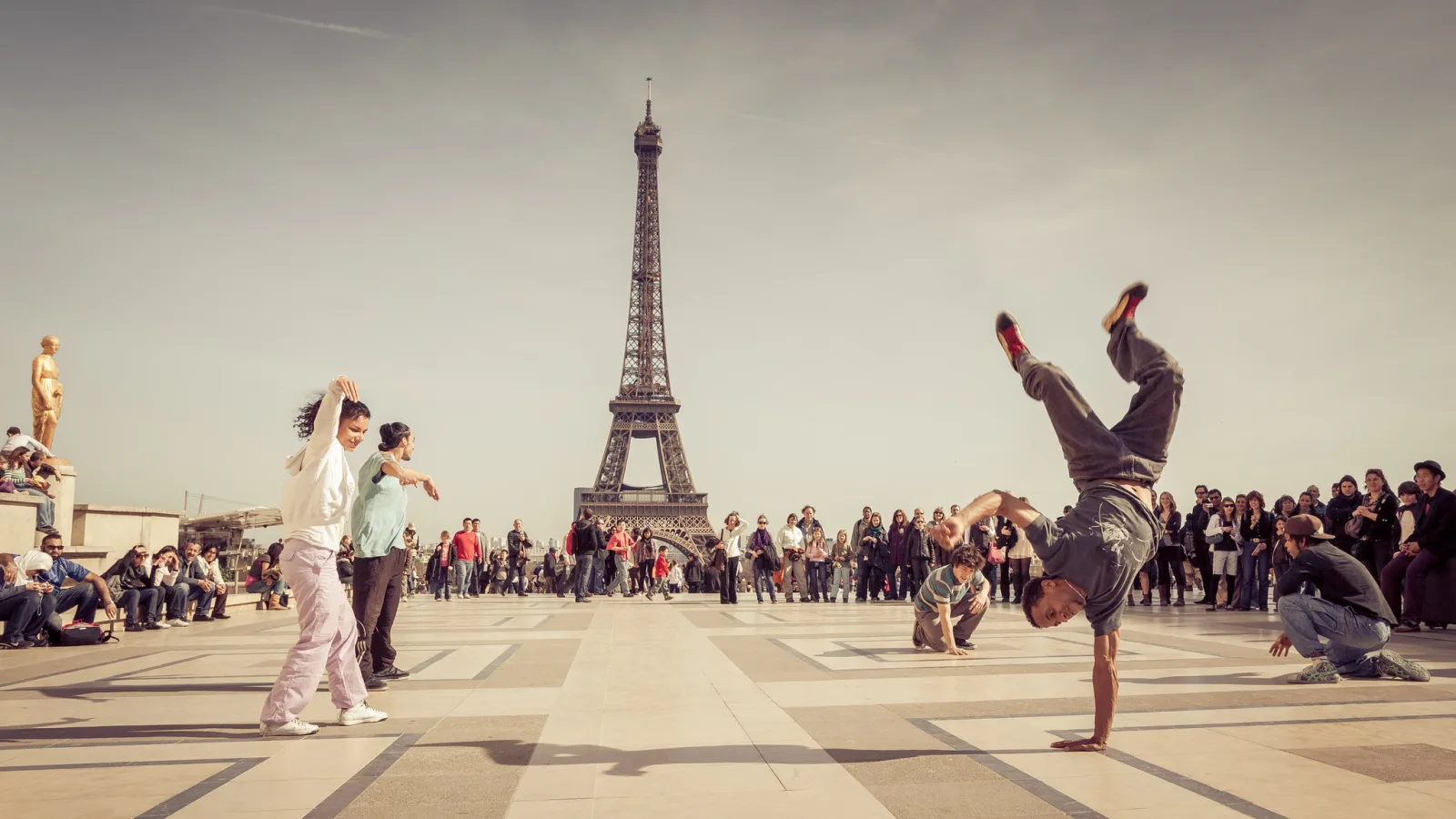
- Jumps: the top of a jump is the slowest part, because the upward speed falls to zero before the fall begins. Start pressing as the takeoff happens and the frame lands near the apex.
- Conversations: hands move before a laugh arrives, and heads tilt back just before the punchline lands. Watch the speaker, not the listener, to know when it is coming.
- Repetitive actions: a juggler, a fire spinner or a child on a swing repeats a cycle. Shoot a few cycles, check the screen, then adjust your timing by feel.
Anticipation also means knowing where the action will be, not just when. Before you raise the camera, ask where the subject is heading, where the light falls, and which background would give the gesture meaning. Then frame that spot and let the subject walk into it.
Gesture and expression: finding the peak of an action
Most actions have a peak, the point where the body or face says the most. In sport it is often obvious: the racquet meeting the ball, the rider at the top of a ramp. In daily life it is subtler, but the principle is the same. Look for the extreme of a movement, the moment when a limb is fully extended, a head is fully turned, or an expression is fully formed rather than halfway through changing.
Hands are often the most expressive part of a picture. A hand reaching, pointing, shielding the eyes or resting on a shoulder tells the viewer what the moment is about. Faces carry the emotion, and the difference between a flat frame and a strong one is often a fraction of a second: eyes half closed in a blink versus eyes wide in surprise. The page on capturing emotion in your photos covers expression in more depth.
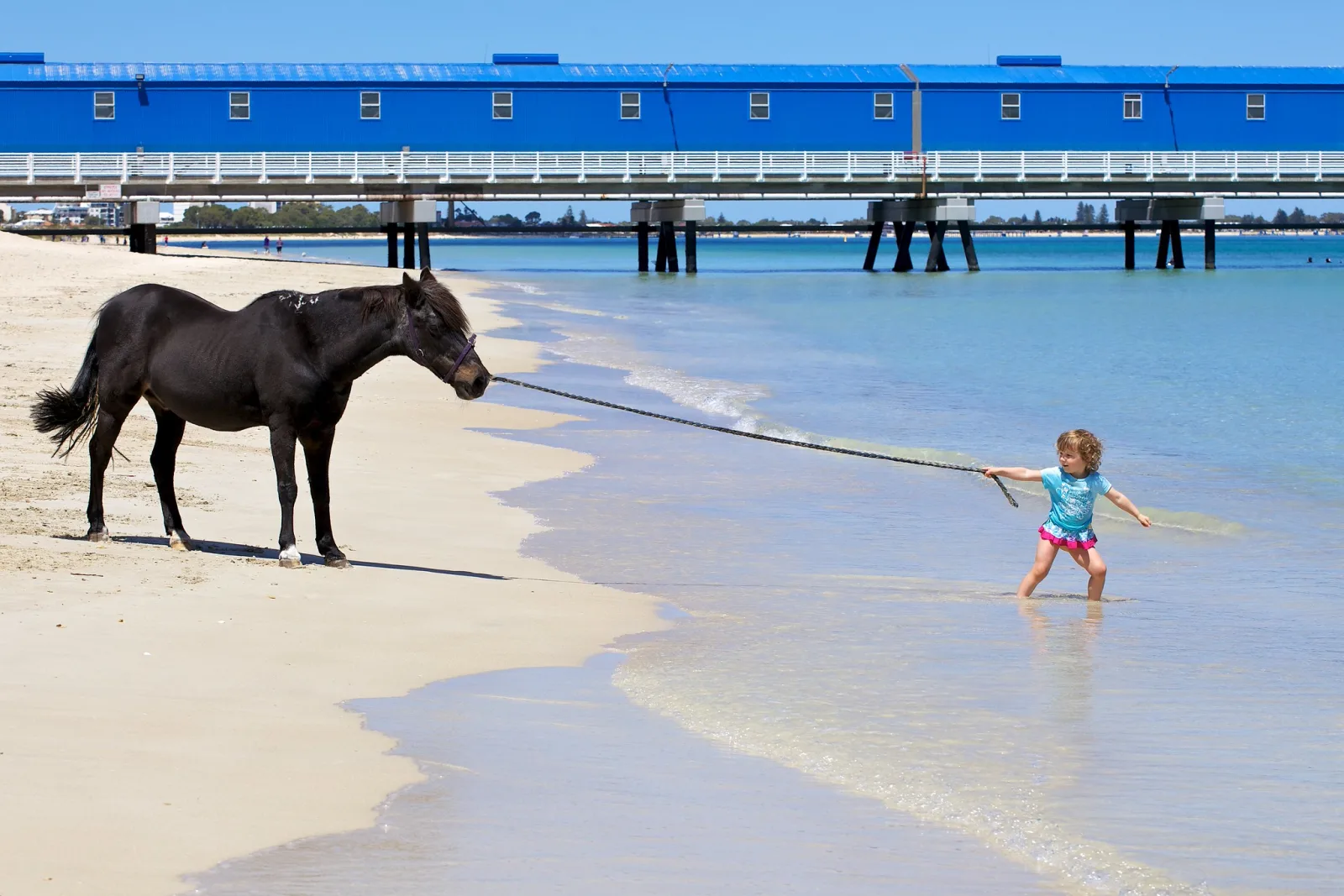
A useful exercise is to describe the gesture in one word before you shoot: reaching, leaning, turning, leaping, embracing. If you cannot name it, the frame is probably between gestures, and the viewer will feel that something is unresolved.
Setting a stage and waiting for the actor
Many decisive moments are made by the approach sometimes called fishing. Instead of chasing people, you find a strong setting first: interesting light, a clean background, a shape or line that will hold the picture together. You compose it carefully, then wait for someone to walk into the right spot. Cartier-Bresson worked this way often, and so do most street photographers who make consistently strong frames.
The method works because it separates the two halves of the problem. The composition, which takes thought, is solved before anything happens. When the subject arrives you only have to solve the timing, which is easier when your mind is not also juggling framing and exposure. Good stages include:
- a pool of light on a pavement surrounded by shadow, where a passer-by will be lit for two or three steps
- a doorway, arch or gap between buildings that forms a frame within a frame
- a wall with a strong mural or poster that a person could echo or contrast with
- a narrow street or path where leading lines converge on the spot where a figure will appear
- a stretch of reflective ground after rain, where a figure will be doubled
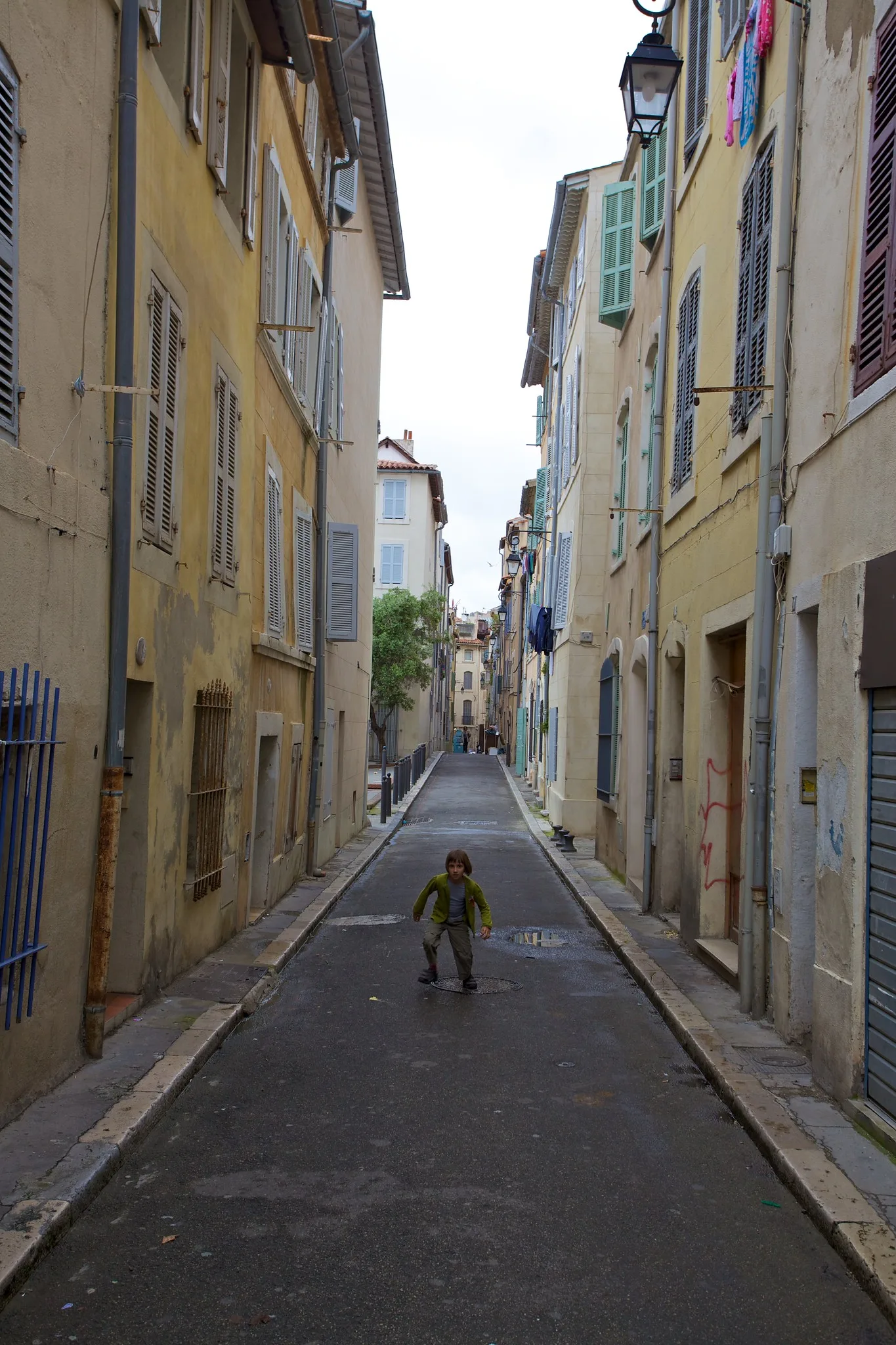
Patience is the price. You may wait ten minutes and get nothing, or see forty people pass before one walks with the right posture, in the right clothing, at the right distance from the others. Decide in advance what would complete the picture (a lone figure, a child, a cyclist, someone carrying something) so you do not fire at everyone and miss the one who matters.
Camera settings that remove hesitation
When the moment arrives you should not be touching a dial. Everything that can be decided in advance should be. The table below shows a setup that works for most people-and-action situations in daylight.
| Setting | Suggested starting point | Why it helps |
|---|---|---|
| Shutter speed | 1/250 s for walking, 1/500 to 1/1000 s for running, jumping or dancing | Freezes the gesture so the peak reads clearly |
| Aperture | f/8 for street scenes, wider for isolating one subject | More depth of field forgives small focus errors |
| ISO | Auto ISO with a sensible upper limit | Keeps the shutter speed you chose as light changes |
| Focus | Pre-focus on the spot where the action will happen, or use continuous tracking | Removes autofocus delay at the critical instant |
| Drive | Single shot for predictable moments, burst for fast unpredictable ones | See the next section |
Pre-focusing is the single biggest help. If you have set a stage, focus on the spot where the subject will be, then switch to manual focus or use back-button focus so the camera does not refocus when you press the shutter. For moving subjects that do not follow a fixed path, continuous autofocus with tracking is the better choice.
If you shoot with an electronic shutter, be aware that on many sensors it reads the image line by line, which can bend fast-moving objects such as swinging arms or spinning wheels. The page on the rolling shutter explains when that matters.
Burst or single frame: choosing how to press
Burst mode seems like the obvious answer to timing: fire a stream of frames and pick the best one. It helps, but it does not do the work for you. At ten frames per second there is a tenth of a second between frames, and many peaks are far shorter than that. A bat meeting a ball, a foot touching water or a blink can fall entirely between two frames. Burst also tempts you to start late and hope, which trains you out of anticipation.
A single, well-timed frame from a photographer who understands the rhythm of a situation often beats a burst from someone who does not. The best approach is to use both deliberately:
| Situation | Better approach | Reason |
|---|---|---|
| Walker stepping into a pool of light | Single frame | The path is predictable, and one frame at the right stride is cleaner |
| Dancer or performer mid-routine | Short bursts of three to five frames | Movement is fast and gestures change between frames |
| Sport with a known peak (a jump, a kick) | Start a burst just before the peak | You bracket the peak in time |
| Candid conversation | Single frames, fired in rhythm with the speech | Burst noise can draw attention, and expressions change slowly enough |
| Wildlife taking off | Burst from the first sign of movement | Takeoff is fast and hard to predict |
Some cameras offer a pre-capture mode that keeps recording frames into a buffer while you half-press and saves the second or so before you fully press. It genuinely helps with unpredictable events such as a bird leaving a branch. It does not help with composition, and composition is still where most decisive moments are won or lost.
Working a scene until the moment arrives
Contact sheets from great street photographers show how many frames often came before the famous one. The photographer saw something interesting, took a picture, moved a step, took another, waited, adjusted, and kept going until the moment arrived. The famous frame is the end of a process, not a lucky single shot.
Working a scene means staying with a situation instead of taking one frame and walking away:
- Take the obvious picture first, so you have something.
- Look at the edges of the frame and remove distractions by moving your feet, not by planning to crop later.
- Change height. A lower viewpoint can place a figure against the sky instead of clutter.
- Change distance. Stepping closer usually makes gestures and expressions clearer.
- Wait. Situations develop, and the best moment often comes after the one that first caught your eye.
- Keep shooting a little after you think you have it. The frame you expect to be best frequently is not.
The guide to working the scene in street photography goes further into this habit.
The decisive moment beyond the street
The idea is associated with street photography, but it applies in every genre where something changes over time.
Festivals and performances
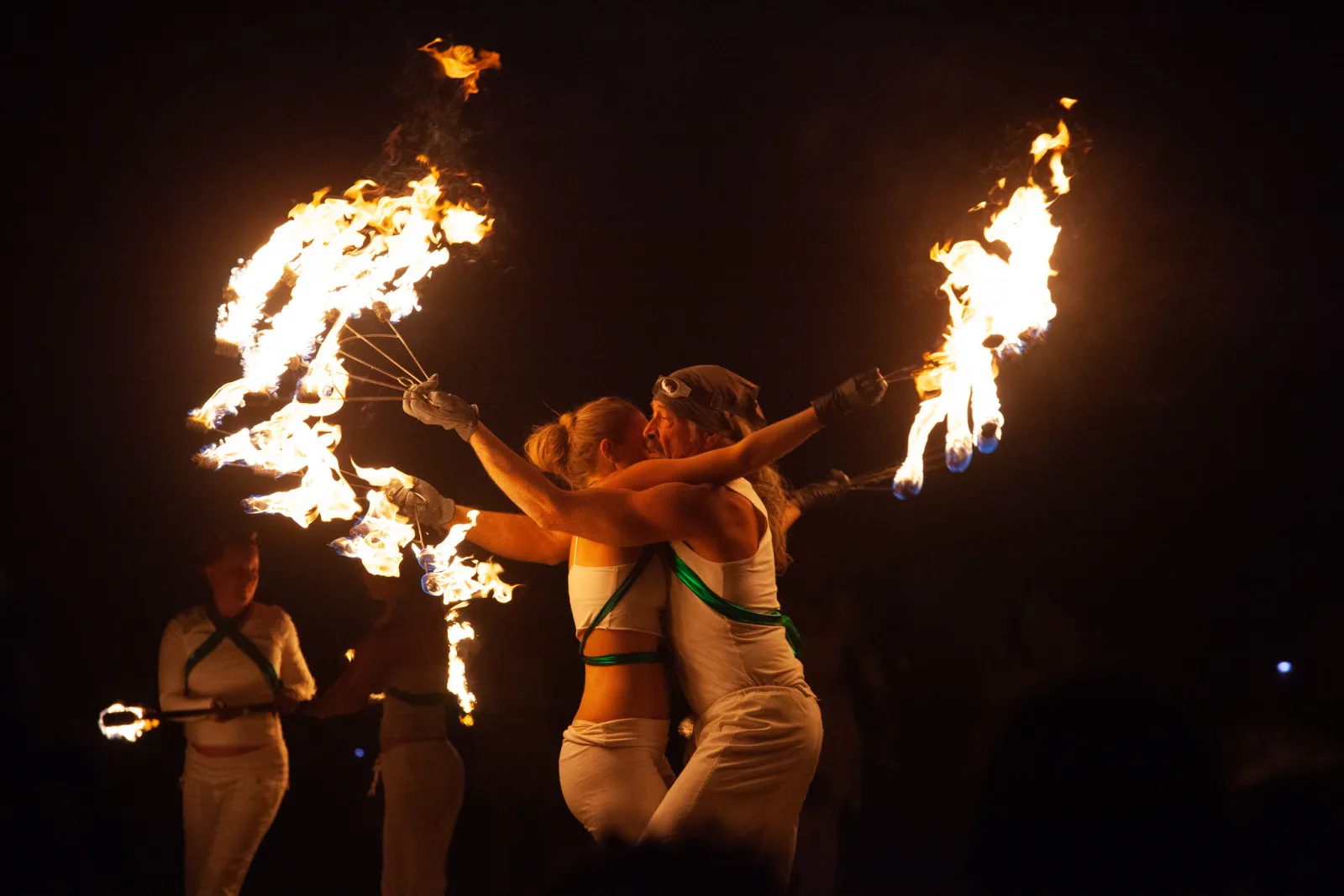
Performers repeat routines, which makes their peaks learnable. Watch a full cycle before shooting. Fire performers are a good example: the flames trace the same arcs each time, and the strongest frame is usually when the arms are fully extended and the flames frame the face rather than hiding it. At night the flames are the main light source, so expose for them and let the background fall dark. The guide to festival photography covers crowds, light and access.
Sport
Sport has the clearest peaks of all: contact, apex, finish line, celebration. Learn the sport well enough to know where the action will happen next, pre-focus there, and let the athletes come to you. The reaction after a goal or a win is often a stronger picture than the play itself. The guide to sports photography has sport-specific positions and settings.
Landscape light
Landscapes do not move quickly, but the light on them does. A break in the clouds can light one hillside for twenty seconds before the shadow returns. A sunbeam can touch a peak and vanish. The decisive moment here is the instant the light falls exactly where your composition needs it. Set up on a tripod, compose, meter, and then watch the sky rather than the camera, pressing when the light reaches the spot that matters. Weather that looks unpromising often produces the best of these moments, as the guide to bad weather photography explains.
Wildlife and children
Animals and young children are unpredictable, but they have patterns. A bird will often crouch and lean forward just before it flies. A toddler will look at an adult before doing something they know is naughty. Spend time watching before shooting, and you will learn the signals that come before the peak.
Common mistakes
- Reacting instead of anticipating. If you press when you see the peak, you get the moment after it. Fix: watch the rhythm, then press slightly early.
- Composing after the action starts. Framing and timing at the same time splits your attention. Fix: find the stage and compose first, then wait.
- Relying on burst to rescue timing. Frames fall between peaks and you learn nothing about rhythm. Fix: use single frames for predictable moments and short bursts only when movement is fast and unpredictable.
- Leaving too soon. One frame and walking away rarely produces a great picture. Fix: work the scene and stay a little after you think you are done.
- Autofocus hunting at the key instant. The lens refocuses on the background just as the subject arrives. Fix: pre-focus on the spot and lock focus, or use continuous tracking.
- A strong moment with a messy background. A pole growing from a head or a bright sign beside a face ruins the peak. Fix: choose the background before the moment, and move to simplify it.
- Shutter speed too slow for the gesture. Hands and feet blur even when the body looks sharp. Fix: use at least 1/500 s for fast gestures unless you want deliberate motion blur.
Try this
Spend twenty minutes on one spot. Find a place in your town where people pass through a clear, simple patch of light, in front of a clean wall or inside a doorway. Pre-focus on that patch, set 1/500 s, and switch to single-shot drive. Watch the first five people pass without shooting and notice where their strides open. Then shoot every person who crosses the spot, pressing slightly before the stride opens.
At home, sort the frames into three piles: too early, too late and right. Count them. Most people find their early attempts cluster in the too late pile, which shows how much anticipation matters. Repeat the exercise another day and compare how the piles change.
Frequently asked questions
Who came up with the decisive moment?
The phrase is linked to Henri Cartier-Bresson, whose book of the same English title set out the idea. He drew on an older saying, attributed to a seventeenth-century French writer, that everything in the world has its decisive moment.
Is the decisive moment only for street photography?
No. It began there, but the same principle applies to sport, wildlife, weddings, festivals, portraits and landscapes. Wherever something changes over time, there is a best instant to press the shutter.
Should I use burst mode to catch it?
Use it for fast, unpredictable action, but do not depend on it. Many peaks are shorter than the gap between frames, and a single well-timed press usually gives a cleaner result for predictable moments.
Can a posed photograph have a decisive moment?
Yes. Even in a portrait session, expressions change constantly. The frame taken as a real laugh starts, or just as the subject relaxes after a joke, often beats every carefully posed frame.
How do I get better at timing?
Practise on repetitive subjects such as walkers, cyclists or a fountain, where you can try again every few seconds. Review your frames straight away and notice whether you are early or late, then adjust. Timing is a learned skill, not a gift.
Related guides
- What photographers can learn from Cartier-Bresson: the working habits behind the idea.
- Street photography: the genre where the decisive moment was born.
- Working the scene in street photography: how to stay with a situation until it pays off.
- Composition in street photography: building the stage your moment happens on.
- Freeze motion: shutter speeds that hold a gesture still.
- Burst mode: when continuous shooting helps and when it does not.
- Capturing emotion in your photos: reading and timing expressions.
- Juxtaposition in photography: moments where two elements meet to create meaning.