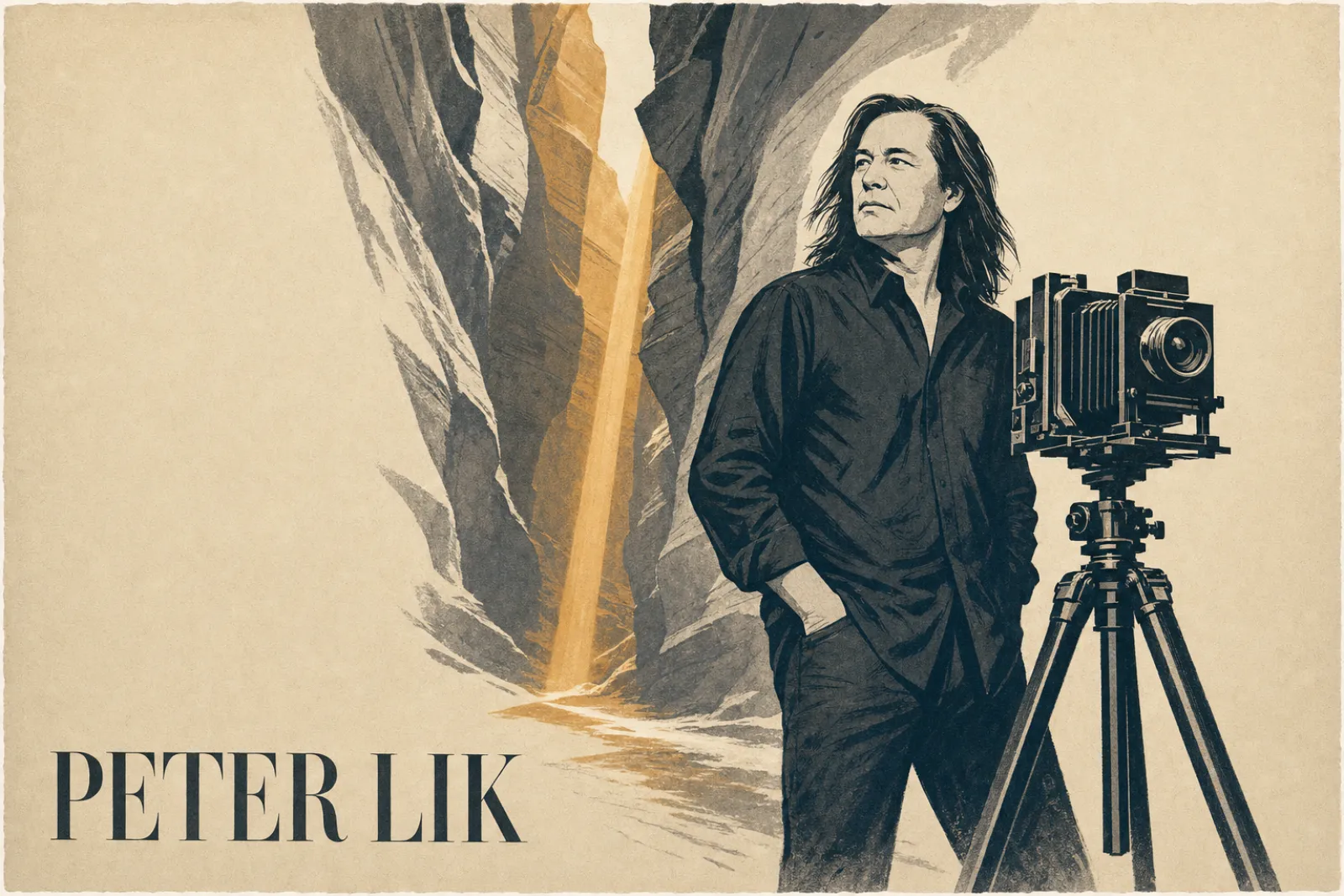
Peter Lik (born 1959) is an Australian landscape photographer, born in Melbourne, who built his career in Queensland and then in the United States. He made wide panoramic colour photographs of the Australian and American landscape on film, and sold prints of them through galleries and books under his own name. He is known for the scale of that business and for a 2014 sale claim that has never been independently confirmed.
Lik was self taught and self published. He issued his own books, postcards and calendars and opened his own galleries. That route differs from the one taken by photographers such as Andreas Gursky, whose record price was set at a public auction, and it is one reason his name comes up in arguments about what a photograph is worth.
A Brownie in Melbourne, a panoramic camera in Alaska
Lik’s parents were Czech emigrants who settled in Australia after the Second World War. They gave him a Kodak Brownie when he was eight. By his own account, his first photograph was of a spider web in the family garden. He learned by trying things.
In 1984 he made his first trip to the United States and spent a year travelling in a van. In Alaska he came across panoramic and large format cameras, and the long, narrow frame became his standard. He went back in 1989 to photograph landscapes in all fifty states, a project he called Spirit of America.
In the early 1990s he worked for the Queensland tourism department, photographing the Outback. He relocated to Las Vegas, Nevada, in 1994.
Wondering how a very wide picture is made with an ordinary camera? Panorama photography explains how to shoot a row of frames and stitch them together.
Books, galleries and a television series
From the middle of the 1990s Lik published his own coffee table books, postcards and calendars. His account dates his publishing company, Wilderness Press, to 1996 and his first gallery, in Cairns, Queensland, to 1997. Australia: Images of a Timeless Land appeared in 1997. Books on American subjects followed, among them Spirit of America, San Francisco and Hawaii: The Aloha Spirit, all in 2003, Las Vegas and Beyond and Maui: Hawaiian Paradise in 2006, and Las Vegas: Beyond the Neon in 2009. A 25th anniversary volume in 2010 held more than 500 images. Equation of Time was published in 2015.
A television series, From the Edge with Peter Lik, began on The Weather Channel on March 31, 2011 and ran for one season. It followed him as he photographed American landscapes, including volcanoes in Hawaii, mountains in Montana, the Grand Canyon and Denali National Park.
His photograph Ghost, made in Antelope Canyon, Arizona, won the Art in Nature category of the Windland Smith Rice International Awards in 2010 and was displayed at the Smithsonian National Museum of Natural History in Washington in May 2011. Inner Peace won one of the same awards in 2011 and was shown at the Smithsonian from April to September 2012. He received the master photographer distinction of the Australian Institute of Professional Photography in 2002, and in 2010 he was made a Fellow of the Royal Photographic Society and of the British Institute of Professional Photography. He became a United States citizen in 2012.
Thinking about entering your own pictures in a contest? The photography competition guide covers choosing entries and reading the rules.
The Phantom claim and the argument about price
In December 2010 Lik said that a print of One, a photograph made on the banks of the Androscoggin River in New Hampshire, had been sold to an anonymous collector for one million US dollars. In December 2014 he said that Phantom, a black and white photograph from Antelope Canyon, had been sold to an anonymous buyer for 6.5 million US dollars, a figure his own account presents as a world record for a photograph.
Neither sale has been independently verified. The buyer of Phantom has not come forward, although a lawyer said that the buyer exists. The claim was met with wide scepticism, and published lists of the most expensive photographs record it separately as a disputed claim instead of ranking it. The confirmed auction records on those lists belong to other photographers, among them Man Ray, Edward Steichen and Gursky.
For a student of photography the useful point is narrow. A price announced by a seller and a price reached in a public auction are different kinds of fact. The second can be checked. The first cannot.
Curious how photographers set a number on a print? How to price photography prints works through costs, sizes and editions, and limited edition prints explains numbering and signing.
How the pictures are made: long frames, film, and light at a known hour
- The panoramic frame. Lik typically worked with a Linhof 617 Technorama, a panoramic film camera, loaded with Fuji film. A frame that long cannot be filled by one subject in the middle. It needs something at each end and a line that carries the eye across. The site’s page on aspect ratio explains how the shape of the frame changes the composition inside it.
- Film, then digital. He also used Phase One and Nikon digital cameras. On film, each exposure costs money and cannot be checked on the spot, so the decision is made before the shutter opens. See film photography.
- Arriving for a specific light. Phantom depended on a shaft of sunlight that enters Antelope Canyon through an opening overhead at noon. By his account he worked out in advance that the sun would be directly overhead at that hour. The page on planning a photo around the sun, moon, tides and weather covers working out such timings in advance.
- Making light visible. A beam of light shows up in a photograph only when it strikes something in the air. In Lik’s account of Phantom, his Navajo guide threw a handful of dust into the beam as he released the shutter, and he noticed the figure formed by the dust only when he reviewed the images weeks later.
- A hard range of brightness. Antelope Canyon is difficult to expose. Light reflecting off the canyon walls can produce a range of ten stops or more between the brightest and darkest parts. The page on dynamic range explains what that means for a sensor or a film, and bracketing is the usual answer.
- Colour and the print. He printed mainly on FujiFlex, a silver halide paper, chosen to strengthen the colours. Vivid colour is central to the prints. The guide to colour in photography looks at when saturation helps a picture and when it takes over.
Want the groundwork for this kind of picture? Landscape photography: techniques, light and composition covers it, and desert photography deals with canyons and harsh light.
Photographs to look for
- Ghost. Made in Antelope Canyon, Arizona. It won the Art in Nature category of the Windland Smith Rice International Awards in 2010 and hung in the Smithsonian National Museum of Natural History the following year.
- Phantom. A black and white photograph from Antelope Canyon, in which dust thrown into a noon light beam forms a ghostlike figure. It is the subject of the unverified 2014 sale claim.
- One. A photograph made beside the Androscoggin River in New Hampshire, and the subject of the 2010 sale claim.
- Inner Peace. A winner in the Windland Smith Rice International Awards in 2011, shown at the Smithsonian in 2012.
Try this: fill a long frame
Fifteen minutes outdoors with a phone or camera.
- Use the panorama mode, or plan to crop every picture to a strip about three times as wide as it is tall.
- Find a view with a clear line running across it: a shoreline, a fence, a row of trees, a street.
- Make six frames. In each, place one thing of interest in the left third and a different one in the right third.
- The constraint: nothing important in the centre. The middle of the frame is only the path between the two ends.
- Compare the six. Keep the one in which the eye travels the whole width without stopping.
Questions people ask about Peter Lik
What camera did Peter Lik use?
He typically shot panoramas on a Linhof 617 Technorama film camera with Fuji film. He also used Phase One and Nikon digital cameras.
Did Peter Lik sell a photograph for 6.5 million dollars?
He announced in December 2014 that Phantom had sold to an anonymous buyer for that amount. No details of the sale have been verified and the buyer has not been named, so lists of the most expensive photographs treat it as a disputed claim.
Where was Phantom photographed?
In Antelope Canyon, Arizona, a sandstone canyon. Ghost, which won an award in 2010, was made in the same canyon.
Where is Peter Lik from?
He was born in Melbourne, Victoria, Australia, in 1959, to Czech parents who had emigrated after the Second World War. He relocated to Las Vegas in 1994 and became a United States citizen in 2012.
Peter Lik is one of the photographers listed in the A to Z of photographers.