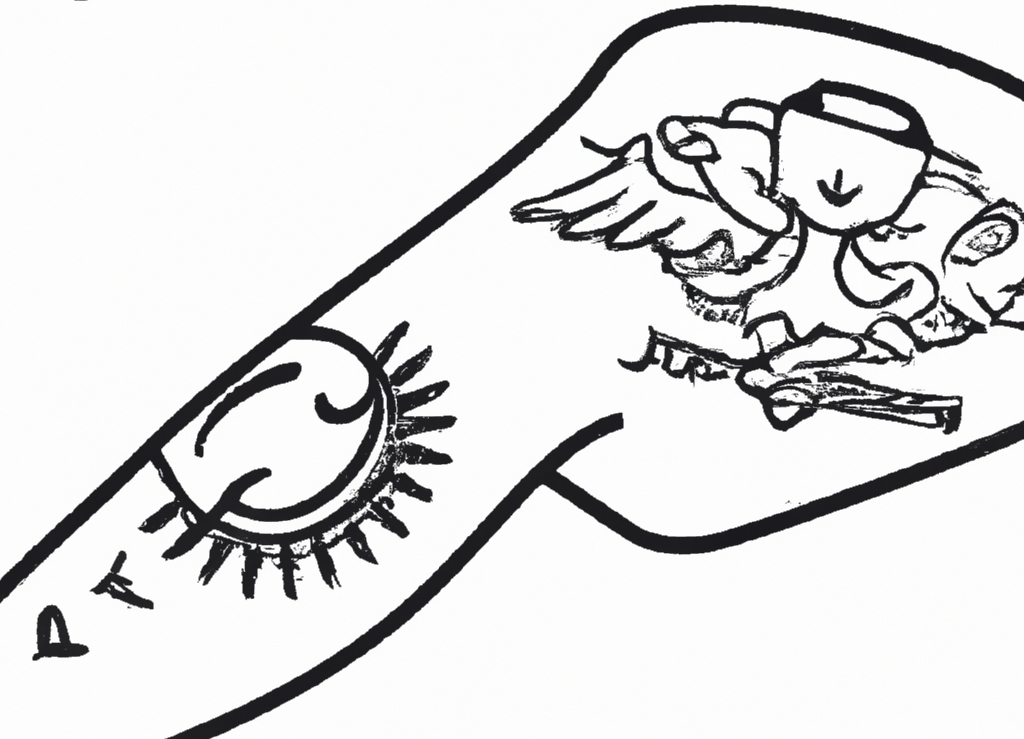
Getting rid of a tattoo can be a hassle, but luckily there are ways to remove them digitally with Photoshop. If you’re looking for a quick and easy way to remove a tattoo from a picture, then you’ve come to the right place. Here’s a step-by-step tutorial on how to remove tattoos in Photoshop.
Step 1: Open the photo in Photoshop Open the picture containing the tattoo in Photoshop. You can do this by going to “File” and then “Open.”
Step 2: Zoom in Zoom in on the tattoo so that you can see it clearly. This can be done by clicking on the magnifying glass icon on the toolbar.
Step 3: Select the tattoo Now that you can see the tattoo clearly, it’s time to select it. To do this, use the lasso tool and draw a selection around the tattoo.
Step 4: Heal and clone the area Now that the tattoo is selected, it’s time to start removing it. To do this, you’ll need to use the healing tool and the clone stamp tool. Start with the healing tool and gently brush over the tattoo to remove it. Then, use the clone stamp tool to blend the healed area with the rest of the picture.
Step 5: Blur the area Once you’ve finished healing and cloning the area, it’s time to blur it. This will help blend the area with the rest of the picture. To do this, go to “Filter” and then “Blur.”
Step 6: Save the changes Once you’re happy with the results, it’s time to save the changes. To do this, go to “File” and then “Save.”
And there you have it! You’ve successfully removed a tattoo using Photoshop. Now you can proudly show off a picture without any unwanted tattoos.
Learn more about Photoshop. Learn more about Lightroom. Learn more about Photography.
📚 More Photoshop Tutorials: Browse all Photoshop lessons | Take the Photo Editing Quiz
Choosing the Right Removal Tools
Photoshop offers several tools for tattoo removal, and the best choice depends on the tattoo’s size, color density, and surrounding skin texture. The Healing Brush (J) works well for smaller tattoos or tattoo edges because it samples texture from a source area while blending color and luminosity with the destination, producing seamless results on skin. The Clone Stamp (S) provides more control for larger areas because it copies pixels exactly, which is useful when you need consistent texture across a wide removal area.
For complex tattoos covering large skin areas, the Patch Tool offers an efficient workflow. Select the tattooed area with the Patch Tool set to Content-Aware mode, then drag the selection to a clean skin area. Photoshop intelligently blends the clean skin into the tattooed region, handling both texture and color matching in a single operation. However, the Patch Tool can produce soft, blurry results on large selections, so divide extensive tattoos into smaller sections and patch each section independently for cleaner results.
Professional Frequency Separation Technique
For photorealistic tattoo removal that preserves natural skin texture, frequency separation is the gold standard technique. Duplicate your background layer twice. Apply a Gaussian Blur (radius 3-6 pixels for high-resolution images) to the lower copy — this becomes your color layer. Set the upper copy’s blend mode to Linear Light, then apply Image > Apply Image using the blurred layer with Subtract blending at Scale 2 and Offset 128 — this isolates the texture detail on the upper layer.
With frequency separation established, work on the color (blurred) layer to paint over the tattoo’s color using a soft brush set to Normal mode, sampling clean skin tones nearby. The tattoo’s color disappears while the natural skin texture on the upper layer remains completely intact. This produces far more convincing results than cloning or healing alone because real skin has a continuous micro-texture (pores, fine lines, peach fuzz) that cloning tends to duplicate or destroy. After removing the tattoo color, switch to the texture layer and use the Clone Stamp at 100% opacity to fix any areas where the tattoo ink had physically disrupted the skin texture pattern. Zoom to 100% for final evaluation — convincing results look indistinguishable from natural skin at full zoom, not just at screen-fit viewing distances.