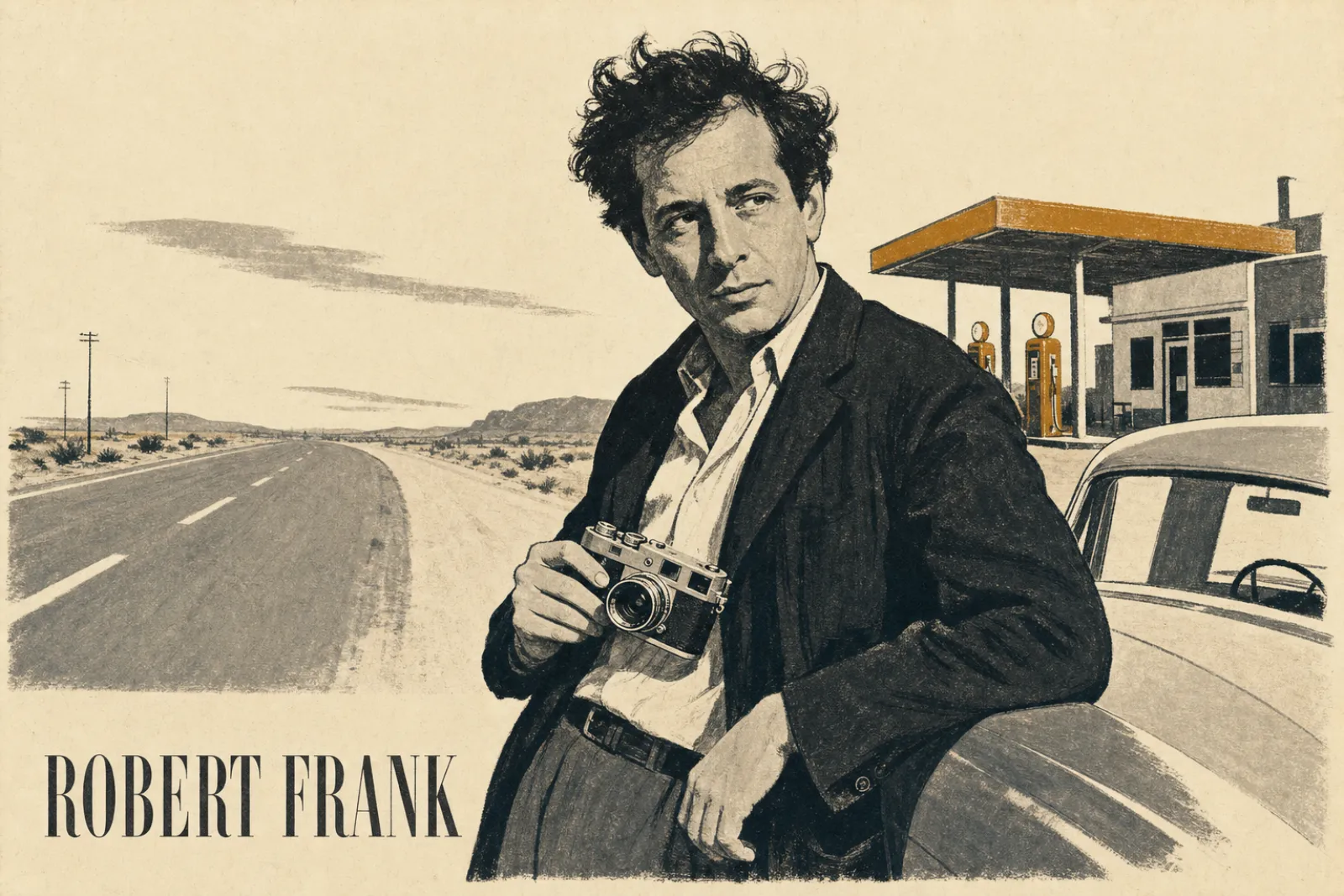
Robert Frank (1924 to 2019) was a Swiss-born American photographer and filmmaker who worked in New York and, later, Nova Scotia. He is known above all for The Americans, a book of 83 black-and-white photographs made on road trips across the United States in the mid 1950s. Its grainy, off-balance pictures and its unsentimental view of the country changed what a photography book could be.
Frank trained in commercial studios in Switzerland and arrived in New York in 1947. Walker Evans encouraged him to apply for the Guggenheim Fellowship that paid for the road trips, and Edward Steichen was among his referees. The books he measured his project against included Evans’s American Photographs and Bill Brandt‘s The English at Home. In New York he is grouped with Saul Leiter and Diane Arbus in what came to be called the New York School of photographers. What he turned away from was the polished, well-lit magazine picture of his day.
Zurich studios, Harper’s Bazaar and a way out of fashion
Frank was born in Zurich on 9 November 1924 into a Jewish family. His father, Hermann, came from Frankfurt and his mother, Rosa, was Swiss. He began studying photography in 1941 and spent the next six years in commercial photography and graphic design studios in Zurich, Geneva and Basel. In 1946 he made his first hand-made book, 40 Fotos.
He emigrated to the United States in 1947. The art director Alexey Brodovitch hired him to photograph fashion for Harper’s Bazaar. Frank disliked the limits of the job and left after a few months. He traveled in South America and Europe, made a hand-made book of his pictures from Peru, and returned to New York in 1950. That year he met Steichen, was included in the group show 51 American Photographers at the Museum of Modern Art, and married Mary Lockspeiser. They had two children, Andrea and Pablo.
Through the early 1950s he earned a living as a freelance photojournalist for magazines including McCall’s, Vogue, Fortune, Life and Look. In 1955 Steichen included seven of his photographs in The Family of Man.
Two years on the road for The Americans
In 1955 Frank was awarded a Guggenheim Fellowship to travel the United States and photograph every level of its society. His referees were Evans, Brodovitch, Alexander Liberman, Steichen and Meyer Schapiro. Over the next two years he drove through, among other places, Detroit, Savannah, Miami Beach, New Orleans, Houston, Los Angeles, Reno, Salt Lake City, Butte and Chicago. His wife and children joined him for part of the way. In a small town in Arkansas he was arrested and put in jail.
He worked with a 35mm Leica and made about 28,000 exposures. From those he chose 83. That ratio is the first lesson of the book. The work of selecting pictures mattered as much as the shooting.
Robert Delpire published the book in Paris in 1958 as Les Américains, with texts by writers including Simone de Beauvoir, William Faulkner and John Steinbeck set beside the photographs. The American edition followed from Grove Press in 1959. It dropped those texts and added an introduction by Jack Kerouac, whom Frank had met in New York in 1957.
The first reception was hostile. Popular Photography derided the pictures for their blur, grain, muddy exposures, tilted horizons and general sloppiness. Sales were poor at first. Kerouac’s name and the rise of the Beat writers brought the book a wider audience, and it came to be regarded as a seminal work in American photography. In 2009 the exhibition Looking In: Robert Frank’s The Americans was shown at the National Gallery of Art in Washington, the San Francisco Museum of Modern Art and the Metropolitan Museum of Art.
Thinking about a project that takes months or years? How to build a long-term photography project covers planning and keeping one going.
Why the pictures look “wrong” and still work
The complaints in that review are a fair list of Frank’s choices. Each one was a decision.
- A small camera and whatever light there was. A 35mm Leica let him work quickly, in available light and shade. Low light meant grain and blur. He accepted both. Anyone shooting film in dim places meets the same trade.
- Focus, framing and cropping that broke the rules. His focus, lighting and cropping departed from accepted technique. Horizons tilt and subjects sit off balance. The effect is of a glance, which suits pictures about how people look when nobody is arranging them.
- Ordinary people, not events. He photographed unremarkable people in unremarkable places, and their expressions are often blank. He was working in the tradition of documentary photography, but he had no single news story to tell.
- Race and class left visible. The book shows the tensions of the 1950s United States, between postwar optimism and the realities of race and class. He did not explain them. He put them in the frame and left them there.
- Black and white as mood. The contrast between black and white is strong. See black and white photography for how tone alone can carry a feeling.
- The book as the work. Eighty-three pictures were chosen from thousands and placed in a fixed order. The single photograph matters less than what it does beside its neighbors. This is photo sequencing at its most deliberate, and it is why The Americans is discussed as a book and not only as a set of prints. Photo book design covers the same decisions for a book of your own.
Curious how the same subject looks in the hands of other street photographers? Street photography lays out the approaches and the practical side.
Films, Nova Scotia and words written on the picture
By the time the American edition appeared, Frank had turned to film. Pull My Daisy, co-directed with Alfred Leslie in 1959, was written and narrated by Kerouac and featured Allen Ginsberg and Gregory Corso. It was added to the United States National Film Registry in 1996. In 1972 he made a documentary of the Rolling Stones on tour. A court case followed and its screenings were restricted. His photographs also appear on the cover of their album Exile on Main St.
The Lines of My Hand, published in 1972, was a visual autobiography. By then he had separated from Mary Frank and moved with the artist June Leaf to Mabou, on Cape Breton Island in Nova Scotia, dividing his time between there and New York. His daughter Andrea died in a plane crash in 1974 and his son Pablo died in 1994. In 1995 he founded the Andrea Frank Foundation, which gives grants to artists.
The later still work looks nothing like The Americans. He moved from straight photography to constructed images: collages, Polaroid negatives, and words written by hand onto the picture. He received the Hasselblad Award in 1996. He died in Inverness, Nova Scotia, on 9 September 2019, aged 94.
Interested in pictures made from more than one frame? Diptychs and triptychs explains how paired and grouped photographs work together.
Photographs to look for
- Trolley, New Orleans (1955). The cover image of The Americans. It shows ordinary people in available light and shade. Study the expressions, and consider why this picture was chosen to stand for the whole book.
- Charleston, South Carolina (1955). A white baby held by an African-American nanny. Two people share one frame and stand on opposite sides of the country’s divide.
- U.S. 285, New Mexico (1955). One of the road pictures, closer to landscape than most of the book, with high contrast and an unbalanced composition. It carries the book’s themes of desolation and loneliness.
- Santa Fe, New Mexico (1955). An abandoned gas station against the desert, with a sign reading SAVE in capitals. Notice how a single word turns a plain scene into a question.
- U.S. 90, En Route to Del Rio, Texas (1955). The last picture in the book, taken through the windshield of the car, with his wife Mary and son Pablo inside. A book about a country ends on his own family.
- For the Glory of Wind and Water (1976). A later work: an ocean horizon seen behind a suspended frame, with handwritten text. Compare it with the road pictures to see how far his method moved.
Try this: 60 frames, keep 5, put them in order
This exercise practises the edit and the sequence, which is where The Americans was made.
- Walk or ride through one neighborhood for fifteen minutes. Use one focal length, with no flash and no tripod.
- Take about 60 pictures of ordinary things: people waiting, signs, cars, shop fronts, flags. Do not stop to perfect any of them.
- At home, cut the 60 down to 5. Drop any picture that only works with an explanation.
- Arrange the 5 in a row. Change the order until the first and last pictures feel like a beginning and an end.
- Ask what the set says that no single picture says.
Questions people ask about Robert Frank
What camera did Robert Frank use for The Americans?
He used 35mm Leica cameras. The small format let him work fast and in low light, and it accounts for much of the grain and blur in the book.
How many photographs are in The Americans?
There are 83. Frank chose them from about 28,000 exposures made over roughly two years of travel on a Guggenheim Fellowship awarded in 1955.
Who wrote the introduction to The Americans?
Jack Kerouac wrote the introduction to the American edition, published by Grove Press in 1959. The first edition, published in Paris by Robert Delpire in 1958, carried texts by other writers and no Kerouac introduction.
Why was The Americans criticized when it came out?
Reviewers objected both to the technique and to the view of the country. Popular Photography complained of blur, grain, muddy exposures and tilted horizons. The same qualities were later taken up by younger photographers.
Robert Frank is quoted on the photography quotes page, and more photographers are listed in the A to Z of photographers.