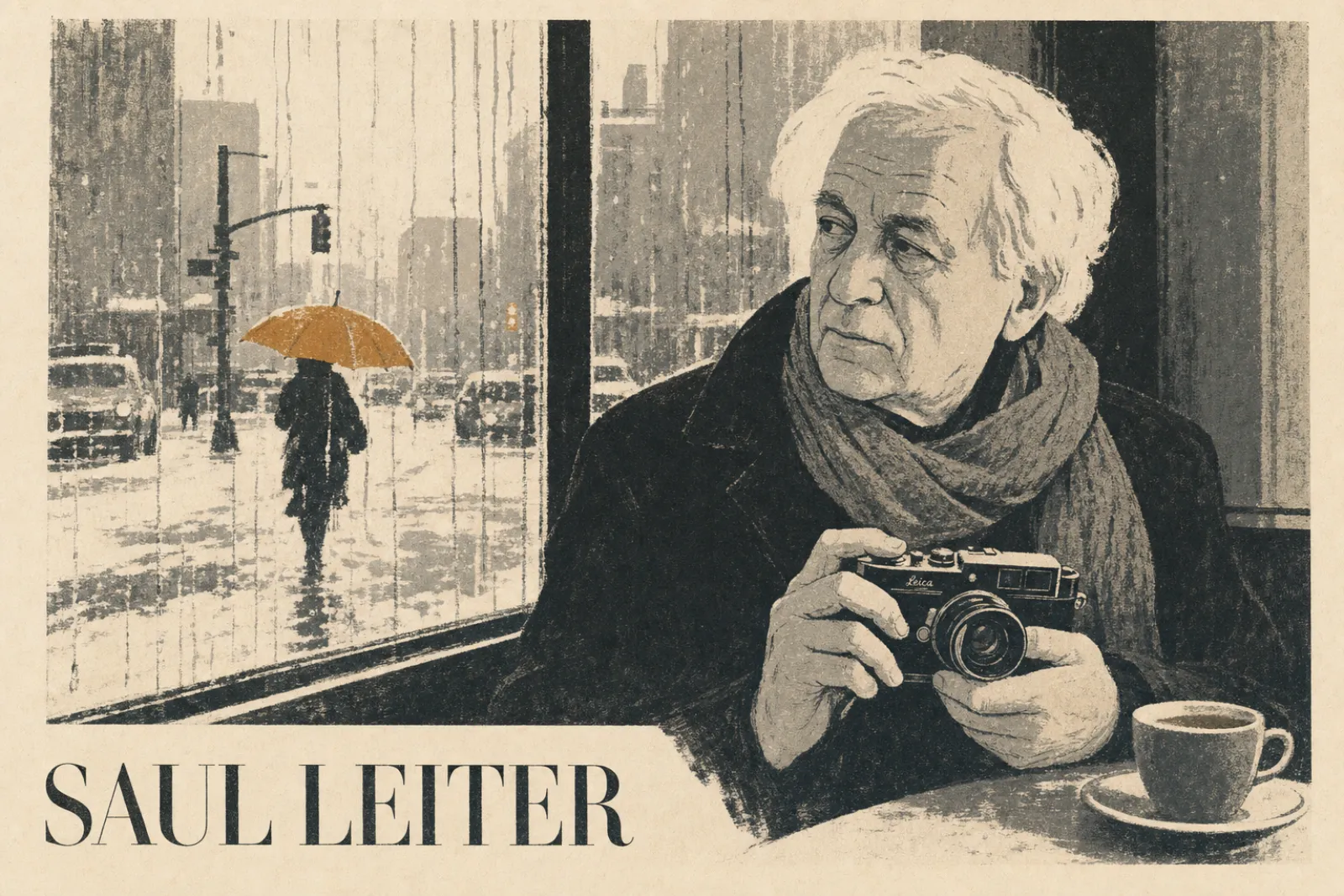
Saul Leiter (1923 to 2013) was an American photographer and painter who lived and worked in New York from 1946 until his death. He photographed the streets near his home, in black and white and, from the late 1940s, in color, decades before color was accepted as a medium for serious photography. He is known for soft, half-hidden street scenes seen through wet glass, snow and reflections.
Leiter came to New York to be a painter. The Abstract Expressionist painter Richard Pousette-Dart and the photographer W. Eugene Smith encouraged him to take photography seriously. Edward Steichen showed his work at the Museum of Modern Art in the 1950s. He is grouped with Robert Frank and Diane Arbus in the New York School of photographers, but his temper was different. Martin Harrison, who edited the book Early Color, wrote that Leiter worked in a more reflective, less confrontational way than Frank, looking for tranquility in the city.
From a rabbi’s household in Pittsburgh to the East Village
Leiter was born in Pittsburgh on 3 December 1923. His father, Wolf Leiter, was a rabbi and a well-known Talmud scholar, and the son was expected to follow him. His mother gave him his first camera, a Detrola, when he was a boy. His early pictures were of his family, especially his sister Deborah.
He studied at religious schools, including a rabbinical college near Cleveland, and taught himself about art in libraries. He had no formal training in painting or photography. The art he admired included the paintings of Bonnard, Vuillard and Degas, and Japanese art.
In 1946, at 23, he left theology school and moved to New York to paint. His father did not approve. His work was shown in group exhibitions in Youngstown, Ohio, in 1946 and at the Art Institute of Chicago in 1947. In New York he met Pousette-Dart, who was experimenting with photography himself. He acquired a 35mm Leica by exchanging some prints by Eugene Smith for it.
He began photographing the streets in black and white. By the late 1940s he was also using Kodachrome color slide film. Life published two of his black-and-white series in 1951. In 1953 Steichen included his black-and-white pictures in the exhibition Always the Young Strangers at the Museum of Modern Art.
Wondering where to begin with pictures of strangers in public? Street photography covers the approach, the settings and the etiquette.
Twenty years of fashion, then decades out of sight
Leiter’s first fashion assignment came in 1957 from the art director Henry Wolf at Esquire. When Wolf moved to Harper’s Bazaar in 1958, Leiter’s commercial work grew. Over about twenty years his pictures appeared in Harper’s Bazaar, Esquire, Elle, Nova, Show, Queen and British Vogue. He wanted a fashion picture to look like a photograph first, and he brought the look of his street work into it.
He kept walking and photographing for himself throughout. His long-term partner was Soames Bantry, a model and painter, whom he met in the late 1950s. They lived in separate apartments in the same building on East Tenth Street until her death in 2002.
In the 1970s he withdrew from commercial work. In 1981 his Fifth Avenue studio was closed over unpaid taxes. A long quiet period followed, with little money and little attention. He went on painting and photographing every day.
Recognition returned slowly. In 1992 Jane Livingston included him in her book The New York School: Photographs 1936 to 1963. The Howard Greenberg Gallery in New York gave him an exhibition in 1993. The turning point was Early Color, edited by Martin Harrison and published by Steidl in 2006. It was his first monograph, and the response was immediate. The Milwaukee Art Museum gave him his first solo museum exhibition in the United States that year, and the Fondation Henri Cartier-Bresson in Paris showed him in 2008. A retrospective opened at the Deichtorhallen in Hamburg in 2012. Tomas Leach’s documentary film, In No Great Hurry: 13 Lessons in Life with Saul Leiter, was released in 2013.
Leiter died at home in the East Village on 26 November 2013, aged 89. He left about 60,000 color slides. The Saul Leiter Foundation, founded in 2014, was set up to catalogue the archive.
Curious what working in fashion involves? Fashion photography: techniques and creative direction describes the job.
Looking through things: how a Leiter picture is made
Leiter’s pictures are easy to recognize and the choices behind them can be named.
- Something between the camera and the subject. He said he liked photographing through things. Glass, boards, mist and falling snow sit between the lens and the scene. The obstruction often fills much of the frame, and the subject is glimpsed past it. Start with photographing through windows.
- Wet windows and reflections. Rain and condensation on glass soften whatever is behind them, and shop windows lay one scene over another. Reflection photography explains how to control that overlap.
- Weather as a subject. Snow and rain recur across the work. Bad weather simplifies a street and changes how people move through it. See how to photograph rain and winter photography.
- Color as the picture. For Leiter color was part of the image itself and not a decoration. His color is often described as subdued and painterly. He used Kodachrome slide film. Color in photography covers how to make color the reason for a frame.
- Ambiguity on purpose. He said he liked a photograph in which one is not certain of what one sees. Many of his pictures sit close to abstract photography. They slow the viewer down.
- A small territory. He made the work on daily walks close to home. The same few blocks, seen in different weather, were enough.
- A painter’s eye. He painted all his life, mostly in watercolor and casein on paper, and sometimes painted over his own photographic prints. The framing devices in the photographs come from someone used to arranging shapes on a flat surface. Framing in photography shows how a frame inside the frame directs the eye.
He shared the color work privately for years by projecting the slides on his apartment walls for friends. Color prints were made much later, from about 1993, with the printer Philippe Laumont.
Shooting slide or print film yourself? Film photography: a complete guide covers cameras, stocks and exposure.
Photographs and books to look for
- Through Boards (late 1950s). The cover image of Early Color. The title states the method: the street is seen through boards. Look at how little of the frame is given to the subject.
- Taxi (1957). One of his best-known color pictures. Study where the color sits in the frame.
- Canopy (1958). A color street picture from the same years. Read the title first, then look at how the named object shapes the view.
- Foot on El (1954). An early color picture. A copy is held by the International Center of Photography. The title names a small detail, not a person or an event, as the subject.
- Package (about 1960). New York magazine put this picture on its cover in December 2013, shortly after his death.
- Early Color (2006). The book that restored his reputation. Its muted palette and quiet, ambiguous views of New York are best seen together, page after page. Early Black and White followed from the same publisher in 2014.
Try this: fifteen minutes behind glass
- Choose a day with rain, mist or snow if possible. If the weather is dry, use a cafe window, a bus shelter or a shop door.
- Stand so that there is always something between the lens and the street: glass, a railing, a curtain, a gap between two posts.
- Focus on the far subject and let the near layer go soft. Then take a second frame focused on the near layer.
- Look for one strong patch of color, such as an umbrella, a coat or a sign, and place it off center.
- Take twenty frames in fifteen minutes without leaving the spot.
- Keep the three pictures in which it is hardest to say at first what is being shown, and work out why they still hold together.
Questions people ask about Saul Leiter
What film did Saul Leiter use?
For his color work he used Kodachrome color slide film, from the late 1940s onward. He continued to shoot black-and-white film at the same time.
What camera did Saul Leiter use?
Early in his New York years he acquired a 35mm Leica, which he got by trading prints by W. Eugene Smith. His first camera, as a boy in Pittsburgh, was a Detrola given to him by his mother.
Why was Saul Leiter unknown for so long?
He rarely promoted his personal work, and color photography was not taken seriously as art when he made most of it. He left commercial photography in the 1970s and worked in obscurity until the 1990s. The book Early Color brought him wide attention in 2006, when he was in his eighties.
Was Saul Leiter also a painter?
Yes. He moved to New York to paint and never stopped. He worked mainly in watercolor and casein on paper, and his paintings were exhibited at the Knoedler Gallery in New York in 2009.
For more photographers and how they worked, see the A to Z of photographers.