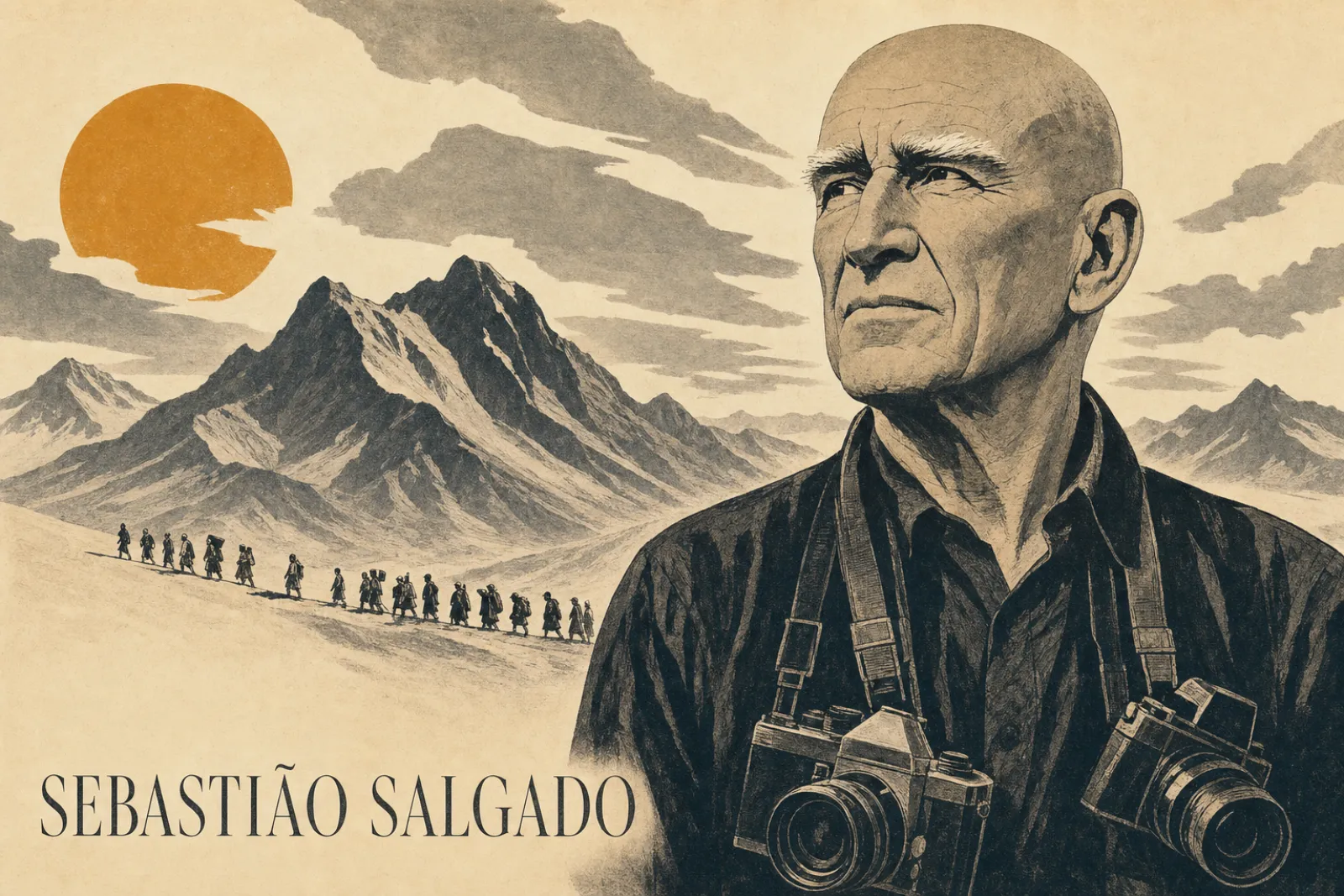
Sebastião Salgado (1944 to 2025) was a Brazilian photographer who trained as an economist and took up the camera in 1973. Working from Paris, he travelled in more than 120 countries and spent years at a time on single subjects: manual labor, famine, migration and, later, land that industry had not reached. He is known for long black and white projects such as Workers, Exodus and Genesis.
Salgado came to photography from outside it. He worked for the agencies Sygma and Gamma in the 1970s, then from 1979 to 1994 was a member of Magnum Photos, the cooperative that Henri Cartier-Bresson helped to found. In 1982 he received a grant from the fund named after W. Eugene Smith, an award for humanitarian photography. Where a fellow Magnum photographer such as Steve McCurry stressed the single picture that stands alone, Salgado presented his photographs in series and refused to cut people off from the setting they lived and worked in.
From coffee economics to the camera
Salgado was born on 8 February 1944 in Aimorés, in the Brazilian state of Minas Gerais. He studied economics, taking a master’s degree at the University of São Paulo in 1968. In 1969 he and his wife, Lélia Wanick Salgado, left Brazil for Paris during the military dictatorship, and he continued his economics studies at the University of Paris.
From 1971 to 1973 he worked as an economist for the International Coffee Organization. The job sent him to Africa, and those trips were where his interest in photography began. His first pictures were made with a Leica that belonged to Lélia. In 1973 he gave up economics and started taking news assignments, then moved toward documentary photography, where a subject is followed for months or years instead of for a day.
His first books set the pattern. Other Americas, published in 1986, came from years of travel among the poor of Latin America. Sahel, published the same year, came from time spent in 1984 and 1985 alongside the medical charity Médecins Sans Frontières during drought and famine in Africa. Both were in black and white, and both were built as sequences, not as collections of separate news pictures.
Wondering how a set of pictures becomes one argument? How to create a photo essay covers choosing, ordering and pacing the frames.
Workers, Exodus and the scale of the projects
From 1986 to 1992 Salgado photographed people doing heavy manual work around the world. The book, Workers: Archaeology of the Industrial Age, appeared in 1993. The International Center of Photography described it as a worldwide study of manual labor that was becoming obsolete. Its best known chapter was made in 1986 at Serra Pelada, an open gold mine in the Brazilian state of Pará. A huge workforce of men dug there by hand, loading earth into sacks that could weigh up to 60 kilograms and carrying them up ramps and ladders out of the pit. Photographers before him had come for a short visit and shot in color. Salgado stayed four weeks and worked in black and white.
From 1993 to 1999 he turned to people on the move: refugees and migrants, including those displaced by the genocide in Rwanda. The result was published in 2000 as Migrations: Humanity in Transition and reissued in 2016 as Exodus. A companion book, The Children: Refugees and Migrants, came out the same year. In 1994 he left Magnum, and he and Lélia set up their own agency, Amazonas Images. She designed most of his books and curated the Genesis exhibition.
The work drew criticism as well as awards. The writer Susan Sontag questioned whether such beautiful pictures of misery could be trusted. The question has followed his photographs ever since and is worth holding in mind while looking at them.
How should a photographer behave when the people in front of the camera are in distress? Photography etiquette and ethics sets out the questions to ask before and after pressing the shutter.
Genesis, Amazônia and a replanted farm
What he saw in Rwanda left Salgado in despair. He and Lélia went back to his family’s ranch in Minas Gerais and, in the 1990s, began to restore the Atlantic Forest on it. In 1998 they founded Instituto Terra to carry on the reforestation, conservation and environmental education. The institute has since planted more than 2.5 million native saplings.
The replanting led to Genesis. Beginning in 2004 he spent eight years photographing landscapes, wildlife and peoples living by ancestral traditions, from Antarctica and the Galápagos Islands to Alaska’s Arctic National Wildlife Refuge. He chose to show the planet in its untouched state instead of showing damage. The book appeared in 2013. Amazônia, on the forest and its indigenous peoples, followed in 2021. A documentary about his life, The Salt of the Earth, directed by Wim Wenders and Salgado’s son, Juliano Ribeiro Salgado, was released in 2014. Salgado died in France on 23 May 2025, aged 81.
Can a photograph help protect a place? What is conservation photography explains how pictures are made and used for that purpose.
How the pictures are made to work
One subject for years. Workers took six years, Exodus six, Genesis eight. The time shows. A reader who wants to work this way does not need to cross continents, but does need a plan for building a long-term photography project.
Black and white throughout. Every major project was in monochrome, on Kodak Tri-X and T-Max P3200 film in the early decades. Removing color makes a mine in Brazil and a camp in Africa belong to the same book. Black and white photography depends on tone and shape doing the work that color would otherwise do.
Light found on the spot. The pictures are known for their dramatic lighting. In mines, camps and open country that means natural light: waiting for it, and choosing where to stand in relation to it.
People stay in their setting. He did not isolate faces from the place. The frame holds the worker and the work, the family and the camp. That is the logic of the environmental portrait, applied to whole communities.
Bigger negatives, then digital, same print. He began on 35mm Leica cameras and later moved to the Pentax 645, a medium format camera. When he took up a Canon digital camera, the files were given a film look, written out to negatives and printed in an enlarger on baryta paper, so the prints matched the earlier work. Readers interested in that last stage can start with black and white printing.
Books as sequences. The projects were edited into chapters. Genesis has five: Sanctuaries, Planet South, Africa, Amazonia and Pantanal, and Northern Spaces. Photo sequencing is the skill of deciding which picture follows which.
Photographs and books to look for
- Serra Pelada gold mine, 1986. The pictures that made his name, later collected in the book Gold (2019). Look at how he conveys the number of men at work and the weight of what they carry, and at what black and white does to a scene earlier visitors had shot in color.
- Sahel, 1984 to 1985. Made in famine and refugee camps. The International Center of Photography wrote that his work conveys the dignity of his subjects without forcing heroism on them. Test that claim against these pictures.
- Workers, 1993. Read it as a book, chapter by chapter. The repetition of hands, tools and loads from one country to the next is the argument.
- Migrations, 2000, reissued as Exodus. People in transit across many countries. Notice how often the place is given as much room as the people.
- Genesis, 2013. More than 200 photographs were shown in the touring exhibition. Compare how he treated ice, desert and forest with how he had treated crowds.
- Amazônia, 2021. The rainforest and the communities who live in it, and the last of the long projects.
Try this: one place of work, fifteen minutes
Choose somewhere people are working with their hands: a market stall, a garden, a kitchen, a building site seen from the pavement. Ask permission if you are close enough to be noticed.
- Set your camera or phone to black and white so you see tone while you shoot.
- Use only the light that is there. No flash.
- Make twelve frames. In every one, show the person and the thing they are working on or in. No tight headshots.
- Afterwards pick four and put them in an order that reads as a short sequence: a wide view, the work, the hands, a pause.
The constraint is the lesson. Keeping the setting in every frame forces you to step back and compose the whole scene.
Questions people ask about Sebastião Salgado
Why did Sebastião Salgado photograph in black and white?
All of his major projects were made in black and white, on film at first and later with a digital camera whose files were printed to match. The choice gave pictures made decades and continents apart a single look, and it put the weight on light, tone and form.
What camera did Sebastião Salgado use?
He started with 35mm Leica cameras, moved to the Pentax 645 medium format camera, and later worked with a Canon digital camera. His films were Kodak Tri-X and T-Max P3200.
What is Instituto Terra?
It is the organization that Sebastião and Lélia Wanick Salgado founded in 1998 to restore the Atlantic Forest on his family’s ranch in Minas Gerais. Its work is reforestation, conservation and environmental education, and it has planted more than 2.5 million native saplings.
What awards did Sebastião Salgado win?
They include the W. Eugene Smith grant in 1982, the Hasselblad Award in 1989, the Prince of Asturias Award for the Arts in 1998 and the Praemium Imperiale in 2021. The Salt of the Earth, the film about him, won the César Award for best documentary and was nominated for an Academy Award.
Salgado is one of many photographers profiled in the A to Z of photographers.