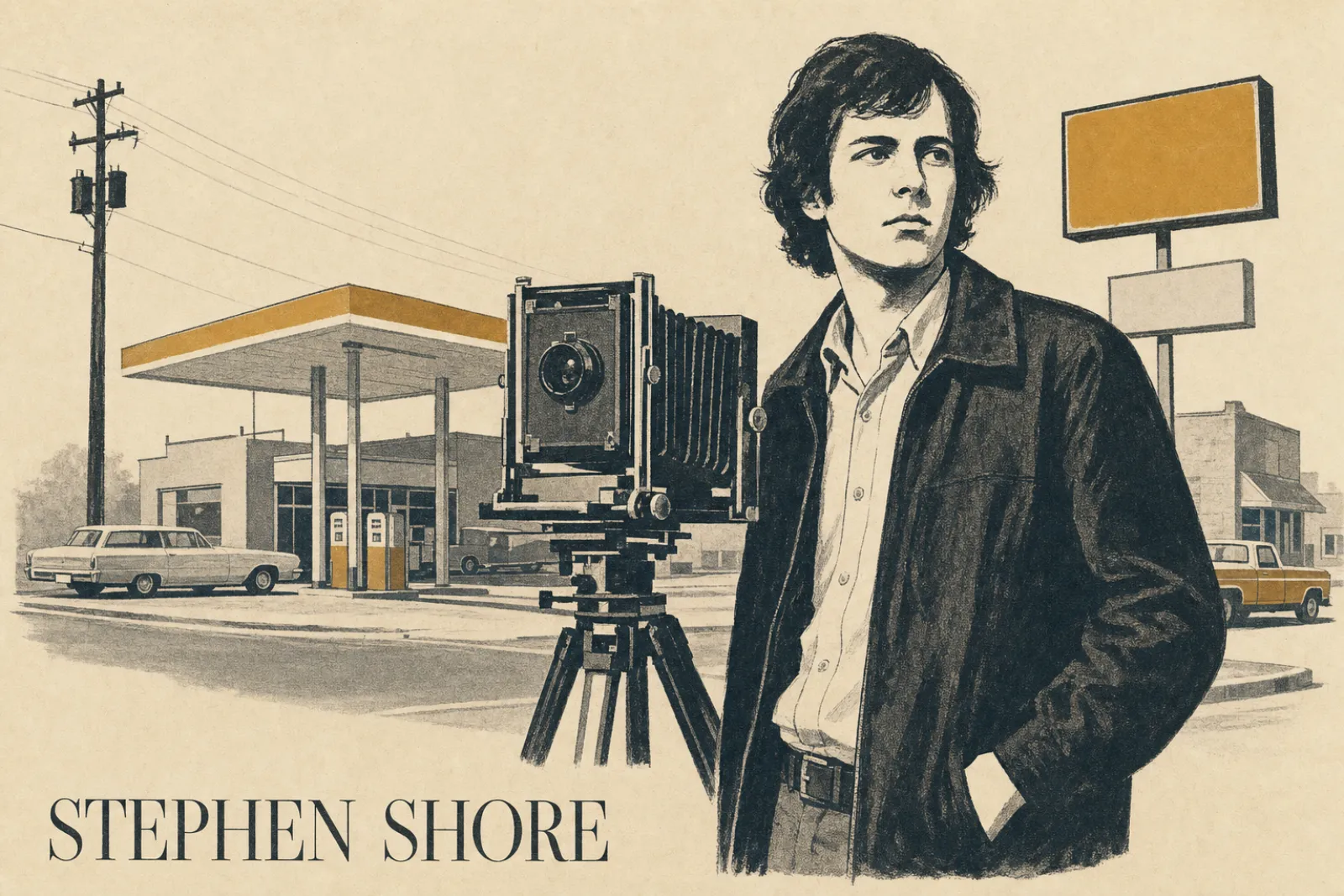
Stephen Shore, born in New York City in 1947, is an American photographer who made ordinary North American places a subject for serious color photography. In the 1970s he drove across the continent photographing meals, motels, rest stops, gas stations and ordinary street scenes, first with a pocket 35mm camera and then with a large view camera. He is best known for two bodies of work from those trips, American Surfaces and Uncommon Places.
Shore started very young. At ten he came across American Photographs by Walker Evans, a book that influenced him deeply. At fourteen he showed his pictures to Edward Steichen, then curator of photography at the Museum of Modern Art, who bought three of them. A few years later he spent his days in Andy Warhol’s studio. When he turned to color in 1972, art photography was still expected to be black and white. Shore and William Eggleston are the names most often given for changing that, and Joel Meyerowitz was another early advocate of color.
A darkroom kit at six, the Factory at seventeen
Shore’s parents ran a handbag company. An uncle gave him a Kodak darkroom set when he was six. By nine he was using a 35mm camera and had made his first color pictures.
In 1965, aged seventeen, he began spending time at the Factory, Andy Warhol’s studio, and photographed Warhol and the people around him in black and white until 1967. Shore later said that he began to think about pictures conceptually there, by watching how Warhol took a detached pleasure in everyday things. The Factory pictures were published as The Velvet Years in 1995 and again as Factory: Andy Warhol in 2016.
In 1971 the Metropolitan Museum of Art in New York gave him a solo exhibition. It showed black and white sequences made in 1969 and 1970, and he is widely described as the first living photographer to have a one-person show there.
American Surfaces: a road trip in snapshots
In 1972 Shore drove from Manhattan to Amarillo, Texas, and the trip turned him toward color. From March 1972 to May 1973 he carried a Rollei 35, a very small 35mm camera, and photographed his own days as he travelled. One summary of the series lists friends he met, meals he ate and toilets he sat on. The camera was held in the hand, and its flash sat underneath the body, which throws a shadow outline around whatever is close to the lens.
The pictures look like snapshots on purpose. They were shown at Light Gallery in New York, where the reception was mixed, and some viewers dismissed them as banal. The series was not published as a book until 1999. It was published again in 2005.
Curious how direct flash shapes a picture made at arm’s length? Flash photography for beginners explains what on-camera flash does and when to use it.
Uncommon Places: the same roads through a view camera
Shore grew frustrated with the grain in prints from 35mm negatives. After a conversation with John Szarkowski, the curator at the Museum of Modern Art, he moved up in size. He tried a 4×5 inch camera in 1973 and then settled on an 8×10 inch view camera, which he used from 1974 into the 1990s. A fellowship from the National Endowment for the Arts in 1974 and a Guggenheim Fellowship in 1975 funded further work.
A view camera goes on a tripod, and every frame is a single sheet of film. The work slowed down, and the pictures became more deliberate and more formal. Between 1973 and 1979 he made repeated road trips across North America, photographing motels, gas stations, typical street scenes and plain details of modern life. In 1975 his pictures were included in New Topographics: Photographs of a Man-Altered Landscape at George Eastman House in Rochester. He was the only one of the ten participants working in color. The Museum of Modern Art gave him a solo show of color photographs in 1976.
Aperture published Uncommon Places in 1982. It became a reference book for younger photographers who wanted to work in color. Andreas Gursky, Martin Parr and Nan Goldin are among those who have acknowledged his influence. An expanded edition, Uncommon Places: The Complete Works, appeared in 2004.
What does a sheet-film camera change about the way a picture is made? Large format photography describes the cameras and what the big negative gives you.
Teaching, small books and new tools
In 1982 Shore became director of the photography program at Bard College in New York State. During the 1980s he photographed landscapes in Texas, Montana and Scotland. In 1998 he published The Nature of Photographs, a primer on how photographs work.
He kept changing tools. From 2003 he worked with digital cameras, and between 2003 and 2008 he made 83 print-on-demand books. He began posting to Instagram in 2014 and published a book of those pictures in 2015. In 2020 he started photographing from a drone, and that work was published in 2023 as Topographies: Aerial Surveys of the American Landscape. The Museum of Modern Art held a retrospective in 2017 and 2018, and his memoir, Modern Instances: The Craft of Photography, came out in 2022.
Thinking of turning a small set of pictures into something printed? How to make a photography zine walks through editing, layout and printing a short run.
How the pictures are made to work
The subject is what is already there. Meals, motels and street scenes are not dressed up. Shore’s pictures treat color as information about a place: the paint on a storefront, a sign, the sky at a certain hour. Nothing is added for effect.
Two cameras, two kinds of attention. American Surfaces is quick and close, a diary. Uncommon Places is slow and wide. Looking at the two side by side shows how much a camera’s size decides the picture. Working from a tripod lets you study the whole frame before you commit.
Everything in the frame counts. A large negative records every part of the scene with precision, so every part has to be placed. The habit to borrow is to check the borders before the shutter, looking for tangents and mergers at the edges of the frame.
Structure without a single center. Uncommon Places mixes landscape, architecture, portrait and detail. That is composition done with whatever the street supplies, and it rewards slow reading. Visual literacy is the practice of reading a picture that way.
A neutral manner. The curator of New Topographics described the work in that exhibition as neutral in approach. Shore does not tell the viewer what to feel about a gas station. He shows it clearly and leaves the judgment open.
Sequence and book form. From the Factory pictures to the print-on-demand books, he has thought in sets. Photo sequencing covers how to order a body of work.
Where does this plain, descriptive approach sit in the history of the medium? Photography movements and the ideas behind them places it among the others.
Series and books to look for
- Factory: Andy Warhol, 1965 to 1967. Black and white pictures made as a teenager. Look for the detachment he said he learned there.
- American Surfaces, 1972 to 1973. Read it as a diary. Notice how the small flash camera makes a plate of food, a bed and a face look equally important.
- Uncommon Places, 1973 to 1979. The large-format road pictures. Compare any street view here with a frame from American Surfaces and note what the bigger camera added and what it took away.
- Transparencies: Small Camera Works 1971 to 1979. Published in 2020, this gathers small camera pictures from the same decade as the two famous series. Set it beside Uncommon Places to see the two ways of working run in parallel.
- Topographies: Aerial Surveys of the American Landscape, 2023. Drone photographs. The viewpoint is new, the subject is the same country seen in the 1970s work.
Try this: twenty minutes, one block, both methods
- Ten minutes as a diary. Walk one block near home. Photograph twelve things you would normally ignore: what you ate, a doorway, a parked car, a shop sign. Hold the camera or phone in your hand, do not crop afterwards, and do not delete.
- Ten minutes as a view camera. Go back to the single most promising spot. Put the camera on a tripod or brace the phone on a wall. Level it. Look at each edge of the frame in turn and move until nothing is half cut off by accident. Make exactly two exposures.
- Compare. Put the best diary frame beside the best slow frame. Decide which tells you more about the place, and why.
Questions people ask about Stephen Shore
What camera did Stephen Shore use for American Surfaces?
A Rollei 35, a compact 35mm camera, used hand-held with a small flash between March 1972 and May 1973. He then moved to a 4×5 inch camera and, from 1974, to an 8×10 inch view camera for Uncommon Places.
Why is Stephen Shore important?
He helped establish color photography as an art form at a time when museums and galleries expected black and white. His book Uncommon Places, published in 1982, shaped how later photographers looked at everyday places.
Was Stephen Shore part of New Topographics?
Yes. He was one of ten participants in the exhibition at George Eastman House in Rochester, which ran from October 1975 to February 1976. He was the only one showing color photographs.
Where did Stephen Shore teach?
He became director of the photography program at Bard College in 1982. His book The Nature of Photographs, published in 1998, is a primer on reading photographs.
Shore is one of many photographers profiled in the A to Z of photographers.