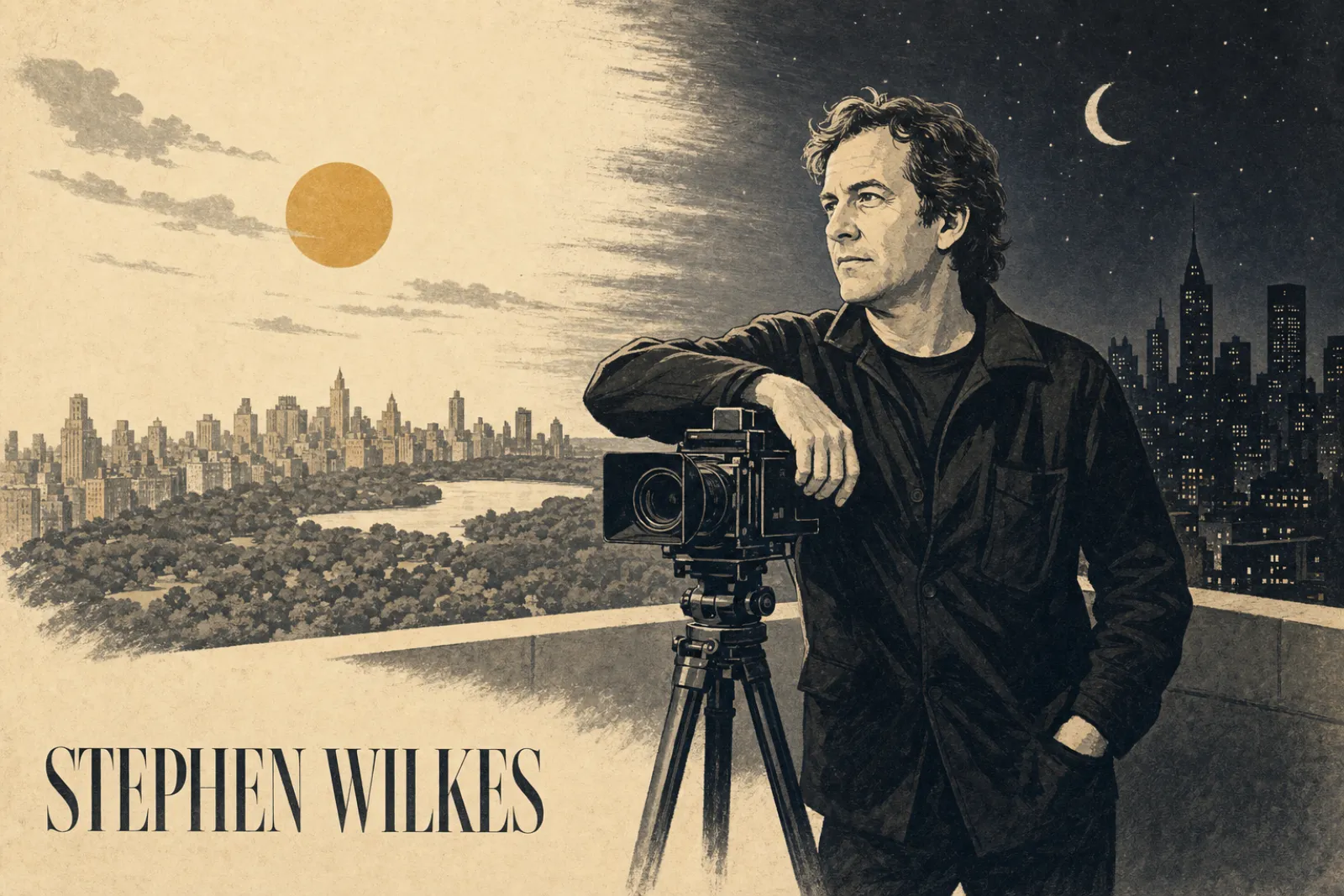
Stephen Wilkes, born in New York in 1957, is an American photographer who has worked across fine art, magazine and advertising photography since opening his studio in 1983. He is known for Day to Night, a series begun in 2009 in which a whole day at one location, from daylight through to darkness, is compressed into a single still photograph assembled from more than a thousand exposures.
Wilkes studied photography at Syracuse University, graduating in 1980 from the S.I. Newhouse School of Public Communications with a minor in business management. In 1979 he met the New York photographer Jay Maisel and became his assistant, his student and his close friend. Decades later he directed a documentary film about Maisel. His magazine work earned him the award named after Alfred Eisenstaedt in 2000. The work he became known for does something neither of them attempted: it stops treating a photograph as one instant.
A New York studio and the empty wards of Ellis Island
Wilkes opened his studio in New York in 1983. His early personal projects included photographs of mainland China, of California’s Highway One, and a series he called Burned Objects. Alongside these he built a commercial career, shooting advertising campaigns for companies such as Nike, Sony, Rolex, Honda and American Express. Adweek named him its photographer of the year in 1992.
In 1998 a one-day assignment took him to Ellis Island. On the south side of the island stood the long-abandoned medical wards where immigrants had once been detained. He kept going back for five years. The photographs helped to raise more than 6 million dollars toward restoration of the buildings, and they were published in 2006 as Ellis Island: Ghosts of Freedom, which Time magazine named one of its five best photography books of the year.
The project shows what returning to one place many times can do that a single visit cannot. In 2000 Epson America sent him on a 52-day trip across the United States for a project called America in Detail. He later photographed the damage left by Hurricane Katrina and Hurricane Sandy.
Drawn to empty buildings yourself? Urban exploration photography covers the safety, the law and the technique before you go in.
Day to Night: one viewpoint, up to thirty hours
Day to Night began in 2009. For each picture Wilkes sets the camera in one fixed position and does not move it. He then photographs the same view for a very long time, in some cases up to 30 hours, making well over a thousand separate exposures as the light changes and as life passes through the scene. An early account of the city pictures put the figures at up to 1,500 images in a 15-hour session, followed by about a month of editing.
Afterwards he chooses moments from across the day and blends them into one seamless image. The finished picture holds day and night in the same frame. Within it, natural sunlight gives way gradually to the artificial light of buildings and streets.
The first pictures were of cities, including New York, Washington and Shanghai. With a grant from the National Geographic Society the series moved outdoors: to America’s national parks for their centennial, and in 2018 to bird migration. Locations have included the Tournelle Bridge in Paris, El Capitan and the Serengeti. In 2017 the United States Embassy in Ottawa commissioned a Day to Night picture for the 150th anniversary of Canadian Confederation, and in 2021 the National Geographic Society commissioned one of the Biden and Harris presidential inauguration. The National Geographic Museum in Washington showed the series in 2018, and Taschen published the book Day to Night in 2019.
Is this a time-lapse? Not quite, but it starts the same way. Time-lapse photography explains how to shoot a long, steady run of frames from one position.
How the pictures are made to work
The camera never moves. Every frame has to line up with every other frame, so the viewpoint is locked for the whole session. A solid support matters more than any other piece of equipment. Using a tripod properly is the foundation.
The viewpoint is chosen for what will pass through it. A Day to Night picture needs a wide scene with a lot going on and a clear change from natural to artificial light. Finding that spot is most of the job, and it happens before the first exposure. Scouting a location ahead of time is how that choice gets made, and for a city view the cityscape guide covers skylines and city lights.
Thousands are shot, few are used. Wilkes has described the pictures as layered with street life, history, people, environment and narrative. The small human events are picked out in the edit. This is selection on a large scale: the photographer is looking for the best moment at each spot in the frame, not the best single frame.
Blending without a seam. The chosen moments are combined so that no join shows. For anyone trying a small version, the starting point is an exposure blend: aligned frames, each contributing the part it does best. The tools for that are layers and masks.
Light is the timeline. The picture has to pass from daylight to artificial light without a jolt, so the frames made around dusk carry a lot of weight. Blue hour photography describes that short window when sky and artificial lights balance.
People give it scale. The stated aim of the series is to hold fleeting moments of humanity from across a full day. Without the small figures the picture would be a study of light on buildings or rock. With them it becomes a record of how a place is used.
Want the crowd gone instead of kept? How to photograph busy landmarks without the crowds uses the same locked camera and repeated frames to do the opposite job.
Work to look for
- Ellis Island: Ghosts of Freedom, 2006. Five years of photographs in the abandoned hospital buildings. Look for what repeated visits to the same rooms gave him that the first one-day assignment could not.
- Day to Night city views, from 2009. New York, Washington and Shanghai were among the first. Find the point in each picture where daylight hands over to street lighting.
- Day to Night in the national parks. Made for the parks’ centennial. The same method applied to landscape instead of streets. Ask what changes across the frame when there are no street lights to mark the night.
- Day to Night bird migration, 2018. Made for the Year of the Bird. Here the passing subjects are animals, gathered from across the day into one view.
- Presidential Inauguration, 2021. A commissioned Day to Night picture of a single public event.
- Jay Myself, 2018. A documentary film, his first as director. It follows Jay Maisel in his last months in the six-story former bank building on the Bowery in New York, which he had bought in 1967, as he sorts through its contents before the sale.
Try this: a twenty-minute dusk composite
You will not shoot for 30 hours, but the idea works on a small scale at the end of the day.
- About ten minutes before the street lights come on, find a view with some movement in it: a crossing, a square, a car park, a harbor.
- Fix the camera or phone on a tripod, or wedge it on a wall or windowsill. It must not move at all.
- Lock focus. Then make one exposure every minute for twenty minutes. Take an extra frame whenever a person or vehicle arrives somewhere interesting.
- At home, pick three frames: the earliest, one from the middle and the last. Stack them as layers and use soft-edged masks to show the early frame on the left third, the middle frame in the center and the late frame on the right.
- If you do not edit in layers, simply set the three frames side by side as a triptych.
The constraint to respect is the fixed camera. One bumped frame and the blend will not line up.
Questions people ask about Stephen Wilkes
How does Stephen Wilkes make a Day to Night photograph?
He photographs one scene from a single fixed camera position for many hours, in some cases up to 30, making more than a thousand exposures. He then selects moments from across the day and blends them into one picture that holds both day and night.
Is a Day to Night picture a single exposure?
No. It is a composite assembled from many separate photographs taken from the same spot over many hours, then blended into a single image.
What is Stephen Wilkes’s Ellis Island project?
Starting with a one-day assignment in 1998, he spent five years photographing the abandoned medical wards on Ellis Island. The pictures helped raise more than 6 million dollars for restoration and were published in 2006 as Ellis Island: Ghosts of Freedom.
When did the Day to Night series start?
In 2009. A book of the series was published by Taschen in 2019, and the National Geographic Museum in Washington exhibited it in 2018.
Wilkes is one of many photographers profiled in the A to Z of photographers.