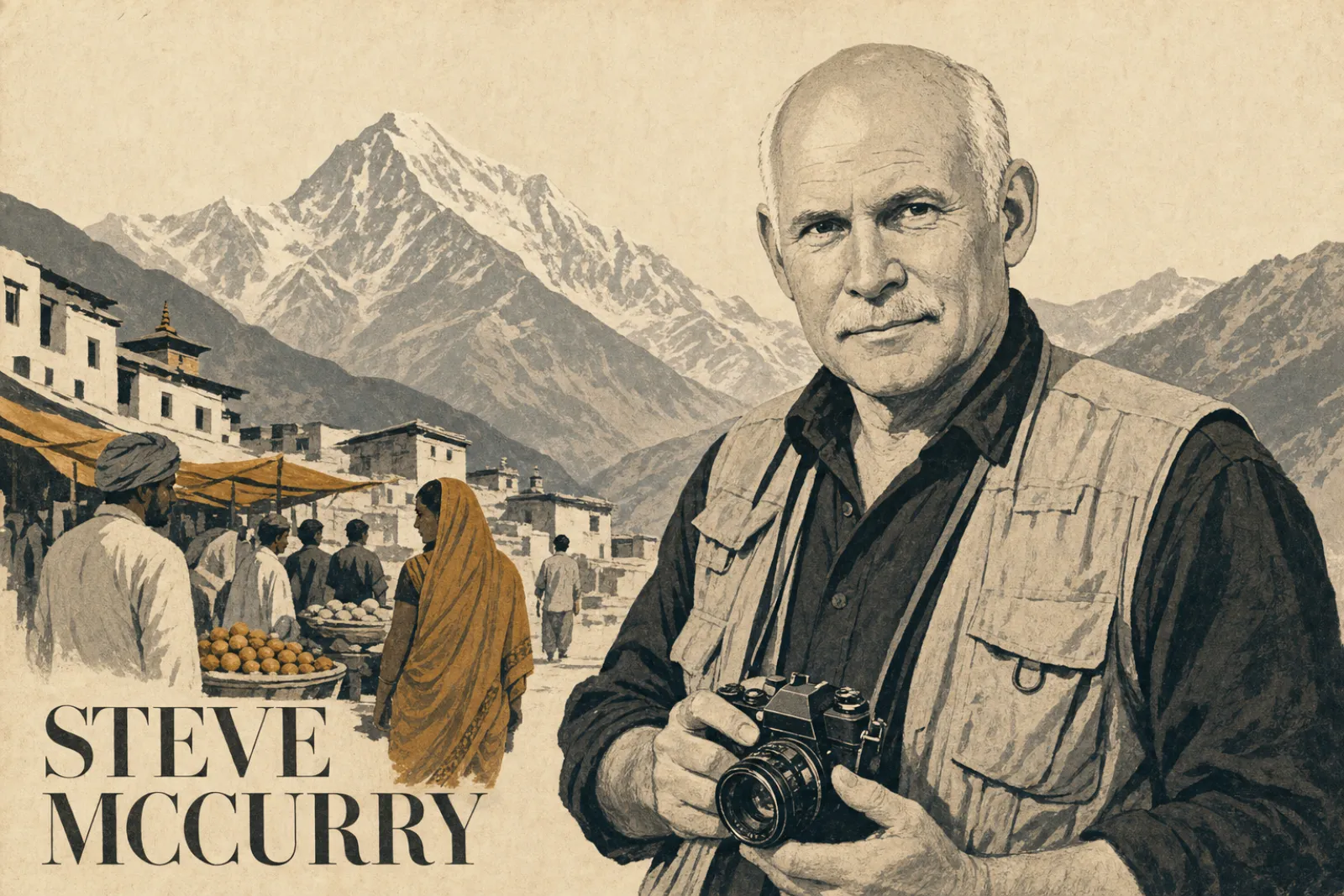
Steve McCurry, born in Philadelphia in 1950, is an American photographer whose color pictures from Afghanistan, Pakistan, India and Southeast Asia reached a very large audience through National Geographic. He began as a newspaper photographer, covered a long list of wars, and joined Magnum Photos in 1986. He is best known for Afghan Girl, a portrait of a young refugee made in 1984 and published on the magazine’s cover in June 1985.
McCurry won the Robert Capa Gold Medal, the award for reporting from abroad named after the war photographer Robert Capa, for pictures he brought out of Afghanistan at the start of the Soviet war. His way of working differs from that of Magnum contemporaries such as Sebastião Salgado, who built long black and white series. McCurry worked in color and has said that what matters most to him is the individual picture, each one able to stand on its own.
Penn State, a newspaper job and a first trip to India
McCurry went to Pennsylvania State University intending to study cinematography and filmmaking. He graduated in 1974 with a degree in theater arts. He became interested in still photography while taking pictures for the student newspaper, The Daily Collegian.
After college he worked for a newspaper for two years. Then he left for India, travelling light with a camera and a supply of film, and spent about a year working his way around the subcontinent. His book Monsoon was published in 1988.
Planning to photograph while you travel? Travel photography covers what to carry, how to work in unfamiliar places and how to come home with more than postcards.
Across the border into Afghanistan
From India McCurry went on to northern Pakistan. There he met Afghans who told him about the war over the border. Shortly before the Soviet invasion he crossed into rebel-held Afghanistan dressed in Afghan clothing. He stayed with the Mujahideen, for months by his own account. When he came out he carried his exposed film sewn into his clothes.
The pictures were among the first to show the conflict to the outside world. The New York Times, Time and Paris Match published them, and they brought him the Robert Capa Gold Medal. He went on to cover the Iran and Iraq war, the civil war in Lebanon, the Cambodian civil war, conflict in the Philippines, the Gulf War and the later fighting in Afghanistan. He won first prizes in the World Press Photo contest in 1985 and 1992. On 11 September 2001 he photographed the burning World Trade Center from the roof of his building in New York, and went to Ground Zero the next morning.
What does a working photojournalist’s job involve day to day? Photojournalism as a career describes the work, the routes in and what it asks of you.
The portrait at Nasir Bagh
In 1984 McCurry was photographing Afghan refugees in camps along the border. At the Nasir Bagh camp near Peshawar in Pakistan he photographed girls at the camp school. One of them, about twelve years old, looked straight into the lens. She wore a red scarf over her head, and her eyes were green. He did not record her name.
He made the picture with a Nikon FM2, a 35mm film camera, and a 105mm f/2.5 lens, on Kodachrome 64 slide film. An editor at National Geographic at first passed over the frame. The decision was reversed, and it ran on the cover in June 1985. It became a symbol of the Afghan conflict and of refugees in general.
Her identity stayed unknown for seventeen years. In 2002 McCurry returned with a National Geographic team and found her in Afghanistan. Her name was Sharbat Gula, and the match was confirmed by comparing the iris patterns in the old and new photographs.
The picture has also been criticized. It has been alleged that permission was not sought, and that showing her face to a man outside the family went against the customs of her Pashtun community. In a 2022 interview with the Italian newspaper La Repubblica, Sharbat Gula said that the photograph had caused her problems and that she would have preferred it had not been taken. She has also said she was happy to learn that it had helped refugees. Any honest account of the picture includes her view of it.
How do you photograph people from another culture with respect? Cultural sensitivity in photography sets out ethical approaches to photographing people and places.
Kodachrome, digital and the 2016 editing dispute
For about thirty years McCurry shot Kodachrome, and by his own count his archive holds several hundred thousand Kodachrome pictures. He moved to digital capture in 2005. Kodak stopped making the film in 2009 and gave him the last roll to come off the line. He shot its 36 frames, and the roll was processed in July 2010 at Dwayne’s Photo in Parsons, Kansas. Prints of all 36 frames went to George Eastman House in Rochester.
In 2016 the Italian photographer Paolo Viglione noticed a badly retouched print of a Cuban street scene at a McCurry exhibition in Italy and wrote about it. Other pictures were then found in which people or objects had been removed. McCurry called the Cuba print a mistake for which he had to take responsibility, and said the lab technician involved no longer worked with him. He also said that he no longer thought of himself as a photojournalist but as a visual storyteller, and that he would use editing software only minimally in future. The episode is a useful case for anyone deciding where their own limits are.
Where is the line between adjusting a photograph and changing what it shows? Photo retouching ethics works through that question for different kinds of photography.
How the pictures are made to work
One picture at a time. McCurry puts the single frame ahead of the sequence. Each picture is meant to be complete without a caption or a neighbor. That is a different discipline from the photo essay, and it raises the standard for every frame kept.
A short telephoto for faces. Afghan Girl was made with a 105mm lens. A lens of that focal length lets the photographer stand back a little while the face still fills the frame, which is why lenses in that range are a common choice for portrait photography.
The look into the lens. The force of the portrait comes from the direct gaze. A photographer who wants that has to be close enough, and patient enough, for the subject to look back. Street portraits covers how to ask and how to get a good frame once someone agrees.
Color as structure. A red scarf around green eyes: red and green sit opposite each other on the color wheel, and complementary colors placed together make each other look stronger. Limiting a portrait to two main colors is a choice a reader can make on purpose.
Slide film discipline. Kodachrome 64 was a slow slide film. Slide film leaves little room for error in exposure, so the exposure had to be right in the camera. Film stocks compared explains how slide and negative films differ.
The human element first. Whether the subject was a conflict or a disappearing tradition, McCurry kept people at the center. His Magnum profile says he prefers to focus on the human condition and on what cultures and peoples have in common.
Photographs and books to look for
- Afghan Girl, 1984. The portrait of Sharbat Gula at Nasir Bagh. Notice the direct gaze and the red scarf against green eyes, a mix that has been described as grit and glamour together.
- The first Afghanistan pictures. The work made with the Mujahideen that won the Robert Capa Gold Medal. It was reporting first, made under real risk. A book titled Afghanistan followed in 2017.
- Monsoon, 1988. An early book in color. Read it as a set and ask whether each picture stands alone, as he intends.
- Portraits, 1999. Use it to compare how he frames one face after another, and what stays the same from country to country.
- The last roll of Kodachrome, 2010. Thirty-six frames, all printed and held at George Eastman House. A lesson in what a photographer chooses when every frame is counted.
Try this: one face, two colors, fifteen minutes
- Ask someone you know to sit for you. Explain what the picture is for and show them the results afterwards. Keep only the frames they are happy with.
- Place them in open shade or beside a window, with a plain background.
- Use a short telephoto: 85mm to 105mm on a camera, or the 2x or 3x lens on a phone. Step back until head and shoulders fill the frame.
- Limit the picture to two main colors. A scarf, a jacket or the wall behind can supply the second one.
- Ask them to look into the lens. Make twelve frames and no more. Choose one.
The limit of twelve frames and one final picture is the point. It makes you decide what the single picture is.
Questions people ask about Steve McCurry
Who is the Afghan Girl?
She is Sharbat Gula, who was about twelve when McCurry photographed her in 1984 at the Nasir Bagh refugee camp near Peshawar, Pakistan. Her name was not known until 2002, when a National Geographic team found her and confirmed her identity by iris recognition.
What camera and film did Steve McCurry use for Afghan Girl?
A Nikon FM2 with a Nikkor 105mm f/2.5 lens, loaded with Kodachrome 64 color slide film.
Did Steve McCurry shoot the last roll of Kodachrome?
Yes. Kodak gave him the final roll it produced. He shot all 36 frames, and the roll was processed in July 2010 at Dwayne’s Photo in Parsons, Kansas.
What was the Steve McCurry Photoshop controversy?
In 2016 several of his pictures were found to have had people or objects removed, after a visibly flawed print was noticed at an exhibition in Italy. McCurry took responsibility for that print, described himself as a visual storyteller and not a photojournalist, and said he would keep editing to a minimum.
McCurry is one of many photographers profiled in the A to Z of photographers, and he is quoted on the photography quotes page.