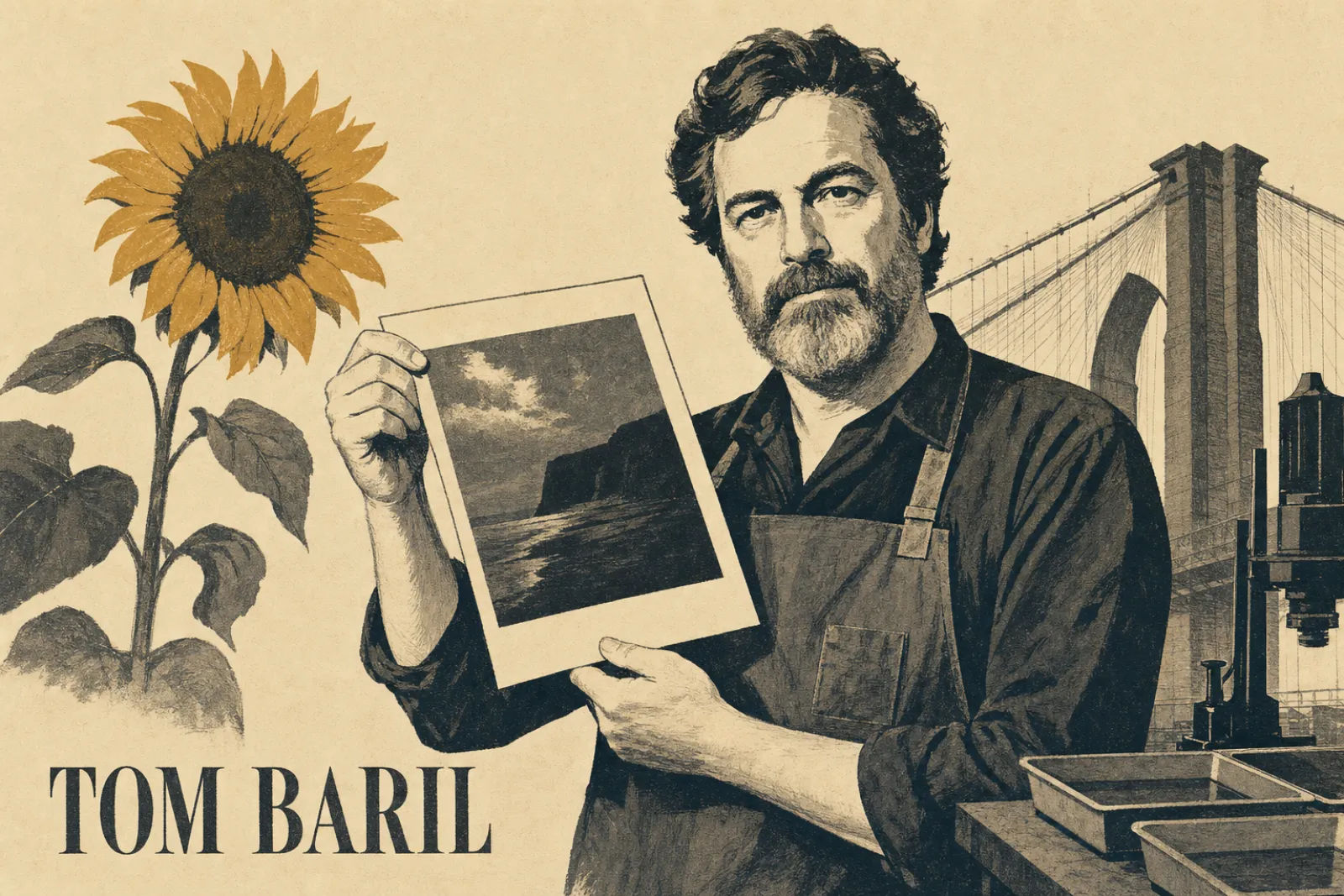
Tom Baril (born 1952) is an American photographer and printer from Connecticut who studied and worked in New York City. From 1979 to 1989 he was the printer for Robert Mapplethorpe. His own photographs are toned black and white prints of flowers, bridges, city architecture and the sea. He is known for the darkroom craft of those prints and for his books Tom Baril and Botanica.
Baril was born in Putnam, Connecticut, and took a degree in photography at the School of Visual Arts in New York in 1980. In 1979, while he was still a student, Robert Mapplethorpe hired him as his printer. He kept the job for ten years, and the quality of Mapplethorpe’s prints in that decade is credited to his technical help. The Robert Koch Gallery’s account of his work names three earlier photographers as his influences: Edward Weston, Imogen Cunningham and the German plant photographer Karl Blossfeldt. The gallery calls all three modernists, and places Baril’s botanical studies in their line.
Ten years in another photographer’s darkroom
A printer’s job is to turn another person’s negative into the finished object that hangs on the wall. For a decade Baril did that for Mapplethorpe. Holden Luntz Gallery describes him as Mapplethorpe’s exclusive printmaker and says that the experience refined his meticulous control of tone and his darkroom technique.
The years of printing gave him the skills his own work depends on. The site’s guide to black and white printing covers the same concerns in present day terms: neutral or warm tone, the choice of paper, and proofing until the print is right.
Never worked in a darkroom? Darkroom basics explains how to set one up and what happens in each tray.
Flowers, bridges and steel mills under his own name
After leaving Mapplethorpe’s studio Baril built an independent career. His subjects fall into a few groups. There are flowers and other botanical studies. There is architecture, including industrial structures: the Brooklyn Bridge, the Verrazzano-Narrows Bridge and steel mills. There are landscapes and spare seascapes. Across all of them, the Koch Gallery notes, his attention is on line, form, pattern and texture.
His first book, titled simply Tom Baril, was published in 1997 by 4AD. The first printing of 2,500 copies sold out at once. A second book, Botanica, was published by Arena Editions.
His photographs are held by the Brooklyn Museum, the Philadelphia Museum of Art, the Los Angeles County Museum of Art, the Stedelijk Museum in Amsterdam, the Fogg Museum at Harvard, the George Eastman Museum, the Center for Creative Photography in Tucson and the Bibliothèque nationale de France, among others.
A pinhole, a Polaroid negative and a bath of tea
In 1994 Baril began making pinhole photographs. He used a 4×5 view camera with the lens replaced by a pinhole, and loaded it with Polaroid Type 55 film. A pinhole has no glass. Light passes through a small punctured hole, which gives a soft image and a very deep zone of acceptable focus. He used it for his seascapes.
Type 55 was a black and white instant film in 4×5 inch sheets. One exposure produced both a positive print and a usable negative. The negative was fine grained and could be enlarged a long way. It also carried a rough, frame like border on three sides, a look that became popular in its own right. Baril left the Polaroid marks visible at the edges of his prints.
He also worked with a much older method. The Holden Luntz account lists 8×10 inch wet plate collodion negatives alongside the pinhole work, and toned gelatin silver prints. The large format page explains why sheet film and plates of that size hold so much detail.
His prints get their color from the darkroom, not from the subject. He toned them first in selenium and then in a bath of tea. The gallery account says the toning enriches the color and depth of the print. He also used solarization during film development.
Want to build a camera with no lens? Pinhole photography shows how to make one and how to work out the exposure.
How Baril’s pictures are made to work
- One subject, studied for its form. His flower pictures have been described as intimate, almost sculptural portraits. The flower is treated as a shape with weight and surface, not as a pretty thing in a garden. The page on how to photograph flowers covers the practical side of working that close.
- Line, form, pattern, texture. These four words from his gallery are a checklist. A bridge is line and pattern. A petal is form and texture. If a frame has none of the four, there is no picture yet.
- Softness as a choice. A pinhole seascape is not sharp, and is not meant to be. The softness and the deep focus remove detail and leave tone and shape. The site’s guide to seascape photography covers the sharper, lens based way of working, which makes a useful comparison.
- Tone is decided in the print. Selenium and tea give a black and white print a richer color than the untoned paper has. The same negative can be printed cold or warm, hard or soft, and each version is a different picture.
- Let the process show. The ragged Polaroid edge tells the viewer how the picture was made. Leaving it in is a decision about honesty to materials, and it also gives the image a frame.
- Old processes for present subjects. Wet plate collodion belongs to the nineteenth century. Used on a present day subject, it slows the work down and changes its surface. Alternative photography processes describes several that can still be practised.
Baril has described his aim in a statement published by Holden Luntz Gallery: when a picture succeeds, it reveals what is overlooked and underappreciated.
How do objects on a table become a photograph worth printing? Still life photography covers composition, lighting and setup.
Books and pictures to look for
- Tom Baril (4AD, 1997). The first monograph. Its first printing of 2,500 copies sold out at once. It is the broadest view of the early independent work.
- Botanica (Arena Editions). The second monograph, titled for the botanical work. Look at how much of the effect of each picture comes from the color of the print.
- Hollyhock (2002). A photograph, titled for a garden flower, held in the collection of the International Center of Photography. It shows that the botanical work continued after the books.
- The bridge pictures. Photographs of the Brooklyn Bridge and the Verrazzano-Narrows Bridge, part of his architectural and industrial work. Compare how the same attention to line and pattern is applied to steel and to petals.
- The pinhole seascapes (from 1994). Made on 4×5 Polaroid Type 55 with no lens. Notice the softness, the depth, and the Polaroid marks left at the edges of the print.
Try this: one flower, twenty minutes, no color
Take a single cut flower or a leaf, a plain wall or sheet of paper as a background, and a window. A phone is enough.
- Set the camera or phone to black and white, so that you judge shape and tone and not color.
- Place the flower near the window, with the plain background behind it. Turn off the room lights.
- Make four pictures only, one for each word: line, form, pattern, texture. For line, find the stem or an edge. For form, turn the flower until it looks solid. For pattern, find the repeat in the petals or veins. For texture, move in until the surface fills the frame.
- Between pictures, turn the flower, not the camera, and watch how the light changes on it.
- Afterwards apply one warm tone to all four pictures in any editor and compare them with the neutral versions.
The last step is a small digital stand in for what toning does in the darkroom: the same picture, with a different color of black.
Questions people ask about Tom Baril
Who printed Robert Mapplethorpe’s photographs?
Tom Baril was Mapplethorpe’s printer from 1979 to 1989. He was hired while still a student at the School of Visual Arts, and the quality of Mapplethorpe’s prints is credited to his technical assistance.
What processes did Tom Baril use?
He made pinhole photographs on 4×5 Polaroid Type 55 film from 1994, and also worked with 8×10 wet plate collodion negatives and gelatin silver prints. He toned prints in selenium followed by tea, and used solarization during film development.
What did Tom Baril photograph?
Flowers and other botanical subjects, city architecture, industrial structures such as bridges and steel mills, landscapes and seascapes. Galleries describe the common thread as attention to line, form, pattern and texture.
What books has Tom Baril published?
Two monographs: Tom Baril, published by 4AD in 1997, and Botanica, published by Arena Editions.
Tom Baril is one of the photographers in the A to Z of photographers, and he is quoted on the photography quotes page.