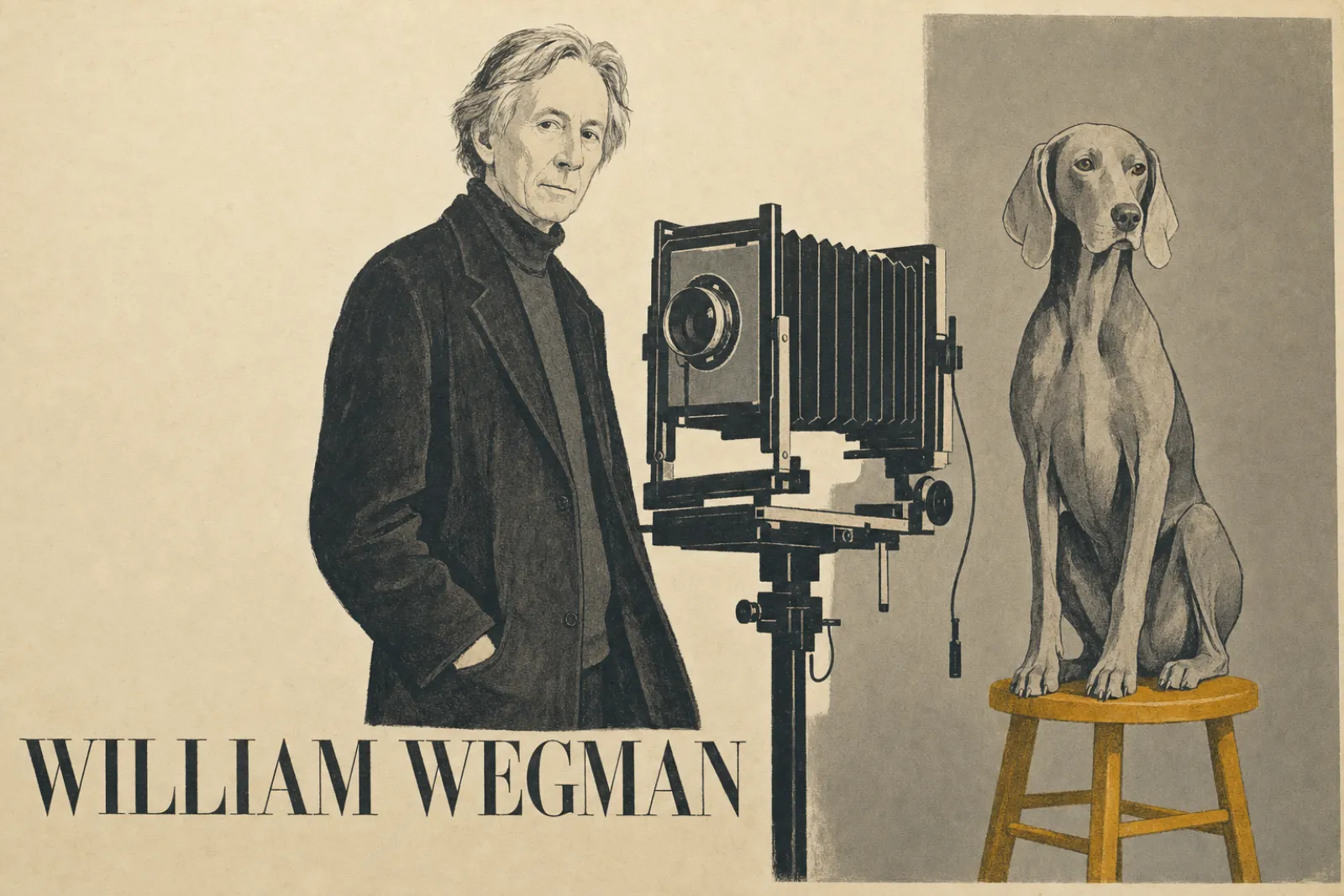
William Wegman is an American artist, born in Holyoke, Massachusetts, in 1943, who trained as a painter and turned to video and photography around 1970. He is known for photographs and short videos of his Weimaraner dogs, beginning with Man Ray in the early 1970s and continuing with Fay Ray and her descendants, many of them made on the very large Polaroid 20 x 24 camera.
Wegman came up through conceptual art, not through camera clubs or magazines. His early work was shown in “When Attitudes Become Form” at the Kunsthalle Bern in 1969 and at Documenta 5 in Kassel in 1972, and he exhibited with the Sonnabend gallery in Paris and New York. His videotapes have been described as deadpan one-liners, built from sight gags and understated humour, some of them parodies of minimalist and body art. The big Polaroid camera he later adopted was shared with other artists, and Ansel Adams used one in 1979 for an official portrait of President Jimmy Carter. For a different kind of comedy with dogs, found in the street instead of built in a studio, compare Elliott Erwitt. For another artist who built a career on dressing up a subject for the camera, see Cindy Sherman.
From a painting degree to a video camera in Long Beach
Wegman took a Bachelor of Fine Arts in painting at the Massachusetts College of Art in Boston in 1965 and a Master of Fine Arts in painting at the University of Illinois at Urbana-Champaign in 1967. He taught at the University of Wisconsin from 1968 to 1970 and at California State College, Long Beach, from 1970 to 1971, then moved to Santa Monica.
In those years he put painting aside for black and white photographs and for video. The first reel of his selected video works, made in 1970 and 1971, runs about thirty minutes and holds 23 short pieces. They use his own body and everyday objects such as balls and dolls. The camera does not move. Each piece was recorded as a single take in real time, and each sets up an ordinary action and lets it end somewhere absurd.
Want to try short pieces like these with a camera that also shoots stills? Video for photographers covers the settings and habits that change when the picture moves.
Man Ray, the dog who became the subject
While he was in Long Beach, Wegman got a Weimaraner and named him Man Ray. The dog walked into the work and stayed there. In the early tapes Man Ray drags a microphone in his mouth, laps up milk from the floor, and runs through a darkened room carrying a flashlight. He became the central figure in Wegman’s photographs and videotapes for more than a decade, known for a deadpan presence in front of the lens.
One writer on the videos described the dog as a blank slate onto which Wegman projected human emotions and motives. That is the engine of the work. The dog does very little, the viewer supplies the feeling, and the gap between the two is where the humour sits. Man Ray died in 1982, and the Village Voice named him “Man of the Year”.
Fay Ray and the 20 x 24 Polaroid
In 1986 Wegman got a second Weimaraner, Fay Ray, and began a new collaboration built around the Polaroid 20 x 24 camera. Only a handful of these cameras were made, between 1976 and 1978. Each weighs about 240 pounds, sits on a wheeled chassis, and produces a print nominally 20 by 24 inches. The film is peel-apart instant film: about a minute and a half after the exposure, negative and positive are pulled apart and the finished photograph is there.
Fay had a litter in 1989, and Battina, Crooky and Chundo joined the cast. Chip was born in 1995, Bobbin in 1999 and Penny in 2004. The dogs carried the work well beyond galleries. Wegman made segments for Saturday Night Live and Nickelodeon, and from the late 1980s he made regular video segments for Sesame Street, in some of which the dogs form letters of the alphabet and numbers. His film “The Hardly Boys in Hardly Gold” was screened at the Sundance Film Festival. He also published children’s books with the dogs in the leading roles, among them “Cinderella”, “Little Red Riding Hood”, “ABC”, “Mother Goose” and “Farm Days”, and “Puppies” became a New York Times bestseller.
Painting never went away. He returned to it in the mid 1980s, and later paintings combine oil paint with postcards on wood panels. He received fellowships from the Guggenheim Foundation and the National Endowment for the Arts.
Curious how instant film behaves, and which cameras still take it? The guide to Polaroid and Instax explains the formats and what to expect from each.
How the pictures get their deadpan
Wegman’s method can be taken apart into a few plain choices, and all of them can be practised.
- A fixed camera and one take. In the early videos the camera stays still and the action runs once, in real time. Nothing is rescued in editing. The idea has to be simple enough to work the first time, which keeps it clear.
- Ordinary materials. The props are things found in a house: a ball, a doll, a glass of milk, a flashlight. The plainness of the props is part of the joke.
- A sitter who gives nothing away. The dog’s calm face is what lets the viewer read a human mood into the scene. A subject who mugs for the camera closes that gap. A subject who holds still opens it.
- Expectation against result. The humour comes from the distance between what should happen and what does. This is juxtaposition used as a working tool: a familiar form, such as a formal portrait, filled with the wrong sitter.
- A slow, heavy camera. A camera of 240 pounds cannot chase anything. The subject has to be placed, the frame built, and the pose held. The 20 x 24 works like a studio large format camera, and the instant print lets the picture be judged on the spot and the next one changed.
- Series, not single frames. Some of the early black and white work is in sets of panels, so the idea develops across the wall. Sequencing is doing work that a single frame cannot.
Want the practical side of working with an animal sitter? How to photograph pets covers focus, patience and expression, and the pet photography guide goes further into sessions and light.
Works to look for
- Selected Works: Reel 1 (1970 to 1971). Thirty minutes of black and white video in 23 short pieces. Watch how little happens in each one and how the static frame makes a small action carry the whole piece. Man Ray appears as a participant, not a prop.
- Stormy Night (1972). A silver gelatin work in nine panels, each 14 by 11 inches. It belongs to the black and white photographs Wegman made between 1969 and 1982, before the colour Polaroids, and it shows how he used a grid of prints to build one idea.
- Dog Duet (1970s). A short video from the Man Ray years. Watch it for the same rules as the first reel: a simple situation and a patient camera.
- Blue Period with Banjo (1980). A Polaroid print from the Man Ray period. The title borrows the language of painting, in keeping with tapes whose sight gags parodied the art of their time.
- Man’s Best Friend (1982). A book published in the year Man Ray died, and the natural starting point for the first decade of the dog pictures.
- Being Human (2017). A later book, followed by an exhibition of the same name that began a four-year international tour at the Rencontres d’Arles in 2018.
Wondering how a body of work like this is ordered for a book or a wall? Photo sequencing explains how to edit and order a set of pictures.
Try this: one prop, one patient sitter, twelve frames
Set aside 15 minutes. Choose a sitter who can hold still: a calm pet, a houseplant, a kettle, or a person who agrees not to smile. Choose one ordinary prop from the room, such as a hat, a scarf or a ball.
- Put the camera or phone on a table or tripod and do not move it again. Use a plain wall as the background.
- Light the sitter from one side with a window or a lamp.
- Make exactly twelve frames. Between frames, change only the relationship of the prop to the sitter: on it, beside it, in front of it, balanced, hidden.
- Do not ask for an expression. If the sitter is a person, ask for a blank face in every frame.
- Afterwards, pick the three frames that read as a short story in order, and the one frame where the prop seems to change who the sitter is.
The exercise practises Wegman’s central move: the frame and the sitter stay the same, and one small change does the talking.
Questions people ask about William Wegman
What breed are William Wegman’s dogs?
They are Weimaraners. The first was Man Ray, acquired in Long Beach, California, in the early 1970s. Fay Ray followed in 1986, and her puppies Battina, Crooky and Chundo, born in 1989, were followed by Chip, Bobbin and Penny.
What camera did William Wegman use for the large dog portraits?
Many of them were made on the Polaroid 20 x 24 camera, which he used extensively from 1986 with Fay Ray. It is a studio instant camera weighing about 240 pounds that makes a single print roughly 20 by 24 inches.
Is William Wegman only a photographer?
No. Both of his degrees are in painting, his reputation was first made in conceptual art and video in the early 1970s, and he returned to painting in the mid 1980s. Retrospectives such as “Funney/Strange”, which was shown at the Brooklyn Museum in 2006, covered his work in all mediums.
Did William Wegman’s dogs appear on Sesame Street?
Yes. He made video segments for Sesame Street from the late 1980s, with Fay Ray and later her offspring. Some of the segments were based on nursery rhymes, and in others the dogs formed letters and numbers.
William Wegman is one of many photographers profiled in the A to Z of photographers.