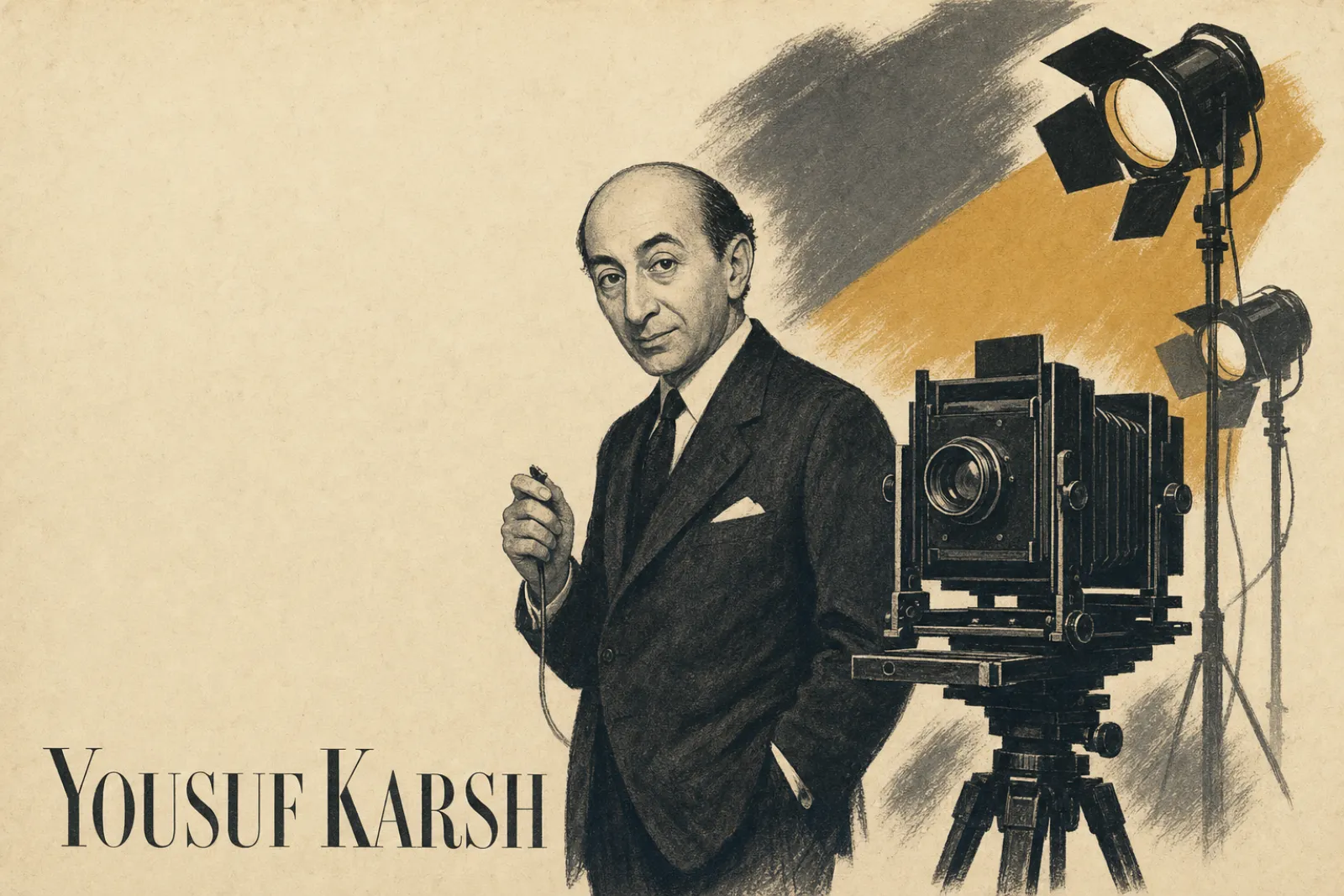
Yousuf Karsh (1908 to 2002) was a Canadian portrait photographer of Armenian origin who worked from a studio in Ottawa for sixty years and signed his prints “Karsh of Ottawa”. He photographed statesmen, scientists, writers, musicians and actors in black and white with dramatic, carefully built lighting. He is known above all for his scowling portrait of Winston Churchill, made in Ottawa on December 30, 1941.
Karsh learned the trade from two Armenian portrait photographers: his uncle George Nakash in Sherbrooke, Quebec, and John H. Garo in Boston. Garo worked by daylight and taught the slow printing crafts of the time. Karsh kept the craft and left the daylight behind once he saw what stage lighting could do. His portraits sit at one end of a range. For portraits that place the sitter inside a telling setting, see Arnold Newman. For portraits stripped back to a plain background, see Richard Avedon and Irving Penn.
From Mardin to a studio in Sherbrooke
Karsh was born on December 23, 1908, in Mardin, in the Ottoman Empire, to Armenian parents. He grew up during the Armenian genocide, and his family escaped to Aleppo in Syria. As a teenager he was sent on alone to Canada, where his mother’s brother, George Nakash, had sponsored him. He landed at Halifax on a New Year’s Eve in the 1920s after a voyage from Beirut, and went to live with his uncle in Sherbrooke.
Nakash was an established portrait photographer. He gave his nephew a camera, put him to work in the studio, and taught him the basics with large format cameras, glass plate negatives and darkroom printing. An early landscape with children won Karsh first prize in a contest, and he sent most of the fifty dollars to his parents in Aleppo.
Three years with Garo in Boston
In 1928 Nakash arranged an apprenticeship with John H. Garo, a leading Boston portraitist. It was meant to last six months and lasted about three years. Garo taught him the technical processes of the period, including platinum printing and the gum arabic, carbon, oil and bromoil methods. Karsh recalled that his first gum arabic print took eighteen days. Karsh wrote that Garo taught him to see, and to remember what he saw.
Wondering what those old printing methods were? Alternative photography processes explains the hand-made print crafts that predate modern papers.
Ottawa, the Little Theatre and the Speaker’s Chamber
Karsh settled in Ottawa in 1931 and opened his own studio on Sparks Street in 1932. Money was short and the furniture was made from orange crates. B. K. Sandwell, editor of the magazine Saturday Night, published his photographs and became an early supporter.
The change in his work came from the Ottawa Little Theatre, of which he was a member. Photographing actors under stage lights showed him that artificial light could be placed, shaped and changed at will, where Garo’s daylight studio had meant waiting for the light to come right. He took that control back to the portrait studio. The theatre also brought him sitters. Through it he met the son of the Governor General, Lord Bessborough, and the Bessborough portraits ran in the Illustrated London News. In 1936, when President Franklin Roosevelt came to Quebec City to confer with a later Governor General, Lord Tweedsmuir, and Prime Minister Mackenzie King, Karsh was invited to photograph the visit. King became his patron and friend.
It was King who arranged the Churchill sitting. On December 30, 1941, Churchill addressed the Canadian Parliament. Karsh had set up his lights and camera in the Speaker’s Chamber the evening before. The session lasted about two minutes. Churchill would not put down his cigar, so Karsh stepped forward, said “Forgive me, sir,” and took it from his mouth. By Karsh’s account the exposure was made in the instant that followed. The photograph, later called “The Roaring Lion”, ran on the cover of Life on May 21, 1945. Karsh wrote that its reception changed his life.
In 1943 he sailed to wartime London and photographed George Bernard Shaw and members of the royal family, and from then on he travelled to his sitters with portable lights. He made a habit of researching each subject before the sitting. In 1952 he took a long assignment from Maclean’s magazine to document Canada’s postwar economic development. The studio moved to the Château Laurier hotel in 1972 and closed in June 1992. Over his career he held 15,312 sittings. He moved to Boston in 1997 and died there on July 13, 2002.
How a Karsh portrait is built
- Light that is placed, not found. Dramatic lighting was the hallmark of his style. He used artificial lights that he could move and aim, and he chose a strong contrast between lit and dark areas. The direction of the light is always a decision in his portraits. The site’s pages on portrait lighting patterns and chiaroscuro cover the general principles.
- Hands as well as faces. For the O’Keeffe portrait Karsh worked from a description that dwelt on her strong white hands. Hands can be a second point of interest that says something about the person’s work.
- A big, slow camera. The Churchill portrait was made with an 8 by 10 inch view camera. A large format camera on a stand forces a fixed frame and a deliberate pace, and its large negative records fine detail in skin and cloth.
- Homework before the sitting. He read about his sitters and talked with them. The conversation was part of the method, because the expression he wanted had to be drawn out and then caught.
- Props with a reason. He often included objects that stood for the sitter’s profession.
- Everything ready in advance. For Churchill the lights and camera were in place the night before. Two minutes was enough because nothing technical was left to decide.
Want to build a controlled light of your own? Studio lighting setup starts with one light and adds from there, and the Rembrandt lighting tutorial walks through one classic dramatic pattern.
More interested in darkness than in gear? High key and low key photography explains how a mostly dark frame is exposed and why it reads as serious.
Portraits to look for
- Winston Churchill, “The Roaring Lion” (1941). Look at the stern expression and the set of the body, which viewers at the time read as defiance. Then remember that the look came from a cigar being taken away. The picture is a lesson in how a portrait’s meaning is supplied by its audience.
- Albert Einstein (1948). Made at the Institute for Advanced Study in Princeton. Karsh wrote that he found Einstein simple, kindly and almost childlike, with none of the poses of an eminent man. Compare the mood with the Churchill.
- Pablo Casals (1954). Made at the abbey of Cuxa in Prades. Karsh photographed the cellist from behind, in a bare room, something he said he did on no other occasion. He felt the empty room conveyed the loneliness of the artist and of exile. It proves that a portrait does not need a face.
- Georgia O’Keeffe (1956). Made at her home in Abiquiu, New Mexico. Karsh set out to photograph her as a friend had described her: in calm profile, hair drawn back, with strong white hands against black and white.
- Ernest Hemingway (1957). Made at Finca Vigía, near Havana. Karsh wrote that he found a man of unusual gentleness, the shyest he had ever photographed, and one who was recovering from injuries suffered in a plane accident in Africa.
- Audrey Hepburn (1956). Made in Hollywood. Karsh spoke of her “sophisticated vulnerability”, and the portrait shows that his method worked for actors as well as for statesmen.
Try this: one lamp, face and hands
This takes about 20 minutes and needs one sitter, one desk lamp or bare bulb, and a dark room.
- Turn off every other light. Seat the person a metre or more in front of a dark or unlit wall.
- Before picking up the camera, talk for three minutes about what they do with their hands: work, a craft, an instrument. Ask them to hold one object from that activity.
- Place the lamp to one side and slightly above the face. Make four frames, moving the lamp a little further round each time, and watch the shadow side of the face.
- Now lower or turn the lamp so that the hands are lit as clearly as the face. Use a white card or a sheet of paper to bounce light onto whichever of the two is darker. Make four more frames.
- Keep the camera in one place for all eight frames. Compare the frame with the brightest hands to the frame where they fall into shadow.
No lamp you can move? Window light portraits shows how to get direction and contrast from a single window.
Questions people ask about Yousuf Karsh
How did Karsh get the Churchill photograph?
Prime Minister Mackenzie King arranged a brief sitting in the Speaker’s Chamber in Ottawa on December 30, 1941, straight after Churchill’s speech to Parliament. Karsh had his lights and camera ready from the evening before. When Churchill kept his cigar, Karsh removed it and made the exposure a moment later.
What camera did Yousuf Karsh use?
The Churchill portrait was made on an 8 by 10 inch view camera. Karsh learned on large format cameras with glass plate negatives in his uncle’s studio and carried portable lights and a camera to sittings around the world.
Was the Churchill portrait stolen?
A signed print that hung in the Château Laurier hotel in Ottawa was found in August 2022 to have been replaced with a copy. The original was traced to Italy and returned in November 2024. A man pleaded guilty to the theft in 2025.
Where are Karsh’s negatives kept?
His archive of negatives, prints and transparencies was acquired by the National Archives of Canada in 1987 and is held by Library and Archives Canada. Published counts of the negatives differ, from 150,000 to more than 250,000.
Karsh is quoted on the photography quotes page, and he is one of many portraitists in the A to Z of photographers. The wider craft is covered in the guide to portrait photography.