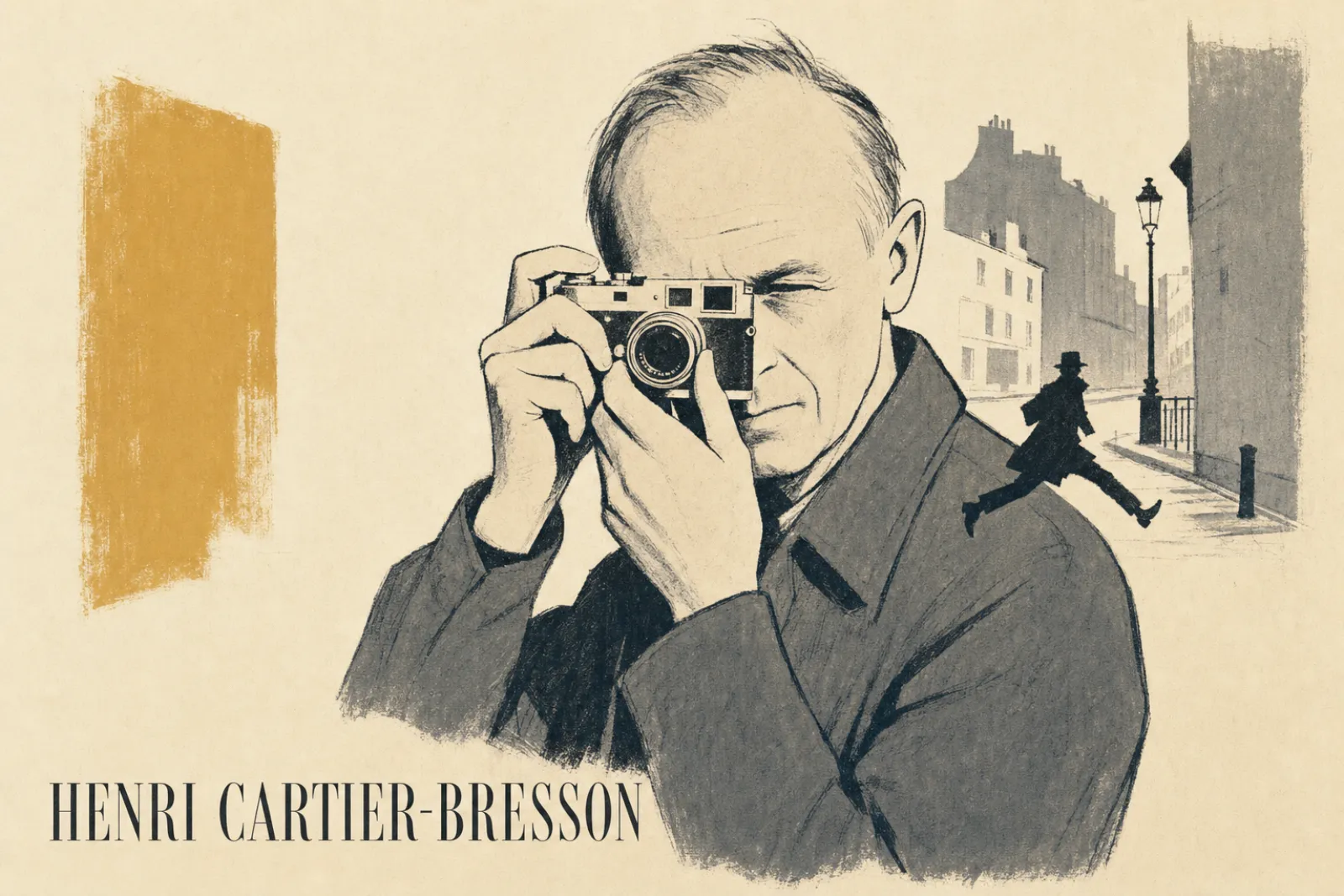
Henri Cartier-Bresson (1908 to 2004) was a French photographer who trained as a painter, took up a Leica in the early 1930s and spent four decades photographing daily life and world events in black and white. He co-founded the Magnum Photos agency in 1947. He is known for the idea attached to his 1952 book “The Decisive Moment”: that an event and the form that expresses it can be recognised and caught in the same fraction of a second.
His teacher was the Cubist painter André Lhote, and he later called that training photography without a camera. In Paris he mixed with the Surrealists, who prized the subconscious and the immediate. He shared early exhibitions with Walker Evans and Manuel Álvarez Bravo, studied film-making with Paul Strand, and built Magnum with Robert Capa, David Seymour, George Rodger and William Vandivert. What he pushed against was manipulation after the fact. He would not use flash, and he would not let his pictures be cropped.
A painter who found a small camera
Cartier-Bresson was born on August 22, 1908, in Chanteloup-en-Brie, in the Seine-et-Marne department of France. His father was a wealthy textile manufacturer whose family firm made thread. He studied painting under Lhote in the late 1920s. Around 1930 he spent close to a year in the Ivory Coast, where he fell seriously ill with blackwater fever.
A photograph by the Hungarian photojournalist Martin Munkácsi turned him. It showed three boys running into the surf at Lake Tanganyika, caught almost in silhouette, and it convinced him that a photograph could fix an instant for good. He bought a Leica with a 50mm lens and travelled in Europe with it. His photographs were first exhibited at the Julien Levy Gallery in New York in 1933. In 1934 he went to Mexico with an ethnographic expedition. He exhibited in Mexico with Álvarez Bravo.
From the mid 1930s he worked in film. He was second assistant to the director Jean Renoir on “Une partie de campagne” and “La vie est à nous” in 1936 and an assistant on “La Règle du jeu” in 1939. In 1937 he photographed the coronation of King George VI in London.
Prison camp, Magnum and the years in Asia
He joined the film and photography unit of the French Third Army and was captured in June 1940. He spent nearly three years as a prisoner of war and got away on his third attempt, in February 1943. He then worked with an underground organisation, photographed the liberation, and in 1945 directed “Le Retour”, a documentary on the return of French prisoners and displaced people.
In 1947 the Museum of Modern Art in New York gave him an exhibition, and in the same year he and his partners founded Magnum Photos as a cooperative agency owned by its members. The founders divided the world between them, and Cartier-Bresson took India and China. He was in India at the time of Gandhi’s death in 1948, and his coverage of the funeral brought him international recognition. He covered the last months of the Kuomintang government in China and the first months of the People’s Republic, and then the independence of Indonesia.
The book came out of those years. “Images à la sauvette” was published in France in 1952, with a cover by Henri Matisse. The American edition from Simon and Schuster was titled “The Decisive Moment”. It held 126 photographs and a long preface by the photographer, which quoted a line from the memoirs of Cardinal de Retz saying that everything in the world has its decisive moment. In 1954 he became the first Western photographer allowed to work freely in the Soviet Union after the war.
He kept travelling through the late 1950s and the 1960s: China again, Mexico, Cuba, Japan, India. From 1968 he turned away from photography and back to drawing and painting, and his first exhibition of drawings was held in New York in 1975. In 2003 he, his wife Martine Franck and their daughter opened the Fondation Henri Cartier-Bresson in Paris. He died in Provence on August 3, 2004.
Want to know what this kind of work is as a job? The guide to photojournalism covers how news pictures are made and used.
How the decisive moment is made
The phrase is often taken to mean fast reflexes. His own definition has two halves: the significance of an event, and a precise organisation of forms that expresses it, both recognised at once. The method below serves the second half as much as the first.
- One camera, one lens. He used a 35mm Leica rangefinder with a normal 50mm lens, and only occasionally a wide angle for landscapes. A single focal length means the edges of the frame are known before the camera is raised.
- Be hard to notice. He covered the bright metal of the camera in black so that it drew less attention, and used fast black and white film so that he could work unnoticed. This is the root of candid photography as it is still practised.
- No flash. He never used it and thought it rude. The picture had to be made from the light that was there.
- Compose in the viewfinder. He believed the picture should be composed when it was taken, not in the darkroom. Nearly all his photographs were printed full frame, and he asked for a thin black line of unexposed negative to show around the image. Read the site’s page on cropping with that discipline in mind.
- Find the stage, then wait. For “Hyères, France” he stood at the top of a staircase and waited for something to cross the space below. The geometry was chosen first. The moment arrived inside it.
- Leave the printing to others. He disliked developing and printing, and said that people think too much about technique and not enough about seeing.
The painter’s training shows in every one of these choices. The frame is treated as a drawing that has to be right at the first attempt.
Want the timing itself broken down? The decisive moment: timing, anticipation and gesture explains how to see a moment coming.
Wondering how the shapes in a street scene are organised? Composition in street photography looks at structure in fast, unposed pictures, and the street photography guide covers the practice as a whole.
Photographs to look for
- Behind the Gare Saint-Lazare (1932). A man jumps across a flooded patch of ground outside the Paris station, caught in the air above his own reflection. A ladder lies partly in the water, and posters on the wall behind show dancers whose pose echoes the jump. He shot through a gap in a wooden fence that was too narrow for the lens, which is why the picture is cut off on the left.
- Hyères, France (1932). A cyclist passes below a staircase, seen from the top of the steps. The fixed spirals and curves of the architecture and the moving rider are held in one frame. It is the clearest example of choosing a setting and waiting.
- Juvisy, France (1938). Two couples picnic on the bank of the Marne, seen from above as they face a boat on the river, while one man pours wine. It was made on a commission from the newspaper Ce Soir about the movement for workers’ holidays.
- Gestapo Informer Recognized by a Woman She Had Denounced (1945). Made at a camp in Dessau, Germany, in the weeks when he was documenting freed prisoners and refugees. One woman, angry and defiant, identifies another, who lowers her head, with an official seated at a desk and onlookers behind.
- Gold Rush, Shanghai (1948). A crowd pressed tightly together outside a bank during the collapse of the currency in the last months of Kuomintang rule. The picture looks arranged and was entirely spontaneous.
- Rue Mouffetard, Paris (1954). A smiling boy walks down the street carrying two bottles of wine, with two amused girls slightly out of focus behind him. It shows the lighter side of the same method.
Try this: choose the stage, wait for the actor
This takes 15 to 20 minutes on any street, in a park or in a station.
- Set the camera or phone to a single focal length and do not zoom. On a phone, use the main lens only.
- Walk until a background has strong geometry of its own: a staircase, a doorway, a curve of railings, a shadow across a wall.
- Frame it so that it works as an empty picture. Decide exactly where in the frame a person would complete it.
- Stand still and wait. When someone reaches that spot, make one frame. Do not take a burst.
- Stay for ten minutes and make no more than ten frames. Do not crop any of them afterwards.
Looking through the ten, note which misses were caused by timing and which by the frame being wrong before anyone arrived.
Feel exposed standing in one place with a camera? Working the scene in street photography covers staying with one location until it gives a picture.
Questions people ask about Henri Cartier-Bresson
What did Cartier-Bresson mean by the decisive moment?
He described photography as the recognition, in a fraction of a second, of both the significance of an event and the precise organisation of forms that gives it expression. The English title of his 1952 book was suggested by his American publisher. The French title, “Images à la sauvette”, means something closer to images taken on the sly.
What camera and lens did Cartier-Bresson use?
A 35mm Leica rangefinder with a 50mm lens, with a wide angle lens used now and then for landscapes. He covered the shiny parts of the camera in black and worked almost entirely in black and white.
Did Cartier-Bresson crop his photographs?
Almost never. He composed in the viewfinder and had nearly all his pictures printed full frame, with the edge of the negative showing. “Behind the Gare Saint-Lazare” is a known exception, because a fence blocked part of the lens.
Why did Cartier-Bresson stop taking photographs?
From 1968 he began to move back to drawing and painting, the art he had trained in, and he said he had perhaps said all he could through photography. He held his first exhibition of drawings in 1975.
Cartier-Bresson is quoted on the photography quotes page, and his contemporaries can be found in the A to Z of photographers.