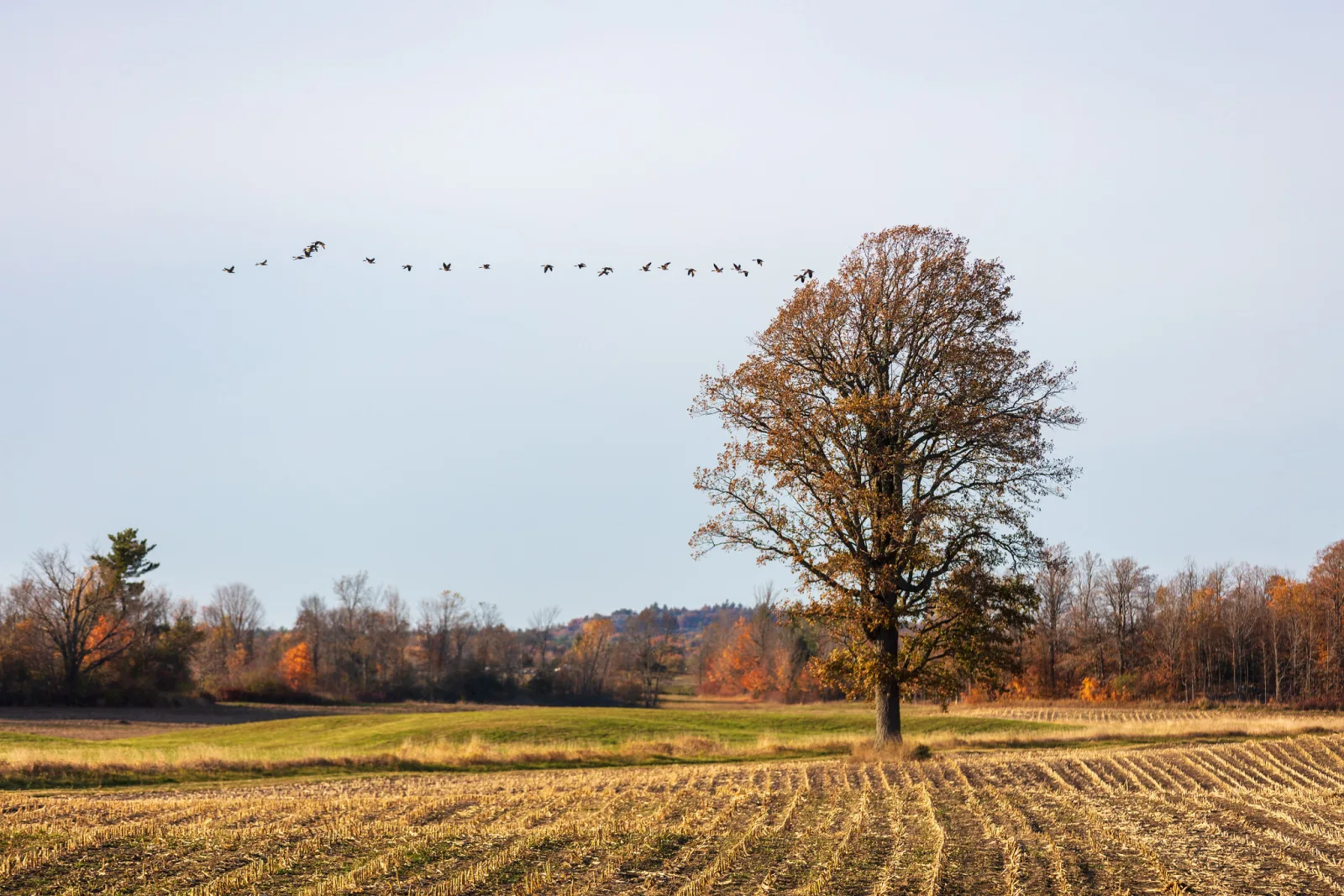
The rule of thirds is a composition guideline: divide the frame into nine equal boxes with two vertical and two horizontal lines, then place your subject on one of those lines or at one of the four points where they cross, instead of in the middle. In practice that means eyes on the upper line in a portrait, the horizon on the top or bottom line in a landscape, and a moving subject with more room ahead of it than behind.
This page shows how to place a subject on the grid for portraits, landscapes and moving subjects, how to turn the grid on in a camera or phone, how to fix a frame by cropping afterwards, and when to ignore the rule. It is one tool within photography composition, and painters and designers use the same grid.
What the rule of thirds says
Picture a tic-tac-toe board laid over your photo. Two vertical lines split the width into three equal parts. Two horizontal lines split the height into three equal parts. That gives nine boxes, four crossing points, and four lines to work with. Some photographers call the crossing points power points.
The rule asks you to put the most important thing in the picture on a line or at a crossing point. The reasoning is simple. A subject in the exact centre divides the frame into two matching halves and tends to look static, like a target. A subject on a third gives the frame a main side and a quieter side, and the eye has somewhere to travel. You move the subject onto a line by moving the camera: turn it, step to one side, or change your height.
The lines sit at one third and two thirds of the way across and down. On a frame 6000 pixels wide and 4000 tall, the vertical lines fall at 2000 and 4000 pixels from the left edge, and the horizontal lines at about 1333 and 2667 pixels from the top. You never need the numbers in the field. They only show that the lines are measured from the frame, so they move whenever the frame changes shape.
Switch the grid on over real photos to see where the lines fall, then crop one yourself and put the subject on a third.
Placing a subject on the lines and intersections
Start with one clear subject and ask where it should sit. A few working habits cover most scenes.
- One subject: put it on a crossing point. Which of the four you pick depends on where it faces or what else is in the scene.
- Two subjects: try one near each of two diagonal crossing points. A pair of people, two boats or a figure and a doorway often settle into a balanced frame this way.
- A long vertical, such as a tree, post or standing person: run it along a vertical line rather than a crossing point.
- A long horizontal, such as a shoreline or a fence: run it along a horizontal line.
- The rest of the frame: use the two thirds on the other side of your subject deliberately. Plain sky, water, wall or shadow is not wasted. It is the space that makes the subject read. See negative space for how to use it well.
Perfect alignment is not required. A subject that sits close to a line works just as well.
Portraits: where to put the eyes
In a portrait, the eyes carry the picture, so they get the placement. Put them on or near the upper horizontal line. That leaves the lower two thirds for shoulders, hands or the surroundings and avoids the common problem of a head floating in the middle of a frame with empty space above it.
Sideways position matters too. If your subject turns or looks to one side, put them on the opposite vertical third so there is space in front of the face. This is called look space or nose room, and a face pressed against the edge it is looking toward feels cramped.
The same idea works for environmental portraits, where the person works, lives or plays. Put the person on a third and let the other two thirds show their surroundings. The empty part of the frame tells half the story. With a shallow depth of field, focus on the eye nearest the camera so the sharpest point and the placement agree.
Landscapes: put the horizon on a line
The horizon is the longest line in most landscape pictures, and a horizon through the middle splits the image into two equal, competing halves. Move it to the upper or lower horizontal line, and decide with one question: which is more interesting, the sky or the ground?
- Interesting ground: rocks, flowers, a textured field or a leading path. Put the horizon on the upper line so the ground fills the lower two thirds and the sky is a one third band.
- Interesting sky: a storm, layered clouds, or colour near sunrise or during golden hour. Put the horizon on the lower line so the sky takes two thirds.
- Both are dull: look for a different view, not a different line.
The same question works on a lake. If the clouds are the show and the water is plain, give the sky two thirds. If the water has reflections or ripples worth keeping, reverse it.
Then place the landmark. A lone tree, a mountain peak, a lighthouse or a boat can sit at a crossing point rather than dead centre. A tree on the left vertical line with the horizon on the lower line is a complete composition on its own. A leading line, such as a road, a fence or a shoreline, can then run toward that point and pull the viewer in.
Is the horizon sloping even though you placed it on a line? How to crop photos covers straightening and what it costs at the corners.
Moving subjects and lead room
A car, a runner, a bird in flight or a cyclist has a direction. Give it more room in front than behind. Put the subject on the vertical third at the back of its movement so two thirds of the frame lie ahead, in the direction it is heading.
The reason is how a viewer reads a picture. The eye follows where the subject is going, and if it hits the edge of the frame right away, the picture feels like it is about to crash. Space ahead lets the movement continue. This is lead room, and it is the same principle as look space in a portrait.
Leave less room only on purpose. A subject close to the frame edge, with plenty of space behind, can suggest that something has just left, or that the subject is fleeing, or can add tension. If the action is fast, frame a little wider than you think you need and place the subject accurately when you crop later.
Not sure how much room to leave in front of a face or a moving subject? The rule of space covers lead room, nose room and when to break them.
Turning on the grid in a camera or phone
Nearly every camera and phone can draw the grid over the picture while you compose. The setting has a different name on different devices, but you will find it in the menus under words like grid, gridlines, framing grid, composition grid or viewfinder overlay. Some cameras offer a simple nine box grid and others offer finer ones. Pick the nine box version.
- Camera with an electronic viewfinder or rear screen: the grid is a display option you switch on in the menu. It does not appear in the saved picture.
- Camera with an optical viewfinder: a grid may appear in the viewfinder only on some bodies. If not, use the rear screen in live view.
- Phone: look in the camera settings for grid or gridlines. See phone camera settings for other options worth turning on.
Use the grid as a check, not a cage. Compose the way you naturally would, glance at the lines, and nudge the subject onto one. After a week, you will start seeing the thirds without the overlay.
Cropping to thirds afterwards
Often the best thirds composition is made after the shutter. If your subject was too central, crop to move it. The crop tool in many editing programs shows a thirds overlay, and you can drag the frame until the subject lands on a line.
- Open the crop tool and pick the aspect ratio you want to keep. Changing the shape of the frame moves all four lines, so choose this first. See aspect ratio for what each shape does.
- Straighten the horizon before you judge the placement.
- Drag the frame so the subject sits on a vertical line or crossing point, and the horizon on a horizontal line.
- Check how much resolution is left. A tight crop is fine for a screen but may be too small to print large.
Cropping can only remove edges, so it cannot add room that was never there. Crop a runner to give lead room ahead and you may run out of frame behind.
When to break the rule and what to use instead
The rule of thirds is a guide, not a law. It trains you to move subjects off the middle and think about balance. Once you understand why it works, you can ignore it on purpose. Four situations call for it.
Centre the subject when symmetry is the point. Architecture, reflections, tunnels, corridors and a face looking straight at the camera often work best in the centre, because the two halves match. See symmetry in photography.
Fill the frame when the subject is the whole story. A close-up of a face, a flower or a texture has no room for a grid. Fill the frame and the thirds stop mattering.
Push to the edge for tension. A subject placed at the extreme edge of the frame can feel uneasy or isolated, which is sometimes exactly what the picture needs. Use it deliberately and check the edge for tangents and mergers.
Let a pattern run edge to edge. When repetition is the subject, there is no single thing to place on a line. See patterns and repetition.
See it side by side
Placing the subject on a thirds line or intersection creates tension and movement. Dead center works when the scene has symmetry to earn it. Neither is wrong. Knowing why you chose is what matters.
If a pure centred shot does not suit the scene, there are other systems for off-centre placement. The golden ratio places the subject along a spiral, or on a grid whose lines sit a little closer to the centre than the thirds. The thirds grid is usually easier to apply in the field. The rule of odds deals with groups, visual weight explains why a small bright subject can balance a large dark area, and visual hierarchy covers what the eye sees first.
Want the other composition techniques in one place? The composition cheat sheet lists them side by side, with the rule of thirds among them.
Common mistakes
Putting something on a line just because it is there. The rule helps only if the thing on the line is the subject. Fix: decide what the picture is about first, then place that.
Treating the grid as exact. Chasing a precise crossing point wastes time. Fix: aim for near a line, then judge by eye.
Forgetting the empty two thirds. The space on the other side should be doing a job. Fix: ask what the empty part adds, and if the answer is nothing, change the framing or fill it.
Facing the subject out of the frame. A person or animal placed on the right third but looking right runs out of room. Fix: put them on the third opposite their gaze or direction.
Leaving the horizon crooked. A tilted horizon on a third line still looks wrong. Fix: level the camera, or straighten it in the crop tool.
Using it on every picture. If every photo has the subject on the same third, they all feel alike. Fix: change which line or point you use, and break the rule when the scene asks for it.
Try this: a 10 minute thirds walk
Turn on the grid, then take ten minutes around your house, street or a park.
- Pick one simple subject, such as a mug, a tree, a bench or a friend.
- Take a first frame with the subject dead centre.
- Take a second with the subject on the left vertical line, and a third on the right. Check the empty space.
- If the scene has a horizon or a table edge, take one frame with it on the upper line and one on the lower line.
- Find a moving thing, like a person walking or a passing car, and take two frames: one with space ahead of it and one with space behind.
- Look at all the frames together and pick the best in each set. Note what changed: balance, mood, or where your eye went first.
Finish by cropping your centred frame so the subject lands on a third. You will see whether the original was fixable, and that teaches you how much to leave around the subject next time.
Frequently asked questions
What is the rule of thirds in photography?
It is a guideline that divides the frame into nine equal boxes with two vertical and two horizontal lines. You place the main subject on a line or at a crossing point rather than in the centre, which usually gives a more balanced and interesting picture.
How do you use the rule of thirds for portraits?
Put the eyes on or near the upper horizontal line, and put the person on the vertical third opposite the direction they face. That leaves space in front of the face and gives the picture room to breathe.
Where should the horizon go in a landscape?
On the upper or lower horizontal line, not the middle. Choose the upper line if the ground is the more interesting part and the lower line if the sky is.
Do you always have to follow the rule of thirds?
No. Symmetrical scenes, reflections, close-ups and patterns often look best centred or filled edge to edge. Learn the rule so you know what you are giving up when you break it.
How do I turn on the grid on my camera or phone?
Open the camera or display settings and look for grid, gridlines or a composition overlay. Choose the nine box grid. It shows on the screen while you shoot and is not saved in the picture.
Is the rule of thirds the same as the golden ratio?
They are related but not the same. The thirds grid is evenly spaced, while the golden ratio puts the main point a little closer to the centre. For most photos, the thirds are simpler to use.