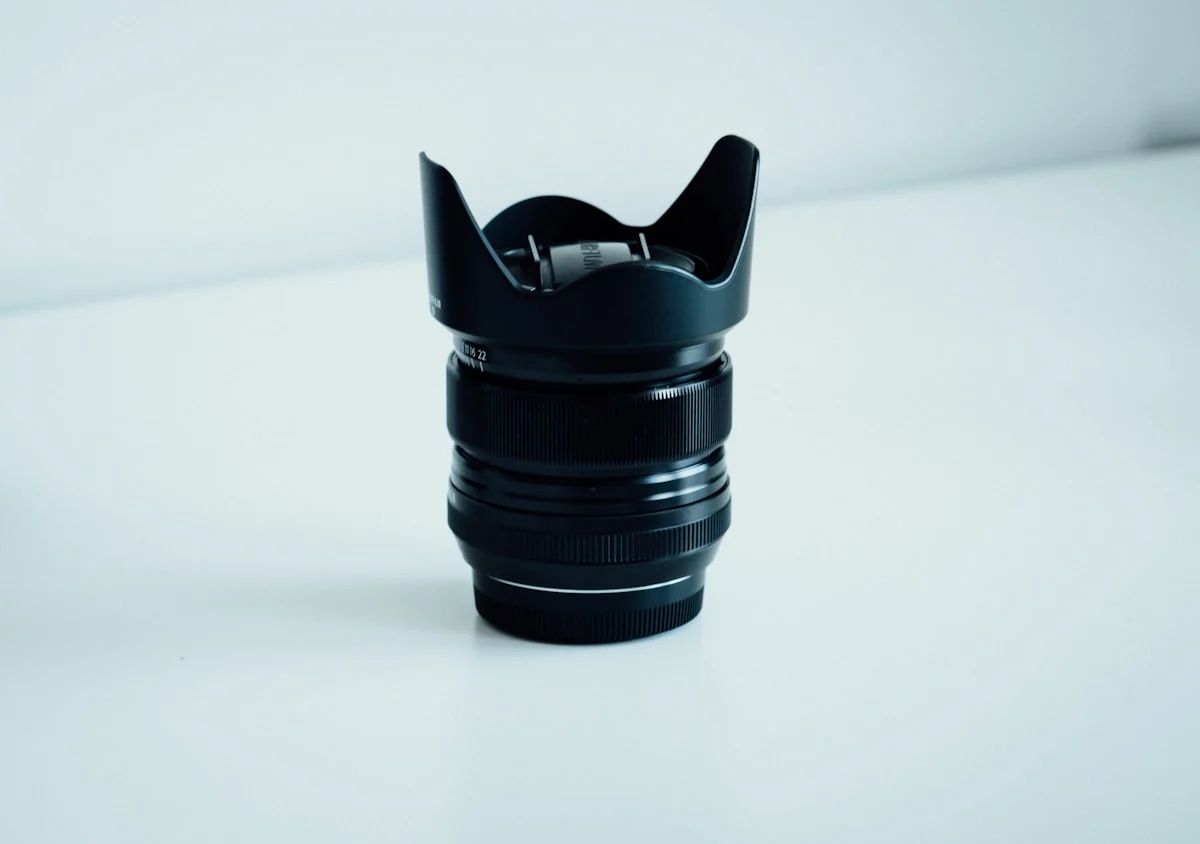
For most landscape photography the best lens is a wide-angle zoom covering about 16mm to 35mm on a full-frame camera (about 10mm to 24mm on a crop sensor), used at f/8 to f/11. The most useful second lens is a telephoto zoom of about 70mm to 200mm, which isolates details and compresses distant layers. Landscape photography demands a lot from your lenses, and the demands differ from portrait, event or street photography. Vast scenes, extreme depth of field and the need for edge-to-edge sharpness mean you need corner-to-corner resolution for fine detail in distant mountains, wide angles to capture sweeping vistas, and durability to survive early morning hikes and unpredictable weather. The right lens does not just frame the scene, it faithfully records every detail from the nearest wildflower to the farthest ridgeline. This page covers how to choose a lens for landscape work, from wide-angle primes to versatile zooms and specialized options. It teaches the principles of focal length, aperture, filters, weight and build rather than specific models, so you can judge any lens on its own merits.
What Makes a Great Landscape Lens
Landscape photography has different lens requirements than most other genres. You are typically shooting at smaller apertures like f/8 to f/11 for maximum depth of field, so the maximum aperture of the lens matters less than in portrait photography. What matters most is sharpness across the entire frame, minimal distortion, good flare resistance, and build quality that can handle the outdoors.
Unlike portrait lenses where a wide aperture and creamy bokeh are priorities, landscape lenses need to perform brilliantly when stopped down. Edge sharpness is especially important, a lens that is razor-sharp in the center but soft in the corners will produce landscapes where the edges of your frame look blurry, which is immediately noticeable in large prints and detailed scenes. Important detail often runs to the very edges, such as foreground rocks, wildflowers or a tree line. Chromatic aberration (color fringing around high-contrast edges) should also be minimal, as it is particularly visible in landscape images with tree branches against bright skies. Post-processing handles it well, but a lens with little of it gives cleaner results straight from the camera.
Beyond sharpness and fringing, these optical traits matter most for the genre:
- Distortion: Wide-angle lenses often show barrel distortion, where straight lines near the edges bow outward. It is correctable in post-processing but adds a step to your workflow, so a lens with well-controlled distortion saves time.
- Flare resistance: Landscape photographers often shoot toward or near the sun, especially during golden hour. A lens with good flare resistance keeps contrast and avoids unwanted artifacts when the sun is in or near the frame. Multi-coated lens elements and well-designed lens hoods help control flare.
- Vignetting: Light falloff in the corners at wider apertures is common in wide-angle lenses. It is easily corrected in post-processing, but heavy vignetting at landscape apertures (f/8 to f/11) is a sign of lesser optical quality.
Wide-Angle Lenses: The Landscape Standard
Wide-angle lenses are the workhorses of landscape photography. On a full-frame camera, focal lengths between 14mm and 35mm are the most commonly used for landscapes. These lenses let you capture expansive scenes, include dramatic foreground elements, and create a sense of depth that pulls the viewer into the image. They convey the scale of a landscape in a way narrower focal lengths cannot, and they exaggerate the apparent distance between near and far objects.
The relationship between foreground and background is what separates compelling landscape photographs from snapshots. A wide-angle lens lets you place a rock, flower, stream or leading line close to the camera while still capturing the distant mountains, sky or horizon. That layering of distinct foreground, middle ground and background gives the viewer’s eye a journey through the image.
Want help choosing what goes in the foreground? Foreground Interest in Landscape Photography covers the types of foreground elements that work and the camera settings that keep them sharp.
Wide-angle lenses are not the only option, though. Telephoto lenses (covered below) isolate and compress, and the best landscape photographers use a range of focal lengths to tell different stories about the same location.
Ultra-Wide: 14mm to 20mm
Ultra-wide lenses create dramatic images with an enormous field of view, roughly 94 degrees diagonally at 20mm and about 114 degrees at 14mm on full frame. They exaggerate the sense of depth, making foreground elements appear larger and more prominent while pushing the background further away. This is powerful for compositions where you want a striking rock formation, flower, or leading line in the foreground with a sweeping landscape behind it. They are also the lens for tight spaces such as slot canyons, dense forests and narrow valleys, where you cannot step back far enough for a standard wide-angle to capture the scene.
The challenge with ultra-wide lenses is that they can make compositions feel empty if you do not have a strong foreground element, wide does not automatically mean interesting. It becomes hard to fill the frame without vast empty areas, so a strong element placed close to the camera is needed to anchor the image. They also introduce visible distortion at the widest settings: objects at the edges of the frame stretch, and straight lines near the edges curve noticeably.
Do your wide shots keep coming out empty? How to Use a Wide-Angle Lens explains why wide shots look empty and how to build the frame from the foreground back.
Standard Wide: 24mm to 35mm
The 24mm to 35mm range is where many landscape photographers do their best work. These focal lengths are wide enough to capture sweeping scenes but restrained enough to maintain natural perspective and minimal distortion, with spatial relationships closer to what the eye sees. Many landscape photographers find 24mm to 28mm is their most-used range. A 24mm lens is wide enough for most grand landscapes while keeping straight lines relatively straight. A 35mm is excellent for landscapes that include a specific subject, a lone tree, a barn, a winding road, where you want to frame the scene without the exaggerated perspective of an ultra-wide.
This range handles a wide variety of compositions, from broad scenic views to tighter environmental scenes, without the careful foreground management an ultra-wide demands. A single lens covering 24mm to 35mm, or a 28mm prime, makes a capable all-rounder when extreme width is not needed. Plenty of strong landscape photographs are made in this focal range.
Focal Length Choices: The 14mm to 35mm Range
Here is how the common focal lengths within the wide-angle range tend to be used:
- 14mm: Extremely wide, with a dramatic perspective. Best for star trails, astrophotography, and compositions with powerful foreground elements in tight spaces. It needs careful composition to avoid empty, unanchored images.
- 16mm to 18mm: Very wide with slightly less distortion than 14mm. Excellent for sweeping landscapes with strong foregrounds, and popular for seascapes, mountain vistas and waterfall compositions.
- 20mm to 24mm: The workhorse range. Wide enough for grand scenes but controlled enough to feel natural, and versatile for everything from alpine panoramas to forest scenes.
- 28mm: Moderately wide, excellent for landscapes that include people or man-made structures. The natural perspective suits environmental scenes where extreme width would feel forced.
- 35mm: The widest focal length that still feels “normal.” Good for more intimate landscapes, forest details, and scenes where context matters but dramatic width is not needed.
Zoom vs Prime Lenses for Landscapes
This is one of the biggest decisions you will make when building your landscape kit, and there are strong arguments on both sides. The priorities differ from other genres; for the general comparison, see the prime vs zoom lens page.
Wide-angle zoom lenses (such as a 16-35mm or 14-24mm) are the most popular choice among landscape photographers for good reason. They give you enormous compositional flexibility, a few millimeters of focal length adjustment can completely change a landscape composition, and being able to fine-tune your framing from a fixed tripod position is incredibly valuable. Once the tripod is placed with a specific foreground element, a prime would force you to move it, which changes the relationship between foreground and background. When you are standing at the edge of a cliff or in a river for a foreground element, you cannot always move forward or back. The zoom lets you dial in the exact framing you need. Modern wide-angle zooms from camera makers are exceptionally sharp and offer performance that rivals or matches prime lenses.
Common landscape zoom ranges are 14-24mm (ultra-wide zoom), 16-35mm (wide-angle zoom) and 24-70mm (standard zoom). Many landscape photographers carry two of these to cover the span from ultra-wide to short telephoto.
Wide-angle prime lenses offer a few specific advantages. Their potential edge is optical quality, particularly edge-to-edge sharpness at f/8 to f/11, where you want the whole frame tack sharp. They are also typically smaller and lighter, valuable when you are hiking long distances: a single 24mm prime weighs significantly less than a 16-35mm zoom, so if 24mm is your preferred focal length the hike is more comfortable with no loss of image quality. Some ultra-wide primes (like 14mm or 20mm f/1.8 options) offer much wider maximum apertures than zooms, which is useful for astrophotography and night landscapes where you need to gather as much light as possible. Certain primes also produce slightly less distortion and better corner sharpness than zoom lenses at the same focal length, though the gap has narrowed considerably with modern zoom designs.
The trade-off is flexibility. With a prime you must move the tripod and camera to adjust framing, which is slow and may be impractical on cliff edges, in water or on unstable ground.
For most landscape photographers, a quality wide-angle zoom is the more practical choice. If you also shoot nightscapes or astrophotography, consider adding a fast wide-angle prime to complement your zoom.
Aperture Needs for Landscape Photography
Landscape work asks different things of the aperture than portrait or low-light photography. Portrait photographers prize f/1.4 or f/1.8 for shallow depth of field, while landscape photographers typically shoot at f/8 to f/16 to keep everything from the near foreground to the distant horizon sharp.
The f/8 to f/11 Sweet Spot
Many lenses produce their sharpest images between f/8 and f/11. There, optical aberrations are well controlled, diffraction has not yet become a significant factor, and the depth of field is deep enough to render most landscape scenes sharp from front to back. That is why f/8 and f/11 are often called the “sweet spot” for landscape work.
Wondering why a lens peaks at certain apertures? Sweet Spot (Lens) covers why the sweet spot exists, where it falls for different lens types, and how to find it for your own lens.
When to Use f/16 and Smaller
Apertures smaller than f/11, such as f/16 or f/22, give even more depth of field but introduce diffraction, which slightly softens the image across the entire frame. The trade is worthwhile when you need extreme depth of field, such as a foreground element very close to the lens with a distant horizon behind it. At f/16, most wide-angle compositions are sharp throughout. Going on to f/22 adds only marginally more depth of field at the cost of increasingly noticeable softening.
Maximum Aperture Is Less Critical
Because landscape photographers rarely shoot wide open, the maximum aperture of a landscape lens is less important than in other genres. An f/4 wide-angle zoom is perfectly adequate and saves significant weight and cost compared with an f/2.8 version, and at f/8, f/11 and f/16 the two perform nearly identically. The f/2.8 version only matters if you also plan to use the lens for astrophotography, where the wider aperture is needed to capture dim starlight.
Telephoto Lenses for Landscape Photography
While wide-angle lenses dominate landscape photography discussions, telephoto lenses are an underrated and powerful tool for landscape work. Focal lengths from 70mm to 200mm (and beyond) let you isolate specific elements within a landscape, compress layers of mountains or hills, and create intimate scenes that wide-angle lenses simply cannot produce: a single peak lit by alpenglow, a pattern of sand dunes, or misty ridges flattening into graphic abstractions.
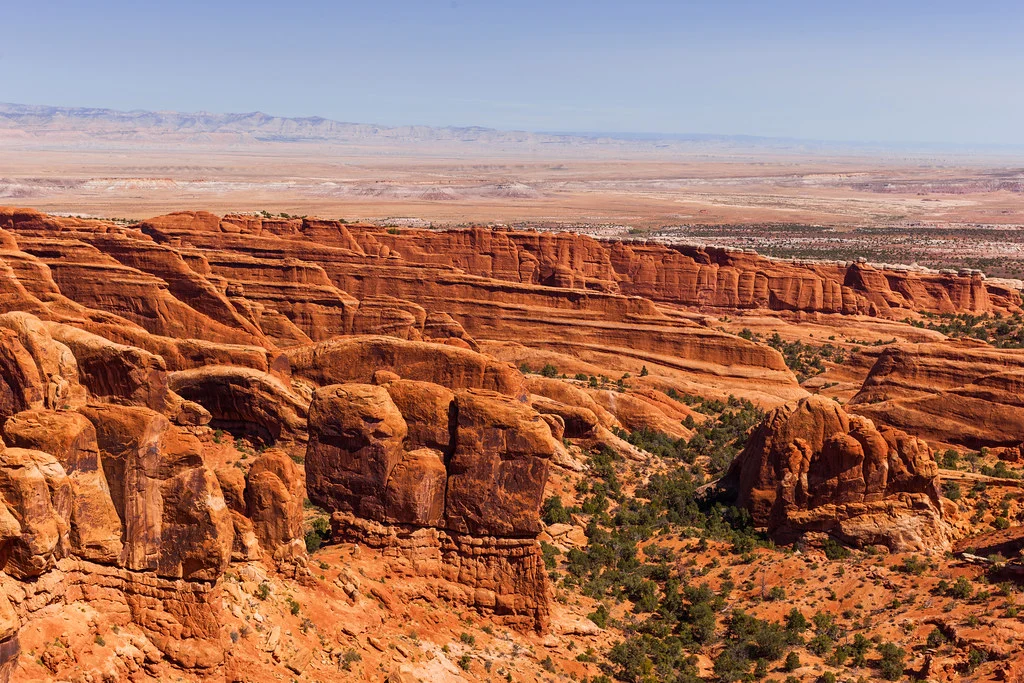
A telephoto landscape shot of layered mountain ridges fading into haze, or a compressed view of rolling sand dunes, has a completely different emotional feel than a wide establishing shot. Telephoto compression makes distant layers look stacked closer together, giving a density and layering that wide angles cannot achieve, and the effect is especially dramatic in mountainous terrain, where overlapping ridges recede into the haze in progressively lighter tones. A 70-200mm or 100-400mm zoom is an excellent complement to a wide-angle zoom, and it is just as good for details: the texture of a cliff face, the pattern of a river delta seen from an overlook, or wildlife met along the way. If you already own one for portraits or events, bring it on your next landscape outing, you may be surprised by the results. For more on adapting your approach to the genre, see landscape photography.
Planning a trip to the mountains? How to Photograph Mountains covers wide versus telephoto, light on peaks such as alpenglow, and why mountains look smaller in photos.
Lenses for Woodland and Forest Landscapes
Forests are tight, cluttered and often dim, so the lens choices shift. A standard wide-angle in the 24mm to 35mm range handles most woodland scenes, because it takes in a path or a stand of trees without the stretched edges of an ultra-wide. Go ultra-wide only when you can put a strong element, such as a root, a stream or a fallen log, close to the camera. A short telephoto, 70mm to 200mm, is often the more productive choice in the woods: it pulls a few trees out of the clutter, flattens layers of trunks in mist, and keeps distracting branches out of the frame. Light is low under the canopy, so plan on a tripod and slow shutter speeds rather than a wider maximum aperture. Light, fog and finding order among the trees are covered in forest and woodland photography.
Hyperfocal Distance: Maximizing Sharpness
Hyperfocal distance is a focusing technique that maximizes depth of field. Focus at the hyperfocal distance and everything from half that distance to infinity falls within the acceptable zone of sharpness, giving maximum front-to-back sharpness without stopping down to tiny apertures where diffraction degrades the image. The full method is on the hyperfocal distance page.
The distance depends on three things: focal length, aperture, and the acceptable circle of confusion for your sensor size. As a rough example, at 24mm and f/11 on a full-frame camera the hyperfocal distance is about 1.8 meters (6 feet). Focus there and everything from about 0.9 meters (3 feet) to infinity looks sharp. That removes the guesswork about where to focus in compositions with near and far elements.
Smartphone apps, printed charts and a hyperfocal distance calculator give the figure for any combination of focal length and aperture. A rougher shortcut is to focus about one-third of the way into the scene. It is only a starting point, so check the result. Live view or an electronic viewfinder lets you check the result: zoom in on the closest foreground element and the most distant element to confirm both are acceptably sharp before taking the shot.
Filter Compatibility and Thread Size
Filters are essential tools for landscape photographers. Graduated neutral density filters balance bright skies with darker foregrounds. Polarizing filters deepen blue skies, enhance sky contrast and remove reflections from water and foliage. Neutral density filters enable long exposures of moving water and clouds. Your lens choice directly affects your ability to use these filters. If you carry only one filter, a circular polarizer is the usual first choice, and it needs a lens with a front thread that accepts it. On an ultra-wide lens a polarizer can darken a blue sky unevenly, so check the frame before relying on it.
Look for lenses with a front filter thread rather than a bulbous front element. Lenses with standard filter threads (typically 67mm, 72mm, 77mm, or 82mm) allow you to screw on circular polarizers and ND filters easily, and filters in those sizes are easy to find. Lenses with unusual or very large thread sizes can be expensive to equip with quality filters. Ultra-wide lenses with bulging front elements cannot accept standard screw-on filters, because the front element protrudes beyond the barrel, and require more expensive filter systems with adapter rings and square or rectangular filters in a holder. Those systems are versatile and high-quality but add cost and bulk.
Not sure what the numbers on a lens mean? Understanding Lens Specifications covers maximum aperture, MTF charts, filter thread size and minimum focus distance.
If you plan to use filters regularly, this is worth considering when choosing between lenses. A 16-35mm zoom with an 82mm filter thread is far more practical for filter use than a 14mm prime with a bulbous front element, even if the 14mm is optically exceptional. Check that an ultra-wide lens works with your preferred filter system before relying on it. Some photographers standardize their kit on a single filter thread size (typically 77mm or 82mm) and use step-up rings for smaller lenses, allowing one set of filters to work across their entire lens collection and cutting the number of filters to carry.
Weather Sealing and Build Quality
Landscape photography frequently puts your gear in harsh conditions. Early morning shoots mean dew and condensation. Rain and snow are common in dramatic locations, and coastal work exposes your lens to salt spray. Mountain and desert environments bring dust, sand, and temperature extremes. A lens that is not built to handle these conditions can fail at the worst possible moment.
Weather sealing, rubber gaskets at the mount, switches, zoom and focus rings, provides meaningful protection against moisture and dust. It is not a guarantee that your lens will survive a downpour, but it significantly reduces the risk of damage from the conditions landscape photographers routinely encounter. Higher-end lenses typically offer better sealing, while others may have reduced sealing or none. If you regularly shoot in challenging conditions, sealing is a practical benefit in the field. If you mostly shoot in fair weather, a lens without it is a reasonable choice.
Metal construction is more durable than plastic, and a metal filter thread is less likely to cross-thread than a plastic one. Metal barrels resist wear better, and internal zoom mechanisms that do not extend the barrel can help keep dust and moisture out compared with extending designs. A lens that will go on hundreds of hikes and years of outdoor use should be built to last. If you are choosing between two optically similar lenses, the one with better build quality is almost always the smarter long-term choice for landscape work.
Specialty Options: Tilt-Shift Lenses
Tilt-shift lenses are specialized tools that offer landscape photographers two unique capabilities. The tilt function lets you angle the plane of focus, enabling you to keep everything from a close foreground to a distant horizon in sharp focus without stopping down to tiny apertures like f/16 or f/22, apertures where diffraction softens your image. The shift function corrects converging lines, which is primarily useful in architecture but can also help with landscape panoramas.
These lenses are manual focus only, expensive, and require a learning curve. They are not for everyone. But for serious landscape photographers who regularly deal with extreme near-to-far focus challenges, a tilt-shift lens is a problem solver that no other lens can replicate. If you find yourself constantly focus stacking in post-processing, a tilt-shift lens can often achieve the same result in a single frame.
Building a Landscape Lens Kit
The right kit depends on your shooting style, preferred subjects and how much weight you are willing to carry. These combinations show how focal ranges and weight trade off:
- Minimalist kit: A single 16-35mm or 24-70mm zoom covers a broad range of landscape compositions. This suits long hikes where weight is critical.
- Standard kit: A 16-35mm wide-angle zoom plus a 70-200mm telephoto zoom covers the full landscape range from ultra-wide to telephoto and handles virtually any landscape scenario.
- Full-coverage kit: A 14-24mm ultra-wide, a 24-70mm standard zoom and a 70-200mm telephoto give complete coverage with overlap. A 1.4x teleconverter adds reach when needed.
- Prime kit: A 20mm or 24mm wide prime plus a 50mm or 85mm for compression shots. Light and sharp, and it forces creative decisions about composition.
Common Mistakes When Choosing a Landscape Lens
- Prioritizing maximum aperture over sharpness. Unlike portrait photography, landscape work rarely uses apertures wider than f/4. An f/2.8 zoom is heavier than an f/4 version, and at f/8 to f/11 where you will shoot most landscapes, the optical performance is often nearly identical. Save the weight unless you also need the lens for other purposes or night photography.
- Only shooting wide-angle. The instinct when arriving at a beautiful landscape is to go as wide as possible to “get it all in.” But wide-angle lenses can make vast, dramatic scenes look small and distant. Try telephoto focal lengths to isolate compelling elements within the scene, you will often come away with stronger images.
- Ignoring corner sharpness. In landscape photography, important detail often extends to the very edges of the frame, a mountain ridge, a tree line, or a leading line that starts in the corner. Test your lens’s corner performance at your typical shooting apertures, and look at reviews and sample images specifically for corner performance at f/8 to f/11, so you know its limitations.
- Forgetting about filter compatibility. If you plan to use polarizers or ND filters (and most serious landscape photographers should), check whether your lens has a standard filter thread before relying on it. Discovering that your ultra-wide lens needs an expensive square filter system is a frustrating surprise.
- Buying weather-sealed lenses but not protecting the front element. Weather sealing means nothing if you do not also protect the front of your lens. A UV or clear protective filter on the front thread keeps salt spray, sand, and rain off your front element. For lenses with bulbous front elements, a proper lens hood is your primary defense.
- Neglecting a mid-range focal length. Many landscape photographers carry a wide-angle and sometimes a telephoto but skip the 35-70mm range entirely. This mid-range is excellent for landscapes with a clear subject and can produce images with a natural, comfortable perspective that ultra-wide lenses cannot match.
Want to check a lens you already own? How to Test a Lens for Sharpness and Defects shows how to set up a flat target and shoot the centre and corners at every aperture.
Kit Lenses and What Matters More Than the Lens
The zoom that comes with a camera is a perfectly capable lens for learning composition, exposure and working with natural light. A dedicated wide-angle zoom in the 16-35mm range is the lens that adds the most to landscape work, and paired with a kit zoom for the telephoto end it makes a versatile pair.
The most spectacular landscape photographs come from photographers who understand light, composition and patience far more than from those with the most expensive lenses. Someone who knows how to find and wait for extraordinary light with a modest lens will consistently outperform someone with premium glass who shoots at midday without thought for the quality of the light. Time in the field counts for as much as the lens.
Frequently Asked Questions
What is the best all-around landscape lens?
A wide-angle zoom in the 16-35mm range (full frame) or 10-24mm range (crop sensor) is the most versatile single lens for landscape photography. It covers the focal lengths you will use most often, accepts standard screw-on filters, and provides enough range to adjust your composition without changing lenses. If you can only bring one lens on a landscape trip, this is the one to choose.
Do I need a fast aperture for landscape photography?
For daytime landscape photography, no. You will almost always shoot at f/8 to f/11 for maximum sharpness and depth of field, so an f/4 lens performs just as well as an f/2.8 in this scenario while being lighter. However, if you also shoot night photography, star trails, or the Milky Way, a fast aperture (f/2.8 or wider) is essential for gathering enough light in those dark conditions.
Is a 24-70mm good for landscapes?
A 24-70mm is a useful landscape lens, though it lacks the ultra-wide perspective that many landscape photographers prefer. At 24mm, it is wide enough for many scenes, and the 70mm end lets you create compressed landscape compositions and isolate details. It is an excellent choice if you want one versatile lens that handles landscapes, travel, and other subjects. But dedicated landscape photographers usually prefer a wider zoom like 16-35mm as their primary lens and use the 24-70mm as a complement.
Should I use image stabilization for landscape photography?
When shooting landscapes on a tripod, which you should be doing for the sharpest results, turn off image stabilization. Some stabilization systems can actually introduce subtle vibrations when the camera is already perfectly still on a tripod. When shooting handheld in good light, stabilization is helpful. Modern in-body stabilization (IBIS) found in many mirrorless cameras complements lens-based stabilization and makes handheld landscape shooting more practical, especially during golden hour when light levels drop.
Are lenses from independent makers good enough for landscapes?
Lenses from independent lens makers can be excellent for landscape photography, and a lens should be judged on what it does rather than on whose name is on it: corner sharpness at f/8 to f/11, distortion, flare resistance, filter thread and build. The areas where a camera maker’s own lens may have an edge are autofocus reliability (less critical for tripod-based landscape work where you often focus manually), weather sealing, and coatings for flare resistance. Check those points against the way you shoot.
What is the best focal length for landscape photography?
On a full-frame camera, 16mm to 35mm covers most landscape work, and 24mm to 28mm is the range many photographers use most. Use the wider end when a strong foreground can anchor the frame, and a telephoto of 70mm to 200mm to isolate distant ridges, light and patterns. On a crop sensor, divide those numbers by about 1.5 (or 1.6 for some cameras) to get the equivalent lenses.
What lens works best for outdoor and scenic photography in general?
A wide-angle zoom is the safest single lens for scenery, and a short telephoto zoom is the best second lens. Choose by what you want to show: a wide lens for the whole scene with a foreground, a telephoto for details and compressed layers. Sharp corners at f/8 to f/11 and a standard filter thread matter more than a wide maximum aperture.