Every photographer eventually encounters the rule of thirds, that simple grid that divides a frame into nine equal sections. It is a reliable starting point for composition, and it works well in many situations. But there is an older, more refined principle that artists and architects have used for centuries to create naturally pleasing compositions. It is called the golden ratio, and understanding how to apply it can elevate your photography from merely competent to genuinely compelling.
What Is the Golden Ratio?
The golden ratio is a mathematical proportion approximately equal to 1.618, often represented by the Greek letter phi. Two quantities are in the golden ratio if the ratio of the larger to the smaller is equal to the ratio of their sum to the larger quantity. Expressed as a formula, if a and b are two quantities where a is larger, then a/b equals (a + b)/a, and both ratios equal approximately 1.618.
This proportion appears with remarkable frequency in nature. The spiral pattern of a nautilus shell, the arrangement of seeds in a sunflower head, the branching of trees, and even the proportions of the human face all approximate the golden ratio. This natural prevalence is one reason why compositions based on this proportion tend to feel inherently balanced and aesthetically pleasing to viewers.
The golden ratio has been used deliberately in art and architecture for millennia. The Parthenon in Athens, Leonardo da Vinci’s paintings, and the works of countless Renaissance artists all incorporate this proportion. In photography, applying the golden ratio means positioning key elements along lines or at intersections that follow this 1.618 relationship rather than the simpler one-third divisions of the rule of thirds.
The Fibonacci Spiral and Photography
The Fibonacci sequence is a series of numbers where each number is the sum of the two preceding ones: 0, 1, 1, 2, 3, 5, 8, 13, 21, 34, and so on. As the sequence progresses, the ratio between consecutive numbers approaches the golden ratio of 1.618. When you draw quarter-circle arcs through a series of squares whose dimensions follow the Fibonacci sequence, the result is a logarithmic spiral known as the Fibonacci spiral or golden spiral.
In photography, the Fibonacci spiral serves as a compositional overlay. The tightest part of the spiral indicates where the primary subject or focal point should be placed. The sweeping curve of the spiral then guides the viewer’s eye outward through the rest of the image, creating a natural visual flow. Unlike the rule of thirds, which provides static intersection points, the golden spiral suggests dynamic movement through the frame.
To use the Fibonacci spiral in practice, imagine the spiral overlay on your viewfinder or live view screen. Position your main subject at the smallest point of the spiral, then arrange supporting elements along the curving path. Landscape photographers often place a foreground rock or flower at the tight end of the spiral while letting a curving river or path follow the spiral arc toward the horizon. Portrait photographers might position an eye at the spiral’s focal point and let the curve of a shoulder or flowing hair trace the spiral’s path.
Golden Ratio vs. Rule of Thirds: Key Differences
The rule of thirds divides the frame into a uniform 3×3 grid, placing intersection points at exactly one-third of the way from each edge. The golden ratio grid, sometimes called the phi grid, looks similar but places its lines closer to the center. Specifically, the golden ratio divides the frame at approximately 38 percent and 62 percent from each edge rather than at the 33 percent and 67 percent divisions of the rule of thirds.
This difference may seem subtle, but it changes the feel of a composition significantly. The rule of thirds tends to create more open, spacious compositions with the subject clearly offset from center. The golden ratio produces a slightly tighter arrangement that many viewers perceive as more balanced and harmonious. The subject sits a bit closer to center, which can feel more natural and less contrived.
Neither approach is universally better. The rule of thirds excels in situations where you want dramatic negative space, strong visual tension, or a clear sense of direction. The golden ratio works particularly well when you want a composition to feel organic, balanced, and naturally appealing. Many experienced photographers develop an intuitive sense of when each proportion serves the image better, often without consciously calculating the ratios.
Wondering why one placement feels more balanced than another? Visual weight in photography covers what creates weight in a frame and how to control it.
The Phi Grid: A Practical Composition Tool
The phi grid is the golden ratio equivalent of the rule of thirds grid. It consists of two horizontal and two vertical lines that divide the frame according to the golden ratio rather than into equal thirds. The four intersection points of these lines are called golden points, and they represent ideal locations for your subject or key compositional elements.
Because the phi grid lines sit closer to the center than rule of thirds lines, compositions built on the phi grid tend to feel slightly more centered and balanced. Many photographers who find the rule of thirds compositions too formulaic discover that the phi grid produces results that feel more polished and intentional.
To practice with the phi grid, you can enable golden ratio overlays in most modern cameras or use post-processing software like Lightroom, which includes a phi grid crop overlay accessible by pressing O while in the crop tool. Start by composing with the phi grid for a week and compare the results to your rule of thirds compositions. Most photographers notice that certain subjects, particularly those with natural curves and organic shapes, respond beautifully to phi grid placement.
Golden Triangles for Dynamic Compositions
Golden triangles offer another way to apply the golden ratio, particularly effective for images with strong diagonal elements. To create the golden triangle overlay, draw a diagonal line from one corner of the frame to the opposite corner. Then draw two shorter lines from each of the remaining corners, meeting the main diagonal at right angles. This divides the frame into four triangles.
The golden triangle composition works exceptionally well with images that contain prominent diagonal lines such as roads, fences, building edges, or sloping terrain. By aligning your dominant diagonal with the main diagonal line and placing key elements at the intersection points where the perpendicular lines meet the main diagonal, you create a composition that feels both dynamic and structured.
Looking for diagonals to work with? Leading lines in photography covers the types of lines and where they should point.
Architecture and street photography benefit enormously from golden triangle composition. The strong geometric lines in buildings, bridges, and urban environments naturally align with the triangle framework. When shooting a building facade at an angle, for instance, aligning the leading edge with the golden triangle diagonal and placing a doorway or window at an intersection point creates a sense of purposeful geometry that viewers find satisfying even if they cannot articulate why.
Applying the Golden Ratio to Landscape Photography
Landscape photography is where the golden ratio truly shines. Natural environments are filled with curves, spirals, and proportions that already approximate the golden ratio, so composing with this principle feels like working with nature rather than imposing an artificial grid upon it.
For horizon placement, the golden ratio suggests positioning the horizon at approximately 38 percent or 62 percent of the frame height rather than the one-third or two-thirds mark. When the sky is dramatic with clouds or color, place the horizon at the lower golden ratio line to give the sky more prominence. When the foreground is compelling, place the horizon at the upper line.
The Fibonacci spiral is particularly powerful in landscape work. Rivers, paths, shorelines, and rolling hills often follow curves that approximate the golden spiral. By positioning your camera so that these natural curves align with the spiral overlay, you create compositions that feel effortlessly harmonious. A winding river that enters the frame at one corner and spirals inward toward a mountain peak creates a visual journey that the human eye follows instinctively.
Foreground elements in landscape photography benefit from golden ratio placement as well. A prominent rock, wildflower cluster, or piece of driftwood placed at a golden point anchors the composition and provides a natural starting point for the viewer’s exploration of the scene. The golden ratio placement feels slightly more natural than rule of thirds placement because it positions the foreground element a bit closer to center, creating a more immersive feeling of depth.
Wondering what makes a good foreground element? Foreground interest in landscape photography covers which elements work and when they go wrong.
The Golden Ratio in Portrait Photography
Portrait composition benefits from the golden ratio in several ways. The most direct application is placing the subject’s near eye at a golden point. Because the phi grid points sit closer to center than rule of thirds points, this placement gives portraits a natural, balanced feel while still avoiding dead-center compositions.
For full-body and three-quarter portraits, the golden ratio can guide the relationship between the subject and the surrounding environment. Placing the subject’s torso along a phi grid line while positioning the face at a golden point creates a portrait that feels harmoniously composed within its setting. This approach works especially well for environmental portraits where the location is an important part of the story.
Group portraits and couples photography also respond well to golden ratio composition. Positioning the visual center of mass of a group at a golden point, rather than dead center or at a rule of thirds intersection, creates an arrangement that feels intentional yet natural. For couples, the point of connection between two people, whether hands touching, foreheads meeting, or eyes locking, placed at a golden point adds an invisible sense of rightness to the image.
Photographing two people in one frame? Couple and engagement photography covers posing, lighting and camera settings for couples.
Using the Golden Ratio in Architecture Photography
Architecture and the golden ratio have a long intertwined history. Many famous buildings were designed using golden ratio proportions, which means that photographing them with golden ratio composition often captures the architect’s original intent.
When photographing buildings, use the phi grid to position key architectural features like doorways, windows, columns, or decorative elements at golden points. The golden triangles overlay is particularly useful when shooting buildings at oblique angles where strong diagonal lines dominate the composition.
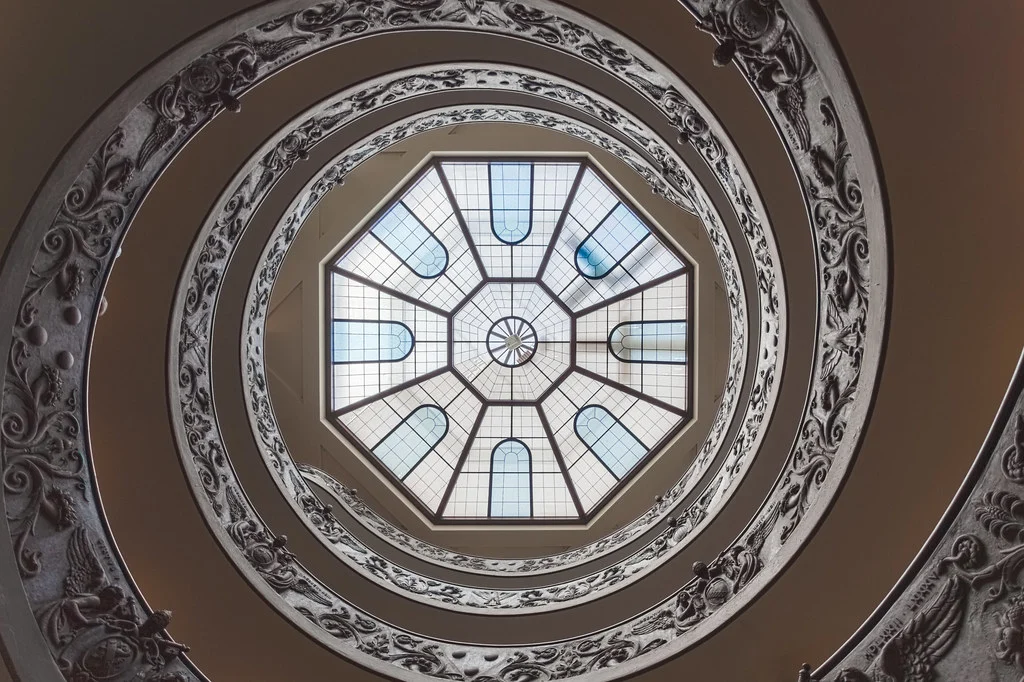
Interior architecture photography benefits from the Fibonacci spiral. Grand staircases, spiraling hallways, domed ceilings, and arched passageways often contain curves that approximate the golden spiral. By finding a vantage point that aligns these architectural curves with the spiral overlay, you create images that feel both grand and harmonious. Many of the most iconic architectural photographs, whether of ancient cathedrals or modern museums, employ golden ratio composition even when the photographer may not have been consciously thinking about it.
When to Choose Golden Ratio Over Rule of Thirds
Use the golden ratio when your scene contains natural curves, organic shapes, or when you want a composition that feels balanced and harmonious rather than dramatic. Scenes with spiraling elements like winding roads, curving rivers, spiral staircases, or circular patterns are ideal candidates for golden ratio composition. Similarly, subjects with natural proportions, including the human body, flowers, shells, and many animals, tend to look most appealing when composed according to the golden ratio.
Stick with the rule of thirds when you want clear visual tension, when your subject benefits from more extreme off-center placement, or when the scene is strongly divided into distinct zones. Minimalist compositions with a lot of negative space often work better with rule of thirds placement because the golden ratio would pull the subject too close to center. Similarly, action-oriented images where you want to emphasize direction and movement may benefit from the wider spacing of rule of thirds intersections.
For a deeper exploration of how these composition tools fit into your broader approach, see our guide on photography composition techniques, which covers the full range of principles that work alongside the golden ratio.
Practical Exercises for Learning the Golden Ratio
The golden ratio becomes intuitive with practice, but deliberate exercises accelerate the learning process. Start with these approaches to internalize the golden proportion.
- Enable the golden spiral or phi grid overlay in your camera or editing software and shoot an entire session using only golden ratio compositions. Review the results and note which images feel most natural.
- Take a set of photographs using the rule of thirds, then recompose or crop the same scenes using the golden ratio. Compare the two versions side by side and develop your sense of when each approach serves the subject better.
- Study the work of master photographers and painters, looking specifically for golden ratio proportions. You will begin to notice the spiral and phi grid appearing in images you have always found appealing.
- Practice with landscape scenes that contain natural curves. Rivers, winding paths, shorelines, and mountain ridges are excellent subjects for golden spiral compositions.
- Shoot a portrait session where you deliberately place the near eye at a phi grid point rather than a rule of thirds point. Note the subtle but meaningful difference in the feel of the resulting portraits.
Post-Processing and the Golden Ratio
Even if you did not compose with the golden ratio in mind during the shoot, you can often improve your compositions during post-processing by cropping to golden ratio proportions. Lightroom and Photoshop both offer golden ratio crop overlays that make this straightforward.
Wondering what a crop costs you? How to crop photos covers straightening, what cropping costs in megapixels and shooting loose so you can crop later.
In Lightroom, enter the crop tool and press the O key to cycle through overlay options including the phi grid and golden spiral. Press Shift+O to rotate the spiral orientation. These overlays let you fine-tune your crop to align key elements with golden ratio proportions.
When cropping for the golden ratio, pay attention to what falls at the golden points and along the spiral path. Even small shifts in crop position can dramatically change whether a composition feels balanced or off-kilter. Take your time with this step and trust your eye. The golden ratio should serve the image, not constrain it. If a crop feels forced, the original composition may simply work better with a different approach.
Common Mistakes When Applying the Golden Ratio
The most common mistake is treating the golden ratio as a rigid rule rather than a guideline. Not every image needs golden ratio composition, and forcing it into scenes where it does not fit naturally will produce awkward results. The golden ratio is a tool, not a formula.
Another frequent error is confusing the golden ratio with the rule of thirds. While they look similar, they produce different results. If you are using a phi grid overlay but mentally treating it as a rule of thirds grid, you are not gaining the full benefit of the golden proportion. Take time to understand the mathematical difference and to see how the slightly different line placement changes the feel of your compositions.
Some photographers become so focused on compositional overlays that they stop seeing the actual scene in front of them. The golden ratio should enhance your creative vision, not replace it. Use it as one of many tools in your compositional toolkit, and always trust your artistic instinct when it conflicts with a mathematical formula. The best photographs work because they communicate something meaningful, and no amount of golden ratio placement can substitute for genuine seeing and feeling.
Moving Beyond Formulas
Ultimately, the golden ratio is most valuable not as a grid to follow slavishly but as a way to train your eye to see proportion and balance. After spending time deliberately composing with the golden ratio, many photographers find that they naturally begin placing elements in proportions that approximate it without conscious calculation. This internalized sense of proportion becomes part of your creative instinct, informing your compositions in subtle ways that make your work more visually satisfying.
The journey from rule of thirds awareness to golden ratio fluency to intuitive compositional mastery is a natural progression for serious photographers. Each tool builds on the last, refining your understanding of why certain arrangements please the eye and others do not. Embrace the golden ratio as a stepping stone toward deeper compositional awareness, and let it guide you toward images that resonate with the ancient human sense of beauty and proportion.